By Ranjona Banerji
 On July 22, the Income Tax department carried out a series of raids on the offices of the Dainik Bhaskar group across India.
Even for those sleeping under a rock to avoid criticising the Modi government, these raids were a sign that someone up there in the higher reaches of power was angry. Very angry.
The anger could be two-fold: The revelations this week of the Pegasus Project and that Bhaskar covered it widely.
And that this Pegasus coverage only added to the rage the government had felt at the relentless manner in which this large chain of newspapers had covered the Covid-19 pandemic. Government lies on Covid cases, lies on the number of deaths, on the lack of oxygen in hospitals, on the dead bodies floating in the Ganga and other rivers and buried in shallow graves in riverbanks were exposed every day in both Gujarat’s Divya Bhaskar and Dainik Bhaskar editions elsewhere.
National Editor Om Gaur took DB’s coverage even further in his edit page piece for the New York Times about the dire Covid situation during India’s second wave, which was headlined: “The Ganges is returning the dead”. As ever, negative international exposure enrages an image-conscious Prime Minister and his government.
Whatever has irked the government more, it is clear that it is riled. And when that happens, there is a malicious, vindictive reaction. Perhaps for almost seven years, the Modi government has got so used to the lavish praise piled on it, for all its transgressions, mistakes, lies, aggressions, disasters, any resistance is seen as unacceptable. Okay, cut that “perhaps”. We know that this is a government, more than any other until now, which cannot handle dissent, disagreement, questions, opposition. And has been enabled by a captive mainstream media.
Between the Pegasus Projects and its revelations, and these raids on a media house, where does the rest of the media stand? The old days when all newspapers ignored each other and operated in their separate silos have gone, and for the better, together with that ivory tower editor who barely comprehended what was happening in his own newsroom forget the nitty-gritties of the world itself. The media has to comment on itself and allow others to comment on it.
The revelations that someone within the government of India was using/ had used Israeli-made military-purpose malware to both hack into people’s electronic devices, run surveillance on them and possibly also implant material into their devices has shaken the world and forced the media not involved in the investigation to take notice. But the voice of the media has been far from uniform and at times, shockingly pro-government even though journalists, citizens, businesspeople, activists and others have been targets.
So how did we respond to the Dainik Bhaskar raids.
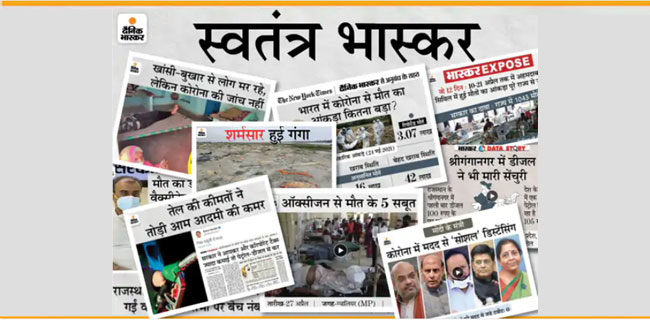
Bhaskar itself called itself “Swatantra Bhaskar” or Free Bhaskar and announced on its front pages, with a series of images of its Covid and other coverage, that the government had to do what it had to do and the media group what it had to do.
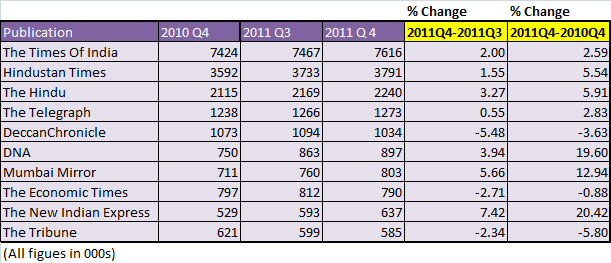
The Mumbai edition of the Times of India, July 23, had an article on Nation pages 11, the focus of which was the Opposition’s reactions to the raid. Shooting from the opposition’s shoulder, rather than straightforward coverage.
The Economic Times, Mumbai, July 23, covered the possibility that industrialist Anil Ambani’s phone had been hacked as well as the corporate reaction to Pegasus on Page 6. But page 2 had Union minister Meenakshi Lekhi’s lies that Amnesty had distanced itself from the Pegasus Project, minus the clear clarification to the contrary that Amnesty had issued soon after.
The Dainik Bhaskar raid was on Page 8.
Hindustan Times, Mumbai, July 23, did better than its rival TOI. The first two pages were dedicated to the Olympics. Therefore, the Pegasus uproar in Parliament and the Ambani phone hack were on page 3. City page 5 had a single column on the DB raid in Mumbai. Nation page 5 ran with the raid as the lead, above the fold. And Nation page 7 had more Pegasus coverage. However once again, Lekhi, was allowed to run with her lie.
The Indian Express, Mumbai has upped its game (although in the days to come expect more government ministers pushing Modi/BJP propaganda on their oped pages). The Dainik Bhaskar raid and Pegasus were on Page 1, continued on 2 as is the paper’s style. On Page 8, the Amnesty rebuttal to Lekhi’s claim made an appearance and Pegasus found space on the economy and world pages.
The Hindu, Chennai had a much better showing, despite the photo of group head Malini Parthasarathy in Modi’s “illuminating” presence, which she put up on Twitter on July 22. Both the raid and Pegasus were on the front page, on page 10 in further detail. Pages 11 (nation) and 13 (world) had further Pegasus coverage.
Of the English language papers MxM looked at, The Telegraph, Calcutta stood out. Both the raid on DB and Pegasus ran as the lead. The Ambani phone hack also found space. The lead story quoted DB National editor Om Gaur about why he thought the group was raided – the strong Covid coverage – as well as his NYT piece.
Of the Hindi papers, Amar Ujala, Delhi had the best coverage: The raids on Dainik Bhaskar as well as the independent UP-based news channel Bharat Samachar were second lead, above the fold. No one else mentioned Bharat Samachar, which has been increasingly critical of the government.
The Pegasus uproar in Parliament was the lead. Amar Ujala also mentioned prominently how Lekhi had called protesting farmers “mawalis” or hooligans. Most English newspapers ignored this stroke of genius from the Union minister.
Rajasthan Patrika, Jaipur, carried the raid on the front page and also had an edit.
Hindustan Delhi: Had the Pegasus arguments in Parliament, but focused on the IT minister as the lead. A small mention of the DB raid on Page 1 sent the reader to page 11, where Pegasus was also covered.
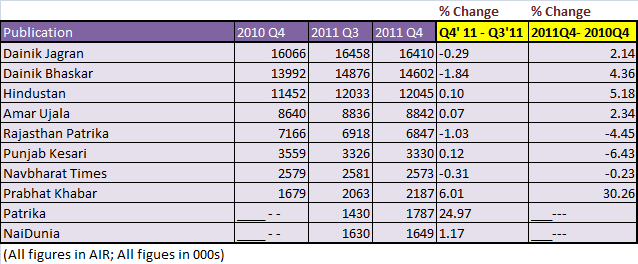
Dainik Bhaskar’s biggest competitor, Dainik Jagran Delhi, carried a tiny mention of the raid on page 4.
Regardless of the extent of the coverage we went through, all media owners and editors know what all journalists also know: that the more you succumb, the more dangerous the world becomes. You may think I was going to say that the more you resist, the more you are under threat. That is true. But unless you want the threat to last forever, you have to resist.
Kudos to Dainik Bhaskar for its stand so far.
And to those who have not been too afraid to cover the actions of a vindictive government.
For those who cover up, well…
Ranjona Banerji is a senior journalist and commentator. She is also Consulting Editor, MxMIndia. She writes on MxMIndia every Tuesday and Friday. Her views here are personal