Tag: Alpana Parida

  • Alpana Parida: Infographics and Design Thinking

    By Alpana Parida


    Whether it’s The Economic Times or The Times of India, Annual Reports or Corporate Brochures, Resumes or Blogs, I see more and more infographics everyday. They are visually rich in detail and tell a story comprehensively as against a verbose explanation that would have taken a few paragraphs. Infographics are a metaphor for design thinking – a way of thinking that is more human centric and makes for more lateral and creative solutioning.


    Having made the journey from a classic MBA/ Marketing/ Excel sheet world to now running a design firm, I am struck by the linear linguistic logic of boardrooms. When we make a Powerpoint presentation (and I can personally vouch for the fact that there is such a thing called “Death by Powerpoint!”), they are linear and narrow. Each slide builds from the previous one and logically take us to a deductive or reductive conclusion.


    But consumers and markets are seldom this linear. A new fashion brand fights for the share of wallet – not only in the category but across multiple unrelated categories – from more data to eating out to spending money on Uber. Is it enough for a fashion brand today to create press advertising, participate in the Fashion Weeks and/or create a retail experience?


    How and when she makes decisions is different. Her influencers are different. Her online and offline behaviours are different. Even online – her behavior on the mobile is different. And yet, we marketers use the same tools. I come across a mindnumbing quantity of market research that gives us too little. Behaviours are changing rapidly. And we do not understand them enough.


    India is changing. Rapidly.

    Girls from small towns are leaving home to study in co-ed institutions of higher learning, are staying un-chaperoned and after graduation; are choosing careers that take them to distant places, rather than rushing headlong into marriage. They are no longer rebelling when it comes to their choice of clothes, careers or comrades. Indeed, their parents are collaborating.


    We see old belief systems eroding all around us. A young employee in our organisation, left his job after a few months. After clearing the first round of ‘Indian Idol’, his father – a small business owner – exhorted him to leave his job and chase this dream. When did this ever happen before? Leave a first, stable job?? Embrace a break in employment, egged on by his father???


    The primary driver for this change is the Indian demographics. By 2020, over 50% of the population would be under 29. This will be a generation that was born with the mobile phone in their hands, that will learn to use the keypad before they write, that will not have been fed the staple of mythology, the likes of Ramayan and Mahabharata – through stories from grandparents or uncles and aunts during summer vacations while sleeping on the terrace; nor the abridged version of the Amar Chitra Katha and not even the hyper-dramatised version on television; and thus have no grounding in what created common value systems for a disparate nation.


    This is a generation growing up on staccato bursts of information qualifying as news. This is the generation that will borrow money for holidays and buy everything they want, here and now, on EMIs. This is the generation that will value personal enterprise and jobs will be much lower down in their value system.


    They will learn to eat on the go and will almost certainly never make pickles. This is the generation where men will increasingly take on cooking and women will become a stronger part of the workforce. Matrimonials already read: “Working bride wanted”.


    This is the generation that will prefer coffee to tea, vodka to whisky. This will be the generation that will discover new professions from animation to property management and redefine the traditional pecking order of Medicine, MBA, Engineering/ IT. This is the generation that will ‘move on’ in relationships, will frequently change jobs/ professions and even their homes. Much will be transient and little will be permanent.


    How does one understand this change? The shifting value systems and deeper beliefs?

    We have to change our old marketing toolkits. Infographics are not simply embellishments to a good article. Visual thinking gives us a holistic view of consumers and markets. All our research is stuck on large boards, with visuals, texts, post its, online information – and then looked at simultaneously, not sequentially. The analysis is through frequent brainstorming – designed to open possibilities and newer ways of doing things. For the old ways will only give us old results.


    As the marketing tribe, if we want to understand an increasingly complex, rapidly changing scenario – our ways of thinking, our methodologies and toolkits, processes and approaches must change. Fast.


     

  • Alpana Parida: An Indian brand for men – Maanyavar

    By Alpana Parida


    The brand that had become synonymous with wedding fashion for groom has been rightfully championing Indian wear across occasions. A few years ago – the brand played out the quintessential India male fantasy of taking over the sedate wedding with a Caucasian girl and her family by getting all to dance to the bhangra. While it captured the new confidence and aspirations of an emerging India, there was not much to set the brand apart from similar ads across categories – whether of a man choosing to buy a hotel where his dadaji worked, or rejecting an international job in favour of staying in India. A little over the top, the ads were clearly make-believe fantasy, a little brash and could not be classified as progressive.


    The recent advertising by the brand brilliantly catches the pulse of the progressive Indian man who has lately been reviled and beleaguered for not sharing the load.  Progressive women are far more ubiquitous. The latest Virat Kohli commercial where he talks of sharing wedding costs or another where the son chooses an Indian kurta pajama for his graduation at Oxford identify a new protagonist rarely seen in Indian advertising. There have been previous instances of the Tanishq man who picks up his wife’s daughter during the ‘pheras’ of his second marriage or the Raymond man understanding his kids or mother. Or even a more recent Ariel commercial of a father apologising to his daughter about not being a good role model to her and now changing by sharing the load. But these have been rare – and have largely been about empowering women.


    The Maanyavar commercials differ because these men are more real. Rather than empowering another and revealing their value systems through that, these are more direct windows into the emerging Indian man’s soul. In earlier times, a progressive man would have asked for an austere wedding to spare the girl’s family any expense, and have further said no dowry. This ad resonates with current times, with talk of a large wedding with an abundance of food and celebrations befitting the status of the two families. There is no paring down here – simply a no-nonsense intent of sharing costs stated clearly.


    In the other ad, the mother who is asking the son to wear a suit to his graduation is converted when he confronts her in Indian attire with a ‘jaisa desh vaisa bhesh” logic. There is a new Indian confidence here, not looking to beat others at their own game like the Rajnigandha man buying a European hotel. Rather, this is a quiet assertion of identity, of owning ones space on world stage.


    As women protagonists have changed significantly in popular culture.  The residual discourse of the hapless women  to empowered women who needed men to give them the space, belief and strength to come into their own, the new women have simply gone ahead with what they want or believe in. They no longer need to be empowered, they are powered themselves. The portrayal of men is in a state of flux right now with bikes and deos harking back to a time of male machismo on the one hand and other ads that call out their hypocritical values, these ads come as a fresh insight into the emerging Indian man. It will take more than a few ads to make Indian men’s wear relevant beyond weddings – but the brand is certainly walking down the right path.


  • Brand Matters by Alpana Parida: Do celeb endorsements work for brands?

    By Alpana Parida


    With the controversial Pierce Brosnan ads, the ubiquitous Deepika Padukone, Amitabh Bachchan and Ranvir Singh, the three Khans, the top male and female actors, the cricketers, the rare winners ofother sports, celebrity endorsements have always been big in India. From underwear to cement, cars to pan masala – no category seems to be without such an endorser.


    Brands spend upwards of at least Rs 10-15cr on such ads: fees to celebrities, production costs of ads and media costs together add up to spends frequently as high as Rs 30-40 cr.


    So does this work?

    Some celebrity endorsers are notoriously promiscuous. They advertise for so many categories, some even jump brands when their contract expires so the same celebrity is now with a different cola or brand of jewellery; that while viewers/ consumers often remember the celebrity and the ad – the brand, very often, has little association. The way celebrity endorsements are supposed to work is by inserting the association of the celebrity with the brand, in our memory system. Associations are how we remember things. And yet, if the association is without relevance or is not unique and is repeated in other contexts as well – it no longer becomes memorable. The chances of the brain remembering this are very low.


    The advertising industry still uses scores for ad recall. Top of mind ads are considered to be effective. Unfortunately, the narratives of ads are getting more and more interesting as budding / arrived film makers try this oeuvre to hone their skills – while they are getting further and further from the brands themselves. An interesting memorable ad is not the same as an effective ad – if the narrative or the celebrity does not resonate the brand values, essence or personality, there is little impact on a brand’s salience.


    Shah Rukh Khan claiming to be a Big Basket shopper or buying/ choosing Nerolac paints is ludicrous. Farhan Akhtar endorsing two wellness brands – Nutrilite and Nutrichoice is confusing (what were they thinking??). Amitabh Bachchan rapping, dancing and appearing as puppets is memorable, creative – but  heis the face of so many brands that TataSky is appearing at the end of the long ad loses out as a brand. Seeing Deepika Padukone connecting with her father for Tanishq, questioning the colour of her jeans for Asian Pains, dropping by on Renuka Shahane to share Coke; all the while being brand ambassador to Axis Bank, Kellogg’s, Garnier, Vogue, Tissot, Van Heusen, Lifestyle Melange, Parachute, HP, Nescafe, Lux, and more confuses us as to which brand is she endorsing now.


    The narrative that engages mores, is more relevant  for the category and is truly reflective of the brand’s values is the one that wins – in this case Tanishq – but the association of the brand is still an uphill battle with so much else attaching to  DeepikaPadukone. Celebrities come swathed with associations already – from their own body of work and success, their relationships and significant others, their awards and accolades,  their other activities such as TV presence, their page 3 appearances and more – that for a brand to try and attach itself to a celebrity particularly at the top of his/ her game is really really hard.


    When does it work?

    It works when it is unique such as James Bond eating Pan Masala. While it is ludicruous to imagine Pierce Brosnan popping small spoonsfull of Pan Masala in his mouth – the audacity of the brand, the sheer fantasy of James Bond, and the need of the category to reach a younger audience has made this a brilliant move. Whether the brand misled him on the contract or that he was a naïve believer who in face of much money, did not ask enough questions is a moot point. Micromax with Hugh Jackman and Pan Bahar with Pierce Brosnan did a lot to elevate the brand’s image. It also helps that international celebrities are not going to be used and overused across categories in India.


    ‘Kya Idea sirji’ worked because Abhishek Bachchan was not associated with any other brand. His relative lack of success workedas he was not an overused face.  He became the face of Idea and the fact that he was seen as being great – even though not at the top, helped the brand. The thing is, the strong association of good, but not a winner dogs the brand still as it has always remained a third to Vodafone and Airtel.


    Brands can do so much more than riding on celebrities – not just through advertising, but also by leveraging many other brand touchpoints to orchestrate a strong brand experience to create a memorable, distinctive and preferred brand. For far less than the cost of a celebrity ad campaign, experience-based brand creation  can shape preferences and create market impact. It is time we gave celebrities a break!


    Alpana Parida is Managing Director, DY Works. A graduate from IIM Ahmedabad and St Stephen’s College, Delhi, she has spent over 30 years across various marketing functions in the United States and India. As part of the steering team at DY Works, she espouses the use semiotics to both decode consumer and category and encode the solutions in design. Brand Matters is a fortnightly column by Alpana Parida for MxMIndia. The views expressed here are not necessarily those of her organisation.


  • Has the Cyrus saga dented Brand Tata?


    Has Brand Tata been adversely impacted or tarnished because of the Cyrus Mistry ouster? Even as all may not have always been very well at the group, it has been India Inc’s most trusted business group over the years. Will a possible backlash from the Cyrus Mistry camp lead to a further devaluation of Brand Tata? We posed this question to a few brand gurus for their views:


    Harish Bijoor

    CEO, Harish Bijoor Consults

    The brand Tata has a rather deep equity and a change in the Chairman or a change of a Director does not hurt the image of Brand Tata as much fundamentally because it is all about the fact that the equity of brand Tata. It’s a Rs 100bn+ company and is in operations in 100+ countries and in the corporate world these kind of things are accepted. People get excited about it and then they forget. It will be seen as a corporate activity.

     

    Trust is a macro issue and trust happens over 100 of years and decades. Trust happens with your experience with the brand. Consumers statically interact with brands and not necessarily with corporate brands. So the Tata brand has got a front-ended facet which is far and wide. When you pick up a Titan watch you are interacting with the Tata brand, when you pick up Tata Coffee packet or Tata Tea packet you are interacting with the brand, never mind what happens behind. If you take the corollary of Kingfisher brand, people have asked me if the brand Kingfisher – the beer is affected because of Vijay Mallya and everything that happened I say, not at all. Anybody who is interacting with Brand Kingfisher and drinking the beer will continue to do so with a great degree of gusto. Tata is a consumer company by and large, whether it is a Tata truck, Tata bus, Tata car or Tata coffee, people are touched by these brands on a continuous basis and these brands are the ones that evoke trust. I really do believe that this will be seen as a corporate hiccup rather than a corporate turmoil.


    Avik Chattopadhyay

    Co-founder, Expereal

    The Tata brand has been a benchmark for business propriety, professionalism and patience. But it seems the old guard got rattled by Cyrus’ plans of restructuring the organisation. His direct, no-nonsense style questioned a lot of deadwood, emotional baggage and personal ego-trips. The group went through a same phase of restructuring when RNT had taken over around 25 years back, but nobody objected then and obediently went through the slash and chop. Guess an ‘outsider’ did not help matters. And this episode does not help the Tata brand either. Bombay House is back to incandescent lightbulbs from LEDs. And its corridors shall be a bit darker now!

     

    Alpana Parida

    Managing Director, DY Works

    There is widespread consternation about this move. The belief- right or wrong – is with the establishment as correcting  a trajectory that was at odds with its value system. The true equity of the brand has not been so much its size or success- which apart from TCS and JLR – seems to be in question. The real reason for the Tata equity has rested on its value system. Both as a corporate citizen and as an employer.


    Tata has been the tall face of Indian global corporate ambitions and a move such as this has the country taking sides.
    Amrita Chowdhury

    President, DY Works​

    Clearly this is a dramatic move for a heritage- and values-driven firm. We have seen such high profile ousters in companies like HP or even Apple, driven from a divergence in the beliefs of the CEO/Chairman and the Board.



     

    When we think of Tata Group what remains in our minds is its brand value. Their challenges in innovation or quality or profitability are systemic in nature. Recalling Lou Gerstner’s stories on the remaking of IBM, such transitions can be brutal. Or it could be steered over a long period of time. What is the right strategy for Tata Group in an Indian and Global context remains to be seen.


  • Is E-commerce Advertising a Sea of Sameness?


    By Alpana Parida


    Over the last five years, e-commerce has consistently clocked double digit growth. With 300 million active internet users (and growing), e-commerce in India is still at an approximate 1.7% of the total retail sales (by revenue). The opportunity is massive and investors are betting big on the category and are pouring in money on marketing and customer acquisition.  E-commerce is one of the biggest spenders on advertising today.


    With Snapdeal spending upwards of Rs 200cr, and Amazon spending Rs 250cr for the advertising of their annual Diwali sales, you would imagine their brands would benefit – and that they would acquire new consumers, create a preference for their brands and thus cause retention of these consumers for the future.


    Actually, this high-spending category is still unable to create brand loyalists. The problem lies with the medium. At brick and mortar establishments, a customer, once in the store, finds store-hopping painful as he/she needs to walk or find transport and physically go to the next destination. E-commerce, however, allows infidelity with a click as choice has no cost and a better deal is just a click away. The entire category has largely played on deals and discounts – a strategy that is inherently at odds with online shopping.  When Big Bazaar says “Is se sasta kahin nahin”, the consumer finds loss-leaders that are cheap such as sugar, atta and other staples and the store benefits because not everything is discounted. The consumer buys into the store and then proceeds to buy discounted AND full-price products. In contrast, for e-commerce, every product can be compared across stores and the lowest price means just that. Lowest price. The entire industry has abetted in creating this unfaithful consumer who only seeks the lowest price.


    The communication strategy of the key players, thus far, has largely been about a deal or choice. Both have been category promises and have done little to build the brand. While Snapdeal, Amazon, eBay, Flipkart, Myntra and Jabong became household names, they did little to distinguish themselves uniquely. With the notable exception of Flipkart, who while also making category promises of genuineness, easy returns, lowest prices etc, broke through the category clutter with its masterful use of kids to subliminally register ‘child’s play’ to the initiates into the category.


    When all promise the same thing, the brand that is the most differentiated benefits the most. Memorable advertising does not translate into long-term brand loyalty. Rather, creation of a distinctive brand that has a distinctive promise and a unique selling proposition requires consistent reinforcement and manifestation of the brand visually and experientially.  They have to engage, provoke and delight.


    Thus, the recent move away from mere category promises to create a deeper connection with the consumer emotionally by all the key players was a much needed shift away from the pure deal/ choice/ exchange based undifferentiated communication.


    But the scourge of undifferentiated communication continues. The eBay ad has an old woman skipping rope, the Amazon ad has a badminton racquet send to a young mother and the Snapdeal ad sends ghungroos to an older lady to help them rediscover their passion. Jabong goes a step ahead, urging consumers to be comfortable in their skins, and boldly expressing themselves. While each one is visualized differently with Snapdeal calling it ‘Unbox Zindagi’, eBay claiming that products do not judge and Amazon exhorting mothers to be a girl again – each is playing on the same theme of rediscovering yourself being true to yourselves and reliving old dreams. Web only ads of Myntra also ran a series of 4 ads that cover homosexuality, single motherhood, career and notions of character. These were cast in the same mould. The exception is their current TV campaign using theuber cool couple – AbhayDeol and Ira Dubey as Myntra shoppers raising the fashion quotient of the brand. Myntra would do well to use them for a longer term – much as Idea telecom had created an association with Abhishek Bachchan.


    What is remarkable in each of these stories is the power that is vested in the self.  Over time, similar ads show a blurring of recall and do not attach clearly to a single brand unless a brand stands out. The red Snapdeal box is clearly distinctive – and if the idea of ‘Unbox Zindagi’ comes alive not just with an evocative box but across all consumer touchpoints – then the brand gains traction. The others, well, will have the satisfaction of creating the category and see some of that growth attaching to themselves.


    The ecommerce space is becoming increasingly cluttered and similar consumer insights have led to similar advertising. When the brand proposition is the same and not differentiated, brands need to stand apart through a clearer definition of their personality and tone of voice. In another category – Axe remains a funny pied piper every single time or an Indigo celebrates the joy of flying in a tongue in cheek way. They tell you that consistency is important and it need not be boring. Ecommerce brands need to learn that before burning more cash. Fast.


    Alpana Parida is Managing Director, DY Works. A graduate from IIM Ahmedabad and St Stephen’s College, Delhi, she has spent over 30 years across various marketing functions in the United States and India. As part of the steering team at DY Works, she espouses the use semiotics to both decode consumer and category and encode the solutions in design. Brand Matters is a new column by Alpana Parida for MxMIndia. The views expressed here are not necessarily those of her organisation.


  • DYWorks opens first office in Shanghai

    By A Correspondent


    DYWorks has announced the opening of its first international office in Shanghai recently. They will advise Indian companies on strategy and market entry into China and Chinese firms entering India.


    Alpana Parida

    This is on the back of a client in Shanghai – the New Development Bank formerly known as the BRICS Bank, having won a global pitch over six rounds and 16 agencies. Speaking on the announcement, Alpana Parida, Managing Director, DYWorks said, “The India- China corridor will see a 1bn dollar investment this year alone. We have been working in China for the last year – and the opportunities are overwhelming.”


    Said Madhav Sharma, Head Greater China &Chief Representative, CII China: “The services sector is a growing and focussed sector in China that provides good opportunities for Indian companies in China. As Indian companies start focussing at the Chinese domestic market and Chinese companies increasingly participate in the India growth story; branding both at the B2B and B2C levels would play a crucial role, which in my opinion will build trustand confidence in products and services in both countries. I am sure DYWorks will play an important role in bridging this gap between India and China through the presence both in Shanghai and Mumbai.”


  • DY Works bags branding mandate for Aurangabad Industrial Township

    By A Correspondent


    DY Works has been awarded branding mandate for Aurangabad Industrial Township, also known as Shendra-Bidkin industrial belt, being developed as a part of Government of India’s prestigious Delhi Mumbai Industrial Corridor Project. DY Works bagged the mandate by towering over five peers including JWT.


    Alpana Parida

    Alpana Parida, President, DY Works, said, “This can be termed as an orbital shift for the company. We have always believed that true design always fosters positive transformation. Associating as a brand consultant with smart city is not only a prestigious moment for the team but will enable us to take the narrative of DY Works into newer arenas that demand design thinking.”


    The awarded mandate for Aurangabad Industrial Township is aimed at development of strategic brand identity, in order to improve awareness and visibility within potential local and global investor community as well as the general public.


    Delhi Mumbai Industrial Corridor (DMIC) is India’s most ambitious Infrastructure programme aiming to develop new industrial cities as “Smart Cities” and converging next generation technologies across infrastructure sectors. The objective is to expand India’s manufacturing and services base and develop DMIC as a “Global Manufacturing and Trading Hub”. In the first phase seven new industrial cities are being developed. The programme has been conceptualized in partnership and collaboration with Government of Japan.


  • DY Works appoints Amrita Chowdhury as Business Head

    By A Correspondent


    DY Works has announced the appointment of Amrita Chowdhury as Business Head.


    An alumni of IIT Kanpur, Amrita obtained an MS from University of California, Berkeley and then an MBA from Carnegie Mellon. She has worked on three continents in Chip Manufacturing, Strategy Consulting and has also led the Harvard Business School education portfolio in India. She holds seven US patents for semiconductor manufacturing.


    Prior to joining DY Works, Amrita was the Country Director of publishing firm Harlequin in India. Amrita has also written two fiction books and contributes regularly in mainstream media, magazines and electronic platforms.


    Speaking on the occasion, Alpana Parida, President, DY Works, said, “Amrita joins us at a critical time – when we are searching for new ways to do things – and living our India-centric approach through greater exploration. It is incredibly exciting that she is not from the world of branding or communications – and thus will bring a fresh perspective to what we do and add value immense value to strategic initiatives of the company going forward.”


  • Brand consultant Santosh Desai picks up one-third stake in DY Works

    By A Correspondent


    Eminent brand consultant Santosh Desai, has picked up stake in brand strategy and design firm DY Works. Desai picked up the remaining stake from the erstwhile promoter of DY Works, Sanjeev Malhotra of Alia Group. In 2009, Future Brands helmed by Desai picked up the majority stake in DY Works.


    Alpana Parida

    Speaking on the occasion, Alpana Parida, President, DY Works, said, “We’ll be looking for future synergies between the work Future Brands is doing and design work DY Works does. Given Santosh’s in-depth knowledge and wide experience, we are confident of building synergies through culture-based design and rural-focused brand amplification strategies. We’ll be working together on some projects. We’ll be focusing much more and building design for India in product innovation and creating brands which are more India-specific.”


    Santosh Desai

    Commenting on the development, Santosh Desai, said, “The synergy between strategy and design is relevant. DY Works encodes solutions through design, thereby creating designs that impact market shares and brand valuation, Additionally, an approach embedded in culture is common to us as well. For brands to succeed in India – we need an understanding of the Indian cultural context, of dimly lit kirana stores and changes in consumer mindsets.”


    DY Works has grown almost 3-fold in the last six years and has Corporate, Consumer and SME practices with offices in Mumbai, Delhi and Bengaluru. The firm also focuses on the rural market and is currently undertaking an extensive rural research to understand the emerging consumer – new behaviors and beliefs in over 150 villages firsthand.


    While Alpana will continue as President; Desai will continue as an advisor with the company.


  • DY Works creates identify for Dewan Housing’s edu finance arm

    By A Correspondent


    Brand strategy and design firm DY Works has created and executed the strategy for Avanse, an all-new brand for Dewan Housing Finance Corporation’s foray in the educational loan category. The assignment entailed conceptualizing the positioning to naming and designing the brand.


    Talking about the brand, Alpana Parida, President DY Works, observed, that “the educational loan becomes the key element, the gateway to an enlightened future with the power to redefine a student’s future karma”.


    Observing the importance of the engagement, Benoy Joseph, Head of Marketing at Avanse, said “We were looking for a brand identity that would create a strong impact and establish affinity for the brand as a trustworthy entity with all the new age qualities that makes it a preferred and convenient choice for the consumer. When DY Works presented the idea to us, which positioned it as a fresh, contemporary brand, we knew it met all our requirements.”


  • DY Works gets new COO

    By A Correspondent


    Brand strategy and design firm DY Works has announced the appointment of Rekha Pamani-Gulati as Chief Operating Officer.


    Ms Gulati began her professional career at the Golden Tulip Hotel Chain, Ghana (West Africa), and later established base in Mumbai with The Concern India Foundation and DMA Branding, where her team serviced prestigious accounts such as Unilever, Mahindra, Godrej, Dabur and Air India.


    Welcoming Ms Gulati, Alpana Parida, President, DY Works said, “Rekha’s cross-cultural experience and strong understanding of both Indian and International markets will be invaluable in creating unique and meaningful brand propositions for our clients.”


    On her new role at DY Works, Rekha Pamani-Gulati said, “I’m excited to take on this new challenge. In recent years the company has built an impressive client portfolio and strong team. As Chief Operating Officer, I look forward to building this further.”


  • Utterly Butterly Everlasticious!


    By Tuhina Anand


    Sylvester da Cunha

    You just cannot ignore the impish Amul girl with her chubby cheeks and red-polka dot dress. Don’t go by her diminutive form as the li’l one has a take on everything that is going around her. Being created in 1966, the Amul girl is still going strong after more than four decades. It is the perfect example for all those following advertising how a simple idea and even simpler words can catch the fancy of a nation. Not to forget that the Amul ads are not a critique of a nation but also a masterpiece in advertising for people across the globe to study and understand.


    It all started in 1966 when Sylvester da Cunha was entrusted with the responsibility of working on Amul and they came up with the Amul girl which actually was in answer to the rival brand’s mascot. When it started, Amul hoardings which grace the skyline of many cities today were intelligent play of words that got the people intrigued and wait for the next hoardings. However, slowly these ads changed and morphed into being mouthpiece of a nation and bringing a take on happenings not just in India but across.


    When asked if he ever expected that what he was creating in 1966 would become an advertising icon and continue for so long, Mr da Cunha says: “I think in 1966, we knew that we had created something special in both the Amul girl as well as the tag line, Utterly Butterly Delicious – but a good creative product requires inspired clients to believe in it – Dr Kurien believed in this campaign in 1966, and Mr RS Sodhi believes in this campaign in 2012. That’s why this campaign has lasted as long as 47 years!”


    So what is it that when in today’s advertising people are always bringing in new faces even if the message remains the same but the Amul girl never seems dated.”I think the Amul Girl, has never seemed dated, because we invest time and creativity in her,” reasons Mr da Cunha. “Plus we can see what a universally loved cartoon character she is. We strive every single day, to keep her young and relevant.”


    Rahul da Cunha

    Rahul da Cunha, the Managing Director and Creative Head, daCunha Communications who has taken over from his father Sylvester and has been working on Amul advertising for a while added, “No, I don’t think the Amul girl will be dated as long as we keep her contemporary and keep the topics covered relevant. One thing I’ve learnt, you are only as good as your last creative.”


    The launch of Amul’s India


    The Amul ads are no less than a study on modern day India thus DY Works and Harper Collins along with daCunha Communications has come out with the Amul book titled Amul’s India which is an anthology of Amul advertising plus eminent people giving their take of the advertising.


    Says Rahul da Cunha on the reason behind coming up with the book, “As an agency we’ve been wanting to bring out book tracking this amazing campaign, its history, controversies, anecdotes  and the rest associated with the book. Attempts with several publishers failed and then DY Works and Harper Collins came along, and the fit seemed right.”


    The book took about a year to take shape and be published. The objective is to track the amazing history of the Amul outdoor campaign from its inception to its present avatar thereby tracking the history of India


    Alpana Parida, President, DY Works commenting on the design aspects that were kept in mind while working on this book, said, “The book had to be accessible to a large number of readers and thus we had to keep it a paperback. But we were clear that we needed a unique design element that would hold the diverse essays from different personalities on various topics together. The polka dots were a clear winner as a continuity device - as they are unique to the Amul girl. You do not see another brand in India using these red dots. The design had to do justice to the hoardings and not over power them. Eventually, we believe the design has enhanced the content of the book greatly.”


    She added that for her the chasing up all the celebrity contributors was the toughest part. She said, “There were many who refused as there was no remuneration for the writers. There were many who were so difficult to get hold of. We would have loved to get Aamir Khan, SRK, Ratan Tata and Rahul Gandhi - but our attempts to reach them were unsuccessful. To our utter delight, Amitabh Bachchan was the easiest to get hold of - and he agreed to contribute to the book immediately. Rajdeep Sardesai wrote a beautiful piece with a personal memory about an obituary to his dad. Harsha Bhogle was all over the map and it was hard to pin him down - but he graciously obliged somewhere between London and Australia. And there were many days spent with Santosh Desai to shape the definitive content for the essay that would be central to the book. Without doubt - the book had more moving parts than pages! We pulled it off eventually.”


    The book will be officially launched on June 11 in Mumbai and June 13 in Delhi.

    While Amul advertising is being continued for decades has there been a change in the way the advertising is being done today? Mr Sylvester da Cunha points out that there are two main differences that he can clearly see. One is that the hoardings are being created at a much faster pace. In the ’70s there was one hoarding every month or so and now they are done almost daily for some city or the other. Another is that as we live in rougher, edgier, more controversial times, the hoardings and the messages too are reflecting these times.


    Adds Mr Rahul da Cunha, “I think two things have changed one definitely is our speed of response to an event has become faster. And the tone of our hoardings has become edgier. We are not scared to take on an issue however controversial. We are careful however not to be malicious.”


    On the periodicity, he says, “Actually it’s not every week, it’s now almost every two days. So much is now happening in our crazy country – be it politics, sport, Bollywood, popular culture and we’d like to comment on all of it. So one new hoarding leaves the agency almost every day.”


    Recalling one of the recent incident that happened, Mr Sylvester da Cunha says, “The funniest incident was in 2009, when we ran a hoarding criticising Satyam for the terrible scam it had wreaked on the Indian public, to the tune of Rs 7000 crore. We said ‘Satyam Sharam Scandalam’ and we got a letter from the Satyam board, telling us how ‘wounded’ they were, and if we didn’t withdraw the hoarding, they would advise all Satyam employees to stop using Amul products! We were at a loss of words.”


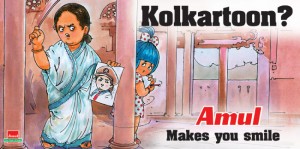
    Mr Rahul da Cunha picks up his three favorite Amul ads which include ‘Victoria Termianted” when VT got renamed, the obituary we did recently for cartoonist Mario Miranda and the one done recently on Mamata Banerjee’s response to the controversial cartoon ‘KOLKARTOON!”


    Giving her take on Amul ads, Priti Nair of Curry-Nation, says, “I feel they take a nice lopsided view of the mess we face day in and day out. They at least put a smile on hopeless situations because quite frankly there is nothing you can do but feel angry and frustrated by the stupidity you fall prey to. Their potshots at least lighten you up most times.”


    “Also as advertisers we know if Amul picks on a topic it is the hot topic or for instance if they pick on your ad you feel quite happy. I know we felt damn good when they did a spoof on Balbir Pasha and Manjula. That’s the power of the communication medium they have chosen and stuck to for years,” adds Ms Nair.


    Says Anil Nair, CEO and Managing Partner, Law & Kenneth India, “Amul is the only brand which has truly done what many brands have preached about, ‘connecting with consumers life beyond making transactions’. Advertising is applied anthropology and hence (should) reflect the society as it evolves. Amul hoardings have done that for years, consistently. Amul hoardings bring huge credibility and pride to an otherwise frowned upon industry. Am a fan… No, am an eternal fan.”


    Prathap Suthan, Founding Member of Bang in the Middle, believes Amul manages to always come up with a perspective that brightens up the subject. “There is an innocence that is welcome no matter the event or subject. A spot of optimism that works like charm, and often disarms the audience,” Mr Suthan says. “With its almost topical and quick changes, it adds to the daily relevance that butter is all about. So much so, like the butter it sells, its advertising has grown to become almost a habit for India.”

    Well said.