Tag: All India Radio

  • Government intervention in media must end


    By Ranjona Banerji


    Ranjona BanerjiNo matter how awful news outlets are and how bad their journalism is, government intervention is worse. It is our nursery mentality which wants the government to step in when something goes wrong, even when government is an essential part of the problem.


    News has to be independent of as many influences as possible, for it to be worthwhile to the consumer, whether reader or viewer or both. All too often you hear people saying X, Y channel is so bad, its news is so biased, why can’t the government do something.


    And what can or will the government do, if it controls what the media can or cannot show? Well, we already see that in many of our news channels and some of our other outlets. You don’t even have to go as far as state-owned broadcast media like All India Radio and Doordarshan. You get party and government propaganda masquerading as news. You see pretend journalists and some real journalists who should know better pushing party and government propaganda.
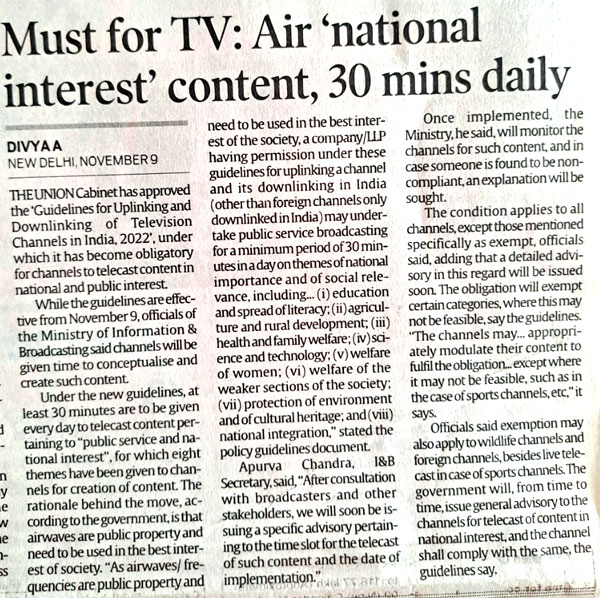
     

    In an already skewed and biased environment the recent Ministry of Information and Broadcasting rule that television channels must broadcast on themes of “national interest” for 30 minutes a day is a giant step in the wrong direction. It is not the government’s business what an entertainment or news outlet broadcasts, as long as it does not break the laws of the land. To direct media outlets to carry anything, of national interest or not, goes directly against the freedoms provided in Article 19 of the Constitution.


    It is television which governments target, not just for their reach, but because current broadcasting regulations make government intervention easy. The same new rules have brought some aspects of the broadcast media into the 21st century, but what one hand giveth the other taketh away.

    https://www.ndtv.com/india-news/centre-deregulates-uplinking-of-satellite-tv-channels-heres-why-3504929


    Although the I&B secretary claims that channels are “free to create their own content”, the very fact of the rule is a contravention of the media’s right to freedom of expression.


    In fact, the time will soon come when we must seriously discuss why we need a ministry of Information and Broadcasting, why we still need state-owned media and why the broadcast industry’s strings are pulled by government like a toddler in reins.


    After 75 years of Independence, we need a truly independent media. Without any government intervention in broadcast rules or paper import or digital space. Let the state-run media become licensed, where we all pay fees so that it is independent of political manipulation. It is only then what we can become truly adult.


    It is bad enough that so many sections of the media capitulate without being asked to, that media owners lack integrity and courage. We see the results of a population fed on misinformation and publicity campaigns. Free choice, free speech all these will soon be in name only.


    The attached screenshot in fact makes it clear just how much control the government wants. And the more you give in, the more you find you will eventually lose.


    This one is on us.

    And we’re losing for sure.


    Ranjona Banerji is a senior journalist and commentator. She writes on MxMIndia on Tuesdays and Fridays. Her views here are personal

     

  • Time to welcome Diversity in Radio?


    By Shruti Pushkarna


    Shruti PushkarnaAs you read this, commercial and state-owned radio stations all across the world are celebrating this day on air. Yes, it’s World Radio Day today.


     

    Surely a medium that has managed to stay relevant for over 120 years (since the first radio device was invented by Guglielmo Marconi in 1899) calls for celebration.


    With new technology and increasing penetration, the content development business is more dynamic than ever. Radio too has been experimenting with various avatars when it comes to programming models or expansion on digital platforms.


    But what hasn’t changed is its devoted listenership, which cuts across culture, age, ethnicity, gender, religion, economics and so on. I start my day with tuning in to my favourite station every morning as I drive to work. You can hear the radio blaring in the local chaiwallah’s shop (no reference to our dear PM here!). Cab drivers, hawkers, housewives, college students, senior citizens, all take in their daily diet of radio content.


    Another ardent group of listeners are millions of visually impaired citizens living in different nooks of our country. Did you know that 20% of the global blind population resides in India? That’s around 63 million people according to the World Health Organisation.


    And this large section of the population depends on radio for not just entertainment but information. Like several persons with disabilities, blind people are often treated as a burden by their families. Confined in the four walls of their homes, they remain isolated from the society. Deprived of education, they have little or no access to information.


    They find a friend in the RJ, solace in music and in that moment, the impairment ceases to be.  As part of my work, in an interaction with a parent, I learned that his 14-year-old blind boy who was absolutely tucked away from the outside world had no skills of communication or the ability to carry out any activities of daily living. But he could sing and dance because he listened to radio for most part of the day.


    In this cricket-loving nation, sighted fans may have moved on to mobile devices for live video streaming, but a visually impaired fan still tunes in to the good old radio commentary.


    Radio fascinates visually impaired people, because they can easily relate to it. There is no discrimination there, in terms of lack of access.


    The question is: are radio producers aware of this audience and their needs? Are they devising any content that is targeted towards the average visually impaired listener? There are a lot of social campaigns various stations undertake. They align with a cause, person or an organisation and garner support through their wide reach.


    I feel radio can contribute a great deal by initiating a campaign to sensitise people about the challenges faced by visually impaired people. Or let’s say how to offer help to a blind person you may encounter on a street, on the metro, in a bus or at an airport.


    Radio also has the potential to offer employment to blind people. India’s first visually impaired radio jockey K Srikanth started off his career with All India Radio and later worked with the BBC. There are private and non-profit institutions that offer courses in storytelling and radio jockeying. Among the section of blind people that has access to mainstream education and technology, there are many students who opt for media courses.


    Not long ago, I’d engaged with a graduate in mass communication from Bengaluru who wanted to become an RJ. He found no luck because he was blind. This young boy was well verse with technology, had acquired all skills of scripting, editing etc. He needed professional training like all newbies do, that’s all.


    This year the theme of World Radio Day is ‘Radio and Diversity’.  Perhaps a cue for the radio industry to promote inclusion and educate the society about ‘diverse’ needs of people who are just as equal citizens of India as you and I.


    Shruti Pushkarna is a former journalist (part of the founding team of MxMIndia) who has now moved full-time to the social sector. She heads operations of the New Delhi-based Score Foundation where she works as Director-Programmes & Communications. She writes for MxMIndia every other Thursday. Her views here are personal. She can be reached via Twitter at @shrutipushkarna

  • Dinesh Gautam joins JK Media Network as Executive Editor

    By A Correspondent


    Dinesh Gautam

    Dinesh Gautam has joined JK Media Network as Executive Editor. The network also runs a national Hindi news channel – ‘JK 24X7 News’ and ‘Gulistan News’ in regional space which caters to the viewers of Jammu & Kashmir.


    Gautam has been in TV news industry for two decades and was rated Best Anchor of the Hindi news industry and was recipient of “NT Award” for the year 2012. He has also worked at senior editorial positions in Live India and Sahara News Network. Prior to this, he was primetime anchor and Principal Correspondent at Zee News and was also associated with All India Radio (AIR).


    On his appointment, RK Arora, said “We believe in bringing more leadership to our growing network, and I welcome Dinesh to a network that has immense potential, and believes in the fundamental principle of “You must be the change you want to see in the world”. I am sure, that under his leadership the channel will create benchmark in innovation, impact, ratings, time spends and viewer-support.


  • AIR appoints releaseMyAd as its online virtual agency

    By A Correspondent


    All India Radio accorded its first official recognition to releaseMyAd, India’s largest online ad platform as its only virtual advertising agency authorized to accept and process radio advertisement bookings for its network of stations, which include Akashvani, Vividh Bharati, FM Rainbow & FM Gold.


    As one of the country’s foremost welfare awareness medium, All India Radio enjoys a far wider reach across the country than that of any other private FM station. As an online platform that creates advertising opportunities for small and medium businesses in radio, cinema and print segments across India, releaseMyAd’s partnership with AIR could not have been a more compatible one. As enterprises, both AIR and releaseMyAd function to empower Indians in their own way.


    To reinforce its presence in the virtual world, All India Radio has engaged releaseMyAd to meet twin objectives of optimum inventory utilization as well as revenue augmentation. The facility allows advertisers to book ads online across all channels of AIR with a simple mouse-click. As an online media option, releaseMyAd makes mass media advertising options accessible to all by effectively matchmaking between media owners and advertisers. “This initiative, a part of AIR’s ambitious web-enabled services for its patrons will not only assist us in adequate utilization of last minute inventory that goes wasted if not put to use but will also fetch us valuable extra revenues”, says Amitabh Shukla, Additional Director General (Commercial) All India Radio.


    “All India Radio is an extensive government owned network that has exclusive rights over communications by every ministry. Be it the parliamentary talk, world cup commentary or the Prime Minister’s monthly address, this is the only platform that gives access to these. We want to help advertisers to capitalize on the AIR’s monopoly on content that is news, sports or common welfare driven. It has such wonderful properties and scope to offer. We shall now play a significant part in communicating its vision and enabling whatever opportunities it has to offer”, says Sharad Lunia, founder of releaseMyAd.


  • Times Internet partners AIR for live IPL commentary

    By A Correspondent


    Times Internet Limited (TIL) and AIR will broadcast live commentary of 33 select Pepsi IPL 2013 matches over AIR’s National Channel and FM Gold. Updates for all matches will be broadcast on AIR FM Rainbow Channel.


    The running commentary of the matches of Pepsi IPL 2013, including the Playoffs/Final, being played in India, will be broadcast alternately in Hindi and English on National Channel and FM Gold Network. The coverage area of National Channel includes Andhra Pradesh, Bihar, Chhattisgarh, Delhi, Goa, Haryana, Jharkhand, Karnataka, Madhya Pradesh, Manipur, Meghalaya, Orissa, Pondicherry, Tripura, Uttar Pradesh, Uttaranchal and parts of Assam, Maharashtra, Rajasthan and Tamil Nadu. The live commentary of all 33 identified matches will be broadcast over National Channel of AIR which is available all over India.


    Satyan Gajwani

    Speaking on the association, Satyan Gajwani, CEO, Times Internet, said, “We’re delighted to renew our association with AIR on Pepsi IPL. By partnering with All India Radio, Pepsi IPL 2013 will tap into a new set of cricket fan audiences across India, particularly beyond the metros.”


    “All India Radio, which has always been in the forefront of popularizing sports in India including cricket, is happy to bring live and exciting action from IPL to its listeners”, said LD Mandloi, Director General, All India Radio.


  • Paritosh Joshi: _____________ Maketh A Man

    By Paritosh Joshi


    Surely, you are wondering why I chose to leave that first word blank when everyone knows the word that completes the aphorism?


    A Methuselah of our Media & Communications business came by a few years ago, when I was still gainfully employed and not a lily of the field, to talk about the media and their place in our lives. The conversation made an impression on me, abiding enough that I am compelled to develop it in today’s essay.


    Let me rewind to my early memories circa 1968.Kanpurhad no local English newspaper. The Times of India would ship theDelhi‘Dak’ Edition to our mofussil outpost. By the time the (now only of distant memory) Toofan Mail with her imposing steam locomotive growled intoKanpurstation with the precious newspaper, it would already be a day late. The news wasn’t yet stale, mind. After all, the only other source of news and current affairs we had, was the nightly bulletin on All India Radio delivered in the richly textured baritones of Jasdev Singh, Ashok Bajpai and their ilk. I must add that the scratchy Short Wave signals that our prized Murphy radio managed to extract from the ether made listening challenging at the best of times. Barring the most momentous of events and emergencies, the world beyond the nearest 10 kilometers was at least two days away. And it didn’t matter. Life, as we led it then, had little or nothing to do with the world beyond.


    Fast forward to 1977, nearly a whole decade later. We lived inNasikjust 175 kilometers fromBombay. Yes, in those days it was stillBombay.  Here was a city that offered not just one but TWO local (also local language) newspapers, Gavkari and Deshdoot. Times ofIndia,Bombay’s Dak edition would reach us the same day except it probably carried the previous day’s stories. There was still no television inNasik, so we still were served only by the stale newspaper and the highly expurgated radio. Not a lot had changed. Our lives continued to be led in the isolation and serenity of small townIndiaand, quite frankly, we didn’t think we were missing anything.


    Things began to change with the move toBombayin 1980. Suddenly, a television arrived at home. Black & White it may have been and only for a few hours of low fidelity transmission every day. And featuring exciting content such as missing people’s reports and Krishi Darshan, the farmers’ show, only occasionally spiced up with Chitrahar and Chhayageet. From consuming less than an hour’s worth of assorted media (perhaps half an hour each of radio and newspaper), our days now had at least another hour dedicated to TV.


    Television continued to grow. Print began to proliferate, not just in the form of a growing range of magazines, but also as a daily in the form of the afternoon or evening tabloid. Soon there was a Mid-Day fan and an Afternoon aficionado; an India Today enthusiast and a Week loyalist; a Stardust addict and a Filmfare feeder. Between all the diversity now available to them, many consumers were spending several hours a day just consuming all the options they were fond of.


    Cut to 2012. From perhaps 2 or 3 hours of exposure to various media a day, the modern urban Indian probably spends 4 or more hours a day consuming or in some way interacting with one medium or another. And it is no longer just urbanIndiaeither. DTH is available all over the country and a subscriber in the most remote hamlet has to just train its little antenna toward the sky to receive the latest content from around the world, a lot of it for free, in full digital video and Dolby Stereophonic Audio.


    People are defining themselves by the mix of content they consume.


    Can there be a segmentation approach that is based on shared commonalities AND uniquenesses in the way people consume the media?


    Which is why I left that heading blank.


    It really ought to read:


    Media maketh the man!


    Paritosh Joshi was until recently CEO, Star CJ. He has been a marketer, a mediaperson and a key officebearer on industry bodies. He is Strategic Advisor, Ormax Media. He can reached via his Twitter handle @paritoshZero


  • Times Internet partners AIR for live IPL commentary

    By A Correspondent


    Times Internet Limited (TIL) and All India Radio (AIR) have joined hands to broadcast live commentary of IPL 2012 over AIR’s national channel and the FM Gold Network.


    The running commentary of the final matches of IPL 2012 will be broadcast alternately in Hindi and English on National Channel and FM Gold Network.


    Speaking on the deal, Rishi Khiani, CEO, Times Internet, said: “By partnering with All India Radio, IPL 2012 will be able to reach out to a much larger base of cricket fans, who are spread all over the country ,especially beyond the metros.”


    “AIR has had a very long innings in promoting sports including cricket in the country. We are still going strong in that direction. We are now about to carry live commentary of the last three important and crucial matches including the final match of IPL. We hope that this would provide a new experience to our listeners,” said LD Mandloi, Director General, All India Radio.