
Tag: Al Jazeera

  • So what will NDTV be under Gautam Adani?


    By Ranjona Banerji


    Ranjona BanerjiIndia’s fastest growing businessman Gautam Adani has almost closed the deal to buy the news channel NDTV.

    Adani has stretched his wings, with a little bit of help from his powerful friends, to various industries from airports to mining to solar power, far from his original bastions of ports and edible oils.

    There has been much ferment over this hostile takeover because for many in India, NDTV has remained the last practitioner of Indian TV’s version journalism, as all its competitors have fallen in line with government diktats. In a sense, NDTV was the forerunner of free non-state-controlled broadcast news in India. Most of the older generation of television presenters were trained by NDTV, and that is where the first star anchors emerged from.

    Dr Prannoy Roy was a major influence on how TV would be conducted in India in the early days, after he and his wife Radhika Roy started NDTV in the mid-1980s. His show The World This Week for Doordarshan was very popular.

    The question now being asked over and over again by loyal viewers is what will happen to NDTV after Adani takes over? What will happen to Ravish Kumar, the fearless anchor who looks after NDTV’s Hindi news channel, the only TV journalist who does not kowtow to government forces?

    Why Adani wants a media outlet of his own is self-evident. His international press is not that good, and that sometimes spills over to India. The general assumption therefore will be one more propaganda channel which focuses on positive publicity for Adani companies and Adani himself. This is how many or most industrialist-owned media houses behave. Earlier the result journalism-wise would be disastrous because people expected some sort of basic standards – the collapse of the Observer papers after the Salgaocar-Ambani takeover is a case study here.

    But since 2014, assisted by a helpful government which demands total loyalty from media houses, the Ambani takeover of the News18 group has been a success. Not obviously when it comes to journalism but definitely when it comes to numbers.

    Hardly surprising then that Adani wants his own mouthpiece.

    What is amusing however – because I am cynical – is that in an interview to the Financial Times, Adani made the following comment: “Why can’t you support one media house to become independent and have a global footprint?… India does not have one single (outlet) to compare to Financial Times or Al Jazeera.”

    https://www.aljazeera.com/news/2022/11/25/indian-tycoon-defends-hostile-takeover-bid-for-broadcaster


    Now that’s an interesting standard for an Indian mainstream media which currently struggles to get even the basics correct. Neither the Financial Times nor Al Jazeera specialise in the sort of nightly high-decibel battles which characterise Indian television. The Financial Times is a serious pink paper, of the sort which today’s media owners scoff at. Indian news consumers, the general feeling goes, are largely thick, easily excitable and undiscerning and thus can only appreciate news in the form of a soap opera.

    There is nothing new in pandering to the lowest common denominator. It is an old media policy. But neither FT nor Al Jazeera fall quite into that News of the World, National Enquirer category. India Today TV recently ran a show where they objected to a tweet by actress Richa Chadha on the Indian Armed Forces. For their show, they ran photos of Chadha in swimwear. That works to belittle women, to put Chadha in her place as it were, and appeal to their crass audience. Actor Akshay Kumar objected to Chadha’s tweet, but the news of that was not accompanied by images of Kumar in revealing swimwear.

    Is Gautam Adani making it clear that this is not the sort of future he envisages for his version of NDTV?

    Well, you can hope as much as you like but the truth is likely to be elsewhere. In the same FT interview, Adani made this remark: “Independence means is government has something wrong, you say it’s wrong”.

    And Adani also said this: that the media should have the “courage” to back the government when it is right.

    There you have it ladies and gentlemen, clear intent from the tycoon himself.


    Ranjona Banerji is a senior journalist and commentator. She writes on MxMIndia on Tuesdays and Fridays. Her views here are personal


     

  • A spat that went too far


    By Ranjona Banerji


    Ranjona BanerjiThe Reporters’ Collective did an amazing series of investigations into political ads on Facebook recently. Published by Al Jazeera, the series showed with relevant data and responses, how the BJP’s ads were given preference by both being pushed ahead of the others and by large discounts. The investigations also revealed how a Reliance-owned company, NEWJ, was an integral part of this pro-BJP exercise.


    The links between the BJP and Facebook are known by now. As are links between Facebook and many rightwing political organisations across the globe. This particular series further cemented the relationship, with additional proof.


    The truth is that there is enormous jealousy and one-upmanship in the arena of journalism. Regardless of the rest of the world referring to “the media” as if it was one large amoeba, the media is a group of bacteria all in competition. And then you have journalists themselves, all jostling for the same information. Rivalries within the same newsroom can be as intense as between newsrooms.


    And yet, it’s hard to understand the argument that broke out between The Reporters’ Collective (TRC) and The Morning Context (TMC) over this series. Like TRC, TMC is also a group of journalists with a preference for quality investigative journalism. It is a digital platform, and has done some excellent work.


    I personally know neither but I admire the work of both.


    What I’ve understood is this. TMC felt that there were some inconsistencies in TRC investigation and/or that TRC had misunderstood/misrepresented the data. An email for clarification was sent by TMC to TRC. TRC replied. However, TMC went ahead with its newsletter on the investigation without using the information it had been sent.


    This irked TRC which then revealed the string of communication and dismissed TMC’s responses as “entertainment”.


    Within the little media arena this “battle” escalated with name-calling and calling out and various takes on who should have, did not, should not and all that.


    Initially, it looked like a spat that went too far. TRC appeared to have overreacted and TMC could well have waited to include the responses it had asked for. Ego and dismissiveness?


    Jealousy?


    Sadly, from the outside, it looks as if TMC’s analysis of the TRC report appeared to absolve Facebook of culpability or even worse, use that pathetic excuse trotted out by old journalists who have to prove they know more than everyone else: everyone does it or it has happened before.


    The TRC series was one more in a chain of evidence against Big Tech. You have to live in a lightless, soundless, impenetrable silo if you are unaware that Facebook – and all such controlling digital platforms – have already created massive damage to democracy.


    Why TMC should decide to give the impression that they need to defend the BJP and Facebook is an intriguing point. Because that’s the impression its reaction gives. A bit like a 50-word edit from The Print. To me, that overshadows the disrespect shown by the TRC to the journalists at the TMC. We in the media – as rivals and as a community – share an enormous responsibility in allowing rightwing propaganda to dictate our lives and to attack the very foundations of our democracy. We all know that the worst culprits are massive names within the media, backed by large industrial groups. If the few independent voices now set up petty skirmishes, we are sunk.

    https://www.scribd.com/document/566564639/The-Reporters-Collective-Response-to-The-Morning-Context

    https://themorningcontext.com/internet/al-jazeeras-non-expose-on-facebook-googles-billing-shift


    **


    Already people are taking sides. The parallel to the incident at the Oscars, where Will Smith slapped Chris Rock for making fun of his wife is unavoidable. So much he shouldn’t, no he shouldn’t, no there’re history, no why does that matter, no violence is bad but so are insults…

    https://www.bbc.com/news/entertainment-arts-60909487


    The consequences of our local squabble however are far worse for India and its media.


    Ranjona Banerji is a senior journalist and commentator. She writes on MxMIndia every Tuesday and Friday. Her views here are personal


  • Varying, worrying reports from Kashmir


    By Ranjona Banerji


    The crackdown in Jammu and Kashmir after the government bulldozed the abrogation of Article 370 has been an acid test for the media. Sadly, many just failed outright or did not even bother to consider success. Or, let us be fair to them, they redefined success. Passing the test in these cases meant that they successfully managed to push forward the government point of view. People fooled, job done, journalism burnt by the acid of betrayal.

    If the people of Kashmir are indeed overjoyed with the government’s actions and moving about freely as the government claims, then well, think for yourself. Why the communications lockdown, why are shops shut, why are opposition leaders under arrest. But even within the media, if anyone asked these questions, our paid lapdog media accused them of being anti-national. That same old line.

    As Pannneerselvan, Readers’ Editor for The Hindu, explains the dangers of blocking access and blackening out the news:
    https://www.thehindu.com/opinion/Readers-Editor/information-blackout-leads-to-silence-and-exaggeration/article28984758.ece?homepage=true

    AltNews, the fact-checking website, has amongst many other instances, exposed how news agencies, in this case the pro-Modi government ANI, has used wrong or old photographs to mispresent the situation in Kashmir:

    ANI, India TV portray photographs of mosque in Jammu as Eid prayers in Srinagar

    The international media has been at the receiving end of pro-government forces, with the BBC, Al Jazeera, The New York Times and Reuters getting maximum flak for not painting a merry picture of the people of Kashmir frolicking about in crocus fields waving photos of Narendra Modi and Amit Shah. Angry protestors, shuttered shops, barbed wire, a strong security presence, pellet gun injuries, a confused people unable to go to hospitals, get medicines, get on with emergencies have formed the bulk of the reports from those who have merely done basic journalism.

    The BBC decided to issue this statement via Twitter when it was accused of lies:

    “The BBC stands by its journalism and we strongly refute any claims that we have misrepresented events in Kashmir. We are covering the situation impartially and factually. Like other broadcasters we are currently operating under severe restrictions in Kashmir but will continue to report what is happening.”

    https://m.economictimes.com/news/politics-and-nation/government-contacts-al-jazeera-and-bbc-for-their-fabricated-video-on-kashmir/amp_articleshow/70634925.cms?__twitter_impression=true#stickyBanner


    This report is from Vijaita Singh of The Hindu who chronicled her experiences for Twitter in real time:

    https://www.thehindu.com/news/national/kashmir-under-lockdown-i-just-want-to-tell-ammi-i-am-fine/article28917905.ece


    This is a personal experience from Bashaarat Masood of The Indian Express:

    https://indianexpress.com/article/india/jammu-kashmir-srinagar-curfew-eid-article-370-5899799/


    In many ways, Twitter has been the frontier for getting information out of the lockdown in Kashmir. Many news outlets, those who have not crossed over to the government’s publicity machine that is, had to rely on editorials and opinion pieces to discuss what was happening in Kashmir. TV studios remained a battleground that looks more and more fake and contrived everyday.

    The very fact that information was not forthcoming, with the government insisting that everyone was happy, should have been enough warning for journalists. But not this time. Some independent journalists reported that things were not normal, maybe but not so bad, in a most wishy-washy manner. It’s a bit rich to say everyone on the street you went to was “happy” when there is a strong police presence everywhere and unhappiness on the next street. Disingenuous. Manufactured naivete.

    The worst of all were those journalists who publicised photographs of National Security Adviser Ajeet Doval walking about Kashmir as a sign that all was well. Journalists who later spoke to those “happy” people Doval interacted with claimed they did not know who he was, that the so-called “biryani” they shared together was just some random rice and meat curry pushed into their hands by Doval’s security!

    You don’t know whether to laugh or cry sometimes at the state of the Indian media.


    Ranjona Banerji is a senior journalist and commentator. She is also Consulting Editor, MxMIndia. Her views here are personal.


  • Al Jazeera unveils ‘Hear the Human Story’ global brand campaign

    By A Correspondent


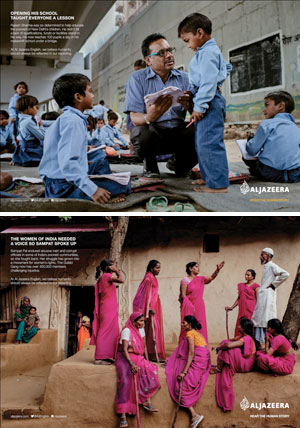
    Al Jazeera English has made virtue of putting real people on its billboards and television commercials rather than its own star presenters and correspondents. The channel’s new brand campaign is its largest marketing push to-date, and the slogan “Hear the Human Story” was unveiled at its global launch in South Africa recently. The brand film featured at the special event was about the Gulabi Gang, also known as “vigilantes in pink”, who tackle issues such as violence against women and corruption in northern India.

     

    Al Anstey, Managing Director of Al Jazeera English, said that the channel covered all the big themes and issues facing the world today, but did so from the perspective of real people: “We believe everyone has a story worth hearing. There are seven billion people to listen to on the planet right now. Al Jazeera exists to cover the people often ignored. People whose voices must be heard – but who are so often neglected by mainstream media.”


    “Our editorial mission is to cover the world without a perspective. What that means is not seeing the globe through a geographical or cultural prism, by not weighting our coverage towards West, the rich nations, or anywhere else. We cover the developing world as much as the developed. So person in Bangui is given as much humanity as a person in Boston or Birmingham.”


    Commenting on the choice of Johannesburg as the location for the launch, rather than the traditional financial centres favoured by other channels, Al Jazeera’s Executive Director for Marketing & Distribution Abdulla Alnajjar said: “In a world where the truth is everywhere under attack, Al Jazeera puts the human being at the centre of its news agenda, giving a voice to the voiceless. This campaign is about human stories and we’re proud that the global launch for the campaign is here from South Africa, a region rich with history and human stories.”


    “Our coverage is not about only about portraying difficult situations – its about the triumph of the human spirit and the ability for people in the most difficult of situations to make change. It’s on that foundation that we built this campaign honouring their lives and struggles. This campaign showcases incredible human stories and the humanity that unites us all.”


    Some of the others featured in the campaign include: Kiki Katese who started a group of female drummers in the aftermath of the Rwandan genocide; and Illac Diaz who brought lighting to slums in the Philippines using plastic bottles.


  • Industry rallies behind jailed Al Jazeera staff

    By a correspondent


    News of Al Jazeera journalists being held captive by authorities in Egypt has grabbed headlines in the past few weeks. As a show of support, some of the world’s most prominent presenters from multiple news organisations have highlighted the importance of journalism by asking their viewers to “imagine a world where reality is distorted, imagine being kept in the dark about major world events, and imagine being silenced when speaking out could save your life”.


    The broadcast of the message comes ahead of the court appearance in Cairo on 24th March of three of the four Al Jazeera journalists who have been detained in Egypt for 85 days.


    The rare coming together of news organisations in one film features CNN’s Christiane Amanpour, ITN’s Mark Austin and Julie Etchingham, Channel Seven Australia’s Mark Ferguson, and Al Jazeera English’s Shiulie Ghosh. The 40 second film ends with a collage of photos of journalists around the world muted as part of the FreeAJStaff campaign. The hashtag #FreeAJStaff has now had over 786 million impressions since it was launched during a day of action in Nairobi on 4th February.


    Al Anstey, Managing Director of Al Jazeera English said: “We are very grateful to our colleagues around the world for their support of our staff detained in Egypt. Mohamed, Baher, and Peter are world-class journalists and are in detention for simply doing their job. We have seen massive support for them and for journalism from all corners of the globe, so the message of this film is clear – journalism matters and people have a right to be heard and to be informed.”


    The broadcast comes just days after Egyptian President and Chief Justice Adly Mansour sent a letter to the parents of Peter Greste, telling them he will “spare no effort to work towards the speedy resolution of the case”. Al Jazeera English journalists Peter Greste, Baher Mohammed and Mohammed Fahmy have been detained by the Egyptian authorities since December 29th 2013. Al Jazeera Arabic’s Abdullah Elshamy has been detained since August 14th 2013.


    The film (https://www.dropbox.com/sh/6yia76f4i0rs8ag/R-hOJuXlPJ ) is available for all media organisations and supporters to broadcast and upload online in support of media freedom worldwide.


  • Wanted: translators for press conferences

    Ranjona Banerji

    By Ranjona Banerji


    This is targeted at TV newswallahs. They have a tendency to show us live press conferences that they deem to be important, from across the country. This week, we had Mamata Banerjee, chief minister of West Bengal, after the victory of the Kolkata Knight Riders in the Indian Premier League. Then we had Kiran Reddy, chief minister of Andhra Pradesh, on the arrest of his predecessor’s son Jagan Mohan Reddy by the Central Bureau of Investigation.


    All very commendable, bringing us the news when it happens. The grouse? Banerjee spoke in Bengali and Reddy in Telugu. This of course makes it virtually impossible for anyone to understand what they’re saying. The on-screen translation process was extremely slow and then, only paraphrased their remarks. Which means for about 3 minutes of someone talking, you got about two lines of material. The reason I know this is because I understand Bengali and have a smattering of Telugu.


    If anyone is old enough to remember, it was a bit like the scene in Charlie Chaplin’s Great Dictator where the typist is taking dictation from the Adolf Hitler character, Adenoid Hynkel. Hynkel talks and talks and the stenographer types two words.


    On the BBC and al Jazeera this week, a live press conference with the British foreign secretary and Russian foreign minister on the Syria issue was also covered.


    When the Russian minister spoke there was a live voice translation. One understands that the translations were provided by the governments concerned and not the TV channels but it is a process which a multilingual country like ours needs to understand.


    It might be more sensible for a reporter present to provide a paraphrasing of events rather than subject people to listening to something they cannot understand. Neither press conference, it has to be said, was particularly scintillating.


    * * *


    There were few scuffles and a lathi-charge in Kolkata’s Eden Gardens when the celebrations were being held. All afternoon, Times Now behaved as if it was covering a major riot and hundreds had been badly injured. Even if you dislike Mamata Banerjee and Shah Rukh Khan, some perspective please. NDTV called it a “mild lathi-charge” which is an unfortunate choice of words but perhaps a more appropriate sentiment.


  • [MJR] A tsunami of hot air and hysteria on Indian TV

    By Ranjona Banerji


    Yes, it is true that there were fears of a tsunami in countries along the Indian Ocean on Wednesday. It is also true that there was terrible damage in the tsunami of December 26, 2004. But there was no need for Indian TV anchors and reporters to start behaving like ambulance chasers as they geared up with excitement to cover this momentous event.


    This high-pitched hysteria for every single event, newsworthy or otherwise, gets exceedingly tedious, especially when there is little modulation in tone or pitch. Most Indian TV news channels didn’t even have adequate information nor do they have credible weather anchors, geologists or meteorologists on call. All they can do therefore is to keep repeating the same thing over and over again.


    On Wednesday, although a tsunami warning was issued, no tsunami had happened yet. There was no call therefore to behave like the end of the world was upon us. This only engenders panic, made worse by the fact that reporters and anchors say one thing and the texts that run across TV screens imply quite something else.


    International channels were a study in contrast. Al Jazeera and the BBC stuck to other world news – Korea, Syria, economic crisis – while CNN concentrated on the earthquake in Indonesia and possible after-effects. There was no breathless reporting; rather the effort was to explain what was happening in a sober and matter-of-fact manner. No attempts were made to audition for a travelling ‘jatra’ party, which appears to be the Indian model. And CNN’s weather expert Mari Ramos was as always excellent in her information and analysis.