By Shruti Pushkarna
 What’s the first thing you reach out for when you wake up? Or, what’s the last thing you use before turning in at night? In all likelihood, it’s your cellphone. An inseparable part of our lives, it’s the mode for all kinds of content consumption. Whether it’s managing your calendar, getting the news, or scanning social media feeds, cellphone is a constant presence and an enabler.
Computers, smartphones, and other smart devices have not only made things easy but also improved our productivity levels. Most services including healthcare, banking, food delivery, and entertainment have gone digital. Now imagine, if one billion people encounter challenges in accessing mainstream digital products and services.
That’s the number of people who live with some form of disability, worldwide. They experience lack of access to basic things which we take for granted in our daily routines. Reading the news, browsing Instagram, making a UPI payment, transferring funds to another account, or ordering a pizza!
Today (May 18) is the Global Accessibility Awareness Day (GAAD), an annual celebration to get everyone talking, thinking, and learning about digital access and inclusion of persons with disabilities. The theme of this year, ‘Keeping technology accessible for everyone’, is in line with the growing shift towards digital infrastructure.
But what does accessibility mean in the context of disability? How can technology include or exclude people with visual, hearing, motor, and cognitive disabilities? To answer these and more, I spoke to three professionals who live with different types of disabilities.
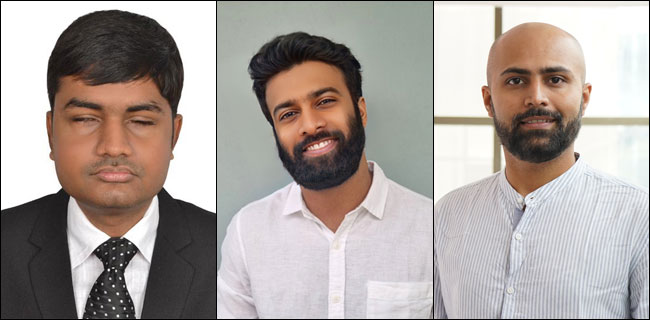
Amar Jain is a corporate lawyer and a person with total blindness. Akshay CM is a DEI (Diversity, Equity and Inclusion) and Talent Management consultant and a neurodivergent individual with multiple invisible disabilities. And, Tushar Viradiya is a deaf individual who works for a Bengaluru-based NGO.
Q: What does ‘accessibility’ mean to you?
Amar Jain (AJ): Simply put, Accessibility = ability to access. People perceive information and user interface components of technology using three senses, as we can neither taste nor smell technology. And to me, accessibility is when all of the information and components I can use with more than one sense. For example, colour alone to convey information relies only on sense of seeing, whereas a colour indicated with text alternatives like a * sign, makes it accessible to other senses of hearing and touch for people who may have difficulty using one of their senses.
Akshay CM (ACM): Accessibility, to me, means ensuring that all individuals, regardless of their abilities or disabilities, have equal access to information, technology, physical spaces, and opportunities to fully participate in society.
Tushar Viradiya (TV): For me, accessibility means creating an inclusive environment and services, which are available to individuals with abilities or disabilities. For example, sign language interpreters play a vital role in making communication accessible for both deaf and hearing individuals.
Q: Give us one example from your daily life where access or the lack of it significantly impacts you?
AJ: As a lawyer, ability to read handwritten text, and different designs that people create using pen on paper like cutting down stuff, inserting new lines, making different signs to indicate intent impacts my daily life a lot because none of this is accessible to me as a person with blindness and I have to depend on others to obtain this information.
ACM: When websites or apps lack proper captioning or transcripts for videos and audio content. As a neurodivergent individual, I heavily rely on visual cues and text-based information. Without adequate access to captions or transcripts, I face difficulties in understanding and engaging with the content.
TV: Every day I visit YouTube channels and social media platforms that provide news and information in Indian sign language. Having sign language interpreters present during work meetings on Zoom enhances accessibility for deaf and hearing individuals. It becomes fully accessible for me.
Q: Given the push towards Digital India and the changed environment after Covid-19, with an increasing transition of activities of education, employment, and entertainment in the virtual space, how important is ‘accessibility’ to you as a person with blindness/neurodiversity/hearing impairment?
AJ: While technology is progressing and replacing almost every manual effort, at the same time, inaccessible design is creating exclusion and more barriers for persons with disabilities. From gadgets to work, to entertainment to everything else, technology is getting the centrestage. And given this push, it is equally important to have the technology which is inclusive, accessible and usable for everyone including people with disabilities.
ACM: As a neurodivergent individual, accessibility is crucial in the digital space, especially considering the increased reliance on virtual platforms for education, employment, and entertainment. It enables me to navigate and engage with these activities effectively, enhancing my overall inclusion and participation. Unfortunately, awareness of the principles of Universal Design for Learning (UDL) is relatively low among content creators, particularly in the context of neurodiversity. Adhering to UDL principles could greatly improve the accessibility and inclusivity of their content.
TV: Before Covid-19, deaf students faced barriers in accessing education due to limited resources and challenges in communication. There is very little awareness around the deaf and Indian Sign Language (ISL). There are mostly hearing teachers in special schools for the deaf, who do not understand sign language and expect the kids to understand through notes they write on the board. There is no explanation, context or description given. Now, there are online education channels which have content available in sign language which helps deaf people acquire knowledge. With the shift toward online learning in education, we need to ensure accessibility for deaf people. This includes, providing closed captions and sign language interpretation for education material, so they can fully engage in the learning activities. However, there are very few qualified ISL interpreters to cater to the needs of around 18 million deaf people!
Q: This year, the theme of GAAD is ‘Keeping technology accessible for everyone’. How relevant do you think this is in the Indian context and how far or close are we from achieving this? Especially in the context of media offerings, whether it is e-papers, news websites, OTT platforms, etc.
AJ: Accessibility can only happen when we have the right attitude and we understand the impact of inaccessibility. While things are changing in terms of policies, the implementation continues to be a daunting task.
ACM: India has witnessed a significant digital transformation in recent years, with increased reliance on online platforms for various activities. However, the accessibility of these platforms, particularly in terms of media offerings like epapers, news websites, and OTT platforms, remains a pressing concern. Many of these platforms lack adequate accessibility features such as screen reader compatibility, captioning, and alternative text for images, making it challenging for neurodivergent individuals and those with disabilities to access and engage with the content. While progress has been made, there is still a long way to go in ensuring inclusive and accessible technology for all.
TV: TV news is not signed, and when it is, sometimes the interpreters are not good enough to be accurate, so it does not make sense to me. I depend on independent YouTube channels and social media that produce news updates in sign language for deaf people. Deaf individuals face challenges when it comes to accessing entertainment such as movies, TV shows, and live performances. However, there has been some progress. Closed captioning is widely available for movies and television programs.
Recently, the Ministry of Social Justice and Empowerment notified that persons with disabilities can now approach the Chief Disability Commissioner to seek redressal under the Rights of Persons with Disabilities Act 2016, if ICT (Information and Communication Technology) products and services are not in keeping with the laid out standards of accessibility applicable to both government and private sector manufacturers and service providers. Will the government’s empowering move prove gamechanging in ensuring accessibility for all?
So why are we publishing this column on an A&M site? Well, we strongly feel that the media can dramatically transform the world of persons with disabilities. And this series can help bring forth issues that the media must champion to create a truly inclusive and accessible India. To write this column, we invited Shruti Pushkarna, a former journalist who is now a disability inclusion advocate based in New Delhi. Her views here are personal. To access the archives of her 70-odd columns, please visit: https://www.mxmindia.com/category/ columns/shruti-pushkarna/
If you have a view on the issues raise or would like to align with MxMIndia on this cause, write to us at editor [at] mxmindia.com.