
Tag: Ajit Joshi

  • Despite e-frenzy, crowds throng malls, markets


    By A Correspondent


    Malls and markets in and around Delhi, Mumbai and Kolkata were teeming with shoppers scouring for Diwali gifts and grabbing the latest electronic items last weekend, bringing relief to traditional retailers facing an unprecedented heavy discounting onslaught from online retailers.


    Supermarkets and consumer durable companies said it is a much better Diwali shopping season — when traditionally the biggest chunk of their annual sales takes place — than last year, thanks to improved consumer sentiments, although some smaller retailers have been impacted by big online sales.


    “There is a good number of serious shoppers out there,” said William Bissell, managing director at Fabindia. The retail chain of ethnic garments and furnishings has seen a 31 per cent year-on-year jump in its sales so far this Diwali season.


    Vineet Jain, vice president for Big Bazaar in the Delhi region at Future Group, said, “Probably, Sunday is going to be the best single-day sale for us in NCR (national capital region).” Even electronics retailers reported sales jump despite huge discounting offered by e-commerce companies such as Flipkart, Amazon and Snapdeal, thanks to the decision of top brands such as Sony, Samsung and LG to control supply of their top models to online stores.


    “This weekend there has been huge rush in malls and parking spaces too are full after a long time, which is a good sign,” said Ajit Joshi, CEO and MD at Tata Group’s Infiniti Retail that owns Croma electronics retail chain.


    “Sales have been extremely good, especially for large appliances like frost-free refrigerators and entertainment products like televisions and home theatres,” he said. This festive season all top companies such as Apple, Sony, Samsung, LG and Lenovo have launched their flagship models, and mostly they were kept away from online stores.


    “Some consumers were waiting in the wings for good offers during the ecommerce discount period but since they failed to get their desired product, they are back in the malls,” a senior executive at a top electronics chain said on condition of anonymity. Consumer electronics firms have been banking heavily on this Diwali after poor performance last year when consumers shied away from making costly purchases due to the economic scenario and inflation, and marketers did not launch any big model then. Amar Babu, managing director at Lenovo India, said consumer sentiments have improved and the company expects a good season.


    “After last year’s Diwali, the market had become really tough but we are witnessing good demand since last 7-8 days,” he said. Sony India said demand for its flat-screen televisions have soared by 40-50 per cent over the period before Diwali last year, helped by a sudden pickup in the last one week.


    Sunil Nayyar, head of sales for Sony India, said the company targets 60-70 per cent sales growth this Diwali, led by heavy demand for flat-screen large televisions of 42-56 inches, which segment is expected to contribute 55 per cent of total sales. Garment retailers such as Pantaloons Fashion and Arvind Lifestyle Brands, too, said Diwali sales had a delayed start.


    Offline retailers feel it’s is no longer a month-long festive buying phenomenon as Diwali sales period has been shrinking each year. Less number of shopping days doesn’t necessarily mean lower sales.


    “While we saw delayed start to Diwali shopping this year, like-to-like sales growth has increased 10 per cent which we had aimed for,” said Shital Mehta, chief executive officer at Pantaloons Fashion. “The growth was much higher at over 30 per cent on Saturday, which indicates that the next few crucial days leading to Diwali will also be good.”


    In fact, while people rushed to the malls in the weekend, they have had a near-deserted look during weekdays. J Suresh, managing director at Arvind Lifestyle Brands, said, “This Diwali, there has been a contrast of sorts with low sales during weekdays and better than expected demand on weekends.” Meanwhile, some apparel and electronic retailers that had built up inventory for Diwali have been caught off-guard by the heavy discounting by e-commerce companies.


    Source:The Economic Times

    Copyright © 2014, Bennett, Coleman & Co. Ltd. All Rights Reserved

    Licensed to republish
     

  • Croma Home Stories survey unveiled

    By A Correspondent


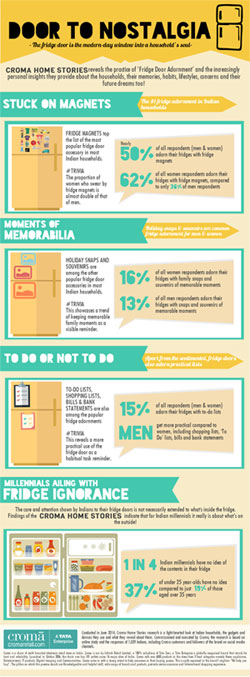
    The Croma Home Stories survey has revealed that nearly 50 per cent of Indians adorn their fridge doors with magnets, with 15 per cent of them adding holiday snaps and souvenirs, the same percentage of 15 per cent appending ‘To Do’ lists, and 13 per cent sticking their weekly shopping lists to this particular piece of kitchen furniture.


    According to Ajit Joshi, MD & CEO, Infiniti Retail Ltd, “Fridge door adornment serves a vital purpose within modern families; not merely to prevent them from forgetting what to buy or when to collect the dry cleaning, but of holidays, trips, vacations and other family moments for which the fridge door can provide a constant – and very visible – reminder.”


    Croma Home Stories, in its second leg, further reveals the practice of ‘Fridge Door Adornment’ and the increasingly personal insights they provide about the households, their memories, habits, lifestyles, concerns and their future dreams too.


    Other insights from the survey include the fact that women are the principal protagonists when it comes to Fridge Door Adornment with 62 per cent admitting to decorating their fridge doors with magnets compared to just 36 per cent of their male counterparts, while men lead the way with more practical types of adornment including shopping lists, ‘To Do’ lists, bills and bank statements.


    The survey noted that while Fridge Adornment is actively being practiced across generations in India, the younger age group pays decidedly less attention to what’s actually inside; 37 per cent of under 25 year-olds have no idea compared to just 19 per cent of those aged over 35 years. Clearly, the survey findings indicate that for Indian millennials, it really is about what’s on the outside.


    Conducted in June 2014, Croma Home Stories research is a light-hearted look at Indian households, the gadgets and devices they use and what they reveal about them. Commissioned and executed by Croma, the research is based on online study and the responses of 1,029 Indians, including Croma customers and followers of the brand on social media channels.


  • Croma’s Household Habits survey throws up interesting insights

    By a correspondent


    India’s women own the household TV throughout the day, however when the clock strikes 9pm it’s the men who take over, according to a new research published by Croma, the electronics megastore from Infiniti Retail Limited.


    The findings – highlighted in Croma’s Household Habits survey – reveals 9pm as a form of ‘Remote Relay’ hour when control of the ubiquitous and all-important remote finally passes from female to male jurisdiction. According to the findings, nearly 40 per cent of men claim that their female partners dominate the remote control all afternoon (from midday to 9pm); while over half of all respondents collectively claim that it’s their respective mothers who rule the remote during the same period. Over half female respondents actually admit to ‘fighting for control’ for the precious device.


    “While we all know the day of multi-device and cross-screen usage is here, Croma’s Household Habits survey demonstrates the importance, protocols and household politics relating to control of the household TV set. And – according to our findings – the females of the household exercise a near monopoly on the remote; at least during daylight hours,” shared Ajit Joshi, MD & CEO, Infiniti Retail Ltd.


    “With the current soaring FIFA fever, men are likely to invade the TV largely. Quite aptly, the survey sees a spike in male viewership during the night slot. In all honestly, with many World Cup matches kicking off well into the early hours Indian time, this is probably a battle most women are happy to cede to their male co-habitants,” Joshi, added.


    Part One of Croma’s Household Habits survey coincides with the launch of Croma’s much awaited month-long festival – ‘Croma Gadget Fest’ – which runs until 13th July, 2014. This festival is a one-stop-shop for all buyers on the lookout for exciting offers on tablets and laptops. EMIs, student offers, easy exchange policies, cashback offers on SBI and new launches are all major attractions available during this back-to-school month.


    “According to the study, during the day when the family watches television together it is still the female gender, this time the mother, who usually retains control of the remote. It is only during the time slot of 9pm to 12am that fathers take the remote reins. This is a perfect metaphor for family life, keeping all parties happy and together; which is really what the TV remote’s ‘Changing of the Guard’ and ‘Remote Relay’ hour are all about,” he concluded.


  • What’s-On-India acquires Middle East co, sets up What’s-On-Arabia in Dubai & Jordan

    By A Correspondent


    Leading television search and EPG company What’s-On-India has expanded its operations into the Middle East under the name ‘What’s-On-Arabia’. The Middle East TV industry has seen a firm and rapid movement into digitization, paving the way for increase in channels and content as well as proliferation of digital TV technologies. “These factors are ideal catalysts for a very specialist TVSearch offering that What’s-On-India can bring in given its expertise in this arena”, said Ajit Joshi, CFO of the company.


    What’s-On-India has now set up a What’s-On-Arabia office in Amman, Jordan by acquiring a local EPG company and is in the process of setting another in Dubai. With four large Middle East contracts spanning across nine countries already under its belt, What’s-On-Arabia has started in right earnest.


    Spearheading the effort Mr Joshi said, “We are proud to announce the setting up of our Middle Eastern arm – What’s-On-Arabia in Jordan. We have appointed Ms Hiba Dajani as our Country Manager and she is aided by a very able, committed and growing team that promises to dramatically alter and enhance the TV Search and EPG experience for millions of viewers in that region.”


    Through this expansion, What’s-On-India now offers EPGs for India, Sri Lanka and the Middle East for more than a thousand TV channels making it one of the largest TV Search companies in this part of the world. The localization of TV Search is also undergoing an expansion with a multi-lingual offering of English as the base language but translated EPGs for Hindi, Arabic, Tamil, Telugu and Marathi!

    What’s-On-India Media Private Limited, founded by Mr Atul Phadnis and owned by Intel, Sequoia Capital and Nexus VP,  is Asia’s Premier TV Search and EPG Company. The company’s Technology vertical powers EPG Metadata content from 1000+ TV channels for set-top boxes and devices across cable, DTH, IPTV, MobileTV, Smart TVs and tablets.