
Tag: Ajay Shah

  • Convergence & Digital disruption pull for M&E M&As


    The Mergers and Acquisitions (M&A) outlook for the media and entertainment (M&E) sector is being driven by sector convergence and digital disruption, according to EY’s 15th biannual Media & Entertainment Capital Confidence Barometer (CCB). Sector convergence is the greatest disruptor to M&E businesses, according to 31% of executives surveyed.


    Digital remains at the heart of corporate strategy in the sector. Nearly a third (31%) of the executives saw the impact of digital technology on the business model elevated on the boardroom agenda over the past six months, notes the report.


    In India, M&A activity in the media and entertainment sector registered a total of 56 deals with cumulative disclosed deal value of US$1.8 billion in 2016, as against 56 deals with a total disclosed deal value of US$1.2 billion in the previous year. The largest deal of the sector was US$1.2 billion merger of Dish TV and Videocon D2H, which signals that consolidation is the way forward in the DTH space.


    Said Ajay Shah, Partner – Transaction Advisory Services, Media and Entertainment, EY India: “During the year, digital marketing players were also high on the M&A radar, as media and e-commerce companies acquired them to gain technological capabilities and target consumers with customized advertisements. TV Broadcasting was another hot segment as players in the industry made acquisitions to strengthen their presence in the rapidly growing segments of entertainment.”


    In response to both sector convergence and digital disruption, M&E executives are seeking out cross-sector opportunities. Sector blurring — companies making increasing and deeper incursions into adjacent or unrelated industries — has become a prominent feature of the current M&A market. The strongest driver of cross-sector deals, according to 67% of executives, is access to new technologies/digitalisation.


    More than half (56%) of industry executives expect to pursue acquisitions in the next 12 months, up from 46% six months ago. This appetite for dealmaking remains well above CCB’s long-term average of 45%, pointing to an upturn in M&A in the first half of 2017. Executives also expressed a high level of confidence in key deal indicators. Ninety-two percent indicated stable-to-positive confidence in the number of acquisition opportunities, 85% in the quality of acquisition opportunities and 94% in the likelihood of closing acquisitions.


    While 73% of executives see the global economy as stable (53%) or improving (20%), macroeconomic risks still exist. The rise of populist parties across the globe has become a rising concern for executives. Twenty-seven percent regard political instability as the most important risk to their business in the next year; however, this is not causing M&E companies to slow down cross-border investment.


    The report shows that companies are expanding geographic reach in order to gain exposure to high-growth regions and under-penetrated markets. Forty-two percent of executives are targeting a cross-border acquisition in the coming year. The Top 5 destinations for 2017 will be the US, France, the UK, Germany and China. Last year, before Brexit, the UK was number one, finds the report.


    The EY Global Capital Confidence Barometer is a biannual survey compiled by the Economist Intelligence Unit of more than 1,700 senior executives from large companies around the world and across industry sectors. This is the 15th semi-annual Barometer in the series, which began in November 2009; respondents for the 15th edition were surveyed in August and September 2016, 50% were CEOs, CFOs and other C-level executives. The objective of the Barometer is to gauge corporate confidence in the global and domestic economic outlook, to understand boardroom priorities in the next 12 months, and to identify emerging capital practices that will distinguish those companies building competitive advantage as the global economy continues to evolve. In this survey, there were 66 respondents from media and entertainment companies.


    A full copy of the Media & Entertainment Global Capital Confidence Barometer, can be accessed at: ey.com/ccb/mediaentertainment

     

  • Achche Din for M&E


    By Ajay Shah


    India is expected to become the third largest economy in the world by 2030 — after the US and China — and the GDP per capita is expected to grow from $1600 to $4,500 by 2030. As seen globally, an increase in the GDP per capita increases the proportion of the M&E industry’s contribution to the GDP. With a triple fold increase in GDP over the next 15 years, the M&E industry’s contribution to the GDP is expected to increase significantly. But this isn’t all. Here are eight reasons the country will be an attractive destination for M&E investments —


    1. Currently, the Indian M&E industry is growing at a CAGR of 13-14 per cent per year which is almost twice that of the global media industry. Despite the faster growth, advertising spends, which drive growth in M&E industry, as a percentage of GDP is 0.4 per cent, which is significantly lower than developed markets (0.7- 1 per cent). Over time, the M&E sector will witness increasing ad spends as a proportion of the GDP


    2. With over half a billion people under the age of 25, India is witnessing a rise in disposable incomes. Increasing income levels have also led to increasing spend on M&E, as evident from the fast growth of multiplexes  and the success of various sporting leagues in the last five years


    3. Compared to the most developed markets, India is a unique market with traditional media and digital media segments growing simultaneously. Traditional media is expected to continue on the growth trajectory because of the under-penetration of media segments in Tier II and III cities


    4. Several government initiatives, like the digitisation of Cable TV, Phase III auctions of FM spectrum and increase in FDI limits, will aid the growth of traditional media


    5. India is the second-largest internet market after China, with over 300 million internet users. Additionally, government thrust on the Digital India campaign will significantly increase internet penetration in the next decade, thus expanding the digital media opportunity


    6. The mobile subscriber base of 900 million users, sub-$100 smartphones, and one of the lowest data cost globally, is expected to drive a surge in mobile data traffic from 88 TB/Month in 2014, to 1,100 TB/Month by 2019


    7. With existing internet penetration lower than 25 per cent, India is already among the Top Five online video markets globally, in terms of viewership, and is expected to be the second largest market by 2017. As internet penetration increases, India will become one of the most important M&E markets


    8. Currently, investors are interested in TV distribution, cinema exhibition and digital media sub-segments, and we expect this trend to continue for the next few years


    Ajay Shah is Partner and Leader, Deal Advisory, Media and Entertainment at EY (Ernst & Young). Last week, EY released its 12th Media and Entertainment Capital Confidence Barometer


  • M&E firms more confident in economy than ever before: EY report


    By A Correspondent


    India has emerged as one of the Top 5 destinations where Media & Entertainment companies would like to diversify.  This has emerged in the 10th edition of the Confidence Barometer: Media & Entertainment. report released by Ernst & Young (now known as EY). M&E companies are more confident in the global economy than ever before, according to the survey of senior executives conducted by the report. “The benefit of an emerging market including access to a growing middle income population is primarily responsible for India becoming attractive to foreign media players,” said Ajay Shah, EY India’s Media & Entertainment Transaction Advisory Services Leader. Adds Atul Mehta, EY India’s Media & Entertainment Financial Diligence Leader: “The benefits far outweigh the challenges such as political risk, slowing of economic growth and currency risk”.


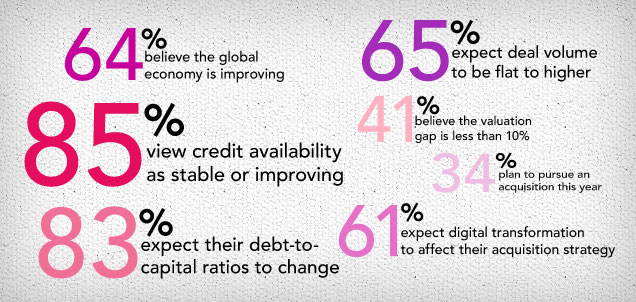
    The report shows 64% of executives believe the state of the global economy is improving, compared with 59% a year ago. Executives are more confident in the likelihood of closing deals (33% compared with 23% a year ago), and coupled with a narrowing valuation gap, this is creating momentum to get deals done.


    The report is a survey of senior executives from large media and entertainment companies around the world that gauges corporate confidence in the economy, identifies boardroom trends and provides insight into companies’ capital agenda.


    Respondents’ confidence in the availability of credit and financing is at its highest level in five years, which provides a solid platform for deal-making and has resulted in media and entertainment companies significantly increasing their borrowing from the previous year. Eighty-five percent of respondents believe credit availability is either stable or improving, and 52% of respondents indicate it is improving, compared with 36% one year ago. Thirty-five percent of executives indicated they have debt-to-capital ratios greater than 50%, which is up from 17% the year before, which shows a dramatic increase in borrowing. Perhaps the greatest indicator of the industry’s confidence in credit and financing availability is that 51% of executives plan to use debt as their primary source of deal financing during the next year, compared with only 21% one year ago.


    “Media and entertainment companies have significantly increased their borrowing the past year, which indicates a combination of greater deal-making activity, paying down debt and returning capital to shareholders,” said Tom Connolly, EY’s Global Media & Entertainment Transaction Advisory Services Leader. “This increased availability of credit and growing confidence in key economic indicators shows that more media and entertainment executives plan to pursue acquisitions now more than at any time the past couple of years. However, they need to move quickly – with fewer assets on the market, valuation gaps will widen.”


    Other key findings include:

    o Only 11% of executives think the economy is declining; 25% believe it is stable and 64% that it is improving.


    o Media and entertainment companies that hired aggressively after the cutbacks of the 2009 financial crisis and now optimizing skillsets and the makeup of their workforce. 21% of executives say they will reduce workforce numbers, up from 13% last year; 21% will hire, down from 44% last year and 58% will keep their workforce its current size, up from 43% a year ago.


    o The two largest trends affecting acquisitions in the media and entertainment industry are digital transformation (61% of respondents) and “future of work” issues (43% of respondents).


    o Ninety-two percent of executives see political, regulatory and emerging market instability as the greatest economic risks to their businesses during the next year.


    o Sixty-five percent of executives expect deal volumes to increase during the next year, with 98% of respondents believing deal volumes will either increase or remain the same.


    o Executives strongly see deal sizes increasing, with 52% of respondents expecting deals during the next year to be greater than US$251 million, up from 21% the previous year.


    o Thirty-four percent of executives expect to pursue acquisitions during the next 12 months, a continuation of a rising trend.


    o The valuation gap between buyers and sellers in narrowing, with 41% of executives believing the current valuation gap is less than 10% compared with 28% one year ago.