By Ashoke Agarrwal
 Does John Wanamaker’s lament, “Half my advertising spend is wasted; the trouble is I don’t know which half.” hold in the digital marketing era?
First, the question to ask is whether Wanamaker knew what waste meant.
Did Wanamaker measure the efficacy of his advertising spending over a given period -weekly, quarterly or yearly- in terms of sales in the immediately subsequent period? Or did he also take the brand lift – changes in his brand’s top-of-mind, unaided and aided awareness and share of the consideration set -into account? Wanamaker probably did not. Sales figures are always at hand, and brand lift needs consumer research. And Wanamaker probably had another zinger ready about the cost and efficacy of consumer research.
However, the fact that brand lift is a second-order metric does not detract from its importance. In FMCG categories, brand lift determines a brand’s position and potential shifts in the Markov Chain that determine stable shifts in market share. In categories with longer purchase cycles, low or negative brand lifts in one period could lead to a loss of market share in the next.
In the early days of the Internet and social media, the promise was that marketing would evolve into an interactive one-on-one relationship between brands and their consumers. But then, with the arrival of the third-party cookie, this early promise crumbled.
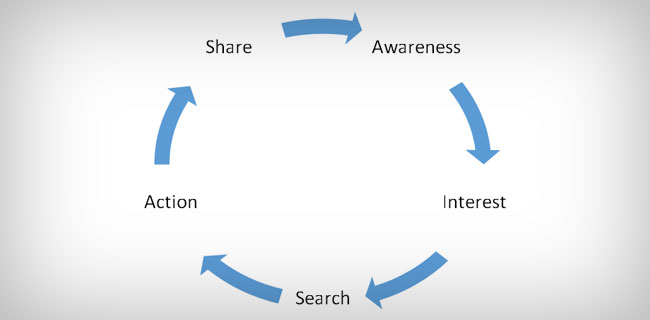
Digital Marketing evolved into a click-baiting exercise driven by algorithms that stalked people until they could lure them to click. The AIDA (Awareness-Interest-Desire-Action) model at the core of marketing fell by the wayside, along with concern for brand lift and consumer research. Digital marketing aided by third-party cookies continued to thrive and take an increasing share of overall spending as the ROI in immediate sales was directly visible in terms of cost per click and conversions per click and profitable. A digital-age Wanamaker would know which part of his digital campaign generated more clicks and clicks from which source led to better sales.
Big consumer marketing companies that built brands in the mass media era embraced digital marketing while retaining the core principles of marketing.
They encouraged their digital agencies to focus their messaging and targeting on creating positive brand awareness and consideration. In effect, these companies gave equal importance to the impact of a digital message and campaign on those who didn’t click.
Some digital metrics measure brand lift. One such is the number of Google search words containing the brand name measuring against the searches with the category name and searches with competitive brands.
The big established brands also had consumer research that regularly measured brand lift.
The digital era has seen the emergence of digital-native or digital-first brands. For these brands, digital was their raison d’etre. It was digital that allowed them to be as small or niche a market; it was digital that allowed them to bootstrap; it was digital that allowed them to experiment and evolve.
Many of these digital brands fell by the wayside. Others were like meteors, burning bright and then fading away. Quite a few lasted long enough to ask questions like where to go from here – when they start pondering growth beyond the next quarter, brand loyalty, brand equity, etc. Now, is when some of them turn to digital metrics that measure such things and even consumer research. Some of them, I can attest, take to the fundamentals of old-fashioned marketing with a vengeance.
Though I am still waiting to see concrete data in this regard, the general sense is that digital marketing ROIs are beginning to fall. If true, the reasons are two-fold – the ongoing abolition of third-party cookies and increasing digital clutter.
As a result, even new digital-first brands are beginning to evaluate their digital campaigns the old-fashioned way – giving importance to immediate sales and brand lift, leading to adtech and consumer research innovation.
Tech start-ups offer SAAS solutions to marketers, and agencies are emerging, which enables them to fine-tune their campaigns to optimise between brand lift and sales. Some of these solutions sit atop the Demand Side Platforms (DSPs) within the programmatic buying ecosystem.
In digital messaging, content marketing has become a core part of the digital communication strategy besides messaging that drives clicks and sales.
Will the emergence of AI in marketing accelerate this brand-building trend in digital marketing? Or will it result in a virulent reversal to the click-bait era aided by the superior pattern-recognition ability of Machine Learning? On the other hand, AI may give rise to an entirely new marketing era, an era in which the AI avatar of a brand markets directly to the AI avatar of a consumer, fulfilling, in a way, the initial promise of the digital area – one-to-one AI-to-AI marketing! I wrote about such a situation in a blog post in February 2022 -“The Post-Digital Age and the Coming of Concierge Intelligence.” We live in interesting times.
 I remember that while growing up all major purchase decisions at home, be it a fridge or a mixer grinder or even a bicycle would heavily depend upon the suggestions and experiences of neighbours, relatives and friends. Not that there was much choice but even if one had to choose between a Hero or an Atlas bicycle the recommendation of someone who had bought and used the brand would matter. I still remember, how my father spoke to at least 6-7 users of Ambassador and Fiat before deciding that a secondhand Fiat will be a good choice for the family of four. That’s the car which introduced me to the world of driving.