Tag: Adspends

  • Adspends to grow by 20% in 2022 to reach 90,000 crores


    By Our Staff


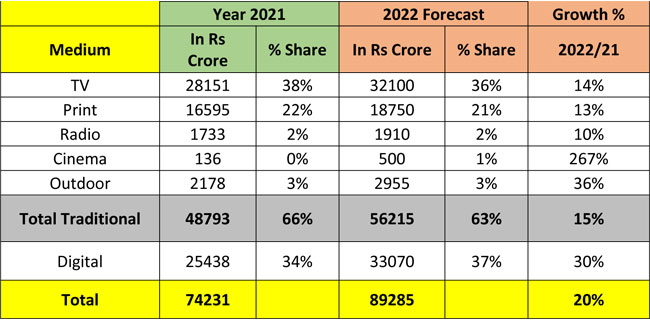
    Madison Media predicts adspends (AdEx) will increase 20% in calendar year 2022. The highlights of the Pitch Madison report were released on Wednesday by Sam Balsara, Chairman, Madison World. According to Madison Media, AdEx is expected to grow by 20% in 2022 and reach Rs. 90,000 crore. This growth is on the back of a dramatic Rs. 20,000 crore increase in 2021 inspite of Covid wave 2. In 2021 Digital grew by 50% and in 2022 is expected to pip television to become the largest contributor to Adex with a share of 37%, compared to TV’s 36%. Print, too has grown dramatically by as much as 39%, retaining its share of 22% in Adex.


    Said Sam Balsara, Chairman, Madison World, “Advertisers seem to be returning to advertising with a vengeance. After Covid year 2020, Global Adex has registered a whopping 21% growth in 2021 and 18% versus pre-covid 2019. Compare this with a compounded annual growth rate of just 5% over 10 years from 2010 to 2019. India infact leads this return, with a growth of 37%, compared to a last 10-year compounded annual growth rate of just 10.4%.”


    Key findings of the Report:

    1. Overall:

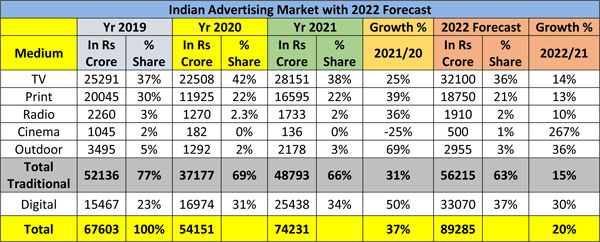
    1 • In 2021 total Adex grew by 37%, Traditional Adex by 31% and Digital Adex by as much as 50%.

    2 • In absolute terms, ADEX has grown from Rs. 54,151 crore to Rs. 74,231 crore and comfortably surpassed the 2019 figure of  Rs. 67,603 crore by 10%.

    3 • Traditional Media contributes 66% of total Adex, whereas the global figure is 35%.  Despite a growth of 31% in 2021, Traditional Media at Rs. 48,793 crore, has not reached its 2019 figure of Rs. 52,136 crore.

    4 • Digital Adex has now reached a share of 34% and is in striking distance of TV, the leader of the pack which ended the year with a share of 38%. TV and Digital Adex now account for 72% of Adex.

    5 • Q3 and Q4 2020 contributed to 60% of Adex. Q4 registered a whopping 49% increase over Q4 2019.

    6 • FMCG continues to be the main category, but its share moved down from 38% in 2020 to 34% in 2021.

    7 • Ecommerce emerged as the 2ndbiggest category of Adex and the largest contributor to its growth, doubling in size from Rs. 3,000 crore to Rs. 6,000 crore.

    8 • 15 new-age Companies / start-ups have entered our list of Top 50 advertisers namely, Dream 11, BYJU’s, Phone Pe, Upstox, My 11 Circle, CRED, Netmed, MPL, Policybazaar, Unacademy, WhiteHat Jr, Swiggy, Netflix, Coin Switch Kuber and Coin DCX.


    2. Television

    1 • TV registered a high growth of 25% to reach Rs. 28,151 crore, following a 11% de-growth in 2020. TV is the only traditional medium that has comfortably surpassed the 2019 number of Rs. 25,291 crore, by as much as 11%. TV’s market share is at 38%, down from a high of 42% last year but one percentage point higher than 2019.

    2 • TV Adexwitnessed a 25% spike in Ad volume or FCT in 2021 over 2020 and a 11% increase against 2019. Significantly ad volume in 2021 is higher than 2020 in all four quarters.

    3 • FMCG continues to be the largest contributor to TV Adex with a share of  46%, but lost as much as five percentage points from a high of 51% in 2020. Ecommerce, the 2ndlargest contributor to TV Adex, increased its  share from 11% to 18%, followed by Edtech which increased its share  from 4% to 6%.

    4 • News as a genre has registered a high growth of 19% over 2019 and  29% over 2020. Marathi and Tamil Regionals have also grown dramatically by 36% and 24% respectively over 2019. Second line GECs de-grew by a massive 18% and mainline GECs de-grew by a negligible 3%. Hindi GEC continues to be the largest segment, followed by Sports and then News.

    5 • TV Adex is expected to grow by 14% in 2022 to reach Rs. 32,100 crore, 27% higher than 2019.


    3. Digital

    1 • Digital grows by 50% in 2021 to reach Rs. 25,438 crore and has emerged as a strong No 2  for the 2ndconsecutive year, at 34% share, a little short of TV at 38%. Digital has achieved a CAGR of 27% over last 10 years.

    2 • Q4 was the largest quarter, where Digital Adex touched almost Rs. 10,000 crore and contributed 39% to the full year.

    3 • Video is the highest contributor to Digital with a share of 29%, followed by Social & Display at 20% each.  E-commerce and Search now contribute 16% each to overall digital pie.  In terms of growth rate,  E-commerce has grown significantly by as much as  50%.  Display, Video and Search have also grown substantially at 30%+.

    4 • Programmatic has firmly taken route in India and its share continues to be 42%.

    5 • Ecommerce advertising revenue is rising rapidly and we estimate ecommerce advertising spends in 2021 to be at Rs. 4,100 crore, mainly on the back of Amazon and Flipkart, but newer entrants like Nykaa, Big Basket and JioMart are also finding favour with a relevant set of advertisers.

    6 • Digital is set to grow by 30% in 2022 to reach Rs. 33,070 crore and set to emerge as the single largest contributor to Adex, overtaking TV by almost a 1000 crores.


    4. Print

    1 • Following a 41% decline in 2020, Print Adex grew by a whopping 39% to reach Rs. 16,595 crore. Despite the high growth rate, Print is still only at its 2015 levels and has registered a 16% drop vs 2019.

    2 • With a share of 22% in Adex, India is the Print Capital of the world, along with Germany. Global share of Print is a mere 5%.

    3 • Print volume in terms of CC has also gone up by 31%.

    4 • 3 categories FMCG, Education and Auto make up 45% of total Print Adex. Both FMCG and Auto have come down in share by 2 percentage points each.

    5 • English and Hindi publications put together, contribute to 63% of total  Adex volume. English publications grew 40% over 2020. Hindi publications which are the largest volume contributor, also grew by 30%, Telugu by 37%, Assamese & Marathi by 33% and Bengali by 27%. All languages grew, the least to have grown are Kannada, Gujarati and Punjabi by 18-19%.

    6 • Print Adex is expected to grow by 13% in 2022 to reach Rs. 18,750 crore, but it will still be at the level it reached in 2017.


    5. Other Media

    1 • OOH Adex has registered a high growth of 69%, taking the industry to Rs. 2,178 crore, but still way below 2019 level. Conventional OOH grew by 63% and Transit Outdoor by almost 100%. Digital OOH is also beginning to take root and grew from Rs. 50 crore to Rs 300 crore and has a share of 13.77%, far below the global average of 40%. We expect OOH Adex to grow by 36%, to reach Rs. 3,000 crore, the level it had reached in 2017.

    2 • Radio Adex has grown by 36% to reach Rs. 1,733 crore, with a share of just 2 %. With this Radio is at the level it had reached in 2016. We expect Radio Adex to grow by 10% and reach Rs. 1,900 crore.

    3 • Cinema has been by far the worst affected medium. Because of 2 years of Covid, it has degrown by a further 25% over 2020 to reach 136 crores. We expect Cinema to grow by 267% to reach Rs. 500 crore, almost half of the  pre Covid level of Rs. 1050 crore.


    Figures at a glance:
  • Happy days may be here again, for adspends


    Indrani Sen
    By Indrani Sen
     

    Two months back on June 22, 2021 I reviewed here the TYNY Midyear report for 2021 and commented: “It seems though the pandemic may not disappear from our lives in 2021, the dark shadow of the pandemic will be lifted from our advertising Industry.” Today, when two months of the second half of 2021 are almost over, it looks like Indian advertising industry is well set on the path of recovery in 2021 H2 with prediction of increased advertising spends during the festive seasons and during the forthcoming back-to-back sporting events.


    Onam ushers in the festive period in India. In Kerala, Onam sales account for more than 50 per cent of the annual sales of the businesses. Advertising during Onam festival accounts for 30-60 per cent of the total turnover of the various media houses in Kerala. This year, Onam (August 12 to August 23, 2021) has been celebrated in Kerala with cautious optimism, the run up to the festival was below the expectations as the number of Covid cases in Kerala again went up. However, going by the latest reports coming out from Kerala, it seems that both sales and advertising spends picked up with the approach of the festival and have performed better than last year.


    The next big festivals are Ganesh Charurthi in Maharashtra (September) and Durga Puja in West Bengal (October) and in both the states, the marketing and advertising industries are feeling upbeat as Indians are learning to live with Covid-19 and its variants. In spite of the predictions that the third wave of the pandemic will hit India during September and October 2021, marketers are expecting good return on advertising investments during the national festival Diwali scheduled on November 4, 2021. The GEC channels are also gearing up for the festive season with properties like Kaun Banega Crorepati (KBC) and Bigg Boss in different regional languages. Print, which saw a bonanza of full page ads with the Independence Day offers, is expecting a repeat of similar advertising with festive offers.


    The Dentsu Global Ad Spends Forecast June 2021 estimated India will be one of the top five markets in terms of advertising growth rate in 2021 which also supports the growth of advertising spends in 2021 H2.


    As per the above report in India, the ad market is “forecast to grow by a further 12.4% in 2022, recovering to pre-pandemic levels, particularly led by Digital and TV versus a longer recovery for Print, Cinema, OOH and Radio.”


    The back-to-back sporting events in 2021 H2 has raised the level of expectations for advertising spends, particularly among the sports broadcasters. It is estimated that Star Sports may earn INR 2500 crore plus between second half of IPL and T20 WC. The Olympics saw a fair number of advertisers and the advertising inventory for the India-Sri Lanka cricket series in last month was fully sold out. Industry experts estimate that the total advertising spends on various sporting properties like Olympics, India-Sri Lanka series, India-England series and UEFA Euro 2020 will contribute another INR 2000 crores taking the total advertising spends on sporting properties to INR 4500 crores on TV alone. It is expected that there will be a good advertising investment in digital media also for a total coverage of the sports fans.


    To sum up, unless another disaster like the second wave of the pandemic hits us during the next two months, the advertising industry is well set on the path of recovery in 2021 H2. The chances of an intensive attack of the pandemic during the third wave is estimated to be less as around 50% to 60% of our total population has already got COVID 19 during the first and the second waves and have developed some immunity. However, a lot depends on the success rate of the vaccination drives currently being untaken by the central as well as the state governments and we are running sadly behind many other countries with only 13% of the eligible population fully vaccinated till now (https://www.bbc.com/news/world-asia-india-56345591).


  • Achche Din… GroupM forecasts 23.2% in CY2021

    GroupM share of adspend


    By Our Staff


    GroupM India has announced its advertising expenditure (AdEx) forecasts for 2021. As per the GroupM futures report ‘This Year, Next Year’ (TYNY) 2021, India will see a major ad recovery in 2021 given the downfall of ad spends in 2020 due to the pandemic.


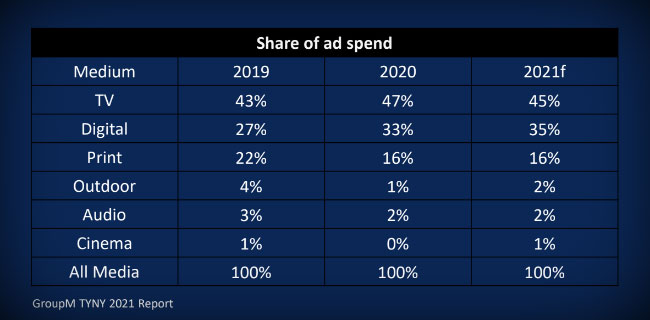
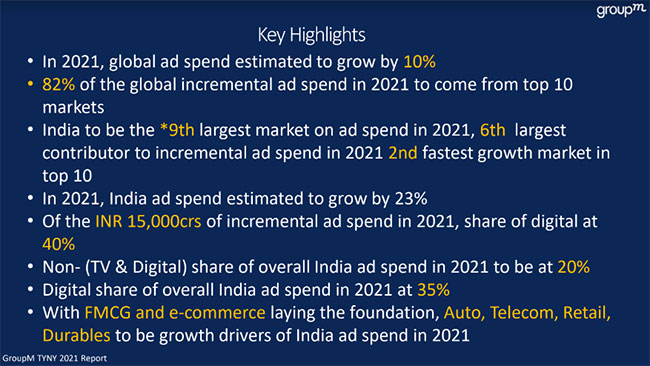
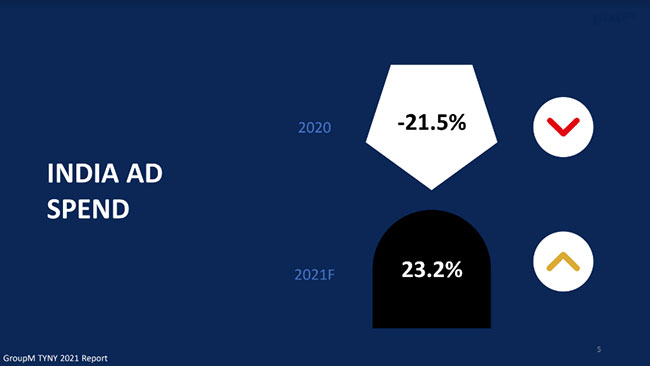
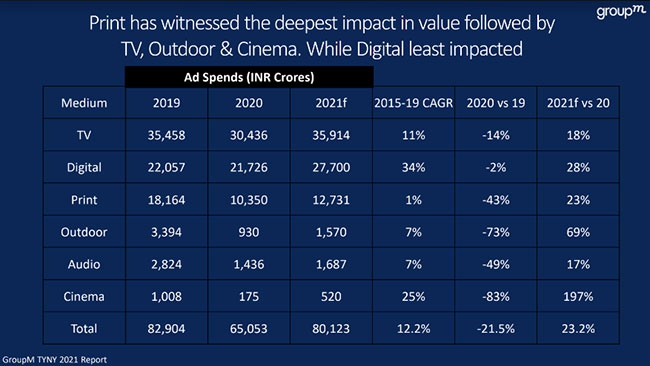
    TYNY forecasts India’s advertising investment to reach an estimated Rs. 80,123 crores this year. This represents an estimated growth of 23.2%, for the calendar year 2021. India is the 2nd fastest growing market in the top 10 countries and will be the 6th largest contributor to incremental ad spends in 2021 globally. While India was ranked 9th in the global ad spend rank in 2019, it dropped to 10 in 2020 and is likely to regain its 9th rank this year.


    Prasanth Kumar, CEO - GroupM South Asia
    Prasanth Kumar

    Commenting on the TYNY 2021 report, Prasanth Kumar, CEO – GroupM South Asia said, “2020 was an unprecedented year. The pandemic impacted across sectors and it, therefore, affected the media investments too. As we are aware, the year that went by had a mixture of lockdowns, many restricted market momentum and overall threw a challenge and impacted multi-industry economies. The ad industry too had its challenges and 2020 witnessed a steep drop in the overall media investments. However, we have witnessed a month-on-month upturn in the industry starting Q3 last year and we are quite optimistic about the revival that 2021 will see. With the gradual easement of the lockdown backed by seasonal spends and big-ticket events like IPL, we expect 2021 to continue to build on that momentum. While the global ad spends are estimated to see a rise of 10% in 2021, digital is expected to take 67% of ad spends. With the help of technology, marketers have adapted to pandemic-proof ways by constantly innovating, staying relevant and offering digitally charged solutions to brands.”


    Digital was the only medium to witness a gain of USD 27bn globally in 2020. Digital as a media vehicle will continue to skyrocket due to the increase in digital dependency and changing consumer patterns.


    Tushar Vyas, GroupM
    Tushar Vyas

    Added Tushar Vyas, President – Growth and Transformation, GroupM South Asia: “2021 will see 90% incremental ad spends on digital globally. The massive switch to digital reliance over the past 1 year has been a major driver for this shift. Brands have been forced to think big and different to transform their businesses, match the newer expectations and overcome the challenges faced. The post-pandemic era will continue to see this upsurge in digital demands. The crisis has brought about a sea change in mindset, adoption, and role of technology in doing business. Brands are seen renewing their business models and are constantly ideating to find better ways to connect with the consumer on a digital tangent.”


    Ashwin Padmanabhan
    Ashwin Padmanabhan

    While Covid-19 resulted in an overall slowdown in the global economy, Indian adspends will continue to see a month-on-month recovery considering the overall media landscape. Said Ashwin Padmanabhan, President – Partnerships and Trading of GroupM India: “Based on a strong foundation built on the back of FMCG and e-commerce, 2021 is expected to see growth across sectors like auto, telecom, consumer durable, retail and education. Manufacturing, which was severely impacted by the pandemic, is now stabilising and moving toward a positive outlook enabled by automation, technology and supply chain optimisation. 2020 has accelerated the adoption of agile, cost-effective business models, which will help brands and marketers offer better products, services and experiences to consumers.”


    Sidharth Parashar, President - Investments and Pricing, GroupM India
    Sidharth Parashar

    Added Sidharth Parashar, President-Investments and Pricing of GroupM India: “Along with digital, television saw a spike in consumption during the lockdown. With acceptance on the subscription bandwagon increasing, OTT will continue to witness a constructive growth and is likely to develop with more players attracting users by investing in content. Print & Radio expected to be backed by local advertisers and certain categories with marketeers leveraging the brand solutions that these media offer. We expect OOH and cinema to see double-digit growth after a difficult year. Given the uncertainty and cautiously spending consumer, brands are realising the importance of being present wherever consumers are. Hence along with continued relevance of television & other mass media, we will witness advertisers leveraging relevant platforms to reach out to its audience.”


    GroupM TYNY Key Highlights

  • AdEx to grow 12.6% in 2020: GroupM


    By A Correspondent


    Adspends in India will grow 12.6% in the year 2020, a slight increase from the 12.4% in the year 2019. This was part of the global ‘This Year Next Year’ report released by GroupM at a global level. It may be noted that GroupM presents its India-specific numbers every year in early February, which can hence be expected two months from now.


    According to the numbers released, for India, the growth in television will be 11.1%, whereas for radio it will be 8%. The growth forecast numbers for newspapers and magazines are 1% and -10% respectively. While the growth for outdoor and cinema is pegged at 8.1%, that for internet will be 26.3%.


    Prasanth Kumar

    Said Prasanth Kumar, CEO, GroupM South Asia: In 2020, India faces challenges and uncertainties across sectors, just like other markets. However, this also brings opportunities for brands to innovate. This will be propelled by greater use of technology and better content across media.”


    Meanwhile, here’s the rest of the report:


    The global economy has weakened in 2019 and will remain similarly soft in 2020. By our calculations, based on Refinitiv data, the gross domestic product (GDP) of the countries we track in “This Year, Next Year” is growing by only +2.6% this year in real (inflation-adjusted) terms.


    Growth in 2020 is expected to be similar (+2.5%), with only slightly faster growth (+2.8%) in 2021 and beyond. For reference, +2.5% would be the slowest pace of growth in any non-recession / non-recovery year over the past two decades. In nominal terms (including inflation), 2019 growth for these countries is expected to be +4.9%, down from growth of +5.8% in 2018 and +5.7% in 2017. 2020 looks somewhat similar to 2019, and marginal improvements follow in subsequent years.


    Nominal growth rates are important to track because they are the most directly comparable figures to those with which marketers and media owners work in determining their own financial plans.


    Personal consumption expenditures are holding up better. One factor that has probably helped sustain marketing growth so far this year is growth in personal consumption expenditures (PCE). As consumer spending represents more than half of all economic activity, PCE can be more important to monitor than GDP. Global growth in nominal PCE is holding up as well in 2019 as it did in 2018 at +5.5% in both years. Growth is expected to slow, but only modestly in the years ahead. Of course, changes in inflation levels diminish these figures, with expectations for real (inflation-adjusted) PCE growth at incrementally slower levels each year over the next five years.


    Industrial production often correlates more tightly with advertising growth trends. Industrial production (IP) figures are another key set of metrics to monitor, as IP often correlates better with advertising activity than either GDP or PCE (manufacturers generally only make things for sale if they are planning to spend money on advertising them). Weighted against GDP in the markets captured here, we see pronounced weakness in 2019 and 2020 (+1.2% and +1.5%, respectively) relative to 2017 and 2018 levels (+3.5% and +3.1%, respectively). Recovery toward slightly higher levels is anticipated for 2021 and beyond.

    Trade and other factors are key sources of uncertainty. As the Organisation for Economic Co-operation and Development (OECD) has pointed out, slowing global trade is clearly dragging on economic activity, and seemingly heightened geopolitical uncertainties are similarly unhelpful. All of this would worsen if the U.S. experienced a recession, although the U.S. economy has remained resilient, likely aided in part by low interest rates and corporate tax reductions, alongside a federal deficit of nearly $1 trillion during the most recent fiscal year. This was equivalent to more than a quarter of all government expenditures and nearly 5% of the overall economy, or more than double its recent trough in 2015.


    Mean and median growth rates may tell different stories. We note the difference between mean and median growth rates, with larger economies expected to perform relatively better than smaller ones in the years ahead.


    Global Advertising Growth Summary


    In this environment, deceleration in advertising growth should be generally unsurprising. Global advertising, excluding U.S. political advertising (large enough to distort global growth rates by +/-1% each year), expanded by +5.7% in constant currency terms during 2018, capping the third year of better than +5% growth and the best year of the current economic cycle. However, 2019 appears set to grow nearly a percentage point slower at +4.8%, and growth is expected to slow by another percentage point in 2020 and 2021. We forecast +3.9% growth next year and +3.1% growth the following year. Growth is expected to range between +3–4% through 2024. Although much worse than recent years, we note that this would amount to a similar pace of growth to what was observed during 2012–2014. We estimate that the total global advertising market during 2020 will amount to $628 billion as we define advertising here, but would likely approach $700 billion on a broader definition that includes spending on direct mail and directories around the world.


    Notably, a substantial share of global advertising is now accounted for by digital-first brands that are endemic to the internet. Based upon their securities filings, we can see that Alibaba, Alphabet, Amazon, Booking.com, eBay, Facebook, IAC, JD.com, Netflix and Uber are each now $1 billion+ advertisers, accounting for $36 billion in spending during 2018, up by a quarter over 2017 levels; growth in 2019 was presumably very similar. Adding a couple dozen companies from the next tier of comparable marketers would easily add tens of billions of dollars of additional activity. Combined, this small group of companies accounts for a majority of the world’s growth in spending on advertising. To the extent that these companies tend to take shares of consumer spending from others and do not directly cause the global economy to expand, at some point their growth converges with global averages, resulting in slowing growth in spending as well.


    The median growth rate has exhibited sharper deceleration in 2019 than the mean. For the countries we have tracked with consistent data back to 1999, the median growth rate in 2018 was +5.2%. It is expected that 2019 will be +2.1%, followed by +2.7% growth in 2020, with generally slower growth than the weighted average. The difference between the mean and median highlights that growth is driven by a small number of large countries and that the typical small country is experiencing worse growth trends, bringing down the worldwide average. By contrast, median country growth was typically well above the mean as recently as 2013, reflecting a period where much of global advertising growth was driven by smaller countries. This maps to the aforementioned global economic trends.


    The U.S. remains the largest global advertising market, with $246 billion in advertising as we define it here, and growing above global averages. With nearly 40% of the world’s total and a still-robust advertising market in 2020 and beyond (at +4–5% growth excluding directories, direct mail and political advertising), the U.S. is helping raise global averages. Our forecasts anticipate a slowing economy as well as the gradual maturation of the digital brands that have driven so much recent growth. On the basis described here, normalized U.S. advertising should slow from +7.6% in 2019 to +5.0% in 2020, +3.4% in 2021, and similar levels in subsequent years.


    China’s $90 billion media market is maturing and beginning to slow, but is still more than two times the size of the number-three market, Japan. After many years of rapid growth, China is now solidly the world’s clear number-two market for advertising, with 16% of total media-owner ad revenue, nearly matching the country’s 17% share of global GDP. However, macroeconomic concerns—including issues referenced above and a general maturation of the Chinese advertising market—are weighing on growth


    this year and beyond. We forecast growth of only +3.7% in 2019 and +1.4% in 2020. Similarly, low levels of growth are anticipated in subsequent years despite faster levels of economic expansion for the overall Chinese economy. Japan remains a solid number three, with 7% of global advertising ($41 billion in 2020) and 6% of GDP, but growth is expected to be tepid there as well; +1.7% growth in 2019 is expected to be followed by +1.8% in 2020, and closer to +1% in subsequent years.


    The U.K. is still growing at a remarkably fast pace. Among larger advertising economies, the U.K. and the U.S. stand out for their healthy growth expectations. For the U.K., it is a feat made more remarkable given how much uncertainty has persisted over the past three years since the Brexit referendum. Five years ago, the U.K. was essentially tied with Germany as the number-four market for global advertising, but since that time the U.K. has grown by +44% while Germany has only expanded by 7%. The factors driving the U.K. are likely similar to those that have helped make the U.S. a strong market, including a substantial presence of digital brand spending as well as the expanding availability of ad inventory (in digital environments, primarily), which help make it possible for smaller marketers to use media. Although we do expect growth to taper off from the high-single-digit levels we have observed since 2014, solid mid-singles (+6.7% in 2020 and +5.5% in subsequent years) are now expected.


    Germany and France are growing at below-global average rates; so is much of the rest of Europe. Brazil should be above average, while India is the world leader among larger media markets. Germany and France have certainly underperformed U.K. and U.S. levels of advertising growth in recent years, but remain in the number-five and number-six positions for now. France appears set to grow at a slightly faster pace than Germany, with a +2.8% five-year compound annual growth rate (CAGR) through 2024 for France versus a +1.6% CAGR for Germany. By 2024, Germany should still be the fifth-largest advertising market, but France will likely be overtaken in importance by both India and Brazil, currently number six and number seven, respectively. Brazil should grow at a solid +4–5% level through 2024 after a soft 2019 (we believe the ad market there grew by only +3.3% in 2019), but India should continue to be stellar, maintaining double-digit growth rates (we estimate +12–13% each year from 2020 to 2024, similar to 2019 levels). Of course, inflation is an issue for both of these countries, negating much of Brazil’s growth. However, in India the effect will only mean that real growth is in high-single digits rather than low doubles.


    Canada and Australia are similarly sized markets, but they are growing in different directions. Canada and Australia round out the world’s $10 billion+ ad markets in 2019, with Canada expected to grow slightly faster over the next five years and growth likely largely tied to the health of its southern neighbor. Australia’s trends will likely differ, as we see at the present time with that country’s economy soft and facing a real risk of recession for the first time in decades. The Australian ad market was likely only stable in 2019 versus 2018 and probably grows only slightly in 2020, for a +2.0% gain expected next year. By contrast, Canada is expected to grow +5.0% in 2019, and should slow toward a high 3%+ growth level next year and in subsequent years. Overall around the world, 14 territories are expected to decline during 2019, with Italy the largest among them: We anticipate Italy will fall by -0.4%. Other large markets among this group include Mexico and Switzerland, which are expected to decline by -4.6% and -8.0%, respectively. Next year, fewer markets are expected to decline, with Switzerland the most significant among them


  • AdEx to grow 16.4% in 2019: Madison


    By A Correspondent


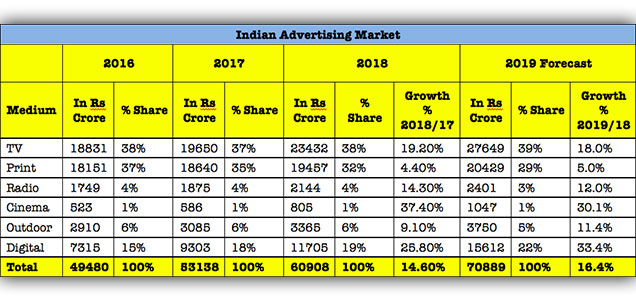
    Media agency network Madison is bullish about 2019 and expects a growth of 16.4% taking the total AdEx to Rs 70,888 crores. “The reasons for our high forecast are upcoming Parliamentary elections, increase in government spending to showcase its achievements, the upcoming ICC Cricket World Cup 2019, growth of OTT, increased spending in rural and India moving to a consumption society,” notes a communique, adding: “In 2019, we believe highest growth will come from Digital at 33%, followed by Cinema at 30% (although on a very small base), followed by TV (18%), Radio (12%), Outdoor (11%) and Print (5%).”

    Adspends have grown from Rs 53,138 crore to Rs 60,908 crore, an addition of  7,769 crores, the highest addition in one year in the last decade. The growth rate of 14.6% achieved in 2018 is almost double the growth rate achieved in 2017, notes the Pitch Madison Advertising Report 2019 release on Wednesday.

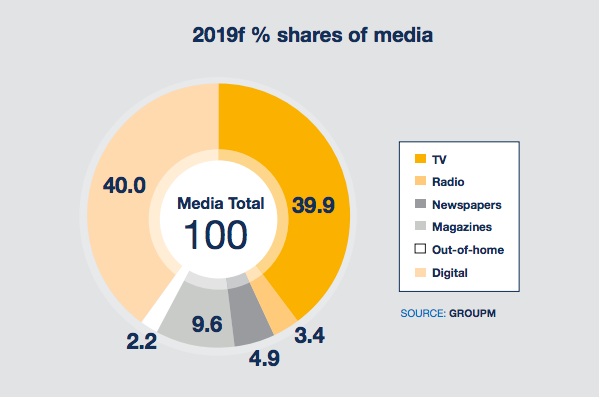
    Television still continues to be the largest contributor to Adex with 38% share, followed by Print at 32%, Digital at 19%. Outdoor, Radio and Cinema share has remained steady at 6%, 4% and 1% over the last 3 years.


    Figures at a glance:

    Indian Advertising Market
    2016 2017 2018 2019 Forecast
    Medium In Rs Crore % Share In Rs Crore % Share In Rs Crore % Share Growth % 2018/17 In Rs Crore % Share Growth % 2019/18
    TV 18831 38% 19650 37% 23432 38% 19.20% 27649 39% 18.0%
    Print 18151 37% 18640 35% 19457 32% 4.40% 20429 29% 5.0%
    Radio 1749 4% 1875 4% 2144 4% 14.30% 2401 3% 12.0%
    Cinema 523 1% 586 1% 805 1% 37.40% 1047 1% 30.1%
    Outdoor 2910 6% 3085 6% 3365 6% 9.10% 3750 5% 11.4%
    Digital 7315 15% 9303 18% 11705 19% 25.80% 15612 22% 33.4%
    Total 49480 100% 53138 100% 60908 100% 14.60% 70889 100% 16.4%


    Other findings of the report, as per the communique:


    1. TV:
      • TV grew by an unbelievable 19% to reach close to the   Rs. 23,500 crore mark, reinforcing regular Advertisers’ unshakable faith in this medium, no doubt aided by the robust measurement mechanism set up by our Industry.
      • This is the highest growth TV has witnessed in last 3 years. In terms of absolute numbers, TV advertising has grown by Rs. 3,782 crore in 2018.
      • And its share in the Adex pie stands at 38%. Whilst its share has declined over the decade from 43% in 2009, it is significant that since 2015 it has increased its lead over Print and now the gap in share is as much as 6 percentage points.
      • The main categories that have fueled the overall growth of Rs. 3,782 crores in 2018 are the evergreen FMCG (Rs. 1,660 crores) and Auto (Rs. 360 crores). E-commerce category too grew dramatically by 29% to reach Rs. 1,100 crores from Rs. 850 crores in 2017.
      • FMCG continues to rule the roost contributing as much as 50% to the total Television Adex, followed by Telecom at 12% and Auto at 8%.
      • Increase in FCT has also been a big contributing factor to the overall increase of 19% in the TV Advertising Market. The overall FCT demand in 2018 has increased by 12% led by growth in frequency channels and new channel launches.


    1. Print
    • India probably is the only major market where Print Adex is actually growing year on year.
    • Print grew by 4.4% during the year, marginally lower than our projection of 5%.
    • However, Print continues to be 2ndhighest contributor after Television with a share of 32%. And this share of Adex is also the highest in the world.
    • The resilience of Print is brought out in the fact that it has 200,000 Advertisers and the number is growing, compared to TV which has only 12,000 Advertisers.
    • Nearly 75%, of Print’s growth of Rs 820 crores is accounted by just 5 categories – FMCG, Education, Auto, Retail & E-commerce.
    • In terms of Volume, Hindi publications continue to be ahead of English publications contributing 35% of the total volume, while share of English publications dropped by 2% and now contributes 25%.


    1. Digital
    • The digital advertising market had an impressive growth of 26% in 2018. It has been growing at a compounded annual growth of 30%+ for last 10 years and 24% for last 5 years.
    • The continued growth of digital is fueled by mobile, online video and social media, which are increasingly attracting more advertising investment.
    • One of the key reasons for this growth has been the proliferation of OTT platforms. The OTT playing field has seen a 3.5x increase in number of players from just 9 players in 2016 to 30 players now.
    • Digital Adex at Rs. 11,705 crores is now 19% of Adex in 2018. It was only 9% in 2013.
    • Google and Facebook continue to dominate digital spends cornering 80% of the total digital pie.


    Says Mr. Sam Balsara, Chairman, Madison World, “After two dull years, 2018 has seen significant growth in Television and Digital and we expect the momentum to continue in 2019. With this growth, India has regained its pole position of being the fastest growing advertising market in the world and is expected to retain this position even in 2019.


    There is no doubt that for Advertisers, Media has become a complex subject and they need competent and experienced, creative media planners, working in enabling environments, provided by good media agencies to build their Brands.”


    If you would like a full copy of the Report, please email rj@madisonindia.com 


  • So where do adspends on print stand vis-à-vis TV & digital for 2019?


    By A Correspondent


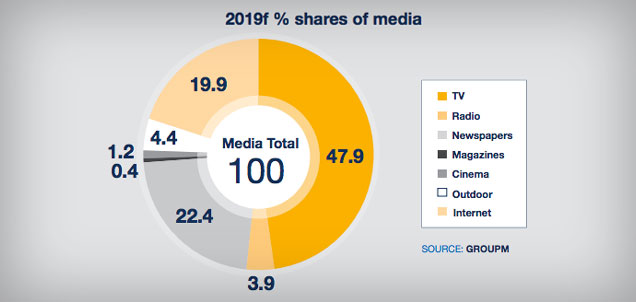
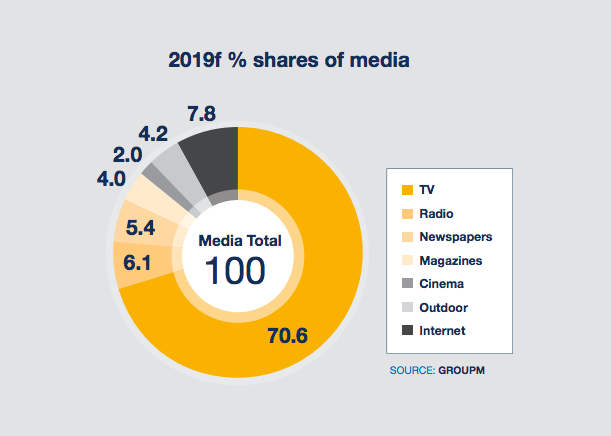
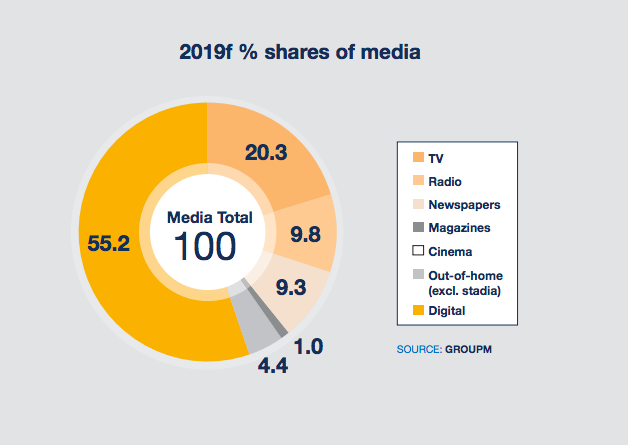
    So where do adspends on print stand vis-à-vis TV & digital for 2019? Earlier this month, GroupM’s TYNY (This Year Next Year) report threw up some interesting data forecasting adspends for 2019 and more.


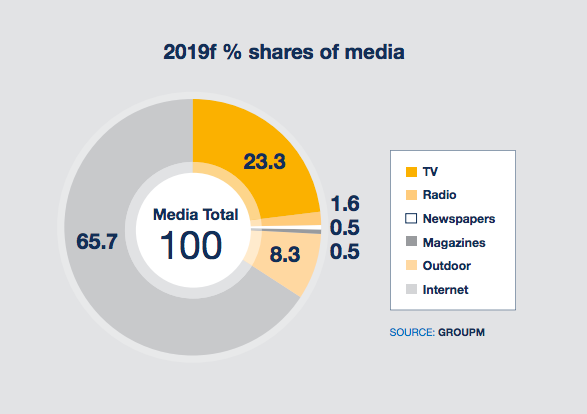
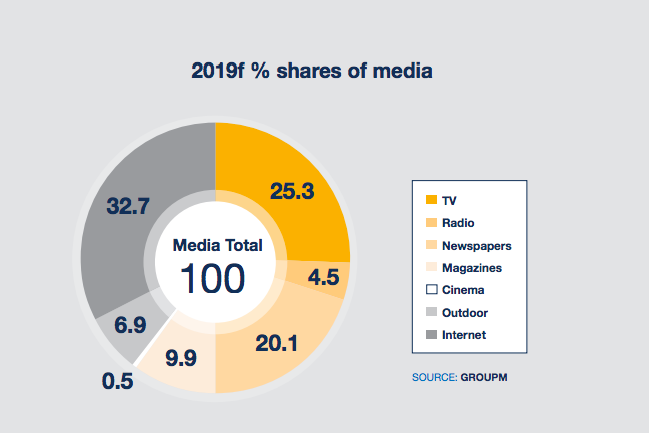
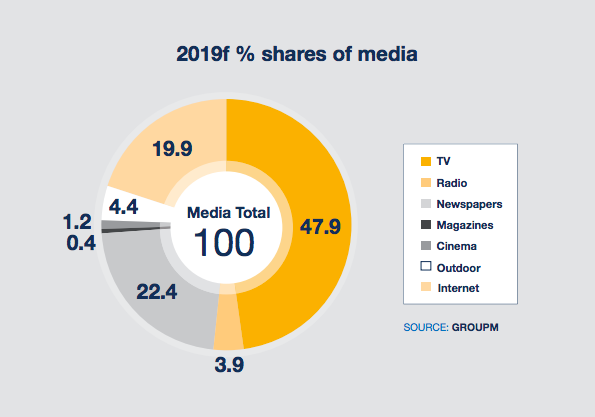
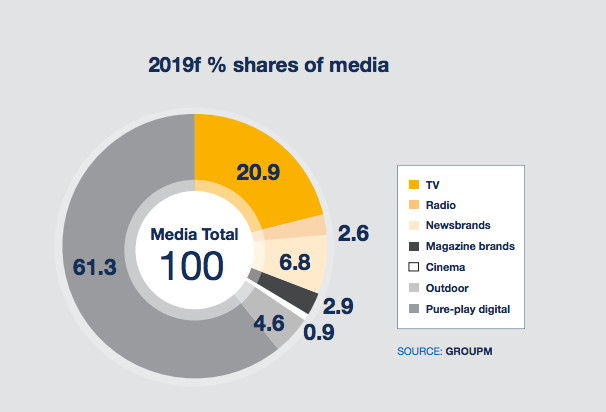
    We have pulled these pie charts from the TYNY report released by GroupM. Read on… the charts tell the story.


    US


    Brazil


    Canada


    China


    Germany


    India


    UK
  • Achche Din…! Zenith forecasts 15% AdEx growth in 2019


    By A Correspondent [to be updated by 9.30am]

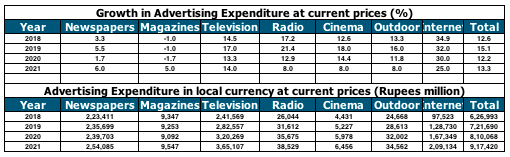
    Media agency network Zenith forecasts that adspends for India in year 2018 will close at Rs 62,699 crore. And the total AdEx for India will see an increase of 15% and climb up to Rs 72,169 crore in 2019.

    India remains one of the fastest growing economies, with strong GDP growth of over 7%, led by reforms in sectors such as retail, infrastructure, manufacturing and services, notes a Zenith communique, adding: “Given that a significant part of the population is below 30 years of age, there is likely to be continued consumption-led growth with less reliance on export-led momentum.  This should give a boost to businesses across the board, ad investments and government initiatives.”


    Furthermore, the release adds: “However, 2018 has also seen the depreciation of the rupee and oil price volatility. The overall expectation is that oil prices will stabilise, giving Indian consumers more disposable income. Indian consumer confidence continues to remain relatively high. “

    According to Tanmay Mohanty, Group CEO at Zenith, many parts of India were experiencing digital transformation, led by mobile. This will accelerate categories such as banking, financial services, healthcare, entertainment and sports, travel and lifestyle. “2019 is the year of the Indian General Elections. These and the State Elections will boost marketing spends.  Additionally, the Cricket World Cup and the Indian Premier League will drive growth.” Mohanty said.

    “Digital will continue to accelerate both in reach and consumption.  Television – linear and catch-up will be on an upward curve. The expectation for radio is that it will digitise aggressively in response to streaming services while both cinema and out of home (OOH) will innovate and increase reach-led investments. Print will thrive on regionalisation.” Mohanty added.

    According to a similar report released last year (Dec 4, 2017), total AdEx for India was estimated to climb up to Rs 58,422 crore, growing  at 8.4% in 2018, led by television. This estimated has been bettered by the figure of Rs 62,699 crore as quoted earlier for adspends in 2018.

    Meanwhile, online video and paid search are driving the growth in global adspend, as advertisers focus on personalised and targeted communications, according to Zenith’s Advertising Expenditure Forecasts, published today (December 3).

    This is what the rest of the summary, as provided to the media, notes:

    With advertisers now able to use these channels to target with pinpoint accuracy and serve personalised messages, they are increasing both the efficiency and effectiveness of campaigns. Between 2018 and 2021, online video advertising will grow at an average of 18% a year, twice as fast as other forms of internet display advertising and well ahead of any other channel.

    Paid search is not growing as quickly in percentage terms – it will grow at an average of 7% a year over this period – but in dollar terms will contribute even more to global growth than online video. The application of AI techniques, better location targeting, integration with commerce and the rise of ‘in the moment’ search are all making search more effective for advertisers. We forecast that between 2018 and 2021, online video advertising will grow by US$20bn, while paid search will grow by US$22bn. Between them these two channels will account for 60% of the extra ad dollars added to the market over this time.

    Online video and television are more important to brand-building than ever

    Advertisers commonly use online video together with traditional television, combining television’s broad reach and immersive experience with online video’s ability to target and optimise frequency. Taken together, these two media are becoming more important to advertisers’ brand-building campaigns. Their combined share of adspend in ‘display’ media (i.e. all media except paid search and classified advertising) has risen from 46.2% in 2012 to 48.4% this year. By 2021 we expect television and video to have a combined 48.8% share of global ‘display’ – a higher share than television ever achieved on its own. Taken together, television and online video are working harder for advertisers than ever before.

    Global e-commerce advertising starts to accelerate

    E-commerce advertising – advertising that sits alongside and within search results and product listings on e-commerce sites – is well established in China, but is only just starting to get going globally. Zenith believes it has the potential to transform the way brands convert customers online, and add about US$100bn of new money into the global advertising market.

    E-commerce advertising has risen from 0.8% of all adspend in China in 2009 to an estimated 18.2% this year, driven by investment by companies like Alibaba in turning e-commerce into advertising revenue. Until recently, e-commerce platforms outside China have largely focused on direct sales to consumers at the expense of advertising, but that is now changing. Amazon generated nearly US$5bn in advertising revenue in 2017 as a whole, and in Q3 2018 its ad revenues grew by 122% year on year. Other shopping platforms are following suit by investing in their own advertising activities.

    Globally, e-commerce advertising is about as advanced as it was in China at the end of the last decade. Amazon accounted for 0.8% of global adspend in 2017, the same proportion that Chinese e-commerce occupied in 2009. If e-commerce follows a similar path globally to the one it followed in China, it could account for 18% of global adspend by 2027. That’s equivalent to over US$100bn in today’s ad market, representing a huge revenue opportunity for the platforms, and a whole new way for brands to reach customers at the point of purchase. This money typically comes from brands’ commercial teams rather than their marketing teams, from budgets set aside for negotiating with retailers. It is therefore new money to advertising, and should expand the market without cannibalising money spent elsewhere.

    Steady growth in global adspend to continue

    We estimate that global advertising expenditure will grow 4.5% by the end of this year, boosted by the Winter Olympics, FIFA World Cup and US mid-term elections. Growth will then remain steady and positive for the rest of our forecast period to 2021, at 4.0% in 2019, 4.2% in 2020 and 4.1% in 2021.

    Central & Eastern Europe will be the fastest-growing region, with average growth of 6.3% a year between 2018 and 2021, driven by continued strength in Russia, which is growing at 6.8% a year and accounts for 39% of the regional total. Asia Pacific is next, growing at an average of 4.9% a year, or 5.7% a year excluding Japan. India is the stand-out growth market here, growing at 13.5% a year from US$9.7bn in 2018 to US$14.2bn in 2021, when it will become the world’s eighth largest advertising market, entering the top ten for the first time. India has huge potential for further growth, with advertising taking up just 0.3% of GDP, less than half the Asia Pacific average of 0.7%

    Young advertising markets like India are playing an ever-more-important role in driving global growth in adspend. ‘Mature’ markets – by which we mean North America, Western Europe and Japan – account for 62% of global adspend this year, down from 75% ten years ago. ‘Rising’ markets – by which we mean all markets apart from the ‘Mature’ ones – will contribute 54% of the growth in global adspend between 2018 and 2021, increasing their share of global expenditure from 38% to 40%.

    “E-commerce advertising is poised to transform the advertising market in much the same way that paid search did in the last decade,” said Jonathan Barnard, Zenith’s Head of Forecasting and Director of Global Intelligence. “It could bring US$100bn in new money into the market over the next ten years.”

    “Brands are transforming their businesses to take advantages of the new digital opportunities available to them,” said Vittorio Bonori, Zenith’s Global Brand President. “Better segmentation and targeting, personalised creative and direct transactional relationship with consumers are combining to drive brand growth.”


  • Net adspend in APAC to expand 6.2% in 2018


    By A Correspondent


    By now, we have published several forecasts for adspends for calendar year 2018 and thereafter. And here’s another from Media Partners Asia (MPA), a leading research and consulting firm specialising in media and entertainment. Accroding to a new report from the MPA, advertising revenue across Asia Pacific expanded by 6.1% in 2017 to reach ~US$173 billion, and is on course to grow by a further 6.2% in 2018 to move close to US$184 billion this year.


    Asia Pacific Advertising Trends 2018 forecasts net adspend after commissions and discounts across 14 major markets in the region. The region’s advertising outlook remains positive with MPA analysts forecasting ad gains in almost all markets in 2018, and ad growth across the board over 2017-22. MPA expects net adspend in APAC to total US$226 billion by 2022, having grown by a 5.5% CAGR from 2017.


    “Market momentum for Asia Pacific as a whole should hold steady over 2018 and 2019, but we expect a slight deceleration from 2020 as online advertising, increasingly the main engine of growth across the region, settles into a gentler trajectory in some large ad markets,” remarked Vivek Couto, executive director, Media Partners Asia. “Much of digital’s growth will be driven by China, which should retain more than 60% of online advertising in Asia Pacific over our forecast period.”


    Added Couto: “Traditional TV advertising is now in or on the verge of decline in most countries, having peaked at US$54 billion across the region in 2017. That said, India, Indonesia, the Philippines and Thailand are notable exceptions, underscoring the ongoing importance of mass-market broadcast as a platform for reach and awareness in these growth economies. Overall, TV advertising should contract very slightlyfrom 2017 to 2022, at a -0.1% CAGR. Print advertising, however, is on the retreat almost everywhere, although both newspaper and magazine advertising will continue to grow at a modest single-digit pace in India. Out-of-home, meanwhile, remains on an upward trajectory in most markets, benefiting from ongoing urbanization as well as digital upgrades.”


    Growth Dynamos In China And India

    China’s ad market, by far the largest in Asia Pacific, also experienced the highest growth in 2017 with a 9.9% increase taking netspend past US$86 billion, powered by increasingly mobile-centric digital platforms as well as a buoyant economy. MPA projects net advertising in China to expand by a healthy 6.9% CAGR from 2017 to surpass US$120 billion by 2022, supported by solid consumer fundamentals and macroeconomic growth. Online platforms dominate with a 56% share of China’s ad market in 2017. This slice should grow to 68% by 2022, an 11.3% CAGR, according to MPA.


    Ad growth in India – a contender for Asia’s most dynamic market – was weighed down in 2017 by the lingering effects of demonetisation as well as a new goods and services tax, which disrupted advertiser supply chains, inhibiting marketing activity in the process. Net ad spend consequently grew by 6.9% in 2017 to total US$9.0 bil., ending three successive years of double-digit growth. Nonetheless, India should re-emerge as APAC’s fastest growing ad market over the next five years. MPA analysts forecast a 10.9% CAGR in net ad spend in India from 2017 to total US$15 billion by 2022.


    This pace just eclipses the Philippines, Asia’s second-fastest growing major ad market over the next five years with a 10.8% CAGR according to MPA. Thailand’s ad market, showing signs of emerging from a prolonged malaise, is on course to grow by an 8.0% CAGR from 2017-22, making it the region’s third fastest growing ad market over the next five years, with China ranked fourth.


    While the overall rate of advertising growth for APAC is slowing, a mixed picture emerges on the ground. Ad spending over 2017-22 should pick up speed compared with 2012-17 in Australia, Hong Kong, Malaysia, the Philippines, Singapore and Thailand. At the same time, cornerstone markets such as India, Indonesia and Japan should be able to sustain the pace they have set over the past five years. Other territories, however, are entering a slower growth cycle. Five markets will see less than a 2.0% CAGR from 2017-22: New Zealand (1.9%), Malaysia (1.8%), Taiwan (1.7%), Korea (1.4%) and Singapore (1.0%).


    Internet Trends Become Market Trends

    The pattern of ad growth across Asia Pacific is becoming increasingly determined by online media, which will soak up the vast majority of new ad dollars in the region for the foreseeable future. MPA estimates that internet advertising in APAC grew by 18.1% in 2017 to nudge past US$76 billion, with a projected 14.4% growth in 2018 taking the total to US$87 billion this year. The overall CAGR for internet ad spend between 2017 and 2022 should slow to 11.1% (10.8% ex-China), although the pace of growth from a low base in India, the Philippines and Vietnam should still top 20%. Online ad spend already accounted for more than half the market in Australia (51%) and China (56%) in 2017. Taiwan is forecast to cross the half-way mark in 2019, while New Zealand should follow suit somewhere around 2020.


    Online video advertising meanwhile is entering into a red-hot growth phase, powered by the rising prominence of high-speed broadband. MPA forecasts that by 2022, online video platforms will contribute at least 10% of all advertising in nine markets: Australia, China, Hong Kong, Indonesia, Malaysia, New Zealand, Singapore, Taiwan and Vietnam, compared with just one market (Taiwan) in 2017. At the same time, online video spend will be near TV’s share in Australia and China, two big internet markets, over the same time-frame, with Hong Kong and New Zealand not far behind.


    About Asia Pacific Advertising Trends

    Asia Pacific Advertising Trends, published annually by Media Partners Asia (MPA), contains detailed analysis of media across 14 markets in Asia Pacific. Key metrics include: historical and projected data (2012 to 2022); net advertising revenues across TV, internet (including local and global online video platforms), print (newspapers and magazines), out-of-home, radio and cinema; macroeconomic analysis and impact; and analysis of key drivers and challenges by market. Market coverage comprises: Australia, China, Hong Kong, India, Indonesia, Japan, Korea, Malaysia, New Zealand, the Philippines, Singapore, Taiwan, Thailand and Vietnam.


  • Adspends to grow 12% in 2018: Madison


    By A Correspondent


    The agency that pushed the ‘Achche Din’ campaign for the BJP in 2014 indicated that it may well be the good times this year. For, what we had in 2017 was indeed ‘burre din’. The AdEx grew just 7.4 per cent last year. Compare the growth number in 2016… it was 12.5% and in 2010 it was 27.8%. Of course in 2012, it was just 5.2%.


    That’s enough to get a better view of the findings of the Pitch Madison Advertising Report 2018 that was released by D Shivakumar, President, Aditya Birla Group on Thursday. MxMIndia was invited to the event.


    Key findings of the report:

    A. Overall:

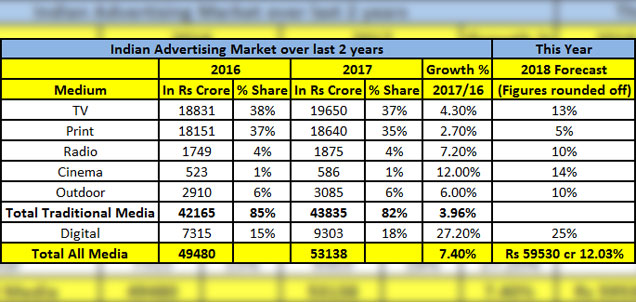
    1. Growth in the Indian Advertising Market slowed down to 4% in 2017, thanks to the after-effects of demonisation and GST roll-out. Traditional Media during 2017 grew by only 4%, the lowest in half a decade while Digital Media grew by 27.2%, taking the overall growth to 7.4%. In absolute terms, the Indian Ad market grew by Rs3,658 crores to take the industry to Rs 53,138 crores in 2017.

    2. AdEx was slow to recover from the impact of demonetization and first quarter of 2017 saw a de-growth of 2% and a growth of mere 2% in second quarter. Just when we expected AdEx to gather steam, GST was announced in July and the market saw a drop of close to 20% in traditional media over June 2017 and a drop of 5% as compared to July 2016. Mercifully, the  festive period brought cheer to AdEx and it grew from August to December by 13%. But because of the slow start in the first half and a drop in July the whole year’s AdEx is estimated at Rs. 53,138 crores, a growth of mere 7.4%.

    3. With a growth rate of 7.4% the Indian market has lost its stellar position of being the fastest growing advertising market in the world and has conceded that position to Russia, going by WARC estimates of international markets.

    4. Television continues to be largest contributor to AdEx with 37% share, but grew by just 4.3%, closely followed by Print at 35% share but with even a lower growth of just 2.7%.

    5. Digital that grew by 27.2% now contributes to a whopping 18% of Indian AdEx. Digital gained 3% share points at the expense of Television and Print who lost 1% and 2% share points respectively.

    6. Radio, Cinema and Outdoor have all grown at a much faster pace than Television and Print and maintained their share in 2017. But share of Digital continues to be more than combined share of Radio + OOH + Cinema and we don’t expect this trend to change in near future.

    7. The categories that have contributed to growth in Print, Television and Radio (and accounted for 56% of growth of Rs. 3,658 crores) have been FMCG followed by Telecom and Automobiles. FMCG continues to be the most dominant sector with a 32% share followed by Auto at 10% and Telecom at 8%. E-commerce that had taken the media market by storm three years ago contributed only 4% to AdEx (compared to 10% in 2015). With implementation of Real Estate Regulation and Development Act (RERA), Real Estate and Home Improvement category as a whole has registered a de-growth of -3%.


    B. Television:

    8. Television AdEx grew by a mere 4.3% and reached Rs. 19,650 crores. This is the lowest growth television has witnessed in the last 5 years. The growth is so low, despite the addition of 100 new channels including cable channels, which in turn contributed to an increase in FCT supply of 11% in 2017. Like-to-like channels shows an increased FCT supply of 7% leading one to conclude that on an average television rates were suppressed, but Advertisers could not reap the benefit of this because of lower ratings.

    9. HD emerged stronger during the year with the launch of 22 HD channels, now reaching 50 million homes split equally between Urban and Rural. Viewership of HD channels has also seen exponential growth and we estimate that HD is today Rs. 2,000 crore advertising market contributing over 10% to the television Adex.

    10. FMCG continues to rule the roost contributing 51% to the total Television spends followed by Telecom 12% and Auto 8%. It’s the same 3 categories that have mainly contributed to the growth of Rs. 820 crores in Television AdEx in 2017. E-Commerce maintained its contribution at 4%.

    11. Hindi GECs including FTA contribute 28% of overall television AdEx and Hindi is by far the largest contributor to television AdEx. FTAs channels have seen robust growth in viewership during the year and account for 19% of the Hindi GEC plus FTA genre.


    C. Print:

    12. Print grew by a mere 2.7% during the year. This is the lowest growth we have seen in 9 years. But it continues to be 2nd highest contributor after television with a share of 35%. It is significant to note that for the last 3 years, Print has been steadily losing share at a rate of 1% share point every year for last 3 years, but this year the decline accelerated and Print lost 2% share points. Dailies increased 3.4%, a bit higher than the total Print AdEx, because Magazines as a medium failed to gain advertiser interest for the 3rd year in succession.

    13. In terms of volume, Hindi publications continue to be ahead of English publications, contributing 34% of the total volume. English publications come close behind at 27%. Contrary to popular belief, volume in English publications has grown by 4% while volume in Hindi publications degrew by -4%. The degrowth in volume of Hindi publications has been observed for the first time in many years. Among other languages, Kannada and Gujarati publications have shown a substantial increase in volume, but Punjabi, Urdu and Tamil publications show a decline.


    D. Digital:

    14. Though there has been exponential growth in Video consumption over the past year, Display, Native and Programmatic have also picked up rather well with Mobile becoming the primary choice to consume content. Newer display advertising elements, Mobile, Online Video and Programmatic are all helping attract more advertising investment into Digital.


    E. Forecast:

    15. The forecast for 2018, is that Adex will grow by 12.03% taking the industry to Rs. 59,530 crores.Highest growth rate should be achieved by Digital (25%) followed by Cinema (14%), TV (13%), Radio & Outdoor (10% each) and Print (5%).


    Said Sam Balsara, Chairman, Madison World: “Demonetisation and GST have causedheadwinds resulting in a stunted AdEx. But you can’t keep advertising or for that matter the Indian economy down for too long. So we are cautiously optimistic about 2018 and project a growth rate of 12% for 2018 with digital again growing by 25%. To take advantage of the figures released by IRS which revealed dramatic growth in Total Readership, publishers will be well advised to offer incentives to advertisers for repeating the same ad in the same publication 2-3 times a month.”

    Pitch Madison Ad Outlook 2018 Published Report


  • Adspends to grow 11.5% in 2017: IPG Magna


    By A Correspondent


    ​India​ is recovering from aftereffects of demoneti​sation introduced in Q4 2016 and the currency deficit faced during this period has helped the country leapfrog towards a lesser cash economy. The country is set to move towards a uniform tax regime with Goods & Services Tax (GST), effective July 2017, while this fuels growth it is likely to create a fleeting disruption in the short term when the industry realigns and adapts to the new tax structure. GDP in real terms is estimated to grow +7.2% in 2017 compared to +6.8% in 2016 according to International Monetary Fund (IMF). Within the next decade India will gallop to become one of the largest consumer markets in the world according. Rising affluence, ease of doing business, urbani​s​ation and enabling infrastructure will contribute to this status.


    Advertising revenue which is accounts for 0.38% of GDP (gross domestic product) is likely to grow CAGR of +12.6% to touch INR 992bn by 2021. Within Advertising, offline is estimated to grow at a CAGR of +9.7%, while digital will grow at +25.5% CAGR in the next 5 years. Mobile is projected to overtake desktop by 2020. Television will still be the largest media in 2021 with a market share of 39%.


    In 2017, Adex is estimated to grow +11.5% to touch INR 611bn, predicts ​Magna, ,the intelligence, investment and innovation strategies agency of IPG Mediabrands​ (earlier called MagnaGlobal)​. Adspends will be driven by sectors like social, fin-tech, and payment banks, telecom service, content distribution platforms etc., in addition to FMCG, Auto and Ecommerce


    TELEVISION the foundation of advertising spends continues to dominate the industry with its market share of 41% and will grow+10.3%. With BARC release of rural audience data, new revenue stream in the form of FTA channels have gained significance. Quality locali
    ​s​ed content and HD experience will help regional TV to keep their audiences hooked. Sporting leagues outside of Cricket is finding way to generate mass involvement and Television will play a larger role. Star Sports Tamil demonstrating tangible results will increase fandom for local/state level formats.


    PRINT in India has been successful in guarding its revenues well with revenue expected to grow by +5.7% and India is one of the large markets where circulation is still growing thanks to rising literacy. The second biggest category with 36% share despite growing is losing its share to Digital year-on-year. Traditional sectors like auto, telecom and education will contribute to ad spend growth. After a gap of 3 years, the category will invigorate with the release of new IRS and help publishers reali ​s​e merit based value. Audit Bureau of Circulation (ABC) measuring digital consumption will lend authority and help in moneti​s​ation. We expect the ad spends to grow beyond the estimated +5.7% in 2017 thanks to government’s focused campaign to populari​s​e their marquee initiatives.


    DIGITAL will grow +28% and within digital, mobile is driving spends with a growth rate of +65.7%. The launch of 4G triggered low price data products there by increase in usage. With improved speed Video, native and customi ​s​ed content has tremendous potential to grow. BARC putting out a road map on digital panel takes India one step closer to a robust measurement not only for digital but also to showcase capabilities in incremental metrics. With expanding content library, OTT viewing is no more restricted to national languages. Aggressive push by Amazon and Netflix to address the original content gap will attract larger base of audience. With mobile increasingly being the choice of access, traffic will be higher than desktop resulting in advertising propelled by mobile which is estimated to grow at CAGR of 48%. E-commerce, Telecom, Auto, BFSI, Durables are large contributors to the revenue.


    RADIO reach with around 150 new frequencies sold during phase III is set to deepen further and will help generate incremental revenue. We estimate radio to grow +13% and continue to grow at CAGR of 13.8% in the next 5 years. Currently the measurement is limited to 4 cities, widening this will help radio increase its share from the current 4%


    OOH will grow +12% in 2017. Technology integration will increase effectiveness and helps drive adspends. Urbani ​s​ation in the form of new Metro lines and smart cities, moderni​s​ation of Indian Railways and their new advertising policy etc., will provide opportunities for a planned development of quality assets and also push the industry to innovate and move beyond billboards. Regional cinema is pushing boundaries to outdo Bollywood cinema which augurs well for the industry.


    Table 1 – Media owner revenue by category in INR Cr Net

    Media Category 2017 2018 2019 2020 2021
    Television 24516 27416 31062 34774 39012
    Print 20644 21916 23348 24696 25884
    Digital 10227 12973 16538 20394 24868
    OOH 3552 3979 4530 5074 5642
    Radio 2227 2539 2920 3329 3762
    Total 61166 68822 78398 88266 99167
    Media Category 2017 2018 2019 2020 2021
    Television 24516 27416 31062 34774 39012
    Print 20644 21916 23348 24696 25884
    Digital 10227 12973 16538 20394 24868
    OOH 3552 3979 4530 5074 5642
    Radio 2227 2539 2920 3329 3762
    Total 61166 68822 78398 88266 99167


    Table 2 – Traditional Vs Digital Adex growth rate


    Table 3 – Mobile gaining shares over desktop

  • Adspends in 2016 to grow 13%


    By A Correspondent


    Leading media agency network ZenithOptimedia says its growth forecast for advertising expenditure in India will be 13 percent for 2016.  Television largely fuels this at 15% and print – newspapers – at 10%. Digital is expected to grow upwards of 20% while all other media are expected to grow at 5-10%. E-commerce, telecom, mobile phones expected to have the maximum growth followed by automobiles and FMCGs.”


    ‘13% growth in adspends is a positive movement’


    Anupriya Acharya, Group CEO, ZenithOptimedia India on her agency network’s global spends forecast as she tells Pradyuman Maheshwari that the actual growth for 2015 will be at 13% as against 12% forecast last year, primarily driven by higher than expected growth on TV at 15%.


    You speak about rational optimism for the year ahead. But given your overall forecast for adspends as 13%, will you say that “achche din aanewaale hain” or would it be that “they could well have been ‘kharaab’, so be happy with this one”?

    The rational optimism is to contrast it with the irrational exuberance that was there last year this time given the new government. But to answer your question… I would say at 13% it’s a positive movement and if we have sustained momentum, it should go up further in the coming years.


    But even as forecast reports such as yours paint a rosy picture, friends in various media sales jobs rue that sales aren’t happening in right earnest…

    That’s right… at an informal level one can get different reports depending on who one is talking to. For example, most sellers will tell buyers that the market is booming and most buyers will tell sellers that it’s a tough market! :))


    Our report however is based on closely tracked data, including inventory sold, impact properties hitting media, annual reports of media companies, secondary research on economic parameters and key categories, actual movement on pricing coupled with market intelligence on key deals.


    Real estate for instance has taken a severe beating…

    That’s right… but actually sometimes that’s when it’s really advertised!


    Your forecast for 2015 was a 12% growth. How has it been in 2015 looking at actual spends. And what about specific sectors… the forecast % v/s actual?

    By the time we close 2015, it looks that the actual growth will be at 13%, primarily driven by higher than expected growth on TV at 15%.


    You’ve mentioned automobiles to see have a good growth, but we have seen modest rise there with very new brands too cutting price?

    Yes, as a category, AdEx on automobiles are quite volatile, say compared to FMCGs which are fairly stable in terms of growth/ degrowth. But this year we have seen a healthy 25% plus growth in automobile spends. New brands cutting price also need to advertise it!


    “In 2018 we expect the internet to overtake television to become the largest single advertising medium,” the report says. Would this apply to India too? And if not, by when do you think will the internet overtake television?

    It does not apply to India at this point in time. But if quite a few things kick in well and collectively like 4G, broadband highways, consumer’s earning and spending potential – and this coupled with the marketer-advertising fraternity accelerating their understanding of this space then it is not impossible to expect it in the next 7-8 years. I must also point out that interestingly, this is not because of slow growth of internet but because in India TV is also growing and far from saturation point!


    Lastly, given that we are the world’s largest democracy, second-most populous country… with a smart and creative advertising fraternity and have very active marketers, isn’t a matter of shame that we are sooooo far behind China?

    Well, China’s GDP is five times of India and their currency ten times stronger! We need to accelerate growth on all fronts in our country and media, marketing and advertising are a subset of it. Collectively, we can and we will 🙂


    ZenithOptimedia predicts global ad expenditure will grow 4.7% in 2016, reaching US$579 billion by the end of the year. This will be a 0.8 percentage point improvement on 2015: 2016 being a ‘quadrennial’ year, when ad expenditure is boosted by the Summer Olympics, the US presidential election and the UEFA football championship in Europe. “The global ad market has enjoyed stable growth since 2011, with growth rates ranging between 4% and 5% a year, and we expect it to maintain this pace for the rest of the forecast period,” the report adds


    Interestingly, while television is currently the dominant advertising medium with a 38% share of total adspend (in 2015), in 2018, ZenithOptimedia expects the internet to overtake television to become the largest single advertising medium. According to the report, one of the reasons for television’s loss of share is the rapid growth of paid search, which is essentially a direct response channel (together with classified), while television is the pre-eminent brand awareness channel – and we expect it to remain so for many years to come.


    Audiovisual advertising as a whole – television plus online video – is gaining its share of display advertising. Television offers unparalleled capacity to build reach, while online video offers pinpoint targeting and personalisation of marketing messages. Both are powerful tools for establishing brand awareness and associations. Audiovisual advertising will account for a record 48.4% of display advertising in 2015, up from 44.1% in 2010, and its share can be expected to reach 48.9% in 2018.


    Also, in 2018 mobile advertising will overtake desktop and account for 50.2% of all internet advertising. Programmatic advertising will account for more than half of digital display advertising (53%) for the first time this year, and will increase its share to 60% in 2016. “We expect programmatic advertising to grow another 34% in 2016 and 26% in 2017, at which point two thirds of global display will be programmatic,” the report adds.


    At regional  levels, Fast-track Asia economies (China, India, Indonesia, Malaysia, Pakistan, Philippines, Taiwan, Thailand and Vietnam) are growing extremely rapidly as they adopt western technology and practices, while benefiting from the rapid inflow of funds from investors hoping to tap into this growth. China accounts for 74% of adspend in Fast-track Asia, so its slowdown naturally has a large effect on the region as a whole. The expectation is for ad expenditure in Fast-track Asia to grow 8.9% in 2015, and at an average rate of 8.4% a year between 2015 and 2018, down from 14.7% a year between 2009 and 2014.


    Adspend growth is slowing down in three out of the four BRIC markets that were responsible for much of last decade’s ad market expansion. India – the only BRIC market – continues to combine rapid growth and large scale, making it a distinct hot-spot of adspend growth. The market is benefiting from sustained, healthy economic growth and strengthening personal consumption. With adspends growing at double-digit annual rates here, ZenithOptimedia expects the market to expand by US$3 bn between 2015 and 2018.


  • Adspends to increase 12.6% in 2015: GroupM


    A Correspondent


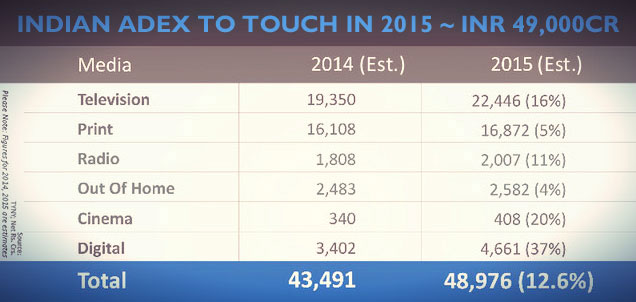
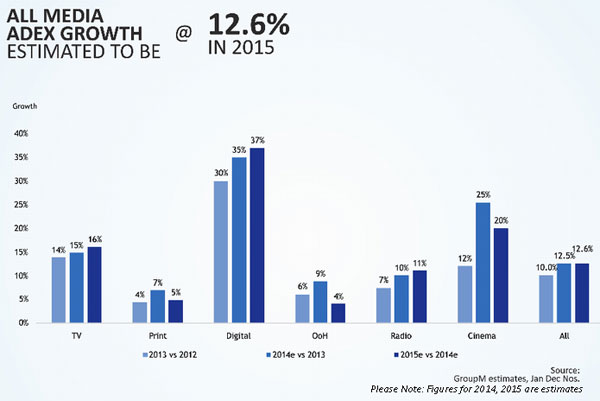
    Leading media marketing services conglomerate GroupM released its biannual advertising expenditure futures report This Year Next Year (TYNY), forecasting India’s advertising investment to reach an estimated Rs 48,977 crore in 2015. This represents a growth of 12.6% for the calendar year 2015 over the corresponding period in 2014.


    As per GroupM the adspending was Rs 43,490 crore for the calendar year 2014, an increase by 12.5% over 2013. This growth was attributed to the heavy adspending due to the General and State Elections and industry categories like ecommerce and telecom.The FMCG sector, which contributes to nearly a third of the AdEx, had a steady year, growing broadly in line with the industry average.


    CVL Srinivas

    Said CVL Srinivas, CEO, GroupM South Asia, “With a new government coming to power, the negative sentiment has lifted but there is still some bit of caution amongst advertisers.We continue to operate in the same zone as last year at an overall level. Digital, TV and Cinema are expected to be the high growth media channels. We are seeing a lot more confidence amongst local businesses to invest in brand building than before. This is a positive sign for the industry. Penetration of smartphones coupled with the popularity of online video is making FMCG spend more on digital. Another trend is the emergence of categories like e-commerce and the increased competition in telecom both of which are aiding the growth of traditional media channels including Print and TV apart from digita.l”


    E-commerce is expected to lead the charge in 2015 in terms of ad spend growth although from a relatively smaller base than more established categories, according to GroupM’s forecast. There is increased competition in this sector and no dearth of funding. FMCG, Auto and Telecom are expected to do better than the previous year. More multinational entrants under single brand retail are likely to add to ADEX spending in the retail category. The recent rate cuts by the Reserve Bank of India will stimulate the banking sector, reactions of which are evident on a buoyant stock market. This year will possibly see a number of IPOs as there is a sense of stability in policy and investors are willing to take more risks. The market will also see higher spends from the Central Government as they showcase their new initiatives.


    Prasanth Kumar

    Added Prasanth Kumar, Managing Partner, Central Trading Group, GroupM South Asia and CEO-designate Mindshare South Asia: “Over the last few years, Indian media has been in a state of change. The next three to five years will be about embracing technology, which will allow both advertisers and media owners to customize distribution to a premium niche audience with very nominal margin of error. In 2015, programmatic buying will see an impetus, as all media in the future will see automation, backed by smart data and analytics.”


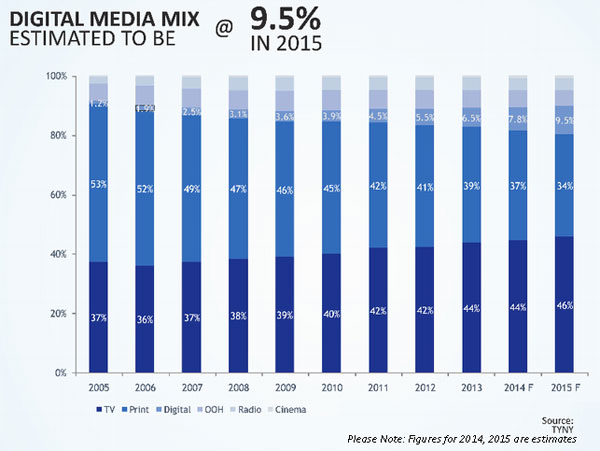
    As per GroupM’s in-depth research of the Indian media industry, digital media continues to show the maximum growth with 37% in 2015. Digital has been growing at an average rate of 35% over the last two of years. This year within digital media Video, Mobile and Social will be the biggest growth drivers.


    Television shows a higher growth percentage in 2015 compared to last year with 16 percent. TV channels will especially be bullish with cross media integration via their own digital platforms. The big ticket event this year is the ICC Cricket World Cup in February and March, with scope for programming and advertising innovation during the tournament.


    Even with pressures on advertising revenues, the print medium shows an increase by 5.2% as against the 2014 estimate of 7.6%; however print magazines continue to be on the decline, as several are looking at digital delivery mechanisms.


    The surprise element in the media mix has been cinema advertising which finally closed 2014 with a 25% increase. This year too, GroupM estimates this media category to grow at 20%, as multiplex chains consolidate, leading to a more organised and accountable environment. With technology fuelling exhibition and distribution, especially in smaller towns, consumers will get a better viewing experience.