Tag: Ad Buzz

  • Cadbury ad. Overdependent on Nostalgia?


    By Prabhakar Mundkur [updated]

     

    Prabhakar MundkurAs I write this, I am sure the latest Cadbury’s ad has already gone viral if that is a measure of its success. The latest message I got on WhatsApp went like this:


    “In 1994, Ogilvy India made an ad for Cadbury Dairy Milk.

    In 2021, Ogilvy India made the same ad for Cadbury Dairy Milk, with a difference.

    Check both out!!!”


    The praise showered on it has had no bounds over the last two days.  One of the comments went like this: “It’s a follow-up to the ad the great Piyush Pandey wrote in 1994 which catapulted him to advertising fame.”  No doubt Piyush is a shining star in the advertising firmament, but I am not sure this criterion can be used to judge an ad, both by commoners or 50-year-old advertising executives. I never thought of an ad as great only because David Droga or Bruno Bertelli wrote it. In any case, I am getting used to the hysteria and adulation India accords its heroes. Just yesterday, we saw a union minister likening our Prime Minister to God.  And later, the Prime Minister’s Report Card handle on Facebook posted the Cadbury ad, giving it record likes and shares. God himself then has endorsed this ad.  So, who am I, a mere mortal to even start evaluating it?


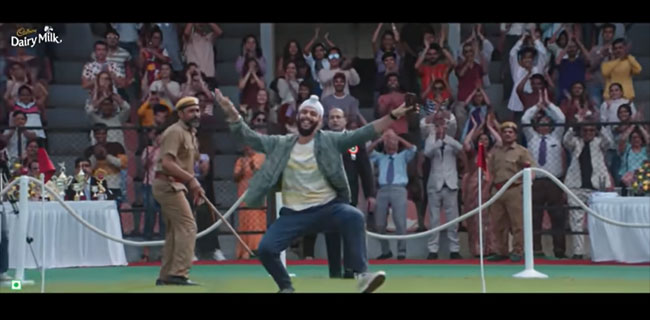
    I must admit I am an aberration of the Indian consumer because I spent the better part of the 90s working overseas and could not use the 1994 ad as a reference. It seemed like just another cricket ad to me, or simply put just a typical scene from Indian cricket which we have seen repeatedly, for much longer than the Cadbury ad. After all, didn’t a woman do the same thing to Brijesh Patel when he scored a century in 1975?  She went past the security (India’s disrespect for the law is legendary), right until the pitch and then planted a kiss on Brijesh’s cheek. I know cricket is a hot button in this country, but the 99 runs on the scoreboard with a sixer coming up is both a bit trite and hackneyed.



    Which brings me back to one basic question: if this ad was trying to capitalise on nostalgia marketing, was it aimed at people who were over 50 years old? We don’t know Cadbury’s strategy, but it could well be that they no longer wanted their brand to be seen as a young person’s brand. If the target audience were expected to have seen the ad in 1994, it does mean that this ad is talking to people who are in the age group of 40-50 years at least or even more.


    Of course, while arguing my way through the merits and demerits of the ad, many people stoutly defended the ad saying that it was brilliant, even as a standalone, and even if people had not watched the 1994 version. Maybe, but I would imagine that the people who had seen the 1994 ad would rate it 5x times better than the people who hadn’t seen the 1994 ad. People who first posted the ad on social media were mostly older, but the overall hype was so overcoming that I believe the youth had taken to sharing the ad later, on Instagram. Take this tweet for example which got a rousing response. I don’t know Karthik personally, but I am willing to wager that he is at least 40 years old to have seen and remembered the 1994 ad.
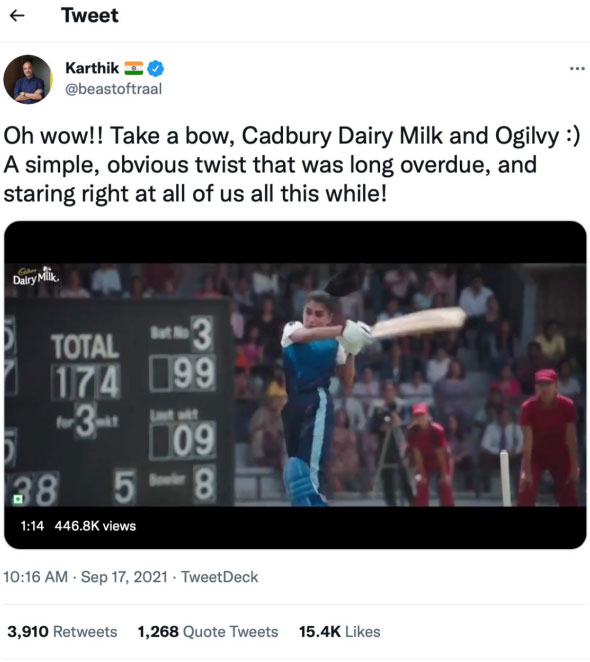


    But somehow the Cadbury ad seems to have touched a chord and has got accolades for showing a woman in the lead role. Many people have commented that this was a long time coming. Of course, any ad like Cadbury’s is a welcome addition to the tirade against gender discrimination. India for centuries has discriminated against women, and there is still scope to do much more. India ranked 131 in the 189-country survey on the Gender Development Index. So, any commercial or full-length movie that goes towards portraying the importance of women is welcome because it can help to change the status quo. I see advertising and cinema as important influencers in pushing the envelope for social change.


    Oscar Wilde in his 1889 essay ‘Decay of Lying’ posed the rhetorical question, whether Art imitates Life or Life imitates Art. I firmly believe that Art must do its bit to change society so that Life can start to imitate Art. The Cadbury ad from that point of view is a step in the right direction.


    Except that as I said earlier, the Brijesh Patel incident also raises the question if this is Art Imitating Life?  It could well be!


    Oscar Wilde was right in posing this queer and difficult paradox.


    Prabhakar Mundkur is a former advertising agency captain and has spent over four decades in marketing services across geographies. He is a prolific writer and was a few years back rated as among the top voices by LinkedIn. Other than advertising and writing, Prabs, as he is known to friends, is a very active musician and a self-taught producer of music. In the pandemic, he has performed and produced nearly 50 songs, including one with the very accomplished Usha Uthup. Mundkur’s views here are personal.



  • Prabhakar Mundkur: Lighter is not better for Heineken

    Prabhakar Mundkur

    By Prabhakar Mundkur


    While the commercial might have been made in good faith, a recent television commercial for Heineken Lite has a bottle of beer sliding past several black people before coming to rest before a light-skinned woman. The tag line “Sometimes lighter is better’ might have aggravated the point about cultural diversity arousing the wrath of hip hop star Chance the Rapper who took strong objection to the commercial.


    The commercial in the meantime has been pulled off-air.  With the number of commercials over the last year including Pepsi drawing criticism, Grey has done a wise thing.  It has a mandate which says that creative teams working on a campaign must answer the question: “How can we make the idea reflect and respect the world’s diversity?


    Seems like an excellent idea from Grey considering the number of commercials that are constantly going wrong on the subject of cultural diversity.


    Silent Rebellion at Goafest?

    The guest line-up of speakers at this Goafest includes Baba Ramdev as the main speaker raising some eyebrows among advertising professionals.Patanjali is acknowledged as an innovator which disrupted the entire FMCG industry but is also seen as a bit of a pariah as far as its own advertising is concerned.  While Patanjali has risen to be one of the largest advertisers in the country, it has also committed the largest body of misleading advertising work in a very short period of time. Not only that, they have strongly questioned the wisdom of the advertising industry in judging their work as misleading.  Sanjeev Kotnala, writer, trainer and consultant, has been vociferously airing his views about how Baba Ramdev was a bad choice for the role of main speaker at a festival that celebrates creativity.  As an aside, none of the work produced by Patanjali could really classify as ‘creative’ by any standards.


    One argument for inviting Ramdev seems to be that he is an innovator and that there is a lot to learn from him.  But there is a lot to learn from many people who have been classified as offenders. After all who would deny that there is a lot to learn from Vijay Mallya about beer and spirits, a lot to learn about cricket and IPL from Lalit Modi, and a lot to learn about innovative jewelry from Nirav Modi?


    While calling Ramdev as a guest speaker might have been an innocent decision, with the sole objective of wanting to include a crowd-puller, one wonders how it affects the sensibilities of senior advertising chiefs?  At the end of day, every professional in his field must also be his own regulator.  Every industry needs to maintain the professional standards it has imposed on itself.


    Coke launches new Summer Campaign

    Coke seems to have broken the usual mould with its new summer campaign.  It has personalised the packaging of Coke through a co-creation exercise with consumers.


    There are 20 descriptors in 12 languages on various relationships in a new trend which is being labelled micro-segmentation and advocacy.


    Thus far co-creation seemed like a good buzz word to drop in conversations on marketing and advertising.  But Coke might has actually made this come alive as part of their “Share a Coke” campaign which is running globally.


    Good strategy for Coke.


    Alexa goes Wild

    India is currently running a boring, very functional campaign for Alexa and Amazon Echo/Dot and perhaps its defence is that they need to educate Indian audiences on how Alexa works through the Amazon devices.  In the meantime, Ellen DeGeneres revealed a funny and probably slightly dangerous side of Alexa in a lighter vein.


    While it does demonstrate what Alexa can do, it gives us an idea of what might happen were Alexa to know so much about you.


    Certainly a peek into our own future. The age of Artificial Intelligence is nearer than we think.


  • Ad agencies vs Consultancies debate gets real


    By Prabhakar Mundkur


    So far, the debate on advertising versus the consultants was a theoretical one because it was not affecting the Indian market yet in any significant way. Companies like EY, KPMG, and PWC have been very active in digital marketing overseas but this capability was still not very active in India.  But with the launch of Deloitte Digital in India on January 12, the landscape is likely to change.  One will have to wait and see how the launch of Deloitte Digital willaffect  competitionlikrGroupM, Dentsu-Aegis and IPG Mediabrands.  Rakesh Barik – Technology Consulting, Deloitte India told the press, “Unlike existing creative agencies, we understand the business also.  We will help companies digitize their core”.  By implication it does mean that creative agencies don’t understand the business of their clients, something that has been troubling the advertising industry for some time now.  What’s more contrary to popular opinion ,the consultancies have been acquiring  talent in creative, designing and research, making up for their traditional lack of skills in this area.


    Hotstar’s Employer Branding Campaign

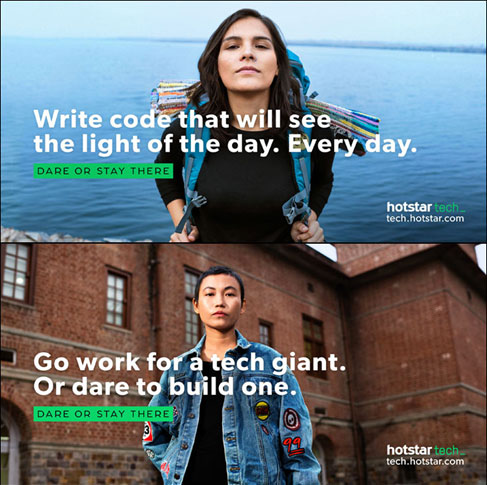
    Hotstar is a live streaming app that lets you watch your favourite shows, movies, sports and live news on-the-go. Most often its funny how we are able to see brands only as consumers of it.  So strong is our consumer perception of brands that often we may not even consider them as employers.  In fact, so strong is the value proposition to consumers that companies have to take a special effort to make a value proposition to its future employees and this is exactly what Hotstar has managed to do in its latest employer branding campaign.  The latest campaign from Hotstar positions it as a tech player to attract the best tech talent, which no doubt has several competitive options in the country today.

    The campaign makes you see Hotstar in a new light.  As a tech company that could offer the youth an interesting challenge.  The ‘Dare or stay there’ baseline is provocative enough for young techies to seriously consider Hotstar.


    Amazon Go 

    No wonder Amazon is being referred to as the ‘tech giant’ these days in the press. It’s no longer just the ‘online store’ or ‘e-commerce giant although its immediate competition might love to see it that way to serve their own purpose.


    With Alexa becoming the preferred personal assistant and taking giant strides forward, Alexa is not just a home assistant but is also taking control of cars (Ford has just adopted Alexa) and our other devices and possessions.


    Amazon now takes the pain out of shopping – no queues and no checkouts in their Seattle store. Just pick what you want from the store and get charged to your Amazon pay card on the way out. That’s the experience that Amazon offers at Amazon Go. The faqs on amazon.com had this to say about Amazon Go.


    What is Amazon Go?

    Amazon Go is a new kind of store with no checkout required. We created the world’s most advanced shopping technology so you never have to wait in line. With our Just Walk Out Shopping experience, simply use the Amazon Go app to enter the store, take I the products you want, and go! No lines, no checkout. (No, seriously.)

    I  liked the commercial because it made the concept of the new store really clear. It was really functional advertising which is a great way to launch a new brand.


    Indian men are not the only ones to touch their junk?

    For a long time now, there has been some public criticism of how Indian men touch their junk. A dermatologist friend of mine explains it away as tropical climate with a lot of heat and dust which could create conditions that justify this despicable Indian habit, especially amongst some classes of people.  But a new TVC from Columbia may imply that the habit is not unique to India.  The Colombian League against cancer has found a hilarious but gross way to make men aware of testicular cancer.


    This is an insight that is waiting to be used in the Indian market.  Everybody is going to identify with it.  In fact, I am wondering why no one has exploited it yet.


  • Prabhakar Mundkur: Does using the same idiom as someone else make an idea original?

    Prabhakar Mundkur

    By Prabhakar Mundkur


    The death of Kapil Mohan,the creator of the Old Monk rum drew a number of memoirs and essays on this iconic brand.  But one particular ad on social media on January 10, became quite popular and went viral.


    To me it was an idea made famous by Chivas Regal in their campaign below.

    In a debate with some of my contemporaries, the opinion was divided.  Many felt that it was reminiscent of the old Chivas campaign, but others felt that it was an adage that could well be re-used. One of my friends even questioned whether the ad was legal since it promoted Old Monk rum. (although the word rum was cleverly not used). Another friend raised the issue of the ad being created as speculative work, since it was not approved by Coca-Cola according to the tweet from the agency that created it.


    One awardwinning creative director I asked said: “Yes it reminds me of Chivas, but the visual makes up for it”.  Another awardwinning creative director said: “Yes it reminds me of Chivas. I remember it was something like ‘To the host it’s half empty, to the guest, it’s half full’.  However, since it’s an adage, nobody really owns it. Chivas did a fine job of adding a twist while in the Thums Up ad, the art director went for a literal visual depiction of the adage.”

    But I leave you to decide if you think the ad is original and if it needs to be applauded.


    Patanjali – LVMH Alliance

    While as a financial proposition it may make some sense, news of the LVMH-Patanjali partnership is as different as chalk and cheese to use a very tired phrase. The L Catterton Equity Fund was set up by LVMH to make investments in high growth companies with consumer brands and is one of the largest funds in the world.


    I thought that there might be some major hurdles to overcome especially the brand name itself.


    L Catterton Managing Partner, Ravi Thakran told the press that he is keen to explore markets like US, Japan, China, South Korea and Europe for Patanjali. However, the markets he mentions are hardly homogenous. For that matter, even the markets in North East Asia are not homogenous.


    The first hurdle for overseas markets could be the name itself – Patanjali. First of all, it is a four-syllable name which is quite uncommon in Asian markets. In addition, the Japanese recognise the foreignness of names both in Katakana and Roman alphabets and the Chinese recognise foreignness whey they see certain Hanzi characters.  And if the foreignness is attributed to Indianess, one is not quite sure what Indianness and Indian products mean in these markets. For most North East Asian markets India is considered both chaotic and mysterious.  The Chinese feel that Indian media is constantly portraying them as evil, which is not going down well with the Chinese.  In addition, in countries like China, the government is officially atheist.  So Babas and Vaids have little cache there. According to a research conducted in 2008, less than 40% of the Japanese population is religious.


    Besides, for Patanjali to accept any foreign investment, might be a bit like selling the brand’s soul, given its nationalistic, anti-MNC positioning thus far.


    The Art of the Crowd

    Crowd Art is an often-employed ploy by artists and advertisers.  The first great commercial to use crowd art was the British Airways commercial in 1990.  It used thousands of people to create a face which then winked at the audience before dissolving into a Union Jack.

    The recent Mercedes ad re-inforcing their leadership in the Indian market used crowd art to form the three-pointed star which was quite interesting.

    Which brings me back to the question I started with: is using the same idiom as another person but dressed differently, original?  When it comes to art, the question of originality needs some deeper introspection.  Under some conditions it still remains original. To me for example, Bernard Shaw’s famous play Pygmalion had to make a transition from being a play to being a musical when it became My Fair Lady, but for me My Fair Lady is still original.


    In general, I like Herman Melville’s view of originality when he ways, “It is better to fail in originality, than succeed in imitation.”


  • Ad Buzz by Prabhakar Mundkur: Will advertising strike back at consulting cos?

    By Prabhakar Mundkur


    Consulting vs Communication Groups

    In a surprise move, Sir Martin Sorrell may have silenced all the critics who have been proclaiming the death of advertising, as consulting companies have been making forays into digital marketing and advertising. Some investment gurus have even been predicting the eventual take-over of the advertising industry by the consulting industry. Kantar, one of the major companies in the WPP group, collapsed four brands – Kantar Added Value, Kantar Futures, Kantar Vermeer and Kantar Retail – into one brand called Kantar Consulting.  Kantar has already informed their clients about the development and hopes to have about a 1000 staff that consists of analysts, thought leaders and software developers.

    Will the others quickly follow suit?  It remains to be seen, but if they do, advertising is certainly striking back. Old professions have great survival skills, as the oldest profession in the world has proven to us time and time again.


    Social Media inspires Communication themes

    Earlier, brands took their cues from the news, cinema and other fields. Or used topics like another brand’s major event to take advantage and poke fun at them. Remember in 2017 when BMW celebrated its 100th birthday, how Mercedes acted cheekily with this ad?

    It paid BMW a left-handed compliment to make a point about themselves while overtly congratulating BMW.

    They also went all the way and invited all BMW employees to the Mercedes-Benz Museum “to discover the complete history of the automobile” from March 8 to 13.

    Now all that is changing. The latest source of inspiration is what is trending on social media.  While President Donald Trump’s #nuclearbutton tweet might have fazed political pundits, some brands decided to have some fun with the latest topic of conversation around the world.

    Closer home, Amul Butter has for the last 5 decades always capitalized on what is the current buzz. President Donald Trump’s tweet inspired this hoarding from Amul Butter.

    KFC UK and Ireland decided to get cheeky with McDonald’s on Twitter. Many Americans acknowledged they weren’t even aware that KFC existed in that part of the world until their tweet took Twitter by storm.


    Consumer Protection

    When Consumer Affairs Minister introduced a new Consumer Protection Bill in Parliament last week, it might have sent shivers down the Advertising and Entertainment industry in an already cold January.  The bill provided for a fine of INR 50 lakh which of course is unlikely to bother the top celebrities since it represents only a fraction of what they earn through endorsements. What might have seemed to be harsh to them was that celebrities could face up to three years imprisonment for appearing in misleading.  No doubt agents of celebrities would seek clarification on what exactly is misleading advertising.  The Advertising Standards Council of India has already made an offer to advise if an ad is misleading.

    Quite simply, misleading means giving the wrong idea or impression about something. In the case of products, if the claims made in advertising are not honest and truthful, it would mean an advertisement is misleading.  Anyway, the new act is likely to put the brakes on blindly accepting every brand offer that meets the celebrity’s standard fee.  Celebrities are also being careful about how the brand affects their own brand equity.  When Virat Kohli refused to endorse Pepsi last year, he was actually being careful about the repercussions on his own image.


    Creativity vs Effectiveness

    The advertising industry celebrated the Effies with their usual revelry. The Effies typically precede the euphoria of getting ready for the Abby’s which are around the corner. The cynics of the creative awards will quote Dave Trott when he famously said “You are not doing advertising for six million people anymore, but for ten people in the jury, and for a few clients”.   While the creative people are centre stage for the creative award, the effectiveness awards are for the ad-fiddlers as Dave Trott labeled our dear planners.

    However, it looks like the old polarity between creativity and effectiveness no longer holds true.  Increasingly I find that it is the creative agency that also wins the Effie.  And often I find that the best campaigns are quite likely to win both the creative awards and the effectiveness awards.  Hopefully it has nothing to do with the same organisation in India conducting both the awards.


    Having spent nearly four decades in the advertising business with companies like JWT, Havas and Y & R in India, Africa, and Asia, veteran adperson Prabhakar Mundkur is Chief Mentor at HGS Interactive, a part of Hinduja Global Solutions. He was LinkedIn’s Top Voice in India in 2016 andis a prolific writer. He recently set up PrabhakarMundkur.com as homebase for his writings. Ad Buzz will appear weekly on MxMIndia.com. The views here are his own.