Tag: Abhishek Karnani

  • Neeraj Roy is guest at IAA webinar on March 5

    By a correspondent


    Neeraj Roy

    Neeraj Roy, Managing Director and CEO of Hungama Digital Media Entertainment Pvt. Ltd. will be the guest at the International Advertising Association (IAA) India Chapter’s next webinar series. The webinar is scheduled to take place on March 5, 2014 at 3 pm. (*Disclosure: MxMIndia is media partner of the IAA India Chapter webinar series)


    Srinivasan Swamy

    Srinivasan K. Swamy, President, IAA India Chapter & Vice President, Development Asia/Pacific region of IAA said, “This webinar series has had both Indian and global industry stalwarts share their insights from the digital domain. This will add more dimension to India’s online endeavours.”


    Abhishek Karnani, Director, Free Press Journal and Manish Advani, Head – Marketing and Public Relations, Mahindra Special Services Group, are co-chairing the IAA Webinar series.


    Abhishek Karnani

    “We have had some great speakers in IAA Webinar Series and Neeraj Roy our upcoming speaker, is the King of Digital. I am confident that the participants could learn how to become digital experts from this session”, said Advani.


    The hangout will be broadcast live on the YouTube channel - www.youtube.com/iaaindiachapter  on 5th March, 3pm IST.


  • IAA webinar to host Rob Norman, Chief Digital Officer, GroupM at 5 pm today

    Rob Norman

    By A Correspondent [updated]


    The India Chapter of International Advertising Association (IAA) has announced its next webinar with Rob Norman, Chief Digital Officer, Group M (Global) today (Thursday, November 28) at 5 pm.


    Mr Norman is also a Director of WPP Digital and Wild Tangent and a non-Executive Director of BBC Global News Ltd.  He is on the board of the Center for the Digital Future at USC, a member of the Facebook Client Council and an advisor to venture capital funds – Greycroft and GGV.


    Said Srinivasan Swamy, President IAA India Chapter & Vice President, Development Asia/Pacific region of IAA said ” I am really happy to see that this is our 7th webinar and our initiative to provide this seamless learning platform is paying off. We now have participants from across Asia. Our speakers are coming from various geographies too. It’s all working well!”


    Abhishek Karnani, Director, Free Press Journal and Manish Advani, Head – Marketing and Public Relations, Mahindra Special Services Group, are co-chairing the IAA Webinar series.


    “We are very excited to host Rob in our forthcoming IAA Webinar; it sets a very powerful example to what IAA seeks to do for the fraternity. He will give us a global perspective on future of Digital with specific to Indian environment”, said Mr  Karnani.


    “I am confident Mr Norman will inspire thousands of young digital aspirants in their digital journey by sharing some great examples of success based on his Digital Journey”, added Mr Advani.


    Over the last seven months, International Advertising Association (IAA) India Chapter has hosted speakers like Sanjeev Kapur CMO & Head of Customer Franchise Management Citi (India), Ashish Hemrajani, Founder and CEO Bookmyshow.com, Rajan Anandan, MD Google India, Nishant Rao MD Linkedin, Ajit Balakrishnan Founder Rediff.com and Julie Roehm, Chief Story Teller, SAP, USA.


    Questions for Rob Norman through the IAA India Chapter Facebook page at www.facebook.com /IAA.IndiaChapter. The hangout will be aired live on IAA (India)’s YouTube channel – www.youtube.com/iaaindiachapter on November 28 at 5pm.


  • Future bright for Emerging Agencies


    By Fatema Rajkotwala


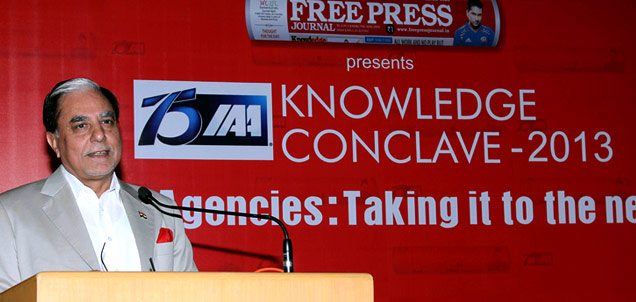
    Downturns and failures are opportunities to be successful in the future,” said Subhash Chandra, Chairman, Essel Group and Zee Network in his address on entrepreneurship at the Knowledge Conclave of International Association of Advertising India Chapter.  The Conclave on Saturday (October 26) in Mumbai was held with the objective of helping emerging agencies understand how to take their businesses to the next level.


    Mr Chandra, who was Chief Guest of the event, shared his mantras for entrepreneurs. “Honour your commitments.  Don’t let fear set in. Listen to your customer. When I hear debates on whether it is better to be independent or enter partnerships, I say you become a multinational. But yes, partnerships help in growth.”


    Srinivasan Swamy

    Led by President Srinivasan K Swamy (CMD, RK Swamy BBDO), the IAA India chapter in association with the Free Press Journal invited senior industrypersons to share their knowledge and experience with the fraternity of small and mid-sized agencies. Acknowledging the growth in number of small agencies and the theme chosen for the Conclave, Swamy pointed out that the growth in membership of the various trade bodies from amongst the small and medium-sized agencies indicates that the business is robust for them.


    CVL Srinivas

    CVL Srinivas, CEO, Group M South Asia spoke on “How to flourish as a mid-sized media agency”.  Putting things in perspective for emerging agencies, he pointed out that in many ways, small and mid-sized agencies have a natural competitive advantage over big corporate and network-owned agencies. “It is easier for emerging companies to go digital. It is no longer a game of the top 4-5 agencies. Fragmentation and specialization is a huge opportunity for emerging agencies. Large agencies are not equipped to deal with local entrepreneurs whereas small agencies can cast the net wider. There is a shift from contextual and demographic targeting to audience planning.”


    Mr Srinivas spoke of how agency life tends to get a little superficial at times, leaving you disconnected from consumers. He said, “There is no better time than now to be a part of the media agency business. Today, all of us (big networks, multinationals and small agencies) are in the same boat. Massive disruptive models are coming in and this indicates that our advertising model needs reinvention.”


    B S Nagesh, Vice Chairman, Shopper’s Stop engaged the audience with his talk on “Preparing to win in a hyper competitive market” where he urged all entrepreneurs in SMEs to bring in out-of-the-box modes of growing their businesses. Summing up his nuggets of advice, he said,”Creativity has to be coupled with financial training. Many processes within SMEs happen in an informal way. To lessen the gap between Desire and Deserve, organisations need to look at building capability along with building capacity. Trust, transparency and empowerment within the company is important. Create an organization that is more responsive, accountable and measures performance. Create opportunities by creating clients in emerging markets. Celebrate trials, failures and successes.”


    Later, Ali Merchant, Director Triton Communications, Harindra Singh, Vice-Chairman & MD, Percept Ltd, that holds specialists agencies in various sectors and Vinod Nair, Managing Director, Network Advertising formed a panel on the topic “Path ahead for an Emerging Agency” that was chaired by Sandip Tarkas, President Strategy, Future Group. The panel debated the pros and cons of commoditizing the advertising product with specialized agencies, the benefits and limitations of being an independent agency versus entering partnerships to grow businesses and the need to position and package in order to be paid for specialized services.


    As the Founder and CEO of classifieds portal, Quikr.com, Pranay Chulet spoke on a session titled, “Future of Interactive Media”. Sharing his insights on digital marketing and the growing digital industry, he said, “In this complex world, the client needs not just an ad but conversations that are generated. We have to think multiple channels. The digital medium has also made Call to action easier. It allows Test, Analyze and Scale Fast or Fail Fast model, which is not possible with other media.”


    Abhishek Karnani

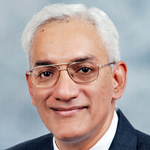
    According to Abhishek Karnani, Chairman of the IAA Knowledge Conclave, the primary objective of the sessions was to get the top advertising and media minds to come together to reflect on ideas and strategies for emerging agency owners to take their companies to the next level. This, he said, was served in ample from the practical advices served at the Conclave.


  • Free Press Journal conducts Spell Champ in Indore

    By A Correspondent


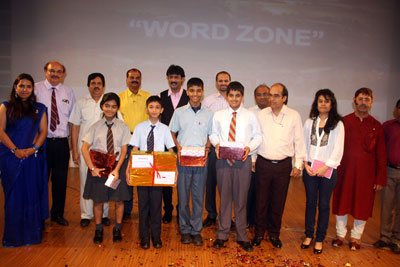
    Spell Bee champions elsewhere in the world, watch out! Kartikeya Dhakad, a student of Sri Satya Sai Vidya Vihar in Indore, showed the same grit and determination that international winners showed when he became the “Spell Champ” at a competition organized by The Free Press Journal to search for students with outstanding spelling skills in schools across the city on Thursday, October 3.


    The competition held at the Dhirubhai Ambani Auditorium of Daly College was tough as Kartikeya lifted the winner’s trophy and took home a laptop after wowing everyone with his splendid ability to spell out words quicker than his fellow contestants. Dev Seth of Emerald Heights International School and Isha Bhorkar of Choithram School were first runners-up while Amogh Kawathekar of Daly College won the third place.


    Abhishek Karnani

    As many as 61 contestants from 20 schools participated in the event that was sponsored by Amul Pro. The grand finale began with lighting of the traditional lamp by Abhishek Karnani, director, Free Press Group of Newspapers, director incharge Pravin Nagar, Group Brand Consultant Debu Mishra and General Manager (marketing) Shailesh Tiwari.


  • IAA webinar with SAP’s Chief Storyteller Julie Roehm today

    By A Correspondent


    The International Advertising Association (IAA) India Chapter has announced its next webinar on ‘World goes Digital’. Ms. Julie Roehm, Chief Story Teller, SAP, will be the speaker at this webinar using the Google Hangout platform. The Google Hangout session will be held at 5.30pm today (Wednesday, July 24, 2013).*


    Srinivasan Swamy

    Said Srinivasan Swamy, president, IAA India chapter, “We began with Rajan Anandan in April, followed it with Ajit Balakrishnan in May and Nishant Rao in June. We are seeing increased participation, and are glad that this knowledge sharing platform by IAA is allowing us to get some of the high profile speakers from across the world who could make a big difference in people’s digital journey.”


    Abhishek Karnani, director, Free Press Journal and Manish Advani, head – marketing and public relations, Mahindra Special Services Group, are co-chairing the IAA webinar series.


    Abhishek Karnani

    “Looking at the way digital is growing, customers in the future will buy products or services based on the stories or experiences of existing users,” said Mr Karnani.


    “Being in the consulting business what we sell is a concept which is difficult to sell the way other products and services are sold, the only method which has worked well for us is Story telling which makes our customers experience what they could expect if they engage us on an assignment,” said Mr Advani.


    *MxMIndia is a partner of the IAA webinar series


  • Video’s the way to go: Ajit Balakrishan @ IAA Webinar


    The International Association of Advertisers (India Chapter) conducted its second webinar on Thursday, May 23 with Ajit Balakrishnan, Founder and CEO, Rediff.com. The IAA Webinar series with the theme ‘World Goes Digital’ is spearheaded by Abhishek Karnani, co-chair and director, Free Press Journal group and Manish Advani, head – marketing and public relations, Mahindra Special Services Group. *


    The panellists included: Abhishek Karnani, Co-chair, Director, Free Press Journal; Ajay Pandey, founder and CEO, Badhai; Gaurav Mendiratta, CEO, Sociosquare; Aditya Kuber, CEO, Media Sphere Communications and K Narssimhan, CEO, Commit. Pradyuman Maheshwari, Editor-in-chief and CEO, MxmIndia moderated the event. Other than the panellists, some questions that came in from the public in response to our announcements on social networks were also posed to Mr Balakrishnan.


    Excerpts from the Q&A:

    Opening Remarks by Ajit Balakrishnan, CEO, Rediff.com

    There is little doubt that the internet has come a long way since all of us started messing around with it around 18 years ago. The way I look at it is that it has often been a surprise to me that the web technology and internet happened first in the media world and my suspicion is that very soon we are going to see internet and web-based thinking in trade areas like education, healthcare etc what I call as the less-frivolous parts of human endeavours. I for one, am looking forward to that.


    Q. With a large number of players venturing into the digital space, how according to you can brands fight with the larger players and continue to make a mark in the digital media space?

    Ajit Balakrishnan: Let me say that every giant killer started off by being small. I remember Google when it started in 2000 was a tiny company with revenues to the tune of US $35-40 million. I think the successful ones that we have seen throughout the world tend to offer some consumer promise in a new technological way, which they manage to deliver. If you manage to do that at all times then you have a chance to upstage the big players. I have no doubt about that whatsoever; the field is wide open at all times.


    Q. You have been a pioneer in the industry and have seen the industry grow from nothing to what it is today. Have you seen any change in the customer behaviour and expectations on the medium as yet, and, what is the change you foresee in the next 3-5 years?

    Ajit Balakrishnan: My guess is that India is at a very early stage of revolution of the internet and the number of users in India who have unconstrained access to high-speed internet on mobile as well as PC is very small. So what has happened so far is that about 12-15 million users in India have so far access to high-speed internet which in relation to about 300 million middle class Indians is a very small number. So it’s a relatively English-speaking, mostly westernised group of people who tend to follow latest trends and what is going on latest in the US and whose brand values are built around the internet. I think that when this number rises from 12-15 million users to around 200 million users in the next 3-5 years by that time you will see more typical Indians landing up on the internet. The first likelihood is that people at that juncture may not necessarily be coming from an English background and secondly, what they do on the internet will also be different – doing more of social. Some of you will remember that in the mid-80s on television there were only a handful English channels that was ruled largely by Star. Then, a pioneer in Subhash Chandra stepped in and broke the rules of the game. Today, English-language television is a very small proportion of the total. So one will see such kind of initiatives taking place in the near future. But, it is still early days and things like email or social messaging will take precedence. In the early stage of all that is happening, technology is very important. I think technology-oriented pace will continue for another 3-5 years. Post that there will be a blending of mediums like content, applications that will be blended with technology…it will become more media applications oriented.


    When you started Rediff, what did you expect in terms of users or economic outcome…?

    Ajit Balakrishnan: I did not start hoping for any financial outcome from entrepreneurship. I saw an interesting idea at that time and was fascinated by the possibilities that the internet had to offer. I was fascinated by the possibilities of the internet by watching Compuserve and AOL experiment with the medium. So I told Arun that I am going to take a room somewhere in Fort, South Mumbai and figure out where this has to go. So I didn’t have the faintest idea where this would go to but yes, even today it is very unclear to me where the internet is headed next. I personally think that the technological tricks dominated the trade are going to pass in a year or two. In fact among the top 100 companies, everybody uses the same technology; there is nothing unique one can do. The problem in India is that early adopters of sophisticated technology are very small but all that will change soon.


    The same could be said of Rediff as well which has undergone a change in the way it now presents itself on the online space. Is that an indication of the changing times…

    Ajit Balakrishnan: We essentially took a ‘tight look’ as one would like to call it. Web is increasingly becoming a visual medium today. That is different from 10-15 years ago where it used to imitate the newspaper paradigm. But it is now moving to be a visual metaphor. There is a big swing being observed towards video as well but as yet nobody in the world knows how video on internet will play out. But one part of it is where pirated video is played out more and the second part of it is bloopers. Nobody knows what will be the grammar of the 2-3 minute video but I am sure it will arrive soon. In the early days of television there were not much popular sitcoms, people played movies. But then the sitcoms arrived with 2-3 slots for ads, so something like that will happen for 2-3 minute videos as well.


    What according to you will be the low hanging fruit that will make the fence-sitters start using this second screen to complement television, newspapers etc?

    Ajit Balakrishnan: I feel the reason why digital ad agencies are not as big as the others is because they tend to be conservative. I have been on that side so I know how it happens. Their best clients are typically the ones that are very large and that make products for mass media conservative audiences. Be it a Colgate or the others, the main market for such clients is outside the sophisticated audience. The internet doesn’t make as much sense to them because their growth comes from smaller towns and rural India. So, big ad agencies tend to be full of such clients. But there are clients in the financial services sector for example, who love to have a sophisticated audience. I’d say do not give up, wait for 2-3 more years and you will see big bucks coming to the sector.


    What problems do you face in online shopping for Rediff where you have many big players in the space?

    Ajit Balakrishnan: As a group, there are lot of things that are going good for Indian online e-commerce sites like us. First is that private equity has more or less withdrawn from organised retail. So if you are based in some Tier 2 town and you cannot find a good phone in a retail shop you can rush online and shop for your product from there. There has been a sudden explosion in 2011-12 in the range of $ 600mn that has been pumped in the Indian e-commerce sector across say 50 companies. That has woken up the e-commerce industry in India. This injection of capital and excitement has made a player like us grow by 100 per cent year-on-year. While that is good news, the bad news is that infrastructure around e-commerce has not yet developed. For example, if you have a credit card you can shop easily but the failure rates with debit cards on the internet tends to be in the range of 40-50 per cent. The reason for that is that for debit cards to work well through banks it has to be communicated well through an internet high speed line and that kind of telecom service will be tougher to achieve in smaller towns and cities. So while there are 100 million debit card users there are only about 8 million credit card users. But this problem is being looked into. Once this problem is sorted the debit card e-commerce will jump up.


    The other thing is that the cost for courier companies is high in relation to margins. So the courier companies need to be much more efficient and make money in no more than Rs 10 per delivery. This is the reason why some players have their own delivery people to capture the imagination of the public. But there are some who are doing a good job compared to Blue Dart and the others that follow a hub-and-spoke model. But like all things in India, these things take some time but when it happens it happens very well. E-commerce is about 2-3 years away from a gigantic boom in India.


    How big a role do you see for video playing on the internet in India?

    Ajit Balakrishnan: The thing about video is that it jumps over the language barrier. The fact is that Indian language-based internet has not taken off at all but with video, you leapfrog that barrier. So video is indeed terrific. In fact the sales people keep telling me that the ad agencies have woken up from their slumber on the internet and they love video because that is something they understand well. So video is destined to be successful.


    The problem that small companies face is talent who get lured away by MNCs after working for a year or two with us. How did you confront a challenge such as this?

    Ajit Balakrishnan: This is not a new problem that any new enterprise faces in Mumbai or elsewhere. There are plenty of jobs and lots of talented people mingling together. This problem will continue to happen at any stage in your professional career. When you grow a little older, things like stock options are technical ways of holding things back but I think that there is a pattern among people you recruit. Some who love the idea of doing innovative work, some who love security, some who like the thrill of changing jobs every year. There are guys my age who have changed some 20-odd jobs. So there are things that you cannot control but try and build an anchor group of 5-6 people whom you feel will be critical to the success of a business. The risk with that again is that those who are among your core group today may not be with you tomorrow. While we had the stock option scheme for us it does not work in every industry. But I can promise you that hiring and retaining talent will remain a 24-hour job and will be so at all stages of your life and not just the start-up.


    How do you mass-produce content that is creative and engaging enough?

    Ajit Balakrishnan: We don’t need to mass-produce content, we should see how we can cost-produce content especially for a 2-3 minute video. I think at most it costs just 5 lakhs but the idea is much more important there than the grand production. I think with television it has come to a point where the ads costs at least 1-2 crore behind an idea which is laughable. I think they have bought this upon themselves. But nobody knows what kind of an idea would work. We are in a situation which Charles Dickens was or the book publishing industry was in the 1830s. Charles came in and showed with ‘Great Expectations’ how we can write a book and we all know that there were more than hundreds of imitators after that. We need such kind of creative geniuses.


    In India, most ad revenues go to global top 5 websites that works up roughly to about 75 per cent. What is left for everyone else is a small pie. What do you foresee of this trend?

    Ajit Balakrishnan: Advertising has such a trend where the winner takes it all; it is not just a web phenomenon. Take the newspaper industry for example, whoever is No 1 takes about 60 per cent of the revenues while the No 2 takes in another 20 per cent. So from No 3 to 10 barely mange to hang in while all the others hang in for prestige reasons. A similar thing is observed with channels as well where the top 2-3 players take in 70 per cent of the ad pie. So media is akin to ‘winner takes it all’ situation partly because audiences tend to gravitate towards what is most popular. The internet space also such a practice but that will change as the industry evolves. People who mix technology and creativity platform will emerge winners. When things begin to change there is an opportunity to move in. I have seen many creative companies that have created successes especially from Korea. I think it is possible in India too. First we have to get the audience then the revenues will follow.


    As an industry, we still hover around the 4-5 per cent ad pie. At Rediff, have you taken any initiatives to increase the pie at a faster pace?

    Ajit Balakrishnan: Where ad spends is concerned, my sense is that big agencies should control about 90 per cent of spends in India. I think they are looking for ideas. If each one is able to produce one success story for brands, overnight the pie could increase significantly.


    With the youth taking to the web in a big way for content consumption, do you foresee the beginning of the end of live television in 5 years time from now? Do you think there will be convergence of internet with television for content consumption?

    Ajit Balakrishnan: I think it is a trend of time-shifting today. It started with the VCD/VCR device that enabled us to record and watch content at leisure. The youth of today are similarly doing time-shifting and watching it whenever they please. The television audience is so large that there are lots of audiences who have nothing to do most of the time. These families will prefer the social family programmes and watch it with friends and family. I think these trends will co-exist.


    Do you see independent publishers including bloggers becoming financially independent in India?

    Ajit Balakrishnan: I am a great proponent about blogging and I think the innocence about the internet was blogging. Individuals who had ideas could go and publish it without the consent of publishers and editors…that is the touching thing about the internet. Unfortunately, the business model has not yet developed but I am sure that it will develop soon. For example, if you see the NY Times paper, you will want to read the columnists first. I keep wondering what if somebody decides to have his own blog; what are they going to do? Many of us will go directly to the blogs. So in a way the magazines and newspapers ought to be threatened. So why is blogging not economically sustainable in India is because of the scale. If there are 300 million users and if even 4-5 million users come to your blog the ratio would be about $2 per user per year. You will end up being a blogger with about $ 3-400,000 a year. That is much more than what you would get if you work for somebody. So we are waiting for scale to come about but blogging will be about text and video in the future.


    If you were to invest $ 1 million in digital in the next two years what would be the three ideas that you would chase?

    Ajit Balakrishnan: It’s a tough one but let me give it a try. I think one will be where there is a language application which does not depend on English or anything; probably more voice-based in approach. The other would be something that will be big for professionals like lawyers and doctors because their business models are local in nature. The web will allow them to practice across more places. So an idea that will enable them to expand their business models further. The third would be doing something in education but I am not sure what. These three are likely to be models that will be successful. And all these will also be highly successful on the mobile platform.


    • MxMIndia was a partner to the IAA Webinar

     

  • IAA launches webinar series, Google’s Rajan Anandan to address inaugural session on April 25

    By A Correspondent


    The International Association of Advertisers (India Chapter) has announced its next interesting initiative – the Face 2 Face series with the theme ‘World Goes Digital’.*


    Srinivasan Swamy

    Speaking on the new initiative, Srinivasan K Swamy, President, IAA India Chapter, said, “With digital media gaining prominence, an increasing number of advertisers are reaching out to consumers via the internet and mobile platforms. However, there is still a fair deal of inertia when it comes to embracing the interactive world. With the Face 2 Face webinar series, we hope to connect professional marketers and agencies with trends, ideas, strategies and success stories from the digital frontier.”


    Abhishek Karnani

    Abhishek Karnani, Director, Free Press Journal and Manish Advani, Head, Marketing & Public Relations, Mahindra Special Services Group, are co-chairing this IAA webinar series. “Our attempt is to build a platform where professionals can share knowledge and experience on the digital medium. The interface will allow a live interaction with each of the experts we will bring to the series,” said Mr Karnani.


    “We are using the Google Hangout platform for the interaction. And coincidentally, we have Mr Rajan Anandan, Managing Director, Google India, in our inaugural session on Wednesday, April 25 at 3pm,” said Mr Advani.


    In the last few months, the International Association of Advertisers (India Chapter) has conducted a series of activities – the IAA Leadership Awards, a unique Gender Sensitization Seminar, the IAA Olive Crown Awards, and the monthly “IAA Debates” on topical issues concerning the industry.


    *Disclosure: MxMIndia is partnering this IAA initiative


  • Free Press inks editorial tie-up with Outlook group

    By A Correspondent


    The Free Press Journal newspaper and the Outlook group have announced a collaboration under which the newspaper will carry select stories from the magazines Outlook Business and Outlook Money on the business pages of the daily.


    The collaboration will help the FPJ, as the newspaper is popularly called, expand its coverage, particularly in the BFSI sector, and as also help the Outlook magazines reach out to a wider target audience in Mumbai.


    The tie-up was effected last week as the Outlook magazine stories began appearing effective Friday, January 11


    Indranil Roy

    Said Indranil Roy, President of the Outlook group, “We have collaborated with the Free Press Journal newspaper to ensure that our content reaches out to a wider targeted readership base in Mumbai. The unique co-operation drives value by enlarging the target audience of Outlook Business and Outlook Money, taking our content and perspective right on to pages of a daily newspaper. In essence, the newspaper readers will now have the benefit of our perspective sitting next to the FPJ stories of the day on key sectors like banking and finance.”


    Abhishek Karnani

    Said Abhishek Karnani, Director of the Fress Press Journal: “The collaboration with the Outlook group is yet another step in our journey to expand coverage, lend new perspective and offer more value to our growing base of readers in Mumbai. Select stories from Outlook Business and Outlook Money will help us add to our growing coverage on the business pages of the newspaper. We will continue to invest in the newspaper as we build on our offerings to meet the changing aspirations of our readers in these times.”


  • Promising tales of tiny, tall agencies


    By Johnson Napier


    The last few weeks were rife with news of independent — or shall we say not-so-big — advertising agencies that were going all out to make their presence felt in the M&E space in India. Whether for the awards they had bagged across festivals or the largescale client wins that they had managed to pocket in their kitty, these agencies were in the news for some reason or the other. But while it may be the ‘popularity’ tag or the affiliation to a large parent company that may have done the trick for these agencies, there are others that fall shy of this honour.


    For instance, one may have faint acquaintance with an agency that goes by the name Apex Advertising or for that matter Flagship Advertising but if one were given a glimpse of the kind of clientele they have to boast – be it RBI, Taj Group of Hotels, BSNL, Pantaloon Retail, Pidilite Industries, MTV Networks etc – or even the kind of billings that they manage to pile up that ranges anywhere from Rs 5 to 50 crore, it would make for an interesting cover. And that’s precisely where the industry seems to be holding back or rather not giving these small yet powerful ad independents their due.


    This lacuna is currently being addressed by veteran print player Free Press Journal, that has come up with an interesting coffee table book titled ‘Tiny Tall Tales’. As the tagline suggests, this book plays up the initiatives of small agencies that are making it big. Said to be a slice of the coverage from The Free Press Journal’s column ‘Small Size Big Ideas’, the book will be launched at FPJ’s second roundtable conclave on 22nd September by Lynn De Souza, Chairman and CEO, Lintas Media Group.


    Abhishek Karnani

    Throwing light on the thought-process and the merit behind warranting such an effort that has been the benchmark of FPJ for some time now, Abhishek Karnani, Director, Free Press Journal said: “There are around 180 accredited ad agencies in Mumbai but we always hear and talk about the Top 15 agencies. There is life beyond them and these not so big agencies are doing great work away from the limelight. These agencies also represent a substantial business and have close affinity with the clients. We are proud of this initiative of the Free Press Journal, where we have taken time to look not at the obvious leaders but at those who are important and often overlooked by the media. This outlook builds on our worldview that there is deep value in the big and the small and it is important to study the not-so-big to learn about ground realities and to spot trends and understand markets that much better.”


    Sharing his experience, Author & producer of the book Sandeep Singh said, “Traditionally if you see, everybody just loves to talk about the top 10-15 agencies but there is a whole volume of business that comes from smaller agencies. Some of them are intentionally small because they want to be creative or whatever way you want to look at it, but great works do come across from them. This book is an attempt to cover these agencies.” Elaborating on the participation factor on behalf of the agencies, Singh said, “Though a few agencies refrained from participating citing some reason or the other, the book profiles most of them. Also, it is worth noting that the minimum billing of the agencies in this book is around Rs 5 crore while the maximum is pegged at Rs 50 crore.”


    Elaborating on the scope and scale of the initiative, Jagdish Rattanani, Business Editor, Free Press Journal who along with his team has helped in putting together the book said, “We hear a lot about the top 10 or 15 small ad agencies in India who are spoken about and praised a lot by the media but if you go beyond there are these ‘not-so-big’ advertising agencies that are still big in terms of what they manage to bring to the table. They are big in being strong and powerful enterprises and are dealing with a lot of interesting ideas. We sensed that there was a lot of energy and growth potential amongst these small agencies. Also we found that nobody ever tries to cover them and understand their perspective or see what they might need in this era of change to make the next big leap. That’s what encouraged us in taking this initiative further.”


    As for the point on finding the cause to be an apt fit with the model with which Free Press Journal itself moves forward with, Rattanani asserted by saying, “Though Free Press Journal is not among the biggest of the big, it is but the oldest Indian-owned English newspaper in Mumbai. Basis this, we said that we have a special interest and focus on trying to look at the others who are as good but are not so big and thus started the journey of deliberately trying to exclude the very big and focussing on the not-so-big,” affirmed Rattanani. Adding further he said, “For this exercise, we ended up going and visiting these agencies and even ran features over a period of two years and tried to play up their point of view and perspectives. All said and done, the larger story is of the ideas that lie just beneath the surface.”


    On whether the initiative was carried out to bring about intangible benefits for the newspaper group in terms of revenue from advertisers, Karnani thwarted the thinking by suggesting, “We are rendering this as a Corporate Social Responsibility. Our only concern is to help this segment to take a leap to the next level. We want to empower the not so big ad agencies to not only survive but also thrive and outgrow the market in these times.”


    In fact the group is looking at other avenues to take forward similar causes on behalf of the industry. Asserted Karnani: “We have already kickstarted our Knowledge Series wherein we invite experts to come and share their views with this group. We are also in talks with international ad associations wherein we plan to use their platform to host events for the not-so-big agencies. Also, we are also hosting our second exclusive conclave “The Change That Cometh” that is focused on the not-so-big advertising agencies. So there is a lot to look forward to.”


    While it is too early to predict the outcome of the book from peers from the ad industry, Singh is hopeful that the book will receive a positive approval from all concerned. He avers: “I hope the bigger agencies are happy and take note of the initiative in a positive light.”


    As for its plans of coming out with a sequel to the book, Singh said, “We would like to explore an opportunity of coming out with a sequel to this edition but it is still early days to be talking about that.” Agreeing with Singh, Rattanani said, “I can only say that the idea is rich and we can build on this idea but how the idea will further shape up only time will tell.”


  • With Nai Dunia in the bag, Jagran is #1 print group


    By Archita Wagle


    There was no press conference announcing the deal. The Kanpur-based Jagran Prakashan Limited (JPL) simply did it by notifying the stock exchanges. The acquisition of Nai Dunia was done via Suvi Info Management (Indore) Private Limited which in turn owns Naidunia Media. It was an all-cash deal.


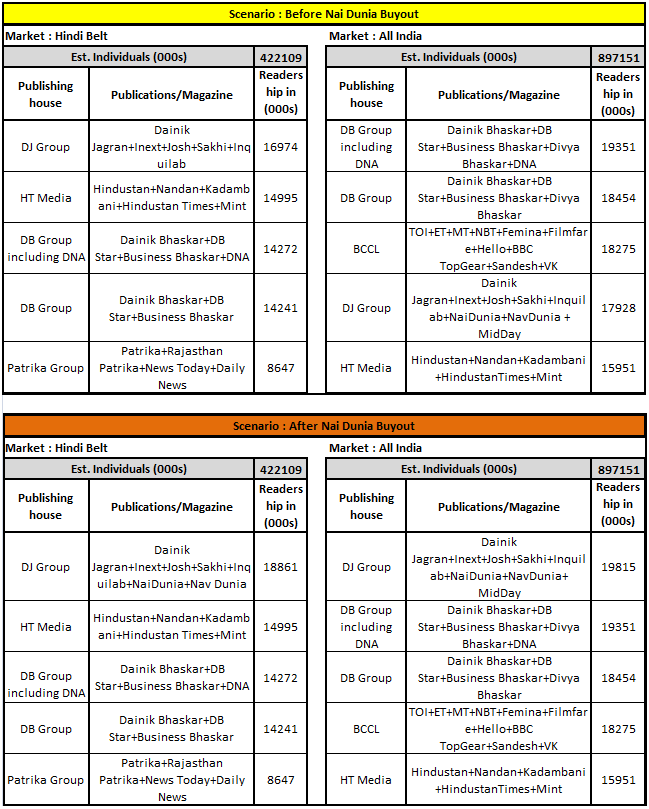
    What it does for the Jagran group is significant as its hold on the Hindi belt becificant, a factor that could help strike better contracts with advertisers. In fact, as an analysis with IRS 2011 Round 4 numbers shows, the Nai Dunia acquisition has helped JPL become the numero uno print media group in the country (see accompanying story: Saala Jagran No 1 print media group ban gaya…)


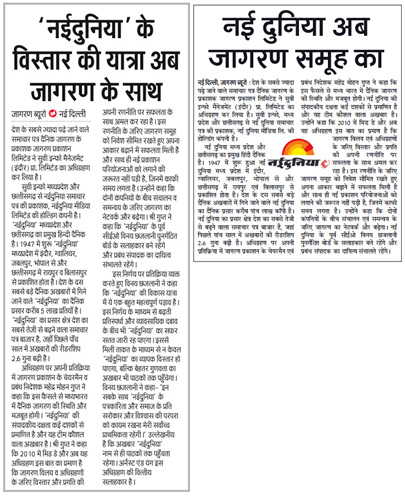
    Announcements of the deal on the front pages of Nai Dunia (left) and Dainik Jagran (right)

    According to an analyst from a domestic brokerage firm, this deal makes sense to JPL as the enterprise value assigned to Nai Dunia is Rs2.25 billion and had JPL planned a greenfield expansion in MPC, the total cost could have run into at least Rs3 billion.


    In an email interaction with MxMIndia, Mr Amit Jaiswal, Company Secretary, JPL clarified that JPL has acquired only Nai Dunia. NewsX and Webdunia are not a part of the deal. Talking about the changes after the deal he said: “Mr Vinay Chhajlani will continue as Advisor to Board. His vast experience of print and knowledge about the market will be quite useful for us. We will add some new members to the team at senior level in sales, marketing and editorial. Our corporate brand team will help in branding and communication. As far as the staff, the erstwhile promoters have already rationalized the staff strength to a large extent.”


    Commenting on the acquisition in a communique, Mr Mahendra Mohan Gupta, Chairman and Managing Director of Jagran said, “This was a logical market expansion for us and enables us to strengthen our presence in Central India. Nai Dunia is a newspaper with a very strong team and has demonstrated editorial excellence over the last decade.”


    Nai Dunia is the flagship publication of Naidunia Media Limited, which was launched June 5, 1947. Nai Dunia features amongst the top 10 Hindi dailies of India and has multiple editions in MP and Chhattisgarh and is the third largest read newspaper in Madhya Pradesh and the fourth largest read newspaper in Chhattisgarh (IRS Q4 2011). According to a Jagran communique, Nai Dunia’s current circulation base is around half a million copies per day with the readership growing 2.6 times over the last five years.


    The industry is almost unanimous in saying that the deal is windfall for both the parties involved, especially JPL, which can now enter the Madhya Pradesh-Chattisgarh (MPC) market. JPPL, controlled by GD Gupta family publishes the Jagran editions in Bhopal and Rewa in Madhya Pradesh and JPL, promoted by the PC Gupta family, has been barred from using Dainik Jagran banner in MP as it has been in litigation since 2007. But with the Nai Dunia acquisition, the other option for JPL, they are entering the MPC market with an established newspaper, which is the second largest newspaper in terms of readership and business volumes in MPC.


    “JPL will benefit in terms of circulation and readership as it gets two new territories, Madhya Pradesh and Chattisgarh, with the acquisition of an established and well-known newspaper. JPL couldn’t enter Madhya Pradesh as per the agreement in the family, but now taking over Nai Dunia has opened the MP market for them,” said Mr Vijaydutt Shridhar, senior MP-based journalist and ex-editor of Navbharat.


    Mr Abhishek Karnani, Director, Free Press Journal which also has an edition in Indore, echoed Mr Shridhar’s sentiments: “The takeover deal is a windfall for both, JPL and Nai Dunia. Entering the MPC market was the next logical move for JPL. Initially the market had only Dainik Bhaskar and Nai Dunia but several local new publications with strong backing were launched in the market. Nai Dunia made a smart move in selling out rather than being marginalised in the market.”


    Says Mr Sundeep Nagpal of leading media consulting firm Stratagem, “This is in line with what other leading groups have done – like the Times of India group did with Vijaya Karanataka.” According to Mr Nagpal, the acquisition is a win-win for all parties involved.


    “With Nai Dunia’s acquisition, JPL has gained foothold in an important and growing market for Hindi publications. Nai Dunia never grew much beyond Indore, though they had launched editions in other cities. But with an aggressive player like JPL taking over we can expect to see Nai Dunia growing in other centres too. JPL has now entered Dainik Bhaskar’s territory. We can now expect a good fight,” said Mr Janardhan Pandey, associate VP, DDB Mudra.


    Stockmarket analysts though are a little cautious about this face-off as they believe that DB Corp will not be impacted because of the entry of JPL from a short to medium term perspective. But they say that Patrika would be impacted as Jagran would become aggressive to win back the No. 2 slot in MPC. The analysts also feel that the price paid (net of tax benefits) is inexpensive and should derive benefits in the medium to long-term.


    For the cash-rich Jagran group, the Nai Dunia acquisition follows that of Mid-Day two years ago and the management plans that Nai Dunia will be consolidated once a year just like Mid-Day.

    Saala Jagran No 1 print media group ban gaya…

    By A Correspondent


    Question: Until last fiscal, which was the largest print publishing house in the country?

    Answer: No, the answer is not Dainik Jagran. It’s Dainik Bhaskar, In fact, Jagran was at No 3 until two days ago, just behind the BCCL group. But with the buyout of the Nai Dunia group, Jagran now becomes the largest print media group in the country. Check tables below:


    Note: MRUC does not share detailed IRS numbers with the media. Given that we had adequate time for the confirmation of the Nai Dunia buy, we collected the information from what MRUC shared with us and from respective media entities.