Blog

  • @FF12: Dedicated tee time as Ten Golf is launched

    By A Correspondent


    Taj Television India Pvt Ltd has announced the launch of Ten Golf, a dedicated 24-hour golf channel. Ten Golf is the fifth channel from Taj Television India Pvt Ltd and began transmission on March 15, 2012. The dedicated golf channel will showcase a mix of live, non-live and feature programming. The channel will also broadcast live, high quality Golf action from around the world.


    Speaking on the occasion, Atul Pande, CEO-Sports Business, Zee said, “India as a sporting nation is fast transforming from a single sport to a multi-sport nation. As India’s leading sports broadcaster we understand that the sports consumption pattern of the Indian viewer raises the need for specialized differentiated sport channels and this is what we hope to deliver to our revered golf viewers. Along with live golf action, Ten Golf will also showcase feature programming on golf including magazine shows and archival programming; making Ten Golf the most comprehensive golf channel in the broadcast space.”


    Ten Golf has acquired rights for European Tour and Asian Tour till 2016, and has also entered into partnership with PGTI for three years to telecast the Indian Tour. Further, Ten Golf will be telecasting 400 hrs of golf programming in association with NBC.


  • Anil Thakraney: Are you cultured?

    By Anil Thakraney


    A senior executive quit Goldman Sachs, and his resignation letter has gone viral. In fact, it’s a hot topic of discussion on Wall Street even as you read this. Full marks to the man for standing up for what he believes in. For sure the officer will be black-listed in the corporate world (as most whistle blowers are) but he will walk with his head held high for the rest of his life. Here’s the full text of his resignation letter, in case you haven’t read it.

    http://www.ndtv.com/article/world/why-i-am-leaving-goldman-sachs-186001


    What got me interested in this issue is the said executive’s reason for quitting: the organization’s culture had eroded and that was unacceptable to him. Haven’t many of us experienced this situation in our careers? Most of us don’t chuck our jobs because of this, but it’s a fact that an organization’s culture is important to its success. And yet, in the chase for profitability, this truth is often ignored. The result is loss of focus and staff friction across all levels.


    The best definition of an organization’s culture is the one I learnt in management school and it’s stuck into my head. It’s about ‘How the employees behave when no one is looking’. If there is a culture existent in an organization, then all employees would behave identically in a given situation. For example, at the Taj, if a piece of paper is found lying in the lobby area, chances are any staffer would quickly pick it up, right from the general manager to the waiter. That’s culture.


    I have noticed that organizations do start out with a clear, identifiable culture. But as the leadership changes, or as more money comes in, it’s quickly forgotten. I’ll give you another example. I once worked in a large ad agency and it used to be entirely client-led. Pleasing the client at all costs was the culture. The sort of people who were hired believed in that. And this percolated down the line. Even the peon treated the visiting client as god. Later when the top leadership changed, the agency’s culture changed to creativity. I don’t work there any more but I suspect every employee, perhaps even their admin staff, thinks of different ways to do routine things.


    [youtube width=”400″ height=”200″]http://www.youtube.com/watch?v=yotq4zr0dRc[/youtube]

    Shut your eyes and ask yourself a question: What culture does my organization have? If the answer is a blank or if it’s something that goes against your core values, it’s best to move on. Like the gentleman from Goldman Sachs.


    ***


    PS: Johnson’s captures the mother/child relationship wonderfully. A simple idea. Instead of a regular voice-over, they have imagined what a child might think of his/her mum. And that makes the emotions flow.


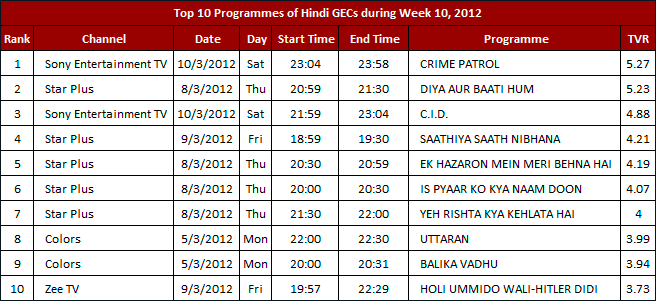
  • TAM data Top 10 programmes on HGEC – Wk 10 ’12


    Source: TAM Peoplemeter System
    TG: CS 4+ yrs
    Market: Hindi Speaking Market
    Period: Wk 10: Mar 4 to 10, 2012


    About TAM Media Research


    TAM is a joint venture between Nielsen Company & Kantar Media Research. Besides measuring TV Viewership, TAM also monitors Advertising Expenditure of Television, Print & Radio through its division AdEx India. Since 2004, it extended its presence in the PR Measurement & Analysis space for Corporate/Marketing Clients by setting up a separate division Eikona PR Measurement.


    In 2007, the joint venture introduced RAM (Radio Audio Measurement) service to track Radio Listenership for the Indian Radio Broadcast Industry. In year 2009, TAM launched a division, called TAM Sports that specializes in monitoring Sports Sponsorship ROI.


    TAM Media Research’s objective is to fuel media insights that will drive the growth of the Indian Media Industry.


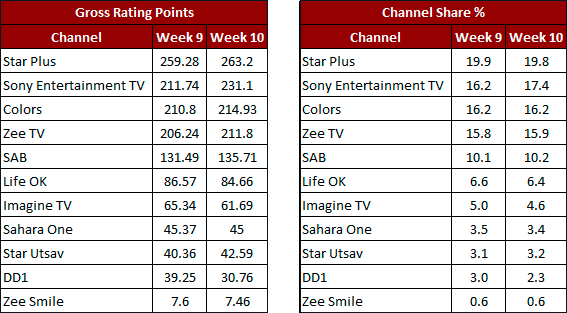
  • TAM Data (GRPs Channel shares of HGECs)- Wk 10 ’12


    Source: TAM Peoplemeter System
    TG: CS 4+ yrs
    Market: HSM
    Period: Wk 9: Feb 26 to Mar 3, 2012
    Period: Wk 10: Mar 4 to Mar 10, 2012


    About TAM Media Research


    TAM is a joint venture between Nielsen Company & Kantar Media Research. Besides measuring TV Viewership, TAM also monitors Advertising Expenditure of Television, Print & Radio through its division AdEx India. Since 2004, it extended its presence in the PR Measurement & Analysis space for Corporate/Marketing Clients by setting up a separate division Eikona PR Measurement.


    In 2007, the joint venture introduced RAM (Radio Audio Measurement) service to track Radio Listenership for the Indian Radio Broadcast Industry. In year 2009, TAM launched a division, called TAM Sports that specializes in monitoring Sports Sponsorship ROI.


    TAM Media Research’s objective is to fuel media insights that will drive the growth of the Indian Media Industry.

  • AbsolutData expands Senior Management team in India

    By A Correspondent


    Global analytics firm AbsolutData Research & Analytics has recently expanded its top management team in India. The new additions to the team will operate out of the Gurgaon, India office of AbsolutData.  A company statement said the expansion is a crucial step forward in supporting the company’s aggressive growth plans for its business activities globally.


    Sundar Ramaswamy has joined as Chief Operating Officer. He has close to 15 years of experience across consulting, off-shoring and outsourcing. Prior to joining AbsolutData, he led the Global Analytics capability at McKinsey and Company, and before that close to seven years at Accenture as consultant.


    Abishek Sawhny has joined as Chief Financial Officer. He has over 20 years of work experience across consulting and industry in England, India and US.  His experience ranges from strategy consulting, cross border company purchase and sale, diligence, funding, ERP, tax and audit.  He was CEO of Tensys, USA, CFO at RMS, and has worked at Arthur Andersen, Tilda, TeamCube, Wagner & Partners, Morgan Brown & Spofforth.


    Rahul Monie has joined as Chief Technology Officer.  He has 22 years of experience across IT business solutions, ERP, data center services, product development, etc. He has successfully run technology startups and managed P&Ls in large organisations. He was Director Engineering at Firstrain, a US based leading provider of search-driven research applications. Prior to that he was at Comsat Max involved with Design, Network Security, Enterprise Data Centres for managed IT infrastructure and outsourcing services. He was at Microsoft Consulting Services leading North & East India branches and before that leading technology at The British Council for SAARC region.


    AbsolutData CEO Anil Kaul said, “AbsolutData has been a leading player in providing Marketing Analytics services to global organizations. With this expansion of the India team, we are adding significant and broad industry experience, business delivery skills and senior leadership to our management team. I am very pleased to welcome the addition of Sundar, Abishek and Rahul to the AbsolutData team”.


    Founded in 2001, AbsolutData is a global consulting oriented analytics firm headquartered in San Francisco.


  • Amir Kassaei, Prof John Philip Jones & Rishad Tobaccowala to speak @ Goafest

    By A Correspondent


    The Goafest Committee has announced the names of three renowned speakers for Goafest 2012 Knowledge Seminars. Amir Kassaei, Chief Creative Officer, DDB Worldwide, Rishad Tobaccowala, Chief Strategy and Innovation Officer, VivaKi and Prof John Philip Jones, Emeritus Professor at the Newhouse School of Public Communications, Syracuse University, New York will impart their knowledge and expertise at the Goafest 2012 Knowledge Seminars to be held on April 20 and 21.


    Commenting on the exciting lineup of speakers for Goafest 2012 Knowledge Seminars, MG. Parameswaran, Member of GoaFest Committee said, “We have lined up a galaxy of globally renowned speakers with an interesting mix of creative, branding, digital and media experts for the Knowledge Seminar this year. We conducted a survey last year and realized that the young delegates wanted Goafest 2012 to cover all aspects of communication at our seminars. Hence we left no stone unturned to get the best speakers to enrich and enlighten young minds this year.”


    “To reiterate our promise of having a bigger and better Goafest 2012, we have brought the best minds from across the globe to be a part of the fest and engage in conversation through their thought provoking ideas and discussions. I am certain that these speakers will add immense value to our event,” added Arvind Sharma, Chairman, Goafest Organizing Committee.


    Amir Kassaei is the Chief Creative Officer DDB Worldwide and one of the most lauded creatives in the world. Born in Iran, raised in Austria, and educated in France, Amir settled in Germany in 1997, gaining experience early in his career in a variety of roles ranging from Account Manager to Strategic Planner to Art Director and Designer at agencies such as TBWA, Barci & Partner and Springer & Jacoby. At Springer & Jacoby, Amir advanced from Copywriter to Creative Director and finally to Executive Creative Director on the global Mercedes-Benz and smart accounts. In 2003, Amir joined DDB as Chief Creative Officer and Associate Partner of DDB Germany, where he quickly helped reshape the agency. After joining the agency as the youngest DDB Chief Creative Officer in Europe, he quickly transformed it into one of the most creative and successful agencies in Germany. Under Amir’s leadership, DDB Germany has also been ranked the most awarded German agency in the Gunn Report. During his tenure at DDB Germany, Amir founded and established Tribal DDB Germany as a modern and multichannel agency. Amir and his teams are the recipients of more than 2,000 national and international awards, including 40 Cannes Lions in the past five years.  He was named TheBig Won Report’s Top Chief Creative Officer” in 2009, and has been one of TheBig Won’sTop 3 Chief Creative Officers for each of the last three years.


    Rishad Tobaccowala helps guide strategy and serves as a catalyst to innovation efforts across Vivaki – a Publicis Groupe entity that combines the collective scale, clout and talent sitting inside of Denuo, Digitas, Razorfish, Starcom MediaVest Group (SMG) and ZenithOptimedia. Working closely with brand CEOs and VivaKi Country Chairs, he helps VivaKi’s companies show clients the way forward in an exciting and changing time for marketing.


    Prof. John Philip Jones was born and educated in Britain and graduated with the Economics Tripos from Cambridge University (BA with Honors and MA). He spent twenty-seven years working in the advertising agency business, mainly in branches of the J. Walter Thompson Company in Europe and as a market researcher and manager of the advertising for major international clients. For eight years he was international account director on Unilever’s Lux Toilet Soap, the largest-selling bar soap in the world. He has also published sixteen books and 100 articles in professional and academic publications: all on branding, marketing and advertising.


    Goafest 2012 is being organized by AAAI and Ad Club Bombay in partnership for the 5th year. Over the years, specialist areas like Out of Home & Ambient, Design, Digital & Mobile Advertising, Direct, and Integrated Advertising have been growing in importance. In recognition of this phenomenon, in 2012, Abbies at Goafest will have provision for Grand Prix in all the nine verticals- the Grand Prix is being introduced in the media awards as well.

    Click here to view all Goafest 2012 stories


  • LinkedIn survey shows luck helps career, Indians believe

    By A Correspondent


    Professional network LinkedIn has released data about global professionals’ perceptions of the role Lady Luck has played in their career trajectory.


    LinkedIn has more than 150 million members worldwide and over 14 million in India.


    LinkedIn surveyed more than 7,000 professionals globally and found that 84 percent of professionals do believe in career luck. Forty-eight percent consider themselves to have better luck in their careers, compared to other professionals.


    Seventy-nine percent of the more than 500 professionals surveyed in India believe in career luck. Out of the fifteen countries in which LinkedIn surveyed professionals, India ranked as the fourteenth-luckiest country. Thirty-six percent of survey respondents report feeling slightly luckier, or much luckier, than other professionals.


    For professionals in India, the top five most important factors that contribute to luck are:

    • Learning from your mistakes
    • Having a strong work ethic
    • Having strong communication skills
    • Striving to be the best at what you do
    • Having strong technical skills

    Globally, the top five most important factors that contribute to luck are:

    • Having strong communications skills
    • Being flexible
    • Having a strong work ethic
    • Acting on opportunities
    • Having a strong network

    India is the only country with “Having strong technical skills” in its list of the top five factors contributing to career luck.


    “Progressing in their careers and moving up the organizational ladder is crucial for professionals across all levels. The objective of this survey was to discover how professionals perceive luck in their career growth,” said Hari V. Krishnan, Country Manager, LinkedIn India.


  • The Day After Cricket – Ormax survey of viewer recall

    By A Correspondent


    Ormax Media has announced the launch of the 3rd edition of its Cricket Advertising Recall & Effectiveness research – Day After Cricket (DAC), for brands advertising on IPL 5. DAC was launched in 2010 for IPL 3. In 2011, the research was conducted for IPL 4 and the Cricket World Cup.


    Day After Cricket research has two components. The first one involves day-after tracking, available as bi-weekly syndicated reports to advertisers and media agencies over the seven-week long duration of the tournament. This phase of research will be conducted across the six metros, covering more than 2100 IPL viewers over the course of the tournament.


    The second phase of DAC is post-event research customized to the brand’s requirements and target audience. In this phase, the impact of IPL on the brand’s equity will be determined, by measuring the difference in the performance of the brand on key attributes amongst viewers and non-viewers of the tournament. An advertiser can opt for either or both phases of the research, depending on its objectives.


    Speaking about DAC, Shailesh Kapoor, CEO – Ormax Media, said, “From a research perspective, there are two key deliverables in big ticket cricket advertising – Recall & Equity Impact. Recall needs to be monitored to understand if the brand has managed to stand out in the clutter. Equity Impact is the long-term influence of the campaign, measured in a way that nullifies the role of all other media or promotions, thereby isolating the specific impact of IPL on the brand.”


  • Tang introduces mango flavour

    By A Correspondent


    Come summer and everyone looks forward to the King of Fruits – juicy mangoes. Tang, introduced last year in India through Cadbury India, part of Kraft Foods, has launched the thick Tang Mango flavour in India. Delicious, refreshing and rich with the taste of mangoes, Tang Mango will give consumers the experience of a juicy mango-flavoured beverage.


    Convenient, affordable and available in delicious flavours, Tang provides mothers with an opportunity to make a quick, refreshing drink for their children by just adding water. Tang also contains vitamins A, B and C; and Iron that normally get depleted during the course of a hectic day in the life of today’s children.


    Announcing the new mango variant, Narayan Sundararaman – Director, Powdered Beverages, Gum & Candy – Kraft Foods, said, “We are extremely happy to announce the launch of Tang Mango, the first product in the Indian powdered beverage category in a unique thick format. Our consumer research showed that consumers prefer mango drinks that are thick, pulpy and give them the mango flavour and experience. Tang Mango has been developed in line with consumer expectations of consuming a thick and juicy mango flavoured beverage.”


    He further added, “We launched the ‘made-in-India’ Tang last year and the consumer response has been very good. We are working towards a bank of flavours that appeal to local tastes. We believe consumers are going to love Tang Mango and the experience that comes with it.”


    Tang Mango will be introduced through a new TVC campaign. Developed by Bates, the campaign is based on the theme of “Surprising Thickness” creatively rendered as ‘isse jaldi se kha jao’– “you will need to eat this”, playing closely on the experience of consuming a mango.


    Developed to suit the Indian palate, Tang Mango will be available in retail stores across the country in two pack sizes of 200 grams for Rs 40 and 500 grams for Rs 85.


  • Femina, L’Oreal announce Women Awards 2012

    By A Correspondent


    Women’s lifestyle monthly Femina in conjunction with beauty products brand L’Oréal Paris has announced the launch of women’s awards property ‐ the L’Oréal Paris Femina Women Awards 2012, in association with Rasvihar, to be held in Mumbai on March 22, 2012.


    The first ever L’Oréal Paris Femina Woman Awards will celebrate and honour the most accomplished women in the fields of art, music, education, business, social activism and cinema for their talents, grace and ability to inspire. The jury includes names from photography, film and the corporate world such as Gayatri Ruia, Jatin Kampani, Nandita Mahtani, Nathalie Gerschtein, Priya Dutt, Sulajja Firodia Motwani, Tanya Chaitanya and Zeenat Aman will choose the winners across various categories.


    Readers are also invited to vote for The Man We Love, The Woman We Love, and The Favourite Face of a Cause by visiting www.facebook.com/feminawoman. They can also participate in the L’Oréal Paris ‘Who’s worth it to you?’ contest by logging on to www.lorealparis.co.in. Commenting on the announcement, Tarun Rai, CEO, WWM said, “Indian women are making their mark in diverse fields including in the traditional male bastions. The L’Oréal Paris Femina Women Awards are both a celebration and a recognition of the achievements of Indian women in arts and entertainment as also science and business. Femina believes that the modern Indian woman can be all that she wants to be and these awards are a tribute to this belief. And we are very happy that L’Oréal Paris is our partner in this celebration.”

    Tanya Chaitanya, Editor, Femina said, “The first‐ever L’Oréal Paris Femina Women Awards set the spotlight on how much a woman can achieve if she believes in herself. Femina, having known the Indian woman for more than 50 years, hopes that the inspiring stories behind each of our winners will help our readers realise their own strength. To women power!”

    Nathalie Gerschtein, Director of L’Oréal Paris in India said, “Our legendary signature – “Because you’re worth it” – has empowered women over the past 40 years. These four timeless words are a reflection of women’s potential to express themselves. L’Oréal Paris is not just a leading beauty brand, but also a brand that embodies self‐confidence and empowerment. Today, being a L’Oréal Paris woman means being an individual with a charismatic personality, a determined outlook and a strong personality. We are happy to honor such women by partnering with Femina to host our first Women awards.”

    Readers can vote in the categories of Woman We Love; Man We Love; and Face of a Cause.


  • Debrief: No Fizz, only Ewwwwww!

    By Anil Thakraney


    This one might possibly be the worst TV commercial on air right now. Everything’s gone wrong out here. The Appy Fizz ad involves some very trite banter between actor Saif Ali Khan and his pals, as they lounge somewhere. The drink, which has come alive, adds in its two bits of nonsense. I am not even going to describe this ad, that’s too boring a task. Please watch it for yourself.


    [youtube width=”400″ height=”200″]http://www.youtube.com/watch?v=iWVoq1ePqx0[/youtube]

    Where do I begin? Saif Ali Khan? What’s the point of casting a middle aged angry actor for a ‘buddy hang out’ drink? How does he fit in? Next. Since the ad is entirely conversation based and nothing else happens aside from that, wit and sharp humour become key ingredients. To say the commercial is so-not-funny would be a mild statement. Truth be told, I haven’t heard such silly, juvenile banter amongst junior school kids. If the copywriter is weak on humour, he/she must avoid that route like the plague. The exchange between the various characters didn’t just bore me, it made me squirm. And of course, no one tells us what makes Appy Fizz a special drink. That it talks utter rubbish is all we know.


    By the way, they missed one little trick. What would have generated some laughs is if the angry middle aged actor punched the Appy Fizz bottle on its face. Boom! Chhote nawab is particularly good at these things. Had they done that, I would have given the ad a few stars. For sure.


    Rating: (On a scale of 1 to 5): 0. Humour falls flat.

  • @FF12: Text of Star India CEO Uday Shankar’s keynote

    Good morning.


    Senator Dodd, Secretary Uday Verma, Chief Minister Chavan, Prosenjit, Jehil and my dear friend Karan Johar, the remarkable team of FICCI that has organized this fabulous event, friends from media, ladies and gentlemen.


    A couple of years ago when I was asked by FICCI to take over the chair of FICCI Broadcast Forum, none of us had an exact idea of the timeliness of that decision.  FICCI was seized off the maturity and the size of Broadcast media and felt that the time had come for it to sharpen focus on this aspect of media and not merely treat it as an adjunct of films.  However the momentous changes that have happened in the Broadcast media landscape in the last 2 years clearly justify the wisdom of FICCI.


    I find a powerful validation of the significance of television and broadcasting in “Positivity” – a report by the IBF on the impact of television. IBF has gone ahead and spoken to our viewers – the key findings of the research are gratifying and humbling for the industry. I don’t want to give too much away, but must highlight two interesting results – Over 90% of our respondents believe that television is a source of encouragement and motivation and a similar percentage of women respondents believe that Television has given them the confidence to believe in the capabilities and potential.


    Gratifying as it may be, it is just the beginning. We are at the cusp of what is set to completely transform broadcasting in India forever.  I am talking about the universal digitization of television distribution.  This is a subject that has dominated all discussions at all forums in the last year and I presume will continue to do so for a long time to come.  But let’s pause a minute and recall what the discussion is centered around.  Most of the discussions that I have participated in are still around whether digitization will happen and if it indeed were to go through, how chaotic it would be.  With all humility may I suggest that it is a meaningless discussion triggered by a bunch of retrograde interests who are living in denial.  Let’s get some basic facts -The Cable Television Networks Amendment Act is not the beginning of digitization.  Digitization of distribution is a big reality and the 40 – 45 million homes that have bought DTH boxes at some point or the other are a conclusive evidence of that.  In fact as we speak, India may just have overtaken the United States as the world’s largest DTH market.


    What Minister Ambika Soni, Secretary Uday Verma and his team are doing is to create a structured, institutional framework for shaping this big social reality.  More than 25 crore people who have stated their preference for DTH over analogue cable have clearly spoken out that this country is now ready for universal digitization and the current move is merely to create a level playing field.


    So, to the critics and the cynics who are still wondering whether digitization would happen, my answer is: Look around, it is already happening and the rest of it is bound to happen because even in this country it would be difficult to undo such a momentous shift. To those who wonder how chaotic it would be, my response is that there would be some chaos, but chaos is not necessarily bad if the alternative is status quo or regression.  When a transition at such a scale is happening that affects the illegitimate but strong vested interest in certain pockets, then there is an incentive to put up with chaos in the interest of the larger social objectives.


    Actually my biggest concern now is a chaos of another kind that we are all set to create by our inaction.  Whether we like it or not, in a few years time, the vast majority of this country will receive its content through digital media – digital cable, DTH, 4G, wireless and internet.  But are we preparing for that? The answer is a big NO.  I worry that while we debate a digital future day-in-and -day-out we are doing nothing to transform or find business models for a digital world. Let’s face it – universal digitization is going to force us to change the way we do business and we are so not ready for it.  We often blame the cable operators and MSOs that they are not ready but I am afraid that even the broadcasters and the content creators are not ready for a digital world.  Are we then setting ourselves up to become uncompetitive and irrelevant?


    In case you think I am a scaremonger, let me ask a question – we all know how many people DTH services and now a large number of them have evolved services like HD, DOLBY sound and digital video recorder and yet what are we doing differently to service this segment?  DTH has been around now for about 6 years and is there one thing that we as broadcasters or the content community have done that we could point out as an example of a strategy to exploit the new technology?  This is despite an intuitive and an experiential understanding that the behavior and the consumption patterns in DTH homes are significantly different from analogue homes. The data also show that the average time spent on content in digital homes is much more and yet we do not treat them differently.


    It is perhaps scary how we have force-fitted an analogue broadcasting model into the digital domain.  Is that what we are going to do even after cable goes digital?  I am afraid if the past behavior is anything to go by, we are not ready to offer anything significantly different and therein lies the biggest crisis and risk of a chaos.  We have often spoken about how digitization would enable a multiplicity of niche channels to emerge.  Digitization of TV and even film infrastructure for that matter can revolutionize the way media is consumed in India.  There is enough global experience to suggest that digitization leads to de-centralization, regionalization or localization of content creation and distribution.  Creatively, it is a huge catalyst for innovation and diversity.  Essentially what it means is that with universal digitization the business models of broadcasting which are built on centralized creation and distribution of content and even a centralized advertising revenue model may come under a huge pressure.  I am proud to lead one of the finest media companies in this country and the world and yet I must confess that all of us have built our businesses in an environment where access to distribution was complicated, expensive and even impossible.  That is all set to change. So the big incumbent advantage is set to slowly, if not rapidly disappear. Socially, it is all very desirable because the plurality of this country is very valuable and digitization is a big catalyst for that plurality.  But, are we ready to re-tool our strategies and our businesses?  The cable community is still busy lamenting the potential loss of carriage fees not realizing what an amazing opportunity it has to participate in the local economic boom that is sweeping most parts of this country.  The first phase of digitization that covers the 4 metros will be a huge unshackling of broadcasting and content opportunities.  These are the cities that have crumbled under the weight of analogue frequency limitations.  Just imagine the opportunities that these metros also our economic hotspots present when, from the first of July access to frequency will no longer be a constraint.  So to my mind the MSOs and the cable operators may potentially become a powerful content creator that the traditional broadcasters have to contend with. There may be new creative talent ready to ride this technological transition.  As the subsequent phases roll on, the decentralization of broadcasting is bound to gain enormous momentum.  However, I don’t see anyone trying to race ahead to take a pole position here.


    Now let’s look at the content and the creative community that I myself am a part of.  But I am struck by our obliviousness to the opportunities and changes awaiting us.  Let me explain this with a slightly different example.  It’s been for a few years now that HD TV sets have been available in this country.  While many people were buying them, their off-take was still low primarily because there was no HD content and nobody was willing to invest in HD content because there were not enough HD consumers.  It was the classic chicken and egg problem.  However early last year, when we at Star launched 5 HD channels with DOLBY 5.1 surround sounds even we were surprised by the rapidity with which HD gained acceptance. Today, in less than a year there are around 25 HD channels. But, I have to admit with a touch of disappointment that I am yet to see an adequate recognition of the potential of HD and a superior sound possibility by my fraternity.  It is a classic case of the old mindsets struggling with a new technology.


    Are we going to stay locked into this struggle or are we going to create a new generation of television which would be designed for the digital world?  It will require all of us to change.  The creative and broadcasting community has to change their approach to content and the distribution mindset needs to change equally. If you are a cable operator or an MSO -  carriage fees is not the reason why you came into this business and people do not take a connection so that you can earn carriage fees. We are all in the business of delivering best television experience for the consumers and they will be happy to pay for it.  There is enough evidence that people want to consume content and lots of it – but they love it when it is customized to their taste.  Today there is an opportunity to do that and let’s put our heads together to take advantage of that opportunity.  Let’s determine what we require from the Government and the regulator. I have been an admirer of the current information and broadcasting dispensation which I think has shown more vision than any other dispensation in my two decades of interaction with the broadcasting establishment.  However, let me point out that we still need a lot of official and legislative enablers to remove the bottlenecks on this expressway.  For instance, a clear policy to enable multiplicity of beams and splits would be a powerful trigger for proliferation of content and revenue opportunities.


    I could go on.  But I would like to end by just reminding you of the latest Oscar success from Hollywood – The Artist – which is an amazing portrayal of how a talented and accomplished artist from the silent era could become completely irrelevant because he refused to see that the times have changed. Let’s not try to thwart a revolution which people are crying for.  We will only hurt ourselves.  The question is whether we will lead the change or whether we will vacate the space for a new set of entrepreneurs and visionaries who will replace us.  It is up to us to use it or lose it. Thank you very much.


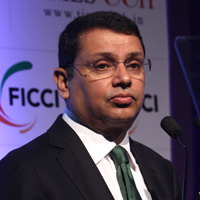
    Photograph: Fotocorp