Blog

  • Satish Singh back @ Laqshya as President, plans rapid growth for OOH major

    By A Correspondent


    Veteran out-of-home industry captain, Satish Kailash Singh is back at Laqshya. He took charge as President of the company earlier this month.


    Mr Singh, an alumnus of the Jamnalal Bajaj Institute of Management, was until recently Managing Director at Realm Media, a company which he and a former colleague, Mr Yuvraj Agarwal had set up.


    Mr Singh has been with the outdoor sector since 1998 after 11-year stint in print – at Dainik Bhaskar, Mid-Day and Sterling Newspapers. He spent a decade at Outdoor Media Integrated (OMI) where he was CEO and later moved to Laqshya as President.


    “The out-of-home industry is at a very interesting juncture and at Laqshya we are equipped to attain greater heights,” said Mr Singh, highlighting that his company has some seasoned professionals holding key roles and portfolios.


  • Freaking News: Making sense of the army revelations

    By Ranjona Banerji


    Not surprisingly, the extraordinary revelations coming out of the army have consumed most of our days and nights. Kudos must go to DNA for first carrying the letter, which the army chief sent to the prime minister, about our lack of defence preparedness. Of course amidst all the high-decibel hot air about “high treason” and calls for sacking, we have as usual wandered into all kinds of marginal territories and taken a little time to put matters in perspective.


    Arnab Goswami on Times Now felt great shock that former prime minister Deve Gowda’s son Kumaraswamy said that arms dealers had tried to approach his father through him. Twitter took this as a joke with someone pointing out that Deve Gowda probably never took up the offer because he was asleep at the time. The innocence of television – is it endearing, annoying or just so put on?


    On NDTV and CNN-IBN, there were sometimes back to back discussions on the same subject with different anchors and guests. No great purpose was served by any of these – people who once wore uniforms claimed that the uniform-wearers were all purer than the driven snow, defence analyst Ajai Shukla said everyone always knew that India was badly prepared except probably Parliamentarians. Tarun Vijay of the BJP took great exception to being called ignorant but was told that he didn’t know what he was talking about for all his troubles. Brajesh Mishra felt that this government had spent too much money on development and “giving money to villages” and other unimportant stuff like that instead of presumably spending it all on national security. Luckily there was very little Chandan Mitra in all this.


    It, therefore, took the newspapers to explain to us the inner workings of the Tatra-Vectra-BEML deal, the connection between Ural trucks and army chief VK Singh and the problems with defence procurement. To be fair to Mishra however, he also said that the armed forces wasted time testing equipment in the snow, desert, mountains, plains, wind, water and so on till everything had become obsolete. All former uniform-wearers blamed the bureaucracy for the same.


    At the end of it all, you had to read the papers to find out who was who and who was doing what to who. This is a familiar pattern now and perhaps TV continues to be the saving grace for newspapers which have to make sense of the sound and fury. We now need some comprehensive stories on what appears to be some sort of internecine warfare within the army. It would also be good to know where the other service chiefs stand on all this.


    * * *


    As a break from all this, was the BRICS summit which just concluded in Delhi. TV did focus on that as well but sometimes when the reporters babble on and on saying the same thing in 16 different ways to guarantee their 2 minutes of air time, your eyes just glaze over. The business channels, however, had more focused coverage, including interviews with industrialists and so on. BBC and CNN were also more interested in the summit than in our military mis-manoeuvres.


    * * *


    A quick look at Pakistani papers this morning showed that in spite of all the fears of our former generals with moustaches quivering with rage, the Indian army’s lack of preparedness has not consumed them.


    * * *


    The Hindu has written a very welcome editorial, if a little late, slamming spiritual guru Sri Sri Ravi Shankar for his ridiculous comment that government schools are breeding Naxals. Does the media usually treat them too kindly?


    * * *


    The felicitation for Sachin Tendulkar by Mukesh Ambani provided the relief factor. TV, of course, pointed out that Bollywood attended in full force, leaving out the industrialists, politicians, artistes, literati and other movers and shakers in evidence. Where Bollywood ends, India ends I guess.


  • Nai Dunia acquisition set to be announced

    By A Correspondent


    The much-awaited Nai Dunia acquisition by Jagran Prakashan, which is reported to have been inked a while back, is set to be announced. Nai Dunia insiders tell MxMIndia that discussions with Jagran insiders on sales planning and execution has been happening for around a quarter.


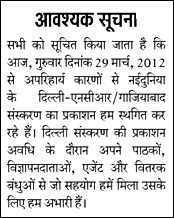
    The Indore-based group has also suspended its Delhi NCR-Ghaziabad edition which, according to reports, the Jagran group wasn’t keen on acquiring since it is still in investment mode. “The objective is to dominate the regional space and not the high cost Delhi market,” said a source close to the development. “That Nai Dunia was making losses in Delhi NCR is not a negative against the group… even today some high profile publications are in losses, but the promoters continue to invest in them given brighter future prospects.”


    The deal may be announced formally before the fiscal year-end, the source said. The Delhi NCR-Ghaziabad edition suspension is effective today. The March 29 edition carried a short announcement.


  • Tweets take wing in airline social media study


    By A Correspondent


    Social media has transformed the customer into a powerful entity. No longer does one need to call customer service to express opinions or share concerns. The tendency of content on social media to spread at a rapid rate can easily build or tarnish the reputation of a brand. This is the single most important reason why brands have started to monitor conversations and manage their online reputations.


    The domestic airline industry in India is growing at a healthy rate of 12 percent annually, and serves 2 percent of the world’s population (an extremely high figure). Therefore, it becomes necessary to understand what the customers want and what their concerns are. This can not only help in better customer service, but also increases brand fidelity.


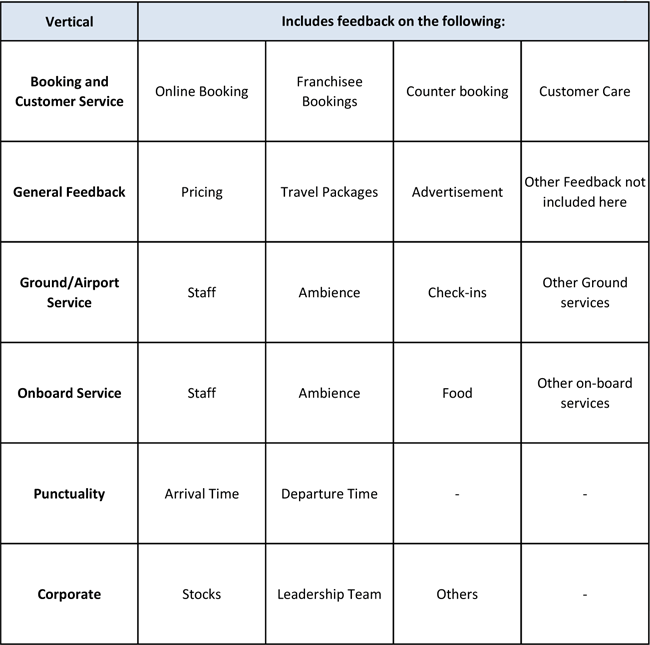
    Explaining this, Social Wavelength has monitored and analyzed conversations for the top 7 domestic air carriers in India to understand how they fare for different service types and departments, according to their customers. Using keywords that are most relevant to these carriers, they conducted a search of conversations on social media at the end of December 2011 and beginning of January 2012, and found 2712 relevant conversations. Each relevant conversation was classified into 6 verticals – Booking and Customer Service, General Feedback, Ground/Airport Service, Onboard Service, Punctuality, and Corporate (table shown in the Annexure). The output results were analyzed and the sentiment of each conversation was judged. The carriers considered for this study are Air India, Kingfisher Airlines, Jet Airways, GoAir, Indigo Airlines, JetLite, and SpiceJet.


    Share of Voice
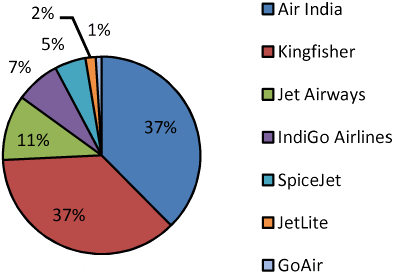
    The two most prominent carriers in India by volume on social media are Air India and Kingfisher Airlines. Together, they accounted for 72 percent of the total volume of results. As observed in many other scenarios, the Pareto rule is found to be true here. (This rule states that, for many events, roughly 80 percent of the effects come from 20 percent of the causes.)


    Jet Airways and Indigo Airlines come in at the third and fourth positions respectively. JetLite and SpiceJet were found in a very low number of results.


    The SWL Index

    Social Wavelength said it has derived the Social Wavelength Index (SWL Index) to calculate the sentiment share for each carrier with respect to the airlines industry. It is calculated as explained below:

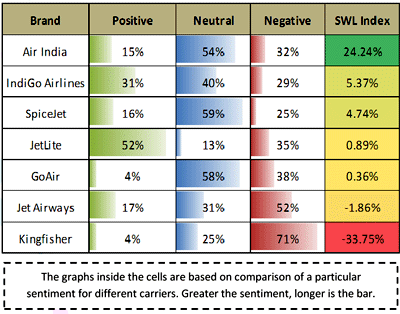


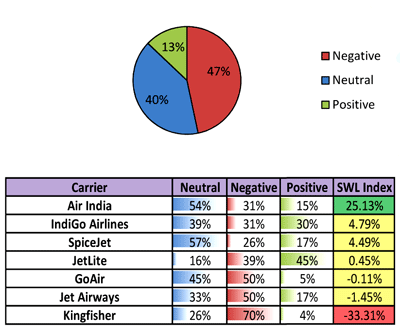
    On the basis of the SWL Index for conversations, we ranked each carrier vertical-wise and overall. Air India, due to the high share of positive and neutral conversations, ranked at the top of the table. Kingfisher Airlines, on the other hand, was the lowest in terms of SWL Index, having the maximum share of negative conversations in the overall data. Apart from Kingfisher, Jet Airways was the only carrier that had more negative conversations than the sum of positive and neutral conversations.


    How The Verticals Fare…

    Punctuality was the biggest concern among customers for almost every carrier monitored. This vertical had the lowest SWL Index at -9.07% and more than 85 percent of the conversations in this vertical were negative in tone. However, Indigo Airlines was mostly praised for timely arrivals and departures. In fact 89 percent of all punctuality-related positive conversations pertained to Indigo Airlines.


    Onboard Services too had a substantially negative SWL Index, at -5.48 percent. Kingfisher ranked better in this department, due to mostly neutral results. Air India, though having more conversations about its onboard services, had more negative results too, which affected in its SWL Index falling to the lowest amongst carriers (-18.38 percent). A recent incident, where the in-flight crew of Jet Airways was in news for being fined for refusing to serve alcohol to a female passenger, decreased its SWL Score to -14.23 percent. Without these results, Jet Airways’ SWL Index would have been better by 7.10 percent. This shows that even one incident can greatly affect the overall reputation of a brand.


    Although there were fewer conversations for the Booking and Customer Service vertical, the share of its negative conversations was second only to the punctuality vertical. The reason it fared better than the Onboard Services vertical was because it had fewer negative results out of the total volume. SpiceJet had the best ranking for its Booking and Customer Service, while Jet Airways had the lowest. Social Wavelength’s analysis of this showed that that there were a few customers that were unhappy with the online booking procedures for Jet Airways, and few complained about not getting refunds for cancelled flights.


    Conversation Sources

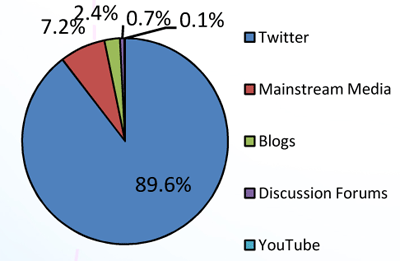
    Twitter accounted for the most number of conversations – 9 out of every 10 conversations. This platform has been very popular to share ideas and opinions, due to short updates that people find easier and less time-consuming to read. Mainstream media followed with 7.2 percent of the total relevant conversations, consisting mainly of news websites and articles.
     

    Sentiment Analysis of Conversations on Twitter

    Twitter, due to the high volume of conversations in the data, was the most influential platform for the overall sentiment of every carrier. When carriers were ranked based only on their conversations on Twitter, the results were very similar to the overall table. Almost half of the conversations found on the micro-blogging site were negative in tone. Being the single most prominent source of conversations, Twitter needs to be actively monitored by carrier companies.


    Demographics (Twitter)


    Top News

    There were a lot of mainstream news articles in the period between December 19 and December 26, 2012. These are the top news items for this period. (Since the number of conversations for Indigo Airlines, GoAir, JetLite, and SpiceJet is low, they have not been included.)


    Influencers

    Social Wavelength found a few notable Twitter users and bloggers who tweeted about the services of carriers.


    *True Reach is the number of people a twitter user influences, both within his/her immediate network and across their extended networks. Source: Klout.com


    Synopsis:


    The details of the verticals considered when analyzing conversations:
     

    Social media agency Social Wavelength was founded in 2009 and its clients include Channel [V], Kotak Mahindra, Idea Cellular and Havells, among others.


     

  • Anil Thakraney: Voda must commission study on campaign

    By Anil Thakraney


    There is a controversy raging in the virtual world over the new Vodafone pug campaign. The one where the doggie plays cupid between two kids who look to be in their early teens. The problem is this: Some people find them too young to be flirting, and feel that this sort of a campaign would send the wrong signal toIndia’s kids.


    I did allude to this when I reviewed the campaign some weeks back, and I recall wondering if the two are indeed a bit too young to be glad-eyeing each other. But I left it at that and passed no value judgments. And that’s because I am not really sure of the propriety (or the impropriety) of the situation. While it is true that young ones in urban India often start dating early in their lives (and this used to be the case even when I went to school, so it’s nothing new), I am not entirely sure what happens in small towns and villages.


    However, some ad experts seem to think that the campaign is indeed a terrible influence on young minds, and veteran ad man Alyque Padamsee’s comments have gone viral in the social media. He seems to think that ads like these can lead to social problems like eve-teasing and sexual harassment when the lads grow up!


    Quite obviously this is an over the top reaction. My own view is that kids would most probably view this as harmless fun, and not as a license to either misbehave with members of the opposite sex or to get into bed at the age of 12. And I also believe that kids usually get influenced by adult behaviour, as it’s the grown ups who tend to be their role models.


    Still, it might be a good idea if Vodafone commissioned a study amongst the young teens, in urban and ruralIndia, to understand the influence of this campaign on young minds. And if it’s a harmless one, then great! And if it is found to be pernicious, they could pull the campaign. Either way the marketer will be appreciated for taking a pro-active step.


    [youtube width=”400″ height=”200″]http://www.youtube.com/watch?v=pSLOnR1s74o[/youtube]

    However, they must act quickly. Before, egged on by comments of worthies like Alyque, some dudes with too much free time on hand file in bitter PILs. And cause the early death of a campaign which to my mind seems to be quite cute, and doesn’t really threaten the moral fabric of the great Indian society.


    * * *


    PS: Wonderful use of emotion. The happywallah emotion. Keep a hanky ready, it’s sure to leave a little moisture in the eyes. Especially if you are a parent.


  • Corporate Voice|Weber Shandwick wins highest number of accolades at e4m PR awards

    By A Correspondent


    Corporate Voice | Weber Shandwick (CVWS), India’s most awarded PR consultancy, took home more awards than any other consultancy or corporation at the exchange4media group’s Indian PR and Corporate Communications Awards again this year.


    The awards, organised by exchange4media, are the most extensive awards to recognise the contribution and success of the PR industry inIndia. CVWS shared recognition with clients for the following campaigns:


    • Hero MotoCorp Launch – Hum Main Hai Hero, Best Use of Public Relations by Private Sector Entity (Agency)
    • Gillette ShaveIndiaMovement, Best Continuous PR Campaign
    • Honda Brio Launch ‘Made forIndia,’ Best Use of Media/Marketing/Consumer Data for PR Planning/Strategy


    Additionally, Atul Ahluwalia, president, CVWS was named PR Professional of the Year (Agency). Tim Sutton, chairman, Weber Shandwick, Asia Pacific, delivered the keynote address to a large audience representing leading corporates and public relations consultancies in India.


    Speaking on the occasion, Shiv Reddy, CEO, CVWS, said: “Another year of recognition and accolades from our peers and clients in the industry leaves us proud, humbled and determined to innovate and succeed. We are grateful to the jury, our clients and the CVWS team.”


    Atul Ahluwalia, president, CVWS, added: “For seven consecutive years now, CVWS has established itself as the most awarded consultancy of the country. This continued success is wholly attributed to our ability to consistently re-invent and innovate as well as to the long-standing relationships with our clients.”


    Corporate Voice | Weber Shandwick (CVWS) is a  joint venture company owned by Weber Shandwick, a unit of The Interpublic Group of Companies, headquartered in New York, USA, and MAA Group Holdings headquartered in Bangalore, India. Incepted in 1992, the firm has grown to become one of the largest and the most awarded consultancies in the country. CVWS is a founder member of the Public Relations Consultants Association of India (PRCAI).


  • Mahrukh Inayet quits Times Now, starts school for anchors

    By Archita Wagle


    If you thought anchoring was just about sitting in front of the camera and talking, Studio Talk, a finishing school for those looking to make their career before the cameras, will prove differently to you. “A lot of youngsters believe that anchoring is not serious journalism and I want to break that myth. It’s time one understands that anchoring is impossible without knowledge,” said Mahrukh Inayet Rizvi, Course Director, Studio Talk, who recently resigned as senior editor (news) at Times Now.


    Ms Inayet was part of the core team at Headlines Today, that helped set up the channel. From the TV Today group, she joined Times Now, again as part of the core team that set up the channel. Her 72-hrs non-stop reportage from outside the Taj Hotel during 26/11 earned her much acclaim and was appreciated as an example of unbiased coverage of the Mumbai terror strike. She has reported extensively on national politics with special focus on the Kashmir imbroglio.


    From the breathlessness of breaking news to understanding the nuances of business and sports anchoring to the intricacies of entertainment and live events anchoring – Studio Talk aims to prepare the young journalists in all genres. ‘This programme is a must for anyone and everyone looking to work before the cameras in the television,” said Ms Inayet.


    Ms Inayet believes that journalism schools teach you how to be a good journalist. But few teach what to do before the cameras and fewer prepare you for what to expect once the cameras start rolling. That’s exactly what Studio Talk aims to do- prepare and polish newbies with an intensive 14-day program on how to be a television anchor/presenter.


    The course is aimed at teaching youngsters how to anchor news, business, sports and entertainment stories. The course will have studio simulated environment and the students will be taught how to work in front of the cameras and connect to the audience, ‘either as an on-field reporter who has 60 seconds to connect to the viewer with his/her story or as an anchor who has to present the final product to the audience. The students will also be taught basic make up skills so that they don’t look washed out in front of the camera.’


    “The camera is ruthless and does not allow you to rewind and press record the second time. Being on television is hard work. Anchors and presenters have to face all kinds of situations. From just one-line information on breaking news to anchoring in live situations,” Ms Inayet added.


    And, Ms Inayet definitely knows what she is talking about, given her rise from a reporter to being among the senior most anchors at Times Now. It is this extensive experience that has allowed the former Times Now Senior Editor to develop perhaps the only such training program in the country.


    While Ms Inayet, as the course director, will personally oversee the 14-day hands-on-training program, Studio Talk will also have some of the best names from the television industry such as Mandira Sawhney Lalwani, former presenter, Times Now, ESPN, Ten Sports & Star News; Prerana Thakur Desai, Producer, Aamir Khan Productions; Ragini Kumar, former sports anchor, Times Now; Mikhail K Vaswani Presenter, Neo Cricketer and Ameet Sawant, Producer & Director, 96 Karatz Productions as guest lecturers to share their experiences on topics like Inside A Television Newsroom, Teleprompter Training, Fundamentals Of News Anchoring, Handling ‘Breaking News’, On Field Reportage and other such relevant topics.


    At the end of the 14-day course, the student will be awarded a certificate and a demo CD on completion of the workshop. “Earlier we could learn from our mistakes on the job. But now there is no time to make mistakes. The demo CD ensures that the recruiters realise that the person knows what in required to be in front of the TV,” concluded Ms Inayet.


  • Focus on increasing number of formats: Govind Shrikhande, Shopper’s Stop

    As was predicted of the sector, retail did take a beating at the hands of slowdown, especially the second half of FY 2011-12 where growth was difficult to come by. But the downturn is not as bad as it seems and good tidings are being predicted for the medium for 2012-13. Much will depend on how the large players will be geared to tackle this difficult phase including undertaking risky yet calculative decisions that will either see them in the red or see them walk away with pots of money.


    Govind Shrikhande, Customer Care Associate & Managing Director, Shopper’s Stop Ltd is all set to take his company to new heights and feels that expanding its product offerings across the country could work in favour of the company as there are always new markets and consumers who are waiting to savour variety. Mr Shrikhande opened up to Johnson Napier of MxM India on the sidelines of Mindshare-Brand Equity Compass 2012 on how his company is geared to tackle the challenges of the future and what the retail industry needs to do to overcome the downfall scare that’s had everyone on tenterhooks.


    Q: It’s been a shaky 2011-12 for the retail industry in India. How is Shopper’s Stop handling the slowdown conundrum?

    2011 has been a mixed year for us – the first half went pretty well, but Q3 which is the biggest quarter for the retail sector witnessed a slowdown. We expect some recovery to take place in the second half of 2012-13 while the first half of 2012-13 will be a little slow.


    Q: How have you grown organically across the multiple formats that you are present in?

    We have grown very fast in the last one year. We added around 13 stores in the main format; overall we added more than 20 stores in all the big formats that we have. So it’s been a very fast-paced expansion drive for us. Going ahead, we plan to add atleast eight stores every year. I’d like to state here that the opportunity for retail community in the future is big, so it’s important that you expand today. Though there could be some short-term difficulties of sales growth not being as high as one expected it would be but if one prepares oneself so well that the model is good, the consumer traction is strong and the assortment is very good then one can be in a good position to perform well and really be ready to face challenges of the future.


    Q: Are you contemplating expanding your product offerings apart from the staple departmental and hypercity formats that you currently cater to?

    We have enough formats today like Shopper’s Stop in the department store format, Hyper-City in the hyper-market format, Crossword in the books store format…so we have enough formats currently by which we can expand and we are doing that.


    Q: What do you derive from the changing FDI stance between the government and the retail industry?

    I think FDI is getting a new meaning every season now. The Indian government did announce FDI in multi-brand retail and took it back. Also, the concept of cash-and-carry has been around for some time but now it’s getting into a different kind of a situation. I think the industry as such is waiting for the government to come up with some concrete plans around FDI but yes, once it does come in it will definitely help the whole retail industry to expand faster than what it has been able to do right now.


    Q: What is the impact that digital will cast on the retail sector? A lot of brands are taking the e-tailing route to increase product traction…

    Digital will help drive growth of retail because it is has been found that globally, a lot of consumers first check details on the internet and then go to a shop to buy stuff. It plays a support role where shopping is concerned. The fact is that almost 30-40 per cent of shopping that happens in a physical store has already been researched about before by people on the digital platform. So I do not see it posing any competition or threat; it would be self-supporting.


    We too have started our own websites for Shopper’s Stop and Crossword which will further ensure that a customer will get a multi-channel delivery whether through physical store or a digital store.


    Q: Apart from talent, what is the other big challenge facing the retail industry as of today?

    Apart from people, the other big challenge for the retail sector is the availability of quality space and rental. This in fact is a bigger challenge than people. As for the people challenge that we face, we are trying to overcome that by building new programs like Fashion Associates, which should help us to face this crisis in a much bigger way. But availability of quality retail space at reasonable rent is still a big challenge.


    Q: As you move forward, what would be your main objective for 2012?

    We have enough happening in the company right now. The key driver would be expanding into more cities and growing the total number of formats rather than getting into new formats.


  • Tier 2 & 3 crucial for radio: Monica Nayyar Patnaik

    By Robin Thomas


    She is the founder member of Radio Choklate, the radio arm of Eastern Media Ltd. Monica Nayyar Patnaik is the Joint Managing Director at Eastern Media Ltd., In conversation with MxMIndia, Ms Patnaik spoke at length about the trends in the radio industry, the challenges, on Radio Choklate post break-even, the phase III plans and much more.


    Q: How would you rate the year 2011 for Radio Choklate and the radio industry?

    The radio industry is still awaiting phase III announcements, and there are hopes in these announcements. Secondly, the increase in FDI has brought some cheer for all of us. As far as the copyright issue is concerned, the talks are still on, though I believe that we have gone ahead and may soon reach a breakthrough point.


    For the past three years Radio Choklate has been able to further consolidated its position and achieve break-even. The year 2011 has seen our listenership in Bhubaneswar, Cuttack and other nearby areas further increased, the reason being the change in programmes. We have been constantly changing our programmes, placed them in the right time slot and it worked well. In addition to these, our on ground activations also gave further momentum to our listenership.


    Q: Radio Choklate achieved break-even couple of years ago… what has changed for the station since then, ie in terms of infrastructure, talent, etc?

    The break-even achieved was purely advertising led, our expenditures has however gone up. One of the significant contributors was the Telecom sector. They had advertised considerably which gave us a huge boost in our advertising revenues. Besides we also deliver a lot of value additions to our clients. Going forward, it is not so easy. It is difficult in getting the right talent, and a lot of money is invested in recruiting good talent. Hence both in terms of talent pool and infrastructure it requires a lot of money and besides the copyright issue is yet to be fully resolved. In fact this year has not been so good for the industry in terms of advertising revenues which has slightly declined.


    Q: According to IRS, radio consumption has seen a decline. Do you agree? Some say that the decline is because of a delayed phase III and content restrictions…

    I have a different view on the listenership because we have been number one in our listenership since a long time and we are still number one radio station. However we have not witnessed any decline in our listenership. There are still many small town areas that need to be covered under the IRS bandwidth, many of which significantly contribute to the listenership share. Hence IRS must bring those uncovered or under covered areas under the IRS bandwidth to bring up the overall listenership.


    Q: Has radio listenership reached a saturation point in the metros and the next phase of growth for radio will come from tier 2 and 3 cities?

    I do agree that the next growth of FM listenership in India will come from the tier 2 and 3 cities as there are lot more cities and towns that need to be covered. With phase III rollout FM radio will be spreading its wings in 227 new cities. I believe it is now time that those cities which have reached saturation point must bring differentiation in terms of delivery, packaging and programming. However these developments can only take place once multiple licenses are allowed and I am sure it will help especially in cities where listeners need variety of music or programming.


    Q: Do you think the industry is confusing innovation with differentiation? As you just said, there is lack of differentiation… but, isn’t there too much innovation happening in radio today?

    It could be true however I am aiming to give listeners a different experience by getting into the niche areas i.e. by providing them a differentiated programme. So, if the listeners in my State want us to get into different areas of programming we would deliver to them what they want. So, if the listeners want a talk show they will be given, and that’s why we are so keen on multiple licenses, which is the key to differentiation.


    Q: You once said, come FM Phase III, you would want Radio Choklate to further expand in Orissa… Do your plans still remain the same?

    Absolutely, our plan still remains the same. We are looking forward to phase III, and our plans to further consolidate in Orissa. Music is just one part of radio, and for the medium to grow robust it needs other elements of contents as well, whether its sports commentaries or news and current affairs. Hence I feel there shouldn’t be any more delay in Phase III, the sooner it is rolled out the better for the industry.


    Q: Will multiple frequencies bring additional listeners and advertisers to radio or will it further fragment the listenership in the already fragmented medium?

    I don’t think so. How many multiple frequencies can one have in the same city? Multiple frequencies will give listeners more choice, and yes it will bring new listeners to radio, perhaps even those that have never listened to radio.


    Q: How has 2012 welcomed Radio Choklate? Any specific industry trends we should watch out for in the coming years?

    In 2012, Radio Choklate will look forward to FM Phase III rollout, we should be able to give different variety to the listeners and we will continue to concentrate more on local music.


  • The Anchor: 5 ways a brand can stay relevant

    By Alpana Parida


    #1 Rejuvenate

    An old brand like Pepsi has remained relevant for Gen X in the ’80s and now Gen Y as it has constantly rejuvenated itself. If a brand never changes the way it appears – it atrophies and dies. It must constantly rejuvenate itself to infuse freshness and youth into the brand.


    #2 Reinvent

    Environment keeps changing and brands need to reinvent the brand proposition to create relevance. Amul Ghee was slowly losing relevance even in homes where ghee was loved. A dry roti was becoming the norm. At DY Works, we realized that the consumer needed a nudge in reassuring them that there was enough according to Ayurveda that said one spoon a day was good for you.


    #3 Repurpose

    No amount of logo rejuvenation can keep a brand from dying if it does not repurpose its core deliverables in a changing environment. By not taking the threat of digital cameras seriously and in a timely manner, Kodak joined the brand graveyard which is littered with examples of giants who did not read the writing on the wall.


    #4 Retract

    Flexibility is key. Admitting mistakes is greatness. Wrong decisions get taken but brand leaders, like great generals, know when to retreat. Coca-Cola became an American Classic when it quickly retracted its New Coke formulation.


    #5 Restore

    As I was passing by Metro Cinema in Mumbai the other day, I was struck by how little interest there is in restoring its glory. Metro Cinema (1938) is an example of our Art Deco heritage. Today it is a multiplex movie theatre in Mumbai. It was built and originally run by Metro-Goldwyn-Mayer (MGM), the Hollywood studio. This has the ability to become a destination landmark and the equivalent of the Kodak Theater in LA for Bollywood. Sometimes, all that great brands really need is a little restoration.


    Alpana Parida is President, DY Works.


  • Mediaah! Network 18 bags 39 news TV awards, MCCS 24

    By Pradyuman Maheshwari


    Under normal circumstances, we wouldn’t write about an event until we were physically present at an event. But, in India, sadly media entities in the same space are normally not invited by peers (rivals), and so MxMIndia wasn’t present at the annual News Television awards of Anil Wanvari’s IndianTelevision.com. Sad, because we would’ve loved to report on the event. Okay, we would’ve have networked with people, exchanged cards and consumed some alcohol and food, but, heck, by not getting due coverage, the very industry you are trying to promote loses out.


    Regardless of this and since I was associated with one edition of the awards, here’s a quick, politicially incorrect report – Mediaah-ishtyle:

    Network 18 channels (and website ibnlive.com) bagged maximum honours at the annual News Television (NT) awards presented by IndianTelevision.com in New Delhi on Wednesday.


    MCCS channels bagged 24, TV 9 with 15 and NDTV and TV Today with 12 metals awards each. CNN-IBN (and its website ibnlive.com) bagged 17 awards followed by IBN Lokmat in Marathi and TV 9 in Telugu with 14 awards each. MCCS channels Star News and Star Majha (Marathi) bagged 12 awards each.


    Some trivia: in general English channels, Headlines Today bagged 7 awards while NDTV 24×7 had 5. Also, ET Now with 5 and Bloomberg UTV with 3 was ahead of CNBC TV18 with 2 in the final tally. CNBC Awaaz was the only Hindi business channel in the awards list with 4 awards. Times Now does not figure in the list of awardees, though ET Now from the stable does.


    Note: Since MxMIndia was not invited to the event, this is based on the Indian Television report at link


    Full list of winners can be accessed at link.


    Important: while reading the tally and list of winners, it is vital to note the number of entries sent by each channel as well as who participated and who didn’t.  Reason: the more you participate, the more you are likely to win. And, an obvious observation, but must be underscored, if you don’t participate, you don’t win.


    It’s good to see Star News bag a good number of awards… they’ve been consistent at their work and also playing second-fiddle to Aaj Tak in mass and NDTV India in class. Though I don’t find anyone more mass than Deepak Chaurasia and class as some of the other anchors whose names I forget.


    Anant Rangaswami on afaqs

    It was nice to read Anant Rangaswami on afaqs.com. He’s a great writer, and having been in the business for a few decades, is on backslapping terms with a host of folks. More importantly, he has a good understanding of advertising and media issues.


    The footnote in the afaqs article says he’s a consultant at firstpost.com, but the site notes he’s senior editor, but those aren’t significant issues. I think firstpost.com is picking up well, and I’m beginning to enjoy some of its commentary, even though I don’t agree with some of it.


    I had stopped reading Campaign India after Anant quit, but his successor (seasoned theatreperson and Printweek editor) Ramu Ramnathan is a great guy and has managed to set it back on sail. It’s credible, looks good and is still popular… guess that’s what matters.


    But lemme not digress any further and get back to Monsieur Rangaswami’s afaqs piece. I was quite surprised to see him believe that regulating ad duration on television is good. Agreed what we have on some of the channels is obnoxious, but that’s because all of them are doing the same. The moment a few channels change their standards, I am sure the rest will follow.


    In fact Anant’s very argument that digitization should reduce the pressure on revenues from advertising is what should make things exciting. If the government really want to reap the benefits of a free-for-all, it must watch the fun post digitization. I understand TAM is also getting digitization-ready and the master strategists amongst all broadcasters will be put to test to figure what their revenue policies must be in the wake of viewership data coming in from addressable set-top boxes.


    Let the free market prevail, my friend!


    The views expressed here are my own and not necessarily those of MxMIndia.com and the team working with it.


  • The Anchor: The top 5 things we can expect from IPL 5

    By Rajneesh Chaturvedi


    #1 Watch out for new sponsors:

    Look out for and identify new brands that will be using IPL in their marketing communication, all for the first time.


    #2 New campaigns and Innovations:

    Watch out for new and innovative campaigns in IPL this year. Traditionally Vodafone has always launched new campaigns around IPL year on year, and every year we see some or the other innovative advertisements on the ground and on air. This year too we can expect new and innovative campaigns during IPL.


    #3 What’s new from Max this year:

    It would be interesting to see what Max has to offer, considering that the advertising and media fraternity is slightly apprehensive of the ratings this year.


    #4 New on-ground experience for viewers:

    What are the new things viewers can expect – the entertainment, the opening ceremony, all this is related to the experience a person gets in the stadium across the 12 venues.


    #5 New IPL winner?

    Last but not the least – are we looking for a new IPL winner this year? Last two IPL seasons, we had the same winner – Chennai Super Kings. Will we have a new winner in season 5?


    Rajneesh Chaturvedi is the National Director, MEC Access.