I am often accused of being obsessed about The Times of India. That the previous, blog-only avatars of Mediaah! (2001-03, 2004-05) would only dwell on the affairs of Bennett, Coleman & Company.
Times @ 175
CVL Srinivas | What makes TOI a formidable brand
Sangita P Menon Malhan | Rediscovering… The Times of India
Sidharth Bhatia | Times have changed, so has the Times
Ranjona Banerji | Times@175: The Good, The Bad & The Ugly
Shailesh Kapoor | BCCL 2.0: The Integrated Media Organization
That’s not right. The Times of India only threatened to take me to court, yet another (leading, if I may add) daily actually did that. The matter was settled later via respective lawyers, and hence I wouldn’t like to name the media group.
There were many other news media entities I’ve written not-so-nice things about. And continue to do so. And even if I don’t write them myself, some of our columnists do that on MxMIndia. There is no malice whatsoever. We may nail Channel X one day and gush about it on another.
There are people who ask me why I single out BCCL for paid content, when scores of others do the same. Yes, I agree, and I don’t do that any longer since TOI isn’t the only national daily doing charging for content in the open. In fact it pains me to see Hindustan Times and Mid-Day, two newspapers which wrote a fair bit about BCCL’s regressive act and I admire much, also succumbing to the lures of paid content. Both papers carry disclaimers as do Times of India’s supplements, but that’s not good enough.
It’s got to have the conviction of this other newspaper’s publisher who has issued a diktat to his editors to not mask names of hotels , restaurants and brands… not over his dead body!
However, even though I hate the group for Medianet, I admire The Times of India a great deal. Since 2005, the year when Hindustan Times and DNA entered Mumbai, TOI has leapfrogged in editorial quality. No other news organisation spends as much energy, effort and dosh on its media products.
My big peeve with BCCL is that it has squandered the opportunity with the web avatar of the newspaper. Sadly most newspaper managements don’t have their web act together.
So is The Times of India our country’s #1 Newspaper? Yes, it is better than the others. It’s a better-produced, better-marketed, better-distributed and better-sold paper. However, in many ways, it stands for many of the ills that afflict our news media. Paid content, diminishing value to human capital and a desire to achieve revenues at any cost.
I understand many top executives of The Times of India agree that Medianet should be dispensed with even though it earns the company revenues of Rs 100-150 crore. But they are too scared to tell the bosses that.
Heck, this is celebration time. The MxMIndia special package is not to damn the Times, but to celebrate the birthday of the country’s biggest media brand.
Here’s to The Times of India at 175. Happy 175th. Â (Hey guys, just axe Medianet, will you? 🙂 )
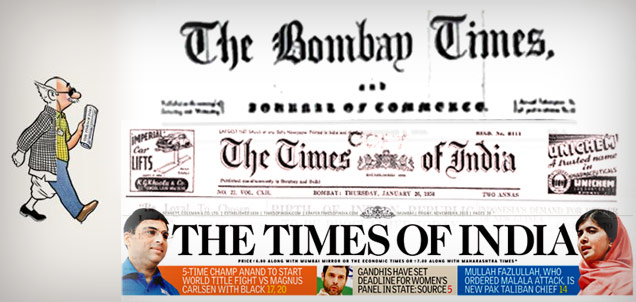
The oldest media organization of the country, The Times Of India group, also known as BCCL (Bennett Coleman & Co. Ltd.), completed 175 years last Sunday. In today’s world of instant gratification and media overload, history may hold little significance for many. But with more than a 150-year heritage gap between BCCL and other media bigwigs in the country today, fascination can’t be too far away.
Two aspects of BCCL interest me in particular. One, it remains the only true multimedia organization in the media and entertainment industry in India today. While Zee is a TV-cum-print force too, and Living Media has presence across television, print and radio, none of them match the scale at which BCCL has managed to operate across sectors. Their scale and dominance in print and radio is well-known, and the last four years have seen strong consolidation on the television side.
But BCCL’s multimedia presence goes beyond these three conventional media. They invested early in the internet, events and OOH businesses, albeit with varying degrees of success. In my stint at Zoom, I got a first-hand understanding of the power of a multimedia organization. There was always an ‘inhouse marketing option’ available to you, no matter which market or audience you wanted to reach.
Such cross-promotional opportunities can be a marketer’s delight. If you had the right idea, the system will give you the platform it deserves. At that time, with the TV business being nascent, set processes to exploit such opportunities did not exist. I’m sure they exist now, as one gets a flavor of the same while consuming BCCL products, especially the newspapers.
The second aspect of BCCL that interests me is the sales institution that it is. We all hear strong criticism of TOI ‘selling out’ through ad innovations that interfere with editorial content, and paid news via the Medianet platform. I find none of it either surprising or offensive, given the group’s clear sales focus. You can feel upset as a reader, but as a media commentator, you can’t help marvel at how BCCL has reinvented the advertiser part of their business over the last two decades.
Many top executives in television today, especially in the ad sales function, come from a Times Response (BCCL’s ad sales division) pedigree. They bring three distinct qualities with them – a leader’s attitude, strong sales processes and an appetite for sales innovation. In just this one way, BCCL’s contribution to the TV industry goes well beyond its TV channels alone.
It is difficult to say if integrated media organizations will be in vogue over the next 25 years. But in the era of convergence, integrated players like BCCL will hold an edge over other media giants.
Ten years ago, BCCL was primarily a print organization. Today, it has spread its wings. And many like me will be keenly watching its flight ahead!
Shailesh Kapoor is founder and CEO of media insights firm Ormax Media. He spent nine years in the television industry before turning entrepreneur. The views expressed here are his own. He can be reached at his Twitter handle @shaileshkapoor
The Times of India has had an amazing journey of 175 years. It occupies a very unique position in the Indian media landscape. I grew up reading The Times of India. In my later years, as a media planner and buyer I have actively dealt with the TOI group. From 2008-2010, I was an employee of the TOI group in its Private Treaties now called Brand Capital) division. Having worked in media agencies or consulted for startups for pretty much the rest of my 20-odd years in the industry, the only time I didn’t have to explain what I did for a living was when I was employed with the TOI group.
I have always admired the way TOI has built its own brands which in turn helped build some of the country’s best known brands. No matter what the purists might say about its editorial style or whacky headlines, it is a media brand that has not just moved with the times, but has often defined it. If the greatest form of flattery is imitation, then TOI surely has been the leader. Most if not all of its practices have been followed by many of its competitors.
Given the challenging times that lie ahead for print media in general and English print in particular, it will be interesting to see how TOI manages to keep its lead. The forays into language dailies and the increased thrust in digital will need to work. Given the group’s track record, there is every chance that we will see more innovation in the years to come as the transformation from a largely English dailies led media business to a more diversified media company takes place.
As an employee of the Times group, I had the good fortune of working closely with some of the finest minds in the media business. Though I had a short stint of two years, it was incredible learning, especially seeing things from the media owner side as against from the advertiser/agency side.
The first thing that struck me was the sheer scale of the business. And the many moving parts that all synchronized so well day after day as if some magical glue had them all bound together. Despite being a very large organization things seem to happen very smoothly. It has a culture that encourages great ideas, big ideas and the machinery and discipline to execute flawlessly.
For advertisers and agencies, The Times of India isn’t just a strong medium to connect with a powerful, youthful target audience, it is a media brand that adds colour, fizz and hype to a media campaign. A front page ad (or now a days the jacket) in the TOI gets a lot of attention and ends up becoming the topic of discussion for the day. The many innovations, be it in size, shape or placement of the ad, that TOI introduced have had a big role in ensuring print advertising stays relevant and top of mind. By combining digital apps with print ads, TOI is smartly riding the digital wave instead of drowning in it.
The next 10 years in our industry will be much more dramatic than the past 175. Media consumption patterns will change as will business models. I am sure TOI will not just stay relevant but shape the times.
CVL Srinivas is CEO, Group M South Asia
(For the benefit of some our journalist readers who may not be in the know, Group M is billings-wise the largest media management agency in the world. Advertisers use various media agencies some of which are part of Group M – like Mindshare and Maxus – to plan their adspends and place their ads in print/ electronic/ digital/ outdoor/ others. Group M agencies represent the interests of large advertisers like Hindustan Lever)
For most readers of the English language media, the Times of India is not just a newspaper, it is a habit that goes back generations. At least in Bombay, where the paper was founded, there must be families who have got the Times every morning for decades. In my own home, I recall reading it as a schoolboy, a college student and ever since. I have a personal connect too-I worked for its sister concern in the same building.
But I speak of it not as a journalist, nor a former employee of sorts. My relationship with the Times is that of a reader and a Mumbai resident. And, as it turns 175 years, I must confess it is a relationship that has remained strong but one that has seen a few ups and downs.
Ask any old time reader and they will tell you that the Times is no longer the paper it was. This is usually the response of those who love the good old days and feel the paper has given up on many of its earlier values-its journalism is often poor, the language is casual and full of mistakes, and its story selection too leaves a lot to be desired. (Too much entertainment and fluff is what they will say.)
Of course the Times is not what it was, but that is because India is not what it was. India has changed tremendously in the last two to three decades-how exactly is not the point of this piece. But what is to be noted is that as the country’s leading paper, the Times of India has kept in step with those changes. Some may even argue that it has led those changes. The much-maligned Page 3 for example is a reflection of the aspirations of a new class of people who want to be noticed and admired socially. They want to feel they have “arrived.” The Times was the first to understand this emerging trend and introduced a full page which would have pictures of parties, with prominent guests showing off their finery. The older, more conservative readers sniffed at this vulgar display of wealth and status, but it became a hit. Every newspaper has a similar page now. For some years, that section is now run as a paid supplement through “Medianet”, which works on a commercial basis, so it is more an ad than news.
For the record, I do not read that section, and I may not even be its target audience. But the main paper, which I devour every morning for almost an hour, gives me all the news in the city, the nation and the world. It offers cogent and high quality commentary on the edit page. (full disclosure-I occasionally write for it.) The business coverage is flimsy, since the paper no doubt thinks interested readers also buy the Economic Times, but the sports pages are comprehensive. It is the first paper that one picks up and it keeps one engaged over the morning cuppa.
But of course, there is some merit in the statement – allegation? – that the Times of today is no longer the Times of yesterday. A few years ago it was noticed that the news pages of the Times were getting frivolous and devoted a lot of real estate to silly issues. By that people usually mean Bollywood. In recent years, gradually, filmstars have been nudged back into the supplements, though it is also a fact that they have now assumed a larger than life dimension in our daily lives.
Perhaps what is more of a concern is that the paper – and this unfortunately applies to the mainstream media in general too – now speaks to and speaks of almost exclusively about the middle classes. The needs and demands of the middle class have now become most important. At one time, newspapers in India spoke up for the under privileged and the indigent, focusing on their problems and bringing these to the attention of the power structure. In the post-liberalisation era, the mainstream media has become a spokesman for the well off; the poor have been largely forgotten. In this, the media has abdicated a prime responsibility. This is obviously a generalization but one that has some merit. Ironically, the Times of India can be very feisty when it wants to be, and has been more activist than in earlier times. As the country’s leading paper, it needs to show the way through its coverage and articulate the voice of those who remain unheard and unseen.
One hundred and seventy five years is not a small timespan. At a time when newspapers around the world are suffering, the Times of India has survived and thrived. It keeps opening new sections. The daily newspaper scene in India, with all its travails at the moment, is vibrant and robust and serves its purpose of bringing independent news to its readers. That is something to cherish.
Sidharth Bhatia is a senior journalist, commentator and author. He can reached at @bombaywallah
Whenever I revisited Michelangelo’s The Last Judgment or Altdorfer’s The Battle of Alexander, irrespective of how many times I had seen these art works before, I was always pleasantly surprised to stumble upon a rare detail, a hidden element that made me see these paintings in fresh light. The interpretations changed. There was a different message each time, and finally, it all converged to reveal the big picture. This is how I came to discover The Times of India, over the span of a decade when I researched for The TOI Story.
Even as the newspaper celebrates its 175 years, it is ironic how little is known about it in the public space. Its first Indian owner was Ramkrishna Dalmia. He had built a fortune in jute and cotton, and bought this newspaper from its British owners in 1946. He was some sort of a critic of the government of the day (notably of Jawaharlal Nehru). Dalmia made a few bad speculative trading calls, and found himself in huge debt. The paper was transferred to his son-in-law and business partner Shanti Prasad Jain, and though “it remained in the family”, the Times of India effectively changed hands.
When Shanti Prasad’s grandson, Samir Jain, came on the scene in the early 1980s, The Times of India was going through tough times. It had emerged from seven “zero years”, a period when the government had taken control after allegations of financial impropriety against the management. The industry was a in a traditional mould, with newspapers more levers of power and influence in a socialist set-up than genuine, viable businesses.
The industry saw itself in the role of a nation builder, with erudite editors of the fourth estate expounding on government policy. Through the columns of the newspaper, they engaged in dialogue with the powers-that-be and the intelligentsia on the “issues” of the day. Besides, for Samir Jain, the other businesses of the family were in decline. Competition in the media industry was growing. India was seeing the first shoots of economic liberalization.
With this context, the 1980s and ’90s became the defining period for the Indian media, with The Times of India at the centre of transformation. Samir Jain resolved that his newspapers will make money for him. Advertisers were required to pay much more, in accordance with the “value” that his papers were providing them. In turn, editorial content and design was made more lively, “relevant” and racy to appeal to the emerging urban consuming class. “Aggregating audience for the advertiser” became the credo of The Times of India.
This was the seed for fundamental changes in the Indian media space. The advertiser, and by extension the audience that the advertiser was targeting, became the point of focus. This defined the new hierarchy of content. If this advertiser – and his target group – preferred local issues or more leisure, lifestyle and travel in the newspaper, so be it. If these readers wanted to quickly make sense of how policy announcements impacted their lives, write-ups were de jargonized and tailored to meet this need. Colour was introduced, first through glossy supplements and then across the board in the newspaper.
To be sure, there was vehement resistance to these changes as they unfolded over a decade. Editors questioned the new paradigm where the entire organization would align with (or be subservient to) the advertiser. The newspaper was not to be treated as a commodity and the enterprise was not to be seen as a business. There was no scope for levity in content, declared the editorial cadre. They saw this as “trivialization”, “commercialization” and a “dumbing down” of the media.
In a complex debate, both sides of the argument had their merits. Over time, however, not only has The Times of India implemented most of what it set out to, its success has persuaded many leading rivals to follow suit and expand newspaper readership manifold.
It may have gone overboard on occasions. People leading the change within the group admitted to me that in simplifying content for the reader, they may have erred into oversimplification of issues. Besides, there is always the conflict between news the reader “ought” to know versus news he “wants” to know. The Times of India may have neglected social and national issues in trying to stay relevant to the urban middle classes.
They have tried to pull back and restore balance, not necessarily by changing the content in the newspaper. Rather, their social campaigns like Teach India and Lead India are meant to help the youth engage in social issues. The premise is that youngsters today prefer working constructively on problems, rather than only read and analyze them in newspaper columns.
The Times of India, and its reclusive vice chairman (or VC) evoke extreme reactions. Without getting into judgments, I believe they have done away with the larger-than-life editor. The current editors who run the newspaper, brilliant they may be, but are barely known to their readers. We no longer have the signed editorials on the front page. They are well and truly aligned to the value system of the organization.
The Times of India has also come in for flak for initiatives like Medianet. Shorn of frills, this means that space in the editorial columns of the paper’s supplements is available for a price. This is a tricky one. All one would wish for is that the disclosures are more visible and comprehensive, as is the norm for any self-respecting publication, though that would mean diluting the value proposition of Medianet.
A clear positive for the newspaper is the way it has contributed to the state versus citizen discourse. It is clearly and deliberately on the side of the citizen, whether that has to do with the prioritization of news, the nature of issues taken up in its columns, the interpretation of policies and so on. It is not intimidating; it does not preach.
Studying it over these years, I find this an innovation machine, forever balancing extremes. It is, at times, the prima donna of the print medium – stylish, urban and uppity. At other times, it is the self-proclaimed ally of the citizen, comme Spiderman. To its competitors, it may have occasionally seemed like the dreadful Bhadrakali with her many arms. Journalists from the old school see it as the destroyer of the medium. Marketers hail its clever initiatives. The TOI manages to fit itself into several roles. It uses its plurality as a strategic weapon.
For every Delhi Times – its advertorial, entertainment, promotional supplement – there is (was) a Crest. To offset the hype and hoopla around its glamour ventures – Miss India, Miss World, there is an Aman ki Asha, promoting Indo-Pak relations. It also gives voice to the drawing room angst of the middle class. It puts the spotlight on these issues, and is able to provide an outlet for the aspirations and often the collective indignation of the masses, even as it goes ahead and pushes its concept of Medianet.
This X factor, with all its contortions, has become the hallmark of the newspaper. Its unpredictability and the rate at which it is willing to try something new keep it relevant and young. As the world around it becomes more and more turbulent, it is the innovation gene that will perhaps see it through in the future.
New Delhi-based Sangita P. Menon Malhan is author of ‘The TOI Story’, a book on the Times of India, published by HarperCollins.
The word “sesquicentennial” was not familiar to most in Bombay when The Times of India splashed it all over the city in 1988. But since my school in Calcutta, La Martiniere for Girls, had celebrated its 150th birthday a few years before, everyone in that city knew what it meant. Those 150th celebrations of the Old Lady of Boribunder were a massive announcement in a sense of a new Times of India. Not so much an old lady but of a group that would transform the Indian media scene – in both good and bad ways.
Although I did a story on the 150 year celebrations for the now defunct Bombay magazine, I must confess I remember very little about what happened. Except for the takeover of Victoria Terminus with massive artworks carefully placed between its ornate columns. Situated across each other, India’s most famous railway station and India’s most famous newspaper have long dominated Bombay’s skyline with their Indo-Saracenic architecture, control of commuter and long-distance travels and of course, people’s minds.
But the sesquicentennial celebrations were actually a message to the world that The Times of India had transformed itself. Samir Jain, elder son of Ashok Jain, would now run the paper as his own – unlike his father who had left it to editors and journalists. In the early 1980s, I worked for a while with an advertising agency which handled Bennett Coleman accounts. There were no Jains in sight when you visited the Old Lady in those days. And of course there was Girilal Jain, the editor who was synonymous with The Times of India and ultimately the apparent cause of Samir Jain’s distrust of editors and journalists.
Girilal Jain (no relation) was sacked in 1988, ostensibly for his pro-Hindutva leanings. But some of those stories about his disdainful treatment of Ashok Jain and Samir Jain’s anger at that must have played a part. After Girilal, no editor would be allowed to reach such dominating heights. The subtle hand of the young owner would be felt everywhere. Soon, his younger brother Vineet would make his own mark on the group.
The Times of India has done a lot of damage to the media in general with its subsequent treatment of journalists, with putting marketing above newsgathering and by introducing money-gathering practices like Medianet which is essentially legitimising bribery. However, it also took media in India into the contemporary world and set the standard for all other newspapers. Over the last 25 years, as it now celebrates its 175th anniversary, The Times of India remains the country’s most-read newspaper and continues to mean all things to all people.
I worked for The Times of India’s Ahmedabad edition from 2001 to 2004. In that time, I saw the best and worst of it. The support given to us in the editorial office during our coverage of the Gujarat riots of 2002 was remarkable and commendable. And it was also most welcome as the local government and civil society turned against us for the newspaper’s decision to be fair in its coverage of the riots and our refusal to give in to the sentiments of the Hindu majority. The newspaper’s management in Delhi dealt with most of the anger and the threats to the group.
However, it was also during my time in Ahmedabad that Medianet was introduced and that led partly to my decision to leave the group. Sadly today most other media houses have followed the Medianet example, where people and corporates can get positive or useful news about themselves printed in the glamour sections of newspapers. Journalists either have to give in or find some other place to work. What happens there is not really journalism anyway.
Yet in these 25 years there has been a lot of hard work and massive growth. The Times of India has complete control over Mumbai, its flagship edition, plays a neck and neck race with the Hindustan Times in Delhi and has editions which are either ahead of the others or serious contenders in major cities in India. Times Now is one of India’s most popular news channels. Radio Mirchi rules the FM waves. Indiatimes hogs internet space, especially for NRIs.
Given the newspaper’s oddly distrustful relationship with culture and cultural activities since 1988, I doubt that Mumbai’s Chhatrapati Shivaji Terminus will be festooned with major artworks by Indian greats again. Perhaps Katrina Kaif and Hrithik Roshan dancing all over the building would be more appropriate? They can pay the newspaper to do it too.
 By Shailesh Kapoor
 By Sidharth Bhatia
 By Ranjona Banerji