Category: LOOKBACK 2011

  • [LOOKBACK 2011] Filmwallahs dominate endorsements

    By Ritu Midha


    Debate on the extent to which celebrities contribute to enhancement of a brand’s image continues. The scale, however, seems to be tilted in the favour of celebrities with a number of big brands and organizations continuing to use them – to the extent that on occasion the same brand, at the same time is using multiple celebrities: Katrina Kaif, Shilpa Shetty, Sonakshi Sinha and Bipasha Basu in one Pantene ad is the first example that comes to mind.


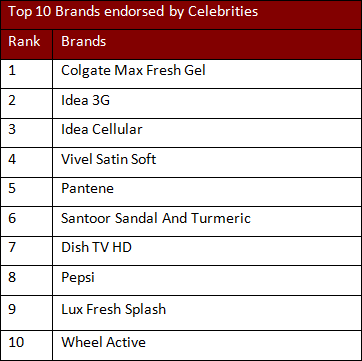
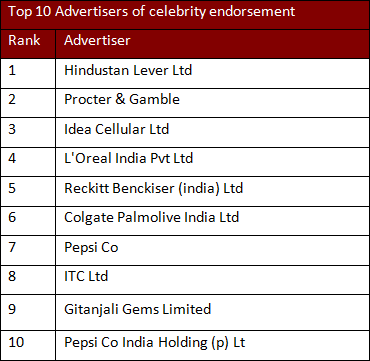
    The percentage of film stars endorsing brands has gone down this year, and that of sports personalities has increased. However, in the top 10 brands using celebrities for endorsement, Pepsi is the only brand that uses sports celebrities extensively.  A look at the top 10 advertisers using celebrities also tells a similar story:


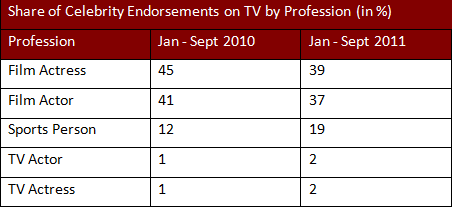
    The absence of sports personalities from these brands’ ads might be due to the category they belong to. However, as compared to same period last year, Jan- Sept 2011 has seen a 7 per cent jump in endorsements by sports personalities. TV actors and actresses endorsing brands has also increased by 1 per cent each – though it does not amount to much, considering the miniscule number of television actors that really do endorsements. Interestingly, 76 per cent endorsements are still done by film stars despite a 10 per cent dip over the previous year.


    The table below lists the share of the pie endorsed by film, sports and TV personalities.


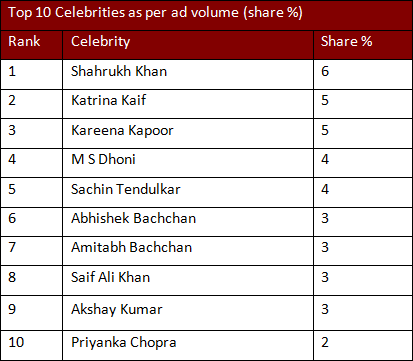
    Moving now to individual celebrities, Shahrukh Khan’s movies may have not really broken box office records of late – but it has by no means undermined his position as the leading celebrity endorser/brand ambassador (as can be seen in the table below). He is closely followed by Katrina Kaif and Kareena Kapoor. The only two non-film personalities in the top 10 are (yes, guessed it right) MS Dhoni and Sachin Tendulkar.


    Data source:

    TAM AdEx

    Media: TV

    Period: Jan- Sept 2011

    *Figures based on ad volumes (secs)

    *Advertising during commercial time (Promos are excluded)

    *Base: Celebrities(Actor/Actress) from Hindi – Movies & TV Industry and Sports personality considered.

  • [LOOKBACK 2011] The Year for GECs

    By Ritu Midha


    One-upmanship among the General Entertainment Channels (GECs) continues. While the top slot, for now, seems to be reserved for Star Plus, number 2 slot is now occupied by Sony. The tough fight between the channels has definitely benefited the viewer, who gets to see differentiated content now.  It is appointment viewing all the way – with viewers happily surfing from channel to channel, depending on the shows being shown at a specific time slot.  With a number of new shows hitting television at the same time – multiple show viewing at the same time (sampling) too is quite common – which is likely to reduce once the programme loyalty sets in.


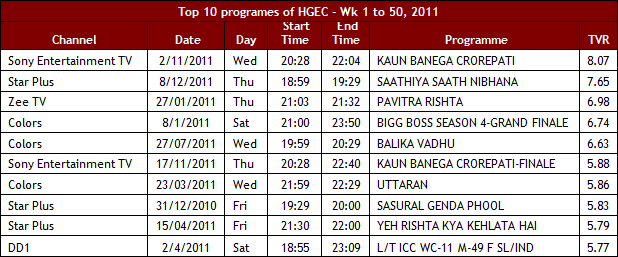
    The top 10 shows in GECs include three reality shows (including the top slot). And the 10th slot is occupied by Cricket (Doordarshan). This effectively indicates that only six of the top ten shows for 2011 (first 11 months) were fiction shows.

    Source: TAM Media Research
    TG: CS 4+yrs
    Market: HSM
    Channels : Hindi GEC
    Period : Wk 1 to 50,2011


    Perhaps, the picture would be bit different if one looked at the entire year, with quite a few new shows like Kuch to Log Kahenge,  Diya Aur Baati Hum, Hitler didi and Bade Acche Lagte Haen settling down.  Interestingly – none of the four is a classic saas bahu drama.

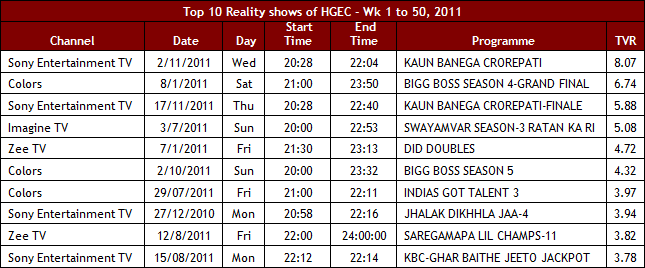
    As for the reality shows, only KBC and Big Boss (Finale) could find a place in top 10 – however others too brought in reasonable numbers for the channel. A quick look at them is here:

    Source: TAM Media Research
    TG: CS 4+yrs
    Market: HSM
    Channels : Hindi GEC
    Period : Wk 1 to 50,2011


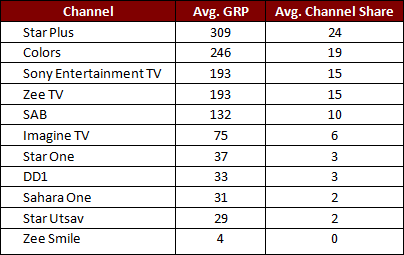
    Now a look at the average TVR of the channels -If one looks at GEC viewership for the first 11 months, Star Plus rules as numero uno, with Colors at number two and ZEE and Sony rubbing shoulders at number 3:

    Source : TAM Media Research

    Period : Jan – Nov 2011

    TG : CS4+
    Market : HSM
    Period : Wk 1 to 50,2011


    However, if one breaks the data by month, it becomes the story of Sony’s steady climb through the year. The channel got it right post KBC. Its numbers did not dip as was being anticipated – but the new shows it brought in have, in fact, consolidated its positions as the number two GEC.  Multi Screen Media with two channels in top 5 GEC, and MAX too going strong is doing well for itself. It would be interesting to watch if Star One in it its new avatar – Life OK proves to be a threat.

  • [LOOKBACK 2011] The Year for News TV

    By Ritu Midha


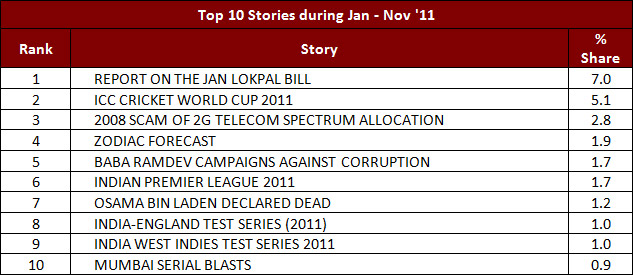
    Anna Hazare got the largest percentage share as far as the news channels go. The other top stories of the year 2011 were Cricket World Cup 2011, 2GScam. Interestingly post these comes Zodiac Forecast, which is two rungs above IPL coverage. Here is a list of top 10 new stories by percentage share:

    Source: Source: News Content Track – A service of TAM Media Research Pvt. Ltd

    Channels: Aaj Tak, CNN IBN, Headlines Today, IBN 7, India TV, NDTV 24/7, NDTV India, Star News, Times Now, News 24 & Zee News
    Period: Jan – Nov, 2011

    Note : Analysis is based on the Telecast duration


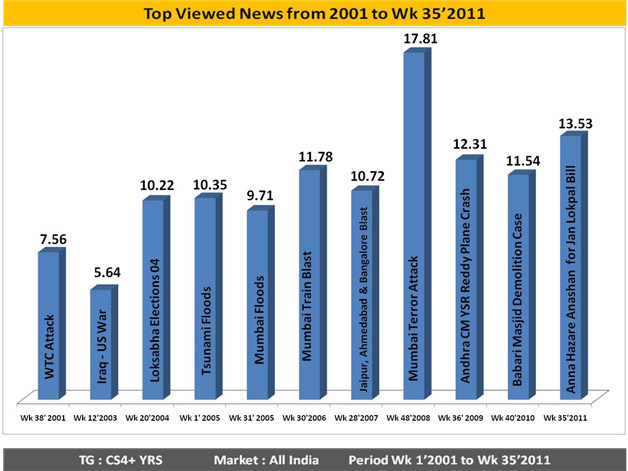
    If one looks at data from 2001, the Lokpal Bill at its peak was the second most watched news in 11 years – second only to the Mumbai Terror Attacks:


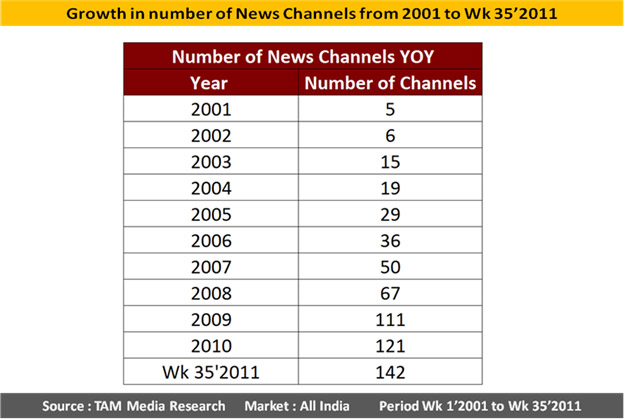
    News, interestingly is the fastest expanding genre with eight new news channels being launched (excluding regional languages) till week 50, 2011: 7 in Hindi and 1 in English.

    Even if on e looks at year on year growth – news is one of the fastest growing genres:

    With the first quarter of 2012 seeing assembly elections including heavyweights like Uttar Pradesh and Punjab – and Lokpal Bill still in the eye of the storm – the share of news channels is expected to grow.

  • [LOOKBACK 2011] What creative & media agencies won

    By Ritu Midha


    A slew of international and national advertising and media awards dot the year. Agencies bag a prize, are written about, and in a few days, it is business as usual. The next set of awards comes up, another agency tops the chart, and the same cycle begins all over again.


    There are, however, agencies which garner awards consistently, across the award shows. Sometimes a few make a mark on the national awards scene, but don’t win so many accolades in international shows or it can happen the other way round.


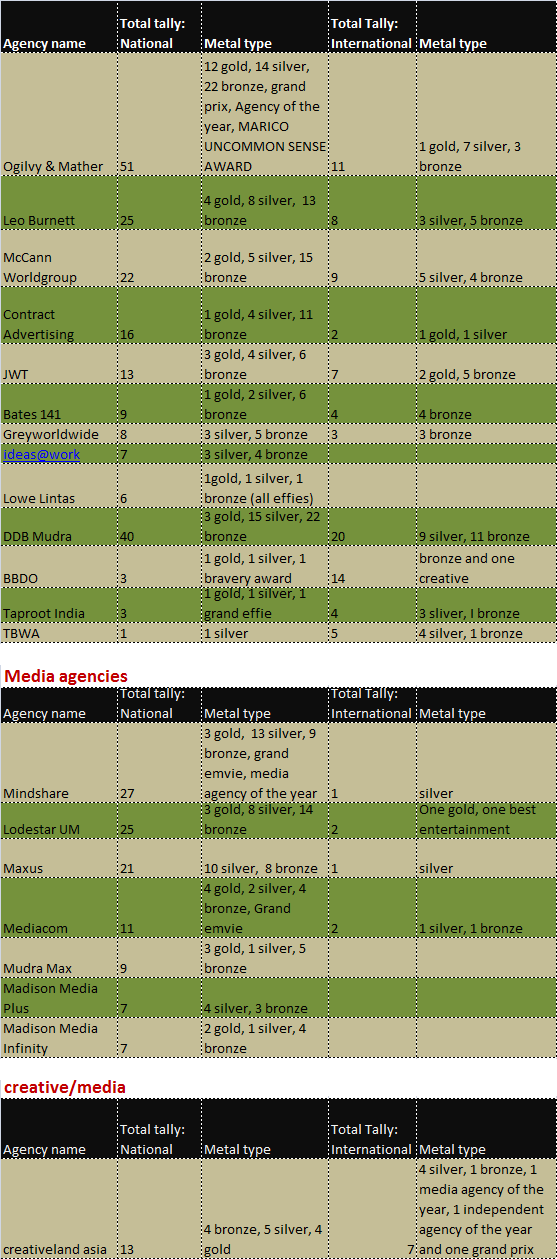
    The year 2011 had a few interesting ups and downs: BBDO which managed to bag 14 awards globally, got just three within India. Contract which got 16 within the country,  got just two globally. Mindshare won 27 awards nationally and one globally, Maxus had a score of 21 and one respectively.


    However, in the case of creative agencies, most national award winners have done well internationally too. (Perhaps the lesser number of global media awards has something to do with it!)


    Below is a quick look at how the key winners in national awards did globally, and in a few cases, how the ones which did very well globally, did in the national scene.


    Click here for a complete list of awards won by Indian agencies in the year 2011.

  • [LOOKBACK 2011] Top TV & Print Advertisers


    By Ritu Midha


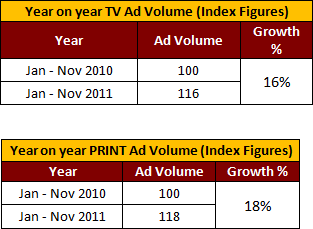
    Slowdown, as a term, might have the highest recall value for media owners in the year 2011 – more so in the case of print. Interestingly, while there would have been a dip in advertising spends in terms of value, advertising volume has in fact increased over the previous year. And even more interestingly volume growth has been higher for print media:


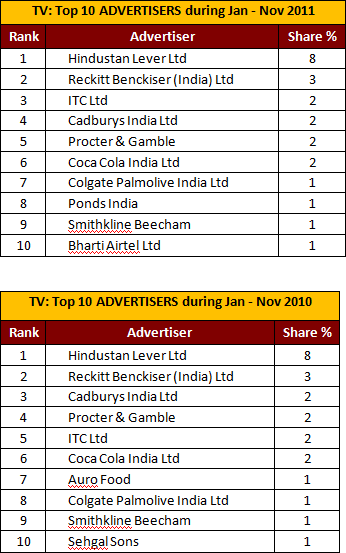
    When one moves to the top 10 advertisers for the year 2011 on television, the list seems more or less similar for 2010 and 2011, though the ranking has, of course, changed.


    Two advertisers from last year which are missing this year are Auro Foods and Sehgal Sons – both with 1 percent share.


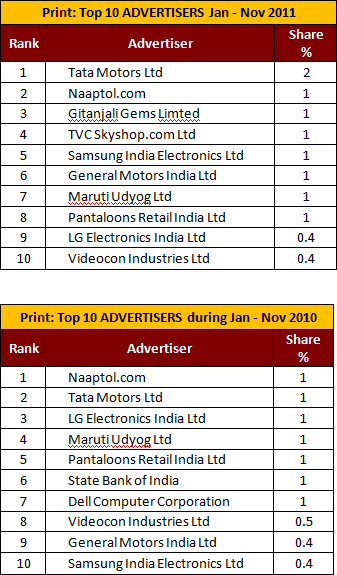
    Is the situation similar for Print? Let’s check it out: Two new entrants for 2011 are Geetanjali Gems and TVC Skyshop. The ones missing from last year are SBI and Dell Computers.


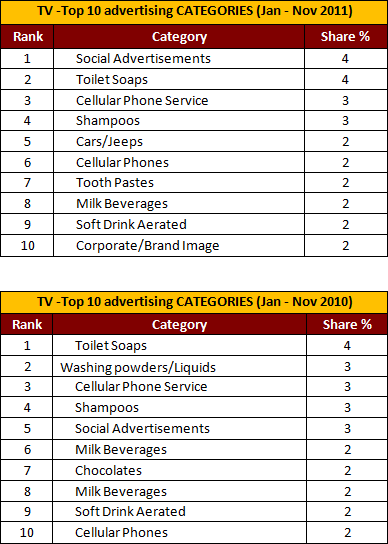
    As for the advertising categories, there are quite a few surprises when compared to the previous year, as far as television goes: Washing powders & liquids, number two category in 2010, is not in top 10 this year. Social advertisement, no 5 last, is top of the heap this year. Have a look at the tables for 2011 and 2010:


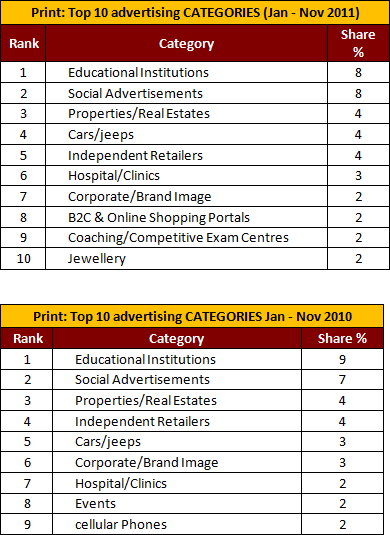
    On to print. The top five categories remain the same with just a position switch in rank in number four and five. However, there are two new entrants on eight and nine – pipping to the post the categories at those positions in 2010. Educational institutions, top category for both the years – shows a 1 percent jump in share:


    Source : TAM AdEx
    Period : Jan – Nov 2011 Vs Jan – Nov 2010
    Medium : Television & Print
    Figures for television are based on duration in seconds & are represented as index figuresFigures are based on CCMs & are represented as index figures
  • [LOOKBACK 2011] People movements: some surprising, some not-so

    By Ritu Midha


    People movement is a way of life for any organisation, more so when it happens in the advertising and media industry.


    Here are some leading movements of 2011, a few of these even making one’s eyes pop with disbelief


    Ashvini Yardi:

    Ashvini Yardi, who seemed to be doing everything right at Colors as Head of Programming quit the channel. This made many wonder what next for Colors shows? Ms Yardi, meanwhile, continues to work with Viacom 18 and would work on film projects.


    Bharat Kapadia:

    Bharat Kapadia quit Lokmat as Director in July 2011, and started two ventures of his own. One of them a marketing consultancy firm called ideas@bharatKapadia, and the other a technology solutions company: Whatuwant Solutions.


    Bobby Pawar:

    Mother of all surprises! Mudra bagged awards by the dozen last awards season, and credit for the same, to a large extent, goes to the creative genius. He joins JWT India as Chief Creative Officer and Managing Partner India. Would the JWT awards tally increase in coming years, courtesy Mr Pawar holding the reins of creative at the agency? We vote in favour – what say you?


    CVL Srinivas:

    CVL Srinivas was the first big movement of the year 2011, moving to Starcom MediaVest as MD, LiquidThread, APAC & Chairman, Starcom MediaVest Group, India. Mr Srinivas moved from Bennett Coleman & Co Ltd, where he was the Director – Private Treaties.


    Divya Gupta:

    One had almost thought that the lady with a razor sharp mind had left advertising for good. But she proved us wrong. She joined Dentsu, as the CEO of media business. She returns to advertising and media after a gap of six years, how much a difference her presence would make to Dentsu India, we would learn shortly, as she believes in driving in top gear.


    Divya Radhakrishnan:

    Her quitting TME as President in January 2011was another big news earlier in the year. Ms Radhakrishan recently launched Helios Media Pvt Ltd which would offer outsourcing services to the broadcasting industry in the sales, marketing, research and traffic management.


    G Krishnan:

    The phones never stopped ringing the day G Krishnan quit TV Today. After 16 years with the organisation, he was the face of the organisation and rightfully so, considering his contribution to it. Future plans of the former Executive Director & CEO, TV Today Network Ltd are still under wraps.


    Haresh Chawla:

    Haresh Chawla, a name synonymous with Network18, decided to move on in November. Currently the Group CEO of the organisation, he has been with the organisation for 11 years and guided its growth from a single television channel, CNBC-TV 18 to a media conglomerate with diversified interests and revenues of Rs2,500 crore in FY 2011. All eyes are now on Mr Chawla’s next destination, while he is busy handing over the responsibilities.


    Joy Chakraborthy:

    Joy Chakraborthy quit Zee Entertainment Enterprises Limited (ZEEL) as Executive Director, Revenue & Niche Channels in October-end and had people guessing where he was headed, but not for long. He joined TV Today Network as CEO on December 1, 2011. How far Mr Chakraborthy fits into Krishnan’s boots, only 2012 will tell.


    Raj Nayak:

    This one left people gawking too! Bosses at Viacom 18, of course, remembered the magic Mr Nayak had created at Star TV, and expect him to pull a similar rabbit out of his hat yet once again. Would 2012 see Colors moving up to be the numero uno yet once again? We would have to wait and watch.


    Rajesh Jejurikar:

    Rajesh Jejurikar announced his movement from Mahindra & Mahindra to Zee Entertainment Enterprises Ltd as president in November. It will be interesting to see how he deploys his learnings as the president of automotive division, M&M at Zee.


    Rajiv Agarwal:

    One of the most acclaimed names in Indian advertising, returned to what he knows best – advertising in February 2011. After a seven years hiatus, he relaunched Nexus Equity in partnership with Arun Kale, his former partner.


    Rohit Ohri:

    He was Senior VP and Managing Partner role at JWT before he moved to Dentsu India Group as executive Chairman in June 2011. Many in the industry are of the view that Mr Ohri’s appointment was an excellent move on Dentsu’s part.


    Sameer Nair:

    When he quit Turner General Entertainment Networks in May 2011, it was, indeed, big news. However, with the organisation all set to fully integrate Imagine operations into Turner Broadcasting System Asia Pacific, many expected this to happen.


    Seema Mohapatra (November 2011):

    No one really expected Seema Mohapatra to move after a dozen-and-a-half years stint with BBC Worldwide. At the time of calling it a day at the organisation, she was the Regional Director, South Asia BBC Worldwide and headed BBC Advertising, ad sales company of BBC Worldwide for the region.


    Shreejit Mishra:

    The biggie from Hindustan Unilevel was appointed as the CEO, BCCL in May 2011. Yet another example of media companies trying to make the most of learnings in FMCGs.


    Suman Srivastava:

    The ace adman moved on from the position of CEO, Euro RSG in January 2011, to be the Founder & Innovation Artist at Marketing Unplugged.


  • [LOOKBACK 2011] Middle India on overdrive

    By A Correspondent


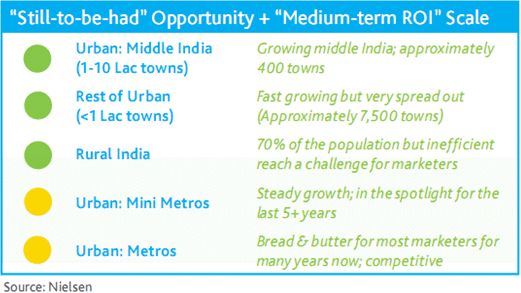
    While metros and mini metros are the flavour of the season for marketers on one side, and rural on the other, it is Middle India that is growing the fastest as far as consumerism is concerned, as per the Middle India Gold Rush, a study released by Nielsen India in December 2011.


    To define Middle India, it comprises 400 towns of population between one to 10 lakh per town. Put together these towns have an approximate populace of 100 million.


    Interestingly, the study states that Middle India would benefit disproportionately from consumerism of middle class (classified as strivers – annual household income of Rs 500,000, and seekers – annual household income of at least Rs 200,000). The reason is simple, a large percentage of the middle class resides in Middle India.


    In these towns, the markets benefit from the fact that they are easier to penetrate than metros due to sparse competition, and also easier to penetrate than rural areas due to better infrastructure.


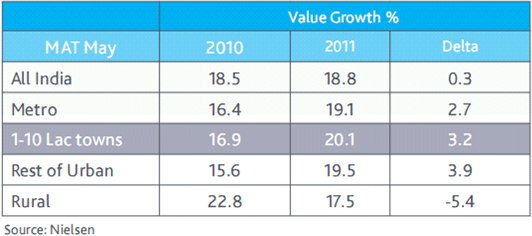
    Nielsen tracks 81 FMCG categories, and in early 2011, 49 saw faster growth in Middle India. As per the study, Middle India is showing strong value growth and as per MAT May 2011, it has moved from 16.9 per cent to 20.1 per cent growth, while for metros, the growth has moved from 16.4 per cent to 19.1 per cent, and on All India level, from 18.5 per cent to 18.8 per cent.


    Middle India is growing at a much faster pace vis-a-vis all India. From the year 2002 to 2010, Middle India saw 3.5 times growth in FMCG sector, vis-a-vis 3.2 of All India. Per Capita FMCG consumption too is much higher in Middle India as compared to All India. In the year 2010, both stood at Rs2,800 and Rs1,200 respectively.


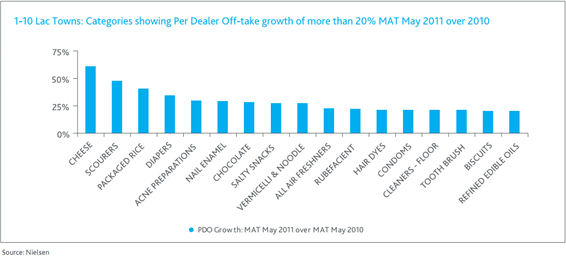
    FMCG players, obviously, are not oblivious to these growth numbers. Top FMCG players have added Rs35.8 billion from these 400 towns in the last two years. As of May 2011, FMCG per dealer off take increased to 14+ per cent in Middle India, up 2.7 points as compared to 1.5 points of metros.


    This, in turn, led to increase in number of FMCG stores in these 400 towns, at an average, 250 stores were added per town in the last three years. The total number of stores in these towns increased from 8,23,000 in June 2008 to 9,26,000 in May 2011.


    The growth story becomes even more interesting, if one looks at the subsection of 350 towns with population of 1 to 5 lakh. These towns are growing at over 20% and 56 of 81 FMCG categories outperformed All India growth rates.


    Marketers, thus, ignore Middle India at their own peril, because people residing there want to check out all the categories from potato chips to skin care and from shampoos to fragrances. They do not only want options in categories they have been using, but newer categories as well.


    Click here to download the complete report.

    http://nielsen.com/us/en/insights/reports-downloads/2011/managing-the-middle-india-gold-rush.html

  • The Year in the News Media


    By Ranjona Banerji


    This year started with a hangover – like all New Years should. But unlike the pleasant pain that goes with the knowledge of a party that may have meant over-indulgence but was fun just the same, the media started 2011 with one of those truly mammoth unpleasant hangovers.


    The outcome of the Radia tapes was, at best, a loss of reputation for a few well-known journalists but at worst, a loss of faith in the media as an institution. Public knowledge about the somewhat questionable dealings between journalists and publicist Niira Radia meant that the media could no longer hide in those famous ivory towers. Even more unfortunate was that the finger of suspicion was pointed at all journalists because of the transgressions of a few. It did not help matters that although Vir Sanghvi lost or surrendered his influential column Counterpoint in the Hindustan Times, Barkha Dutt did not just continue with NDTV, but went from strength to strength.


    So it was a somewhat cautious Indian media which initially tackled the phone-hacking scandal in the UK and the closure of the Rupert Murdoch-owned News of the World. Here was journalistic excess in order to get a story taken to a whole other degree – criminality. The tabloid press and the British public and celebrities have historically had an interesting and confrontational relationship. But the desire to delve into every aspect of the lives of the rich and famous – without the reverence shown in our part of the world – made for big sales and bigger profits. The readers loved the sleaze and watching the powerful cringe.


    But this scandal was something else. It was newspapers hiring investigators to pry into the private lives of ordinary citizens and using dubious methods like hacking into voicemail messages to gain information. One reporter lost his job for spying on British royals; but what was the punishment for breaking into the cell phone of a murdered teenager, deleting her messages and not only giving hope to her family that she was still alive but also materially distorting a police investigation into her disappearance?


    As it turned out, the reprisal was fierce and final: a newspaper which was over 150 years old was shut down and the British parliament had a public questioning of the owners and editor of News of the World – Rupert Murdoch and his son James and Rebekkah Brooks.


    The world’s media watched shocked as skeleton after skeleton popped out of the News of the World and NewsCorp cupboards. But surely there was no room for complacency here in India. After all, the problem was not just the Radia tapes; it was also the elephant in the room – paid news. Media houses – without or without the collusion of journalists – had been selling editorial space to political parties. The reader or viewer, of course, was left in the dark and assumed s/he was reading or watching real news stories.


    In the midst of all these depressing signs that some media introspection was required, we had all the uncomfortable revelations by Wikileaks, which turned international diplomacy on its head and exposed lies about the US role in the Iraq war and the black money held by European banks. The subsequent arrest of Wikileaks editor Julian Assange in the UK, on an old sexual assault charges filed in Sweden added to the drama. Was Assange really guilty as charged or was this an international conspiracy to get him extradited to Sweden and from there to the US to punish him for publishing secret cables and other information on the internet? The jury’s still out on that one.


    Wikileaks, though, emphasised once more how the internet was changing journalism and anyone who ignored it, did it at their own peril. Social media is playing the role of a catalyst in creating public opinion outside of the traditional media. The traditional media may not be destroyed but it will be damaged if it does not pay attention.


    Back in India, though, we still had a couple of dramas to play out. The new chairman of the Press Council of India, retired judge Markandey Katju, decided that he didn’t want to be head of a toothless body that was limited to the print media. He proceeded to write a series of articles attacking journalists, calling them frivolous, badly educated and shallow. He listed the sort of news that should be carried and slammed the choices made. He also said that the Press Council’s ambit had to be increased to include television.


    Katju may have been wrong and he may have been right in his opinions, but unfortunately for him, the Press Council remains toothless. And besides, instructing newspapers and TV channels on what aspects of news should and should not be carried impinges directly on the freedom of the press. No one spared Katju and so he quickly backtracked a little.


    Then, perhaps just to prove Katju right, media coverage of the Anna Hazare-led anti-corruption agitation proceeded on just those shallow, one-sided and breathless lines that the former judge had bemoaned. This protest was covered as if it was the only one the country had ever seen. Numbers were inflated or exaggerated. Those who questioned aspects of the Jan Lokpal Bill were shouted down as enemies of the people. As is inevitable, the print media could not sustain its adoration of this movement and started asking uncomfortable questions. TV however continued with its happy path of supporting this “national movement” at all costs until, slowly, a bit of reason leaked into the emotion.


    The doubts had crept into TV studios after the standing committee submitted its version of the bill but the Anna Hazare movement remained adamant on its own stand. But it was really the indifference shown to the movement by the people of Mumbai which ended that love affair. Rather than focus their cameras on 4,000 people pretending they were 40,000, TV cameras panned empty grounds showing us how low the turnout was.


    In journalism, as in life, there are no absolute truths. But there are facts. In 2011, the facts have shown that the people are watching the media. And there’s hardly any place to run or hide. Like we’re forcing politicians and government servants to come clean on their dealings, a little bit of spring cleaning by the media would not be amiss in 2012.


  • The MxMIndia LookBacks for 2011


    LookBack 2011 coordinated by Ritu Midha


    By Ritu Midha

    The year 2011 has been full of ups and downs for the global economy. While it started on an optimistic note, the projections have been revised downwards several times since.


    LOOKBACK 2011
    The Year in News Media (Ranjona Banerji)
    Middle India on overdrive (Nielsen report)
    Top TV & Print Spenders
    The Year for GECs
    The Year for News TV
    What creative & media agencies won
    People Movements
    The winnings
    Filmwallahs dominate endorsements
    11 Noteworthy Happenings (Tuhina Anand)

    India was no exception – though it was largely due to the global slowdown – the government’s foot-dragger approach to many a policy, and high inflation rate did not help the matters any.


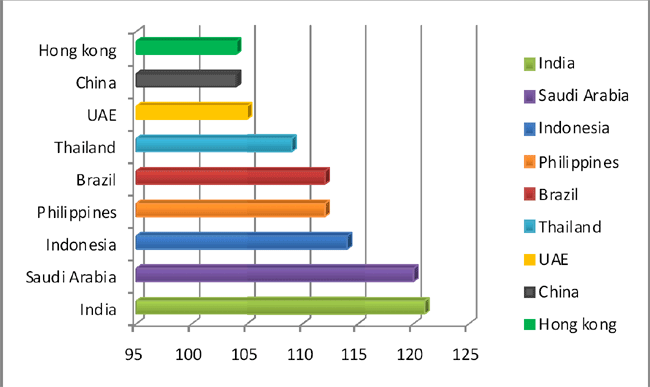
    The slowdown has led to tightened purse strings, however as per a Nielsen report, ‘Global Online Consumer Confidence, Concerns and Spending Intentions – 3rd Quarter, 2011’:  consumer sentiment in India is the most optimistic in the world, for the seventh quarter in a row. (Data Source: Nielsen global consumer online confidence survey, Q3, 2011)


    Click here to download the report from Nielsen website


    As for the economy, in January, World Bank predicted that in the year 2012, India would grow at a pace of 8.7 per cent (and the oft-compared economy, China would grow at a slower pace of 8.4 per cent).


    There is too much water under the bridge since then, and current fiscal is now expected to show growth figures of around 7%, as per Fitch, the credit rating agency.


    However, hope is back for 2012, with credit rating agencies reaffirming India’s ratings in the fag end of 2011.


    Moody’s, in a recently released report, reaffirmed India’s sovereign rating at BAA3. Though it has added that growth downturn is likely to persist for two more quarters.


    As per data released by Fitch in December 2011, the economy is likely to grow by 7.5 per cent in 2012-13. Though, in the current fiscal it is likely to be around 7 per cent.


    Interestingly, the government’s forecast is 7.5 per cent growth in the current fiscal. In its mid-year review released in mid-December, the government revised the growth projection to 7.5 per cent from 9 per cent forecasted in the pre-Budget survey.


    Another good news coming at the end of the year is easing out of food inflation. The index stood at 1.81 per cent in the period up to December10, 2011, while in the previous week it was at 4.35 per cent. The reason behind the improved numbers is the fall in the prices of cereals and vegetables.


    Inflation, till now, has led to a sharp increase in raw material prices, hurting the FMCG companies. As a result, leading FMCG companies like Hindustan Unilever, Procter & Gamble, Reckitt Benckiser, Godrej Consumer Products, Marico and Dabur were compelled to increase their product prices.


    However, according to a report by FICCI, the Indian FMCG market is now expected to grow at rate of 10 per cent (current estimates: Rs 2,600 crore) over the next 10 years and reach a size of Rs 4,13,000 crore by 2015, which would further increase to Rs 6,65,000 crore by 2020. It is good news for media fraternity, as FMCG is their main stay.


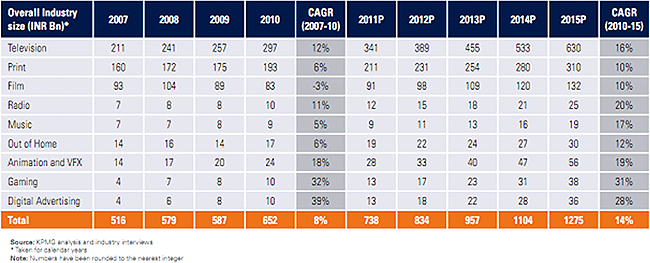
    In this back drop, let us check growth expectations of the media industry. In the beginning of the year, KPMG had predicted that the industry size would grow to Rs 341 billion – an approximate growth of 16 per cent.


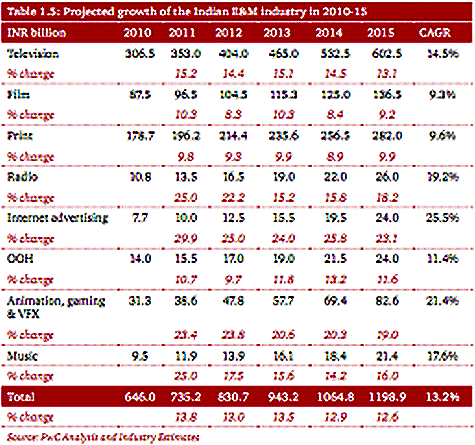
    Meanwhile, as per PricewaterhouseCoopers estimates, the entertainment and media (E&M) industry in 2010 stood at Rs 646 billion as compared to Rs 580.8 billion in 2009.  This was lower than the projected growth rate of 15.1 per cent for last year. The reason for lower growth rate was the decline witnessed in the film segment. The other two key industry segments: television (15.4 per cent growth as compared to 15.6 per cent projected) and print (10.7 per cent as compared to 8.5 per cent projected), showed good growth. As per the estimates, the E&M industry size would have been Rs 735 billion for 2011, but this does not look achievable now.


    In December, both Zenith Optimedia and group M indicated a sluggish growth for 2012 globally.


    As per Zenith Optimedia, global ad spending in major media will grow to $486 billion (4.7 per cent growth). It had earlier predicted a 5.3 per cent growth in 2012. However, Asia Pacific (excluding Japan) is expected to grow by an average 10.4 per cent a year and 33 per cent of the global growth is expected to come from the four Bric markets (Brazil, Russia, India, China).


    Group M, meanwhile expects a 6.4 per cent increase in global ad spending in 2012, As for 2011, it expected to show a 5 per cent increase in ad spends over 2010, to $490 billion.


    As for India, the experts believe that growth rate in 2011 would be in single digits, while Zenith Optimedia prediction of around 11% growth might hold true of 2012.


    Look out for the second part of our yearenders tomorrow