Category: 26/11 RECAP

  • What’s made Arnab the Face of News TV


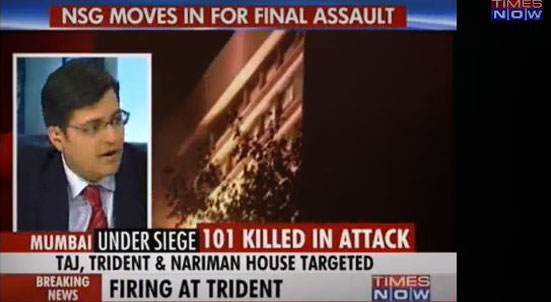
    It’s been five long years since that evening of November 26, 2008 when Mumbai was taken hostage by 10 terrorists in various parts of South Mumbai. We’ve seen the television coverage of the Kargil clash and some of the disturbances within the country like in Gujarat, post-Godhra, but clearly the Mumbai terror siege was the biggest news happening after 24×7 news television arrived. Social media hadn’t taken off in right earnest then, else the coverage could’ve taken an all-new complexion.


    We spoke with Arnab Goswami, Editor-in-Chief of Times Now, who could be called the Face of the 26/11 Coverage and whose channel hasn’t looked back ever since. In fact, in time, he has become arguably the Face of News Television in the country. In this freewheeling chat, Mr Goswami talks to MxMIndia on what he thinks helped his channel score with the coverage, why he chose to stay in the studio and not go out on the field and the government’s criticism of the television media’s live coverage of the terror attack.


    Excerpts from the interview:


    So where were you on the night of November 26?

    I was in our newsroom. We were doing Newshour and there were phone calls from people who said there was some firing at CST. I think we were the first to go on air with the report that something was going on and we were also among the first to break away from standard programming. So I started at about 10 o’clock and went on for three-and-a-half days. I remember going home only once and must’ve slept for an hour in that entire period.


    Was it a conscious decision for you to stay in the newsroom. You were the seniormost journalist of the channel, based in Mumbai and you stayed back in the newsroom rather than be on the field?

    Yes, It was a very critical decision for me. As you know, in my stint at NDTV I was a reporter through and through. I was probably the only news channel editor based in Mumbai at that time so the natural temptation was of getting into a car with camera units and going on the spot. But I had done that, what would have my reporters done and I would have not been able to focus on what we were putting on air minute-to-minute. At that point, what was very important was the graphics, visual and text we were putting out. Key decisions needed to be taken – on what we carried live and what we didn’t, which reporter went to different locations, what versions to take from the security agencies, from the government and how much of the information we had needed to be disseminated. Since all these decisions are taken better in my view if you are in newsroom rather than from the spot, I decided to stay back.


    So you never went to the spot, not even for a wee bit?

    Yes, I didn’t go to any of the spots for the entire duration when this event happened.


    There has been a lot of criticism of the media in general for the coverage especially this charge that the media was giving away vital information on the movement of our armed forces and police. Do you think it’s fair criticism?

    Well I can speak for ourselves, we did not do that. I don’t want to use the fact that we didn’t do that to be critical of other channels but speaking for Times Now, we didn’t give away a lot of the information related to individuals and specifics and at that point of time we had a lot of information which we felt if we put out in the public domain may compromise the security of the people involved. Like the floors/restaurants in individuals were present. I remember we shared the fact that we were holding some information with our viewers and I think our discerning viewers would have appreciated that.


    As you look back, do you think the government and the authorities should have restricted the movement of journalists?

    The government too was reacting to a situation and they had no idea what was happening. Clearly, if the media needed to be held back from reporting from certain locations, the security agencies needed to do that. For instance, there were camera teams right up to the lane which led to Chabad House and that was dangerous for the reporters as well. In retrospect you can always argue that perhaps the reporter shouldn’t have gone that far, but at that time they were doing their job.


    Were your reporters worried about their safety and lives?

    No, I don’t think that was even a consideration at that point of time. We had some reporters wearing bullet proof jackets. I think the place which was from my perspective worrying in terms of safety was Chabad House. We were careful not to compromise any of our reporters, they would go in and out and they would send footage and we would carry it.


    There were many discussions with the government after the siege and there was a possibility of a severe clampdown on the functioning of news channels. What was your advice to the I&B ministry then?

    I have never been in the business of advising the government


    You were part of the NBA and from what I remember instrumental in formulating a code or some such?

    Yes, I did play a role initially in drafting this code and I have been actively associated with the NBA. At that point of time, we did officially put in a word to then information and broadcasting minister because channels had got blacked out in Mumbai and there was outcry from viewers who wanted to watch what was happening and I must say the government responded quite quickly. The channels were back on air in less than an hour. I think there are lessons from all of this and if you ask me one of the reason why people watched Times Now much more than any news channel in that period was the fact that we never compromised the credibility of our coverage. We weren’t hyping the event nor making ourselves the story.


    We were simply and only focusing on getting the maximum amount of information first and fast and to that extent the events of 2008 and we never looked back since as a channel and the events of 2008 told us that at the end of the day, accurate and objective, fast and passionate news coverage determine leadership and that for me was important. Those hundred hours were a big learning for our reporters and in the growth of the Times Now as a channel as well. We have also not forgotten this event as every year we have done something though we don’t try and do it in a commemorative fashion but as a news channel that focuses on internal security issues much more than any other. We bring back renewed focus on 26/11 almost every year whether in terms of how far the case has progressed with Pakistan or the local security situation.


    As you look back, would you possible redo your coverage? Should something have been done in a different way?

    Honestly, we did not do the things that people have criticized 26/11 coverage for. We did not reveal sensitive stills. I would still not do that. There were times when we chose to put out delayed footage. I would still do that and we dropped all breaks in that period and covered it for a stretch in a committed manner and stayed with the story. I would still do that, so I think a lot of the things we did right. I wouldn’t say what we did was perfect, people can say the quality of broadcast could have been better. We did the best we could. We had a very young and passionate team which we still do which did the job. So, looking back after five years, we did as decent job as we could.


    There were some who also said that one of the reasons why other channels were showing more sensitive stuff is because they were getting it… given that there were senior people out there on the field.

    You know I am not the best journalist around but I think that everybody had more or less the same information. It is in these occasions the newsdesk plays a crucial role and the role of the editor is better when he or she is on the desk because you are putting out information which is very quick and you need to put it out in the breaking news situation. The editor has to take decisions on a minute-to-minute basis. I felt that was a big challenge for me in those four days and that’s one of the reason, I stayed with the story nonstop.


    But you were on air all the time, so how could you take those split-second decisions?

    See, most of our anchors on our channels are also people who have had strong experience on the newsdesk and I believe that you can only be a good anchor when you have done that. So I had back0up anchors and I would keep going in and out and we would have a conference roughly every two hours where the producers, the executive producers, the senior producers desk sat down and discussed very briefly what we were doing and we would then go back to the broadcast.


    For Times Now specifically there has no looking back since then. While you may have been on the rise even before, would it be right to say that November 26 was the turning point.

    I won’t try to be politically correct with you. Yes, the evolution of news channels tells you that critical moments in a nation’s history determine the growth of news channel so whether it’s an election or a Gulf War in United States whether it’s 26/11 here or whether it’s going to be an election in the future, how a news channel covers a particular major event is seen to be a test of the channel’s competence. I think that with 26/11, I am not the one to overstate what we did but I think we did a decent job and I think we won the trust of lot of people but we have also worked very very hard to retain that trust because in the news business you often would be remembered for the mistakes you made. We have worked very consciously on retaining the trust and not just on this 26/11 but all the scams we reported. The manner in which the viewers responded to us – with love, affection, respect and regard after 26/11 was quite overwhelming for me and my team because we were a group of journalists who all at least a decade younger and a decade less experience than any of the other channels but the passion and the fact that we were working as a team, we are very closely knit as an editorial team it made up for our lack of experience and the fact that the viewers responded well to us was a big confidence booster for my team at that point of time.


    I don’t really remember how it began and how it ended and I don’t remember what happened in between…  all I remember is that we were at it and most importantly the same team that started the broadcast ended it, in that period not one of my people or reporter went home, there were no shifts so while it will be argued whether that was the way to do it ,but you know putting hundred hours equal focus on a live broadcast where enormous number of people are watching is a huge amount of team work. I personally I think 26/11 is one of those events which teach you that television is all about team work. Some of our people have gone on to do so well inside the organization, some outside the organization and I feel very proud about it. The experience of covering 26/11 has added a lot to our collective experience and our maturity.

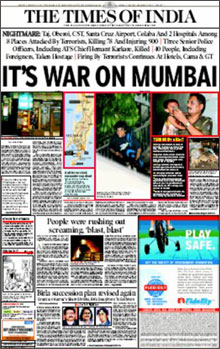
     

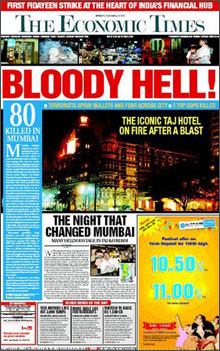
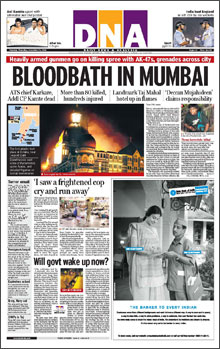
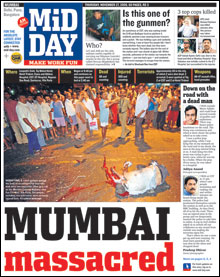
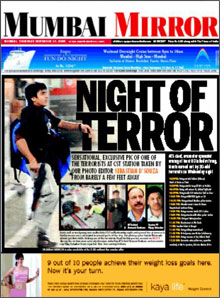
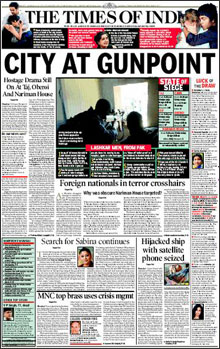
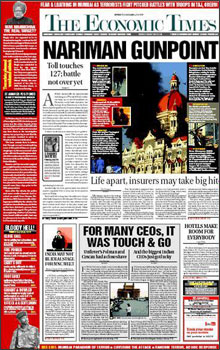
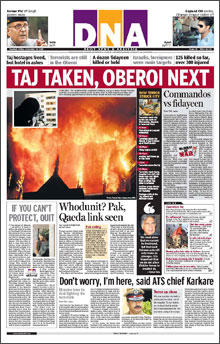
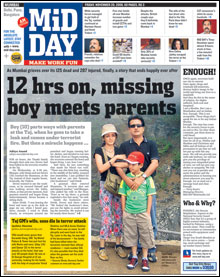
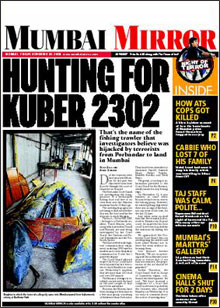
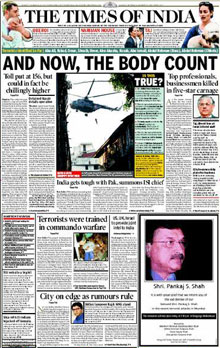
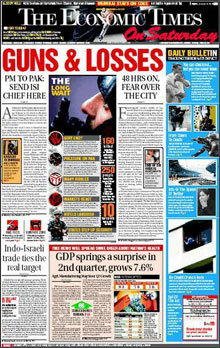
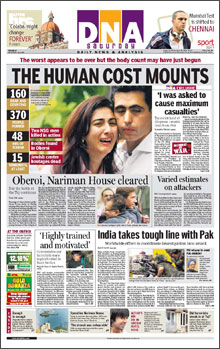
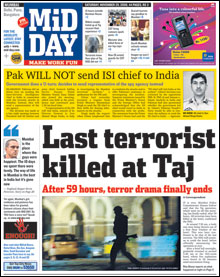
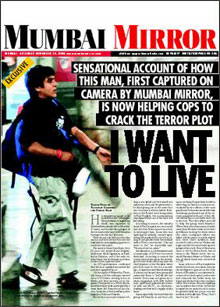
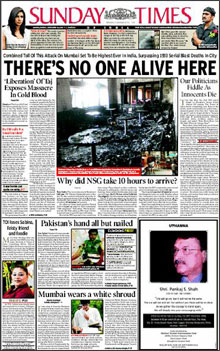
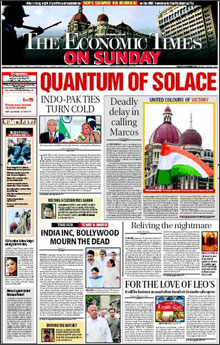
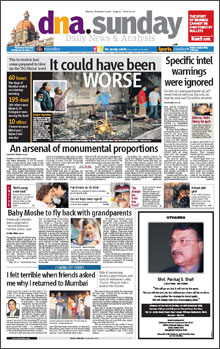
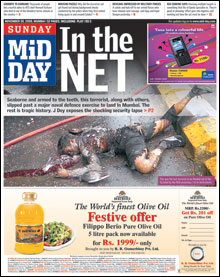
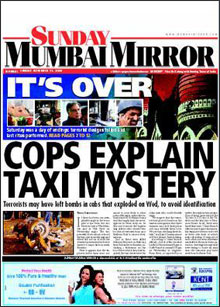
  • Page 1 of some Mumbai dailies – Nov 27-30, 2008

    And this is how the front pages of some of the Mumbai dailies were from November 27 to 30, 2008:


  • Ranjona Banerji: 26/11 – battleground news channels and newspapers

    By Ranjona Banerji


    Like many others in Mumbai, I also got a phone call from friends asking me to switch on the TV on the night of November 26, 2008. And then all night, I watched the surreal events being played out in front of millions. The first suspicions were of a drug gang shootout in Colaba – an area known for the unsavoury characters that emerge once the sun sets. But as the focus shifted from Colaba to the Chhatrapati Shivaji Terminus (also known as VT) and then to Mumbai’s most iconic hotels, the Taj and the Trident (still called the Oberoi) it was clear that something far more sinister was going on.


    Images of the young and gleeful Ajmal Kasab began to flash on TV screens, evil intent apparent in his glittering eyes – or so it seemed to us. There was news of the best and the brightest of Mumbai’s police force being killed in the attacks. There was fear for friends who were out in the area – and never have mobile phones been more useful. There was immense sorrow as news of those missing began to emerge. In my case, it was an old school friend who I had known since we were both five.


    But in all this, you had also to look at the events as a journalist. You were not just a voyeur. You were a trained professional with what is in media terms the story of the decade playing out in front of your eyes. The first drum beat roll therefore has to go to television. Many brave young reporters stood out there for three days telling the world what was happening inside the hotels and Nariman House which were under siege for three days after the first attacks on Cafe Leopold and CST on the night of November 26 ended. By Thursday morning Kasab – the only surviving terrorist of the 10 – had been captured.


    Much as this was a seminal moment for television, it was a particular turning point for Times Now. It emerged as the best channel covering the events and Arnab Goswami – for a long time playing catch up with TV stars and his former colleagues Barkha Dutt and Rajdeep Sardesai – emerged as a national figure. Dutt and Sardesai made two rookie mistakes – they jumped into the fray and tried to get in front of the cameras instead of being the conductor in the studio. This meant that they could only give viewers impressions. All the ground information still had to come from reporters.


    Goswami by contrast stayed in the studio, letting his reporters do their jobs. Editors of newspapers very rarely jump into ground coverage. Not just because they are lazy fat cats but because they know that they have beat reporters trained to do their jobs and it is hard to beat them for information. An editor can go out there to see what’s happening. He or she can provide colour copy. But editors are far more valuable in the newsroom orchestrating coverage. Times Now’s other advantage is that it is Mumbai-based unlike other TV channels which are situated in Delhi.


    There have been complaints against Goswami and Dutt that they gave away vital information about the locations of guests to the terrorists. In the case of Goswami, he acknowledged the error and then stopped that line of questioning. The same cannot be said for Dutt.


    There were also complaints that the media concentrated on the five star hotels because it is anti-poor. This argument is ludicrous. The attacks moved to the five star hotels and stayed there as commandos fought a deadly battle with the terrorists. There were no terrorists at CST from Thursday onwards. Also, as events unfolded as fast as they did, it is unfair to expect the media to have a foolproof coverage plan. For a long time, no one had a clue what was going on, least of all the authorities.


    If 26/11 was the making of Times Now, it was also a battleground for newspapers. The Times of India was at the spot and that gave it a massive advantage. But even though I was working there at the time, I have to give a big shout-out to DNA. I had watched in horror as DNA was paralysed during the July 2006 serial bomb blasts in the train service. I could not believe that I had just joined a newspaper which fell to pieces during a crisis like this – when it should in fact have claimed it as its own, as a new entrant to the Mumbai market.


    DNA redeemed itself during the November 2008 terror attacks. In one of those remarkable miracles – which I had seen once before in The Times of India’s Ahmedabad edition during the Gujarat 2002 riots – the newsroom rose as one. Internal conflicts and politics were put aside and everyone assumed responsibility. It was a stupendous effort and it showed in print. The other newspapers could not match us – for that time at least.


    The tragedy at the personal level remained however. Old friend and fellow journalist Sabina Sehgal did indeed die in the attacks on the Taj. And in another note, none of the promises made to Mumbai at that time have materialised.


    Ranjona Banerji is a senior journalist and commentator based in Mumbai. She is also Contributing Editor, MxMIndia. She can be reached via Twitter at @ranjona. The views here are her own


  • Sachin Kalbag: No time for water, no time to blink

    By Sachin Kalbag


    On the morning of November 28, 2008, around 100 reporters rushed to Chabad House in Colaba where four Pakistan-trained terrorists had taken hostage all the eight Jewish people living in the building. Chabad House, or Nariman House as it was previously known, is the outreach centre for the Jewish community in Mumbai, and is the first stop for any religious activity for the community, especially for those visiting from outside the country. It was a natural target for Islamist militants who had laid siege to key locations in Mumbai from the night of November 26.


    There were a few reporters present at the spot, but most of the attention from media houses for the most horrific terror attack in India’s history was given to the Taj and the Oberoi, both plush five-star hotels where hundreds were held hostage, and many later killed. Nariman House, on the other hand, is in a middle-class area of Colaba at Hormusji Street, and access to the building is through a narrow lane on the west, and a slightly wider but still crowded lane to the north. Escape is practically impossible.


    It was in this situation that Rabbi Gavriel Holtzberg and his pregnant wife Rivka found themselves on the night of November 26. Later, reporters at “ground zero” were told that the hostages were tortured badly before being killed.


    For the reporters, which included this writer who was reporting for the Delhi-based newspaper Mail Today, there was seemingly not much to do but wait until the well-trained National Security Guards (NSG) commandos neutralised the four terrorists.


    However, it was not all just wait and watch. Intermittent fire had already been targeted at journalists at the Taj on the night Nov 27, and the four terrorists at Nariman House could have, out of desperation, hurt any of the hundreds of onlookers and journalists, which included cameramen from news agencies all over the world. In fact, a few bullets were indeed fired at us, but they seemed more like warning shots than any attempt at killing us. The terrorists, reportedly, were told that their only aim at Nariman House was to kill the Jews. According to a Times (of London) news report, the Pakistani handlers told the terrorists that “the lives of Jews were worth 50 times those of non-Jews”.


    A unit of 22 NSG commandos arrived in the morning rappelling down a military helicopter, and entered Nariman House. Soon, the exchange of fire began. A second unit of NSG commandos, most likely snipers, took positions in a building situated 100 metres north of Nariman House. Separating them was the narrow lane, whose most remarkable feature was a large banana godown which was shut indefinitely.


    There was neither food nor any water for journalists, so we relied on the goodness of the locals to provide us with biscuits and cups of tea. The more fortunate ones were given vada pav. We could not even imagine the stamina of the NSG commandos who had nothing to eat or drink during the entire offensive that last close to 12 hours.


    The terrorists, it was immediately obvious, were well-trained in military warfare and hand-to-hand combat. How else could they survive an onslaught by some of the best trained commandos in the world?


    In the middle of all this, journalists were shooting pictures, giving live newscasts and filing stories to their respective newsrooms. The pressure on television reporters was immense. Viewers from all over the world wanted the latest, and the live pictures were not providing much context. Studios kept calling their correspondents, who had nothing much to say. This often resulted in misreporting.


    One such reporter, whom I got acquainted with, was being repeatedly called upon to give updates. In frustration, he began describing events that never took place. For instance, he would sit and chat with me for 20 minutes, and then, when his editor called, he would simply rattle off trivial stuff that was the figment of his imagination at best. When I asked him why he did that, he replied, “This is television, yaar. You print guys will never understand.” Later, at around 6:20 pm, they even claimed that the operation was over.


    I was more amused than angry. I cross-checked with a Hormusji Stree resident, Dhaval Koli, whom I had befriended during the day. He said the firing is still on, and the operation isn’t over. Koli worked at the local Baskin Robbins shop, and he offered to take me around as he had lived his entire life there. His help turned out priceless because I could add details to my reports that others could not. For instance, he was the first to tell me that Sandra Samuel, the 44-year-old nanny of Holtzbergs’ son Moshe, had rescued the toddler. The operation finally got over at night, three hours after television reporters had declared it finished.


    Around 9 pm, I ate my first morsel in 26 hours – a vegetable sandwich bought by a colleague working at India Today’s Nariman Point office. Later, after filing stories, I went to a pav bhaji stall to eat some Mumbai street food. There is a certain satisfaction you get by eating good food after more than a day of not eating. My respect for war reporters went up a hundred notches.


    I had arrived in Mumbai on November 27, and stayed on for four more days. Most of these 102 hours were spent on the streets. I could not meet my parents or my friends, who kept calling up. No reporter I knew there could find time to drink water, leave alone meet friends and family. This was one of the most horrific events of independent India, and as reporters, we could not even blink. We were, we soon realised, eyewitness to history.


    Sachin Kalbag is Executive Editor, MiD DAY


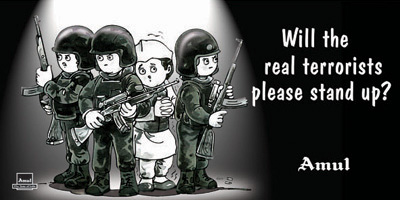
  • Amul ads on the terror attack & after

    The creatives we see on Amul Butter’s billboards are excellent indicators of popular mood and perception. Here we bring you some of these released after November 26, 2008 and until the Kasab hanging


    War of terrorism unleashed in Mumbai – Dec ’08


    Return of the English Cricket Team to play the test matches at Chennai & Mohali – December ’08


    The Taj reopened its Tower Wing, three weeks after the terror attack – Dec ’08


    FBI investigating David Headley’s footprints in India regarding 26/11 terror attack in Mumbai – Dec.’09


    The burning rage and flickering hope amongst the people, on the first anniversary of terrorist attack in Mumbai – Nov.’09


    Judge pronounces terrorist Ajmal Kasab guilty – May’10


    Error in the list of India’s most wanted terrorists – May – 2011


    Ajmal Kasab finally hangs… – Nov’12


  • Sebastian ‘Saby’ D’Souza: I want to erase 26/11 from my memory (alert: some explicit pictures)

    Sebastian ‘Saby’ D’Souza

    By Fatema Rajkotwala


    Five years ago, the city of Mumbai was under siege for three days when terrorists infiltrated the city’s pride and pulsating locations of the Chhatrapati Shivaji Terminus, the Taj Mahal and the Oberoi hotels, the Leopold Cafe and Nariman House at Colaba. While citizens and residents grasped what was the sudden reality, Sebastian D’Souza, then senior photographer with Mumbai Mirror ran out to the train station armed with nothing more than his Nikon camera and lenses.


    Today, five years later, Saby, as he is known in the fraternity and to friends, is far from willing to reminiscence on the incident that brought him much fame and glory. His close-up photograph of Ajmal Kasab, the sole survivor among the terrorists that day, was circulated, flashed and reused by media across the world. “Yes, I made a big name and was praised by all. The photographs were used by the media all over,” he says. “But I wish I had never done it. You’re on the field at that time. It’s crazy. I cannot explain it.”


    Saby was contacted and applauded by the global media for the considerable risk he undertook in documenting the event. “The western media praised and appreciated my work and contribution. They recognised the effort and said they would be honoured to have such a person in their country. Life in India is cheap. Nobody cares. If I had died that day, it would’ve been a very bitter truth for my family. The Indian government, Chief Minister Ashok Chavan, gave me a house but it is a disputed structure. This is the second time this has happened. Earlier I was given a house by Mr Sharad Pawar. If not by the person sanctioning it, you get cheated during the paperwork all the way. I am retired now and I still live on rent.”


    Even though the senior photojournalists shared some of his photographs he had taken, he says he would rather not remember or reminisce the events of the evening of November 26,. “I want to erase the event from my memory completely. I wish it had never happened. I didn’t do it for fame or money. It is not an event worth remembering anyway. I want to forget it ever happened and put it past me.”