Category: FICCI FRAMES 2012

  • 11 reasons why I am going to be @ Frames this year

    By Pradyuman Maheshwari


    #1 This is my 11th FICCI Frames. Must say I had lost count of when the event was launched, except when I learnt yesterday that’s it’s the thirteenth edition of the event. If I remember right, I have missed out on just two years. So, couldn’t not make it this year.


    #2 This is the only time I visit the the Marriott property at Powai. The Renaissance is a great hotel and I quite prefer it to other convention hotels like Taj Palace in Delhi or Leela at Gurgaon, but three days of the trek here are enough for the whole year!


    #3 I can’t do without meeting my Frames friends. Yes, I don’t meet them for the rest of the year… these days I chat with some over Facebook or BBM, but nothing like meeting in the lobby at Frames.


    #4 Star-gazing! Thanks to the fact that Yash Chopra is chairperson of the entertainment committee and now with Karan Johar as co-chair, one can’t not find the big stars around. Last year, we had Vidya Balan pre-Dirty Picture. Now, we have Vidya Balan post-Dirty Picture. Ooh, la, la!


    #5 There is some serious discussion on digitization and with the presence of all stakeholders – the I&B secretary and the TRAI chairman, the key broadcasters and the distribution biggies, we couldn’t have had a better platform now that the sunset date in metro is a few weeks away


    #6 I enjoy Uday Shankar’s keynotes. The industry couldn’t have asked for a better champion. Given that his group is also into films in the country and his own background in news and print, there are few who have a more well-rounded view.


    #7 I am also looking forward to the session with all the legal eagles though I am unsure whether the time allotted will be sufficient for a reasonable discussion. Perhaps next year, there should be a day-long discussion with the law-wallahs.


    #8 Even though MxMIndia is a media partner and there’s no denying the fact that Frames is the premier event of India’s M&E sector, I have also been critical of a few of the earlier editions. It would get boring and I have seen no real merit in some of the deliberations. I have found media captains snooze and wish I had taken pictures of them. But I see that there is an attempt to get some new names in.


    #9 I really like Rajiv Makhni of NDTV and I’m going to try and attend all the sessions moderated by him. In fact I wonder he was only called for three of the sessions… why not all?


    #10 Clinch deals, exchange cards and pleasantries and promise to meet. Now that I am in an entrepreneurial mode, all of this assumes much importance.


    #11 And for the 11th reason why I am going to be at FICCI Frames this year: Be happy that you are part of the media and entertainment business. Okay, folks in other industry sectors may not think much of us and crib about our work – our newspapers, magazines, channels, films… whatever – but they can’t do without us.


    The views expressed here are my own, and not necessarily those of MxMIndia.com and my colleagues.

  • @FICCI-Frames 2012: TV influences life: IBF study

    By A Correspondent


    The Indian Broadcasting Foundation (IBF) has released an in-depth report on the Socio-Economic Impact of Television at FICCI Frames 2012. The IBF has conducted an extensive research in 3 phases to measure the impact of Television on Indian viewers. In the first phase, qualitative research was conducted across 20 focus groups to identify various forms in which television impacts the audience. This information was used to design the questionnaire for the second phase of the research, in which 5400 respondents were interviewed in the 7-60 years age group across 18 cities. They opined on 54 different attributes that encompassed the impact of television on their lives. The third phase of the research was a set of 25 in-depth interviews that amplified the learnings of the previous two phases. This enormous study spanned across 6 months. The research was facilitated by Ormax Media.


    The research findings are published in a formal documentthat is aptly named ‘Posi-TV-ity’. This in-depth report bears testimony to the overwhelmingly positive impact of television on audiences across the country.


    Uday Shankar, President, IBF emphasized, “Posi-TV-ity showcases the wide-ranging impact of Television beyond its conventionally understood & accepted role of being an entertainment destination. Today, television has moved ahead to offer more… a lot more. It in fact impacts the way India thinks and lives. Its impact on the socio-economic fabric of our country is indelible”.


    Today, television gone beyond entertainment and has become a medium that influences public opinion and stirs up sentiments. Everything that one sees on television has an impact and to measure that impact, this extensive study has been conducted by IBF. In this process of understanding the impact, the study has shattered several myths associated with television that were created due to stereotypes associated with it.


    In particular, Posi-TV-ity identifies 7 key roles that television plays in the life of a viewer. The study validates and substantiates these roles and impact of television in the country:


    Education – Respondents agreed that TV has helped them take more informed career decisions, financial decision and also learn new things that they could apply to their jobs.


    Personality Development – Viewers agreed that TV boosted their confidence, helped them become all-rounders and also widened their thinking.


    Social Interaction -Audience today feel that TV has helped them in having a better relationship with in-laws, keeping families together in today’s changing world, and strike a balance between Indian culture & westernization.


    Exposure – Viewers feel TV keeps them updated on the latest fashion & trends, latest products and also aids their purchase decisions. TV also keeps them informed about health related issues.


    Awakening – Respondents felt TV increases awareness of women’s rights, social issues, and rights as a citizen of India as well.


    Opportunity -It is widely believed that TV also gives opportunities to people from all over the country to showcase their talent, makes viewers feel closer to celebrities!


    Rejuvenation – Many viewers feel that TV makes sure that there is not a single boring or dull moment in their lives.


    Shailesh Kapoor, CEO, Ormax Media Pvt Ltd added, “The role television plays in the life of the Indian viewer is grossly underrated. This research identifies seven distinct roles of television, beyond entertainment. Each of these roles have a deep socio-economic or psychological connect with the viewers’ life. The research offers a new way of looking at the medium, in context of today’s India.”


  • @FF12: ‘Console gaming in India is in big trouble’

    By A Correspondent


    Console gaming today has become only an urban phenomenon, in the small towns it is the mobiles which has become a primary source of entertainment. Women too in large numbers are exploring gaming and access to mobile gaming in India is expected to further increase. In a country like India, content needs to be contextually and culturally relevant. These were some of the points raised at the Day 2 session of FICCI Frames 2012 – ‘From East to West: The Next Big Thing in Gaming.’


    This session was moderated by Mr Rajesh Rao, Founder and CEO, Dhruva Interactive. The panel members included, Mr Jithin Rao, Producer with Ubisoft; Mr Ray Sharma, Founder and CEO, XMG Studio Inc;  Mr Howard Donaldson, President, DigiBC; Mr Vishal Gondal, Founder and CEO IndiaGames; and Mr Ninad Chhaya, COO, Playcaso.


    One of the heated topic during this session was the slow death of console gaming and how mobile gaming will play a dominant role. Unlike Mr Ray who strongly believed that the Console market was in deep trouble and that there is a massive value shift happening from console to mobile gaming, his co-panelists Mr Jithin Rao and Mr Howard Donaldson believed that console gaming was here to stay and could still play a dominant role in the Country. “I don’t see the console market going away, it may still have a dominant presence despite the ongoing digital revolution” said Mr Donaldson. Mr Rao of Ubisoft said, “I don’t see console gaming going away even in the next five years because there are still hard core gamers in India. In fact we believe that every platform has its own experience to share with the consumer whether it is big screen or small.”


    Another interesting points raised during the session was the importance of mobile in the rapid growth of gaming in India. According to Mr Chhaya, “The change has been that phones are getting smarter. Consoles have become more of an urban phenomenon but, in smaller towns it is the mobile phones which have become major source of entertainment. The people in small towns are fast adapting to mobile internet. Internet on access through mobile is fast growing and the change which has come is that people have not only become more aware but, the fact that the apps system has also changed the entire environment. I would say for the better.”


    Mr Gondal observed, “Even women are exploring gaming in a big way. We are expecting four to five million Indians accessing Internet from mobile and expecting atleast 50 per cent of them playing games. In a market like India, local IP will do much better that global. On the production values, consumers are looking at higher production values with the best of the breed of contents and I believe that the consumers will not settle for anything less.”


    Mr Rajesh Rao summed up the session stating that while there are many ideas and lots of opportunities and potential in the market, the industry needs to explore them.


  • @FF12: Time to experiment with technology

    By A Correspondent


    Now that digitisation is set to come into effect from July 1, the convergence of media assumes greater significance. This was the topic of discussion in the second session on Thursday at FICCI Frames 2012.


    In a session moderated by Neeraj Roy, MD & CEO, Hungama, Sanket Akerkar, MD, MicrosoftIndiatalked about “The Converged future – Multiple platforms, technologies &transforming applications for media and entertainment”. The theme of his keynote address was significance and emergence of digitisation.


    To illustrate how connected we are today, he cited an example of how a teenaged son of a friend uses Xbox to connect with friends he was with at school and play games. Though this may common enough, he added that the group of friends used the very same environment to connect and do their homework. This can also be taken as learning life lessons of surviving in the digital world.


    Mr Akerkar said that the consumer lifestyles are controlling the conversation, citing the example the “Occupy Wall Street” movement. The industry has to takes its cues from what the consumers want. According to him, even ads will now be consumed as per the consumers’ choice and the advertisers can’t dictate the place and time for the consumption. Now the people are going to become the content creator and content consumer. The main challenge for the industry is now to seamlessly blend and enable technology to become user friendly.


    Jonathan Bill, SVP Internet and Data Services, Vodafone joined the conversation to discuss how the telco-eco system can offer better opportunity to the media and entertainment industry to monetise the services.


    Mr Bill said thatIndia’s telco-eco system is a hyper competitive market which the lowest price points in the global market. It generates the lion share of revenue in the entertainment stream for Vodafone.


    Mr Roy said that technological progress has enabled applications that recognise the customer preferences, be it the Internet or the phone.


    Mr Akerkar agreed and added thatIndiawill have 25 million smartphones by the next year and this connectivity gives the opportunity to the industry to experiment in creating applications for the users. He said that the technology is moving ahead at such speed that one only needs to use their imagination to think ‘what next innovation’.


    All the speakers were in agreement that once the digitisation bill comes into effect, the choice of content available to the user will be limitless. As Mr Akerkar said, “the challenge will be to separate content, be it mainstream or user generated into what is relevant or not.”


    They also discussed the feasibility of creating video content for mobile devices. Mr Bill was of the opinion thatIndiahas huge possibilities as it is the largest internet video consumption market. Mr Roy said thatIndiais poised to become the largest internet market in the next 3-4 years, surpassing evenChina.


    The speakers discussed how even gaming had huge possibilities if one was to look at co-developing games along with films. Mr Akerkar said that there was a business model waiting to happen if one figured how to reduce the initial cost of investment and figure out how to connect a known brand (film) and gaming.


    But the biggest challenge is the transition to the digital eco system. It is not enough to rely only on advertising revenues. Mr Bill said that the way forward is moving from free Internet content to paid content.


  • @FF12: Phase III will bring more innovation in radio


    By A Correspondent


    Radio has often been criticized for lack of content innovation, that all radio stations sound the same and that there is no differentiation in the medium currently. Although contents across all radio channels are more or less restricted to music, it is believed that once FM phase III is rolled out and multiple frequencies allowed by the government, it will lead to more innovations in content and differentiation within the medium itself.


    One of the sessions at the FICCI-Frames 2012 was on ‘Radio: Innovations in Content’ wherein industry veterans discussed at length on the innovations in content radio is witnessing currently and the enormous innovation opportunities FM Phase III would allow. While the session was moderated by Apurva Purohit, CEO Radio City, the panel members included Rabe Iyer, Business Head, Big FM; Abhijit Avasthi, Executive Creative Director, O&M; Bhavna Somaaya, Columnist and Writer; and Charles Falzon, Chair of The Radio and Television Arts School of Media, Ryerson University.


    Ms Purohit kick-started the session stating that radio currently is in a schizophrenic stage wherein on one hand the medium is witnessing immense growth, it has a huge reach in the country and the FM listenership has also further increased with higher number of mobile phones, whereas on the other hand the overall ad pie of the medium is merely 4 per cent. Ms Purohit also pointed out that in the next two years the industry anticipates another phase of growth which will bring news, sports commentary, multiple frequencies, besides further expansion into towns and cities.


    According to Ms Somaaya, “Innovation is a very subjective term and the definition changes from person to person and the state of mind one is in. I believe innovation comes only in content because technology has been exhausted and there is a whole rainbow waiting for us as there could audio books, short stories, debates, helpline etc. Radio therefore is much more immediate that any other medium.”


    Speaking about the strengths of radio Mr Avasthi first admitted that out of all the media, it is the toughest to write radio spots. He explained, “The strength of radio I believe is one can conjure up a world in the listener’s mind. What you hear on radio today is mainly restricted to Bollywood music. There are so many kinds of music still to be explored and so many types of content that can be experimented, and to break this format I believe the industry requires some amount of courage to do so.  The moment programming in radio opens up then there will be plenty of interesting opportunities for advertising in radio itself.”


    Mr Falzon highlighted the use of digital medium as a complement to engaging the listeners, “We are all experiencing a paradigm shift on how entertainment is being consumed, across the world. India has infact a better opportunity especially with the phase III expansion coming that too at a time we can think about how to use the digital medium. Digital and social media in Canada for example is being used in many ways wherein the entertainment experience of radio has been extended beyond radio.”


    According to Mr Iyer, although 80 per cent of content on radio is music and 20 per cent on the packaging of music, there has been some innovation in the medium and with the phase III launch it will bring with it immense opportunities especially on the innovation and differentiation front. Speaking on the reason radio being left out at times during advertising campaigns, Mr Iyer believed the possible reason could be because the industry has not encouraged radio creativity which in itself is a huge opportunity.


    The Q&A session which followed the panel discussion saw many people questioning the lack of innovation and the dominance of Bollywood-centric music on radio. The panelists more or less agreed that radio in India has seen lack of innovations primarily because of government restrictions which is most likely to change with FM phase III is rolled out.


    Photograph: Fotocorp

  • @FF12: Niche isn’t niche any more


    By Rishi Vora


    It is a fact that Hindi GECs command a premium position in the TV space in India and the primary reason behind that is its mass appeal. And thereforea lot of advertiser interest tends to go in favour of the so-called mass channels.


    But there is another set of audiences that prefer a certain kind of content – speciality content such as Action, Comedy, Food, Music and so on; channels that cater to the tastes ofaudiences with a peculiar taste. These channels are termed as niche channels.


    The concept of niche channels started about 18-20 years ago, and now, as experts believe, niche isn’t niche any more as all niche channels put together command a share that is equivalent of the share of Hindi GECs and the mass channels, so to say.


    On day 2 of FICCI Frames, in a session titled “Building Sustainable Models for Niche Content” honchos from the broadcast industry such as Paritosh Joshi, CEO, Star CJ (session moderator); Smeeta Chakrabarti, CEO, NDTV Lifestyle; Monica Tata, General Manager, Entertainment Networks, South Asia for Turner International India; Ajay Chacko, President, A + E Networks I TV 18 JV; Atul Pande, CEO, Sports Business, Zee; and Rasika Tyagi, Sr VP – English Programming, Star India discussed on revenue models to sustain TV content catering to niche audiences and its long-term sustainability.


    Atul Pande talked about the launch of Ten Golf, a speciality channel for Golf followers in India. He stressed on the need to charge premium to audiences who really are on the lookout for speciality content.


    Smeeta Chakrabarti said that as a speciality channel one cannot talk about TRPs, rather it is the brand connect that what needs to be spoken about as far as ad sales was concerned. Rasika Tyagi on the other hand remarked that the whole idea of measuring a speciality interest channel should be relooked at. “It’s not about how many people are watching you, it’s more what kind of people are watching you.” She also said that the audiences of niche channels are of such quality that they do not mind paying, and that broadcast companies should look to tap into that opportunity.


    Atul Pande remarked that the Pay TV as a concept does not yield great deal of revenue as the pricing of the niche channels are on the lower side. “We keep the pricing on the lower side because we don’t want the consumers to be shocked despite the fact that some of the content that we do justifies a price in the higher range.


    On whether the industry requires a different approach as far as measurement for these channels was concerned, Paritosh Joshi said, “The big challenge with respect to measurement is that we need to find a way to measure both quantity as well as quality. The quality aspect is very critical for a speciality channel.” Monica Tata added, “We need to have a different measurement system to evaluate special interest channels.”


    As for the digitization mandate that all channels have to follow, Ms Tata was of the opinion that to move from the present model of advertising to embracing the digital opportunities will be a challenge, and something that will take time before becoming an industry norm.


    The panel also discussed the need to create global content, thus opening up monetisation opportunities across markets.


    Photograph: Fotocorp

  • @FF12: Financing, a cause for concern in media and entertainment


    By A Correspondent


    The media and entertainment industry of India has scripted a glorious growth story in the past decade or so, and the future looks even more promising with digitization and the advent of technology across media verticals such as broadcast, print and also films. But one area of concern is the lack of private equity and VC funds showing adequate interest.


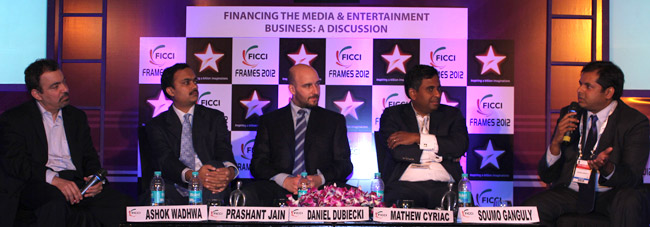
    In a session titled “Financing the Media and Entertainment Business” eminent personalities such as Prashant Jain, Executive Director, HDFC Mutual Fund; Matthew Cyriac, Sr Managing Director, Private Equity, Blackstone; Soumo Ganguly, Managing Director, Moxie Entertainment Pvt Ltd; and Daniel Dubiecki, Founder and Partner, The Allegiance Theatre, Hollywood shared their views on the subject. Ashok Wadhwa, Group CEO, Ambit moderated the session.


    Matthew Cyriac started off the session by pointing out that majority of the investments within the media and entertainment industry were made in television and print as they represent a fairly large share in terms of sheer numbers as against Internet and Radio . The Hindi GECs in TV is where typically where a lot of money into followed by regional GECs and sports channel. For print media, it was the regional publications command a lot of attention as regional advertising is very robust – one which extracts a lot of profit.


    Prashant Jain pointed out thata lot of companies in India have managed to get good funding and that it is not reflective of a very, very sorry picture as is being talked about. “It’s not that all of India in the media entertainment space not attracting funds. Companies like UTV and a few others have attracted investors.”


    Ashok Wadhwa remarked that the film industry in India is not institutionalised enough to attract private equity. Daniel Dubiecki spoke about the need to be more global in concept, widen the scope of the market and thereby making it more viable to attract investments in the films business.


    Photograph: Fotocorp

  • @FF12: Entertainment has become a revolution


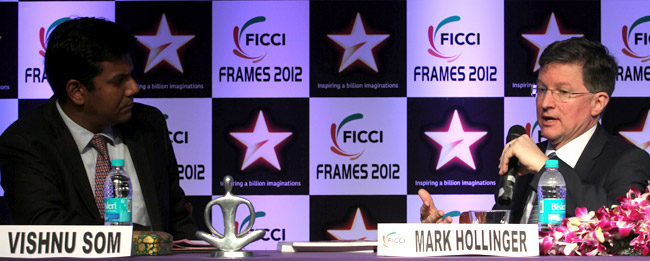
    The second session of FICCI Frames had ‘industry doyens, including key enablers, shed light on challenges and opportunities for the times ahead’. The session was moderated by Vishnu Som, Editor, Documentaries and Senior Anchor, NDTV.


    The session was opened by Mr Som welcoming Mark Hollinger, President & CEO, Discovery Networks International (DNI), who took the stage to talk about DNI’s journey in India. From a single network launched in 1995, today DNI has grown to seven channels. Mr Hollinger gave the credit of this success to DNI’s advantage of being an early mover in the Indian market.


    While talking about the process of digitisation, Mr Hollinger said that it is a great opportunity for a truly interactive pay TV experience. He appreciated the investment  made by the C&S community (the set top boxes and the marketing for the same).


    Mr Hollinger was of the opinion that the viewers today prefer sophisticated technology and the same applied for TV too. He said that digitisation is a win-win situation for all. The consumer gets a better product with ‘wider choices’ and the broadcasters will get a better business model which allows ‘faster and broader penetration of HD channels’. He stated that embracing digitisation will push broadcasters to perform better.


    In the Q&A session with Mr Som, when he was asked about the benefits of producing content v/s revenue, Mr Hollinger said one-third of their operational revenue and profits is recovered from the market due to their early mover advantage. He revealed that they spend almost $1 billion on producing content.


    Being an international channel which enteredIndiain 1995, Mr Hollinger talked about howIndia, as a country, is more open to foreign content. He also said that even then they offer regionalised content created specially for the local viewers and also the option to view the international content in the local language. Mr Hollinger stated that their strategy worked as was evident from the Brand Trust Report which has named Discovery as the third most popular channel and TLC as the fifth.


    In the Q&A session, when Mr Som questioned him about the pros and cons of local v/s international content, Mr Hollinger said that the local staff keeps them appraised about how the content is received. He said that the mix of international and local content is almost 50-50.


    Mr Hollinger saved the best for the last. While closing his speech, he announced that DNI is launching Discovery Kids in India, which is the launch pad for theAsialaunch. The channel will also be launched inIndonesiaandPhilippines.


    He also revealed plans to expand DNI’s scope to DVDs, retail, publishing and merchandising in the “biggest satellite market today”.


    Next up was Puneet Goenka, CEO and MD, Zee Entertainment Enterprises Limited (ZEEL). Mr Goenka opened his address by stating entertainment is no longer an evolution but has become a revolution. He said that digitisation of content is a good move as the drivers of today’s content are “highly motivated youngsters who are high risk takers and have large disposable income”. They have the power to influence products to be customised and digitisation will help achieve just that.


    With the help of a powerpoint presentation, Mr Goenka listed out the pros and cons of digitisation. He listed the fact that the penetration of private channels is still low and there is a lot of scope to grow as a benefit. Citing the example of Ditto TV, he said that now new media is the media to go to.


    During the Q&A session, when asked about the benefits of digitisation, he said that the sheer choice that the consumer gets is the benefit which will also be beneficial to them as the number of channels being offered in HD will go up.


    While talking about self-regulation in media, Mr Goenka said that it is still early days, as the norms have just been laid out by the news and entertainment industry. Time is needed to let them evolve and make a difference.


    Next to address the audience was Carolyn Everson, VP, Global Marketing Solutions, Facebook, whose address featured on how Facebook can benefit the media and entertainment industry. Giving the example of Open Graph, Ms Everson illustrated how Saavn in music, Zinga in gaming and films being released in theUSuse Open Graph by sharing stories built their brand on “top of Facebook”.


    Her ‘Aaha’ moment about Facebook came when, while talking to an anthropologist, she realised that communities and networks have always been around us but Facebook brings them to us at a scale never seen before due to the technology available.


    She said that Facebook is a reflection of the unique individual identity and the social graph is created using the information shared by the individual.


    Ms Everson also dealt with how Facebook is trying to take marketing from ads to stories. The thought behind the idea is that ads may be remembered once but stories are shared and remembered by millions. The best example of this is the Timeline pages for the brands which allow them to communicate one-on-one with their fans.


    During the Q&A session, Ms Everson faced some tough questions from Mr Som, when he asked her about how Facebook has been dealing with objectionable content. She answered that they work very hard to regulate content and address complaints regularly. When she was asked how and why do they decide what is unsafe or objectionable, she answered that the communities regulate the content and Facebook takes their input very seriously.


    Photograph: Fotocorp

  • @FF12: Financing, a cause for concern in M&E

    By A Correspondent


    The media and entertainment industry of India has scripted a glorious growth story in the past decade or so, and the future looks even more promising with digitization and the advent of technology across media verticals such as broadcast, print and also films. But one area of concern is the lack of private equity and VC funds showing adequate interest.


    In a session titled “Financing the Media and Entertainment Business” eminent personalities such as Prashant Jain, Executive Director, HDFC Mutual Fund; Matthew Cyriac, Sr Managing Director, Private Equity, Blackstone; Soumo Ganguly, Managing Director, Moxie Entertainment Pvt Ltd; and Daniel Dubiecki, Founder and Partner, The Allegiance Theatre, Hollywood shared their views on the subject. Ashok Wadhwa, Group CEO, Ambit moderated the session.


    Matthew Cyriac started off the session by pointing out that majority of the investments within the media and entertainment industry were made in television and print as they represent a fairly large share in terms of sheer numbers as against Internet and Radio. The Hindi GECs in TV is where typically where a lot of money into followed by regional GECs and sports channel. For print media, it was the regional publications command a lot of attention as regional advertising is very robust – one which extracts a lot of profit.


    Prashant Jain pointed out thata lot of companies in India have managed to get good funding and that it is not reflective of a very, very sorry picture as is being talked about. “It’s not that all of India in the media entertainment space not attracting funds. Companies like UTV and a few others have attracted investors.”


    Ashok Wadhwa remarked that the film industry in India is not institutionalised enough to attract private equity. Daniel Dubiecki spoke about the need to be more global in concept, widen the scope of the market and thereby making it more viable to attract investments in the films business.


    Photograph: Fotocorp

  • @FF12: IBF, ISA & AAAI announce launch of BARC

    [youtube width=”400″ height=”250″]http://www.youtube.com/watch?v=Zjuq1sB7h-E[/youtube]

    Video and Text By Shruti Pushkarna


    The Indian Broadcasting Foundation (IBF), the Indian Society of Advertisers (ISA) and Advertising Agencies Association of India (AAAI) announced the official formation of a nationwide audience research joint body, Broadcast Audience Research Council (BARC).


    The announcement was made at the inaugural day of FICCI Frames 2012 in Mumbai in presence of I&B Secretary Uday K Varma, TRAI Chairman Dr JS Sarma, Managing Director & CEO of ZEE Punit Goenka, Star India COO Sanjay Gupta, Times Television Network MD & CEO Sunil Lulla, Star CJ CEO Paritosh Joshi, Madison Group Chairman Sam Balsara and Landmarc Leisure Corporation MD Paulomi Dhawan.


    IBF will have 60 per cent stake in BARC, while ISA and AAAI will each have 20 per cent stake.


    Originally founded in 2008, BARC was earlier to be set up as a joint venture between the IBF and the ISA on a 60:40 ratio and initial investment of Rs 300 million. However, there was a need felt for the apex body of ad agencies – the AAAI – to also be part of the BARC.


    Talking about the way forward, Paritosh Joshi, CEO, Star CJ said BARC will be similar to what BARB (Broadcasters’ Audience Research Board) is in the UK. He said, “There will be a professional CEO who will be appointed, and we have learnt a lot from watching the BARB work in the UK and one of the things that makes BARB work as well as it does is that they have a professional management system. So we are going to learn from the best practices around the world and one of those best practices is to make it run like a professional setup.”


    A technical committee is being set up, now that all the stakeholders are in place. Mr Joshi said, “The Board of Directors will appoint a technical committee Chairman and then a technical committee and that is where the work actually begins. The work really is going out there and finding the best solution for television audience measurement in India.”


    BARC will not conduct audience measurement directly but commission independent specialist research vendors.


    The Board of the council will have 10 members, six members from the IBF and two members each from the ISA and AAAI.


    Talking about the formation of BARC, Abdul Khan, Senior Vice President & National Head of Business Marketing, Tata Teleservices remarked, “I don’t really think that we need another currency…I think the task is to make what we have more robust and it’s never ending. If two, why not three, why not four? So we should have one currency that is comprehensive enough to tackle major problems and be accepted by the entire industry.”


    “Maybe we need to get people from the younger generation on board  to figure because it is a rapidly changing environment. I am not seeing any changes happening in television research in India – it’s become static in a way. So we need to make it more robust.  Sample size has to increase; one also needs to look at the quality of the sample etc. It’s like if it’s not broke, why you trying to fix it,” added Mr Khan.


    Paulomi Dhawan, MD, Landmarc Leisure Corporation said, “Advertisers are always looking for transparent and robust research and in-depth insights in the rapidly changing television viewership landscape. With time, it is going to be more challenging and you will need more insights from research. We have been working together since some time to launch BARC.”


    ISA Chairman Bharat Patel added, “ISA is pleased to be a part of this joint industry body, BARC, along with the IBF and AAAI to provide continued and meaningful research.”

    with additional inputs by Rishi Vora


  • @FF12: Price control equals creative shackles for broadcast: Hernan Lopez, Fox Intnl Channels


    [youtube width=”400″ height=”250″]http://www.youtube.com/watch?v=MCkprEBcPAs[/youtube]

    Video and Text By Shruti Pushkarna


    As President and Chief Executive Officer of Fox International Channels (FIC) Hernan Lopez oversees a massive international multichannel television organization that operates over 200 channels and their related online and production units. Mr. Lopez is responsible for all operations of FIC, which produces channels primarily under the brands Fox, National Geographic Channel, FX, Fox Life, Fox Crime, NatGeo Wild, MovieCity and Star Movies. He also oversees Fox’s US Hispanic cable networks, Fox Deportes and Utilisima. On the sidelines of FICCI Frames 2012, he spoke to MxM India about digitization, the vision for the Indian broadcast industry, HD penetration and economic uncertainty. Excerpts:


    On digitization

    I believe that digitization is good for consumers, for television industry and for both on the platform side and broadcaster side and like any process of gradual change of technology it won’t be without hiccups. There will be consumers that will be confused, there will be broadcasters who will be getting more or less space than they did before but at the end of the day all television markets that have gone from analog to digital have seen an increase in consumer satisfaction, in industry revenues and in the transparency of the system overall.


    Price control equals to creative shackles

    I argued in my presentation that price controls are putting artificial limit on the total revenue that the Indian television industry can generate and that limit in turn puts a limit on how much can it spend on content, how much you can afford to pay writers, directors, etc. What I have argued is that if the price controls went away, that’ll create a new incentive for television broadcasters to invest more in drama productions that can be here in India and also exported all around the world.


    On economic uncertainty

    We have seen uneven stories as it relates to advertising in Europe, for instance pan European advertising is down in some of the southern European countries but in some European markets, it’s up and it’s also significantly up in Latin America and Eastern Asia. So overall worldwide total advertising revenue is up.


    Advertising vs. subscriptions – what’s the right mix?

    In the US it’s close to 50:50 and I believe it will take many years for India to get to that stage but I think that’s a healthy balance.


    On HD penetration

    HD is a service that today consumers see as a luxury, at some point they will come to see it as a necessity. So around the world, as global television broadcasters, we are very advanced in giving all of our channels in both HD and SD. In fact it’s very much a policy that whenever we launch a new channel we try to do it simultaneously in HD and SD. And when consumers get used to that kind of service, it’s hard for them to go back.


    Do away with price control, Hernan Lopez tells FICCI Frames 2012


    By Archita Wagle


    The morning session on the second day of FICCI Frames 2012 opened with Anto Joseph, Resident Editor, Financial Chronicle, introducing Hernan Lopez, CEO, Fox International TV. Mr Lopez started his address by talking about how India and Indian presence is felt in the US, be it Indian doctors or yoga. But he rued the fact that inspite the ideas or innovations in diverse fields, one area that sadly lacked the innovative ideas and content was television.


    According to Mr Lopez, the reason for India’s lack was due to the fact that Indian talent “operates under price control which equals creative shackles”. Citing the example of Columbia which exports its programs to 80 countries, Mr Lopez compared the two and said that inspite having creative talent, technical expertise and skilled tradesmen at par; Columbia is much ahead as it is not restricted by regulations and price control.


    Mr Lopez said that Indian television industry was almost totally dependent on advertising revenues, almost $2.6 billion per year, which coupled with the fact that there was an overabundance of channels and less number of affiliates meant that the broadcasters were in a tight bind. He added that even then, almost $700 million had to be paid in carriage fees, which meant that paying the talent came last.


    The way forward according to Mr Lopez was if the price control was done away with. He said that this would make it possible to pay the talent in the industry what it deserves and then it can operate without any constraints to produce the best possible content.


    Mr Lopez lauded the move to digitisation which would reduce the carriage fees being paid and increase the revenues for the industry. When asked what is the right ratio for advertising v/s subscription, Mr Lopez said that it is 50-50, as advertising alone can’t fund a large degree of quality content. According to him, a stronger content needs a dual stream revenue model.


    A member of the audience questioned Mr Lopez about the government sanctioning digitisation for broadcast industry and how feasible is the government intervention, he answered that in a country like India, market forces alone can’t help a technology to be established hence government intervention was needed to push the digital solutions. But he was emphatic that now decision about the pricing should be left to the cable operators and consumers can choose the price level they want to pay.


    Asked if better technology is a guarantor to better quality content, Mr Lopez said that there is no guarantee, but he reiterated that if the industry is freed from the price shackles, it will definitely produce better quality content.


  • @FF12: NBSA chief suggests independent regulation for media

    By A Correspondent


    In 1950, Jawaharlal Nehru said that freedom of speech should be granted to good and bad editors, but they should use it in national interest for he believed that if it is left to the government to decide, the good editors will be jailed and the only the chamchas will survive. This was the opening Justice JS Varma, former chief justice, Supreme Court and  News Broadcasters Standards Association (NBSA) Chairperson used for his keynote address for the session ‘Freedom of Media: Significance of self regulation’.


    Justice Varma said that freedom of speech is precious and we have to preserve it. The way to do so is self regulation as the media is mature enough to know to do it themselves and ward off the danger of state regulation.


    He said that it is not media’s right but rather an obligation to keep the people informed so that they can participate in government decision making process. It is the media’s duty to ensure transparency to ensure accountability.


    Justice Varma emphasised that the media should not give the government a chance to step in and hold it accountable. He said that the media (which reports) and judiciary (which decides) are the two strongest pillars of our democracy and they shouldn’t use their strength (power) to harm anyone, lest their power be curtailed due to lack of their accountability.


    Moving on, Justice Varma criticised the media, especially the broadcast media’s tendency for breaking news. He said that the key tenets of journalism should be kept in mind while reporting ‘breaking news’- is it true, fair and in public interest. He said that objectivity and due diligence must be applied while covering news. He cautioned the media, which has tremendous reach, to be cautious in its reporting as the effect of the news it flashes is instantaneous. He closed his address by saying “The more potential for damage, the more is the accountability you have”.


    The moderator, Barun Das, Zee News CEO and Vice President, News Broadcasters Association (NBA) spoke about how the media can’t be regulated as it is an essential pillar of democracy. He opined that free media can be good or bad but media which is not free can never be good.


    Mr Das said that regulation is a process of evolution. The media needs to introspect and understand where it stands.


    He outlined the dilemmas faced by the media while trying balance the content and the bottomline where news is trivialised for gaining eyeballs. The broadcast media especially is constantly grappling with trying to strike a balance between what the audience ‘would like to see’ and what they “should see”.


    The stage was then thrown open for the panel discussion. Each of the panellist was given time to speak and answer questions by the moderator.


    The discussion was opened by KVL Narayan Rao, executive vice chair person NDTV and President, NBA.


    Mr Rao said that there is no question of compromise on the fact that that media is free and that is the way it should be in a democracy. He said thatIndiais the largest free news market with a reach of 500 million households (news TV reaching nearly 115 million households).


    He said that in the early 2000s, after the private players were allowed in, they got together to set up the NBA to set up a code of programming and ethics which will regulate their broadcasting. He emphasised that it was important to have an independent and respected authority to keep a vigil on what is happening in the industry. He was proud of the fact that they telecast a scroll reminding the viewers that they have a forum to go to if they have any complaints.


    He also spoke about the NBSA which has been an advisory to the media with regards to improvement in news coverage and takes up issues suo moto if the media is found lacking.


    When questioned by Mr Das about balance or conflict on interest between news and business, Mr Rao was emphatic that there should be a “Chinese wall separating news and commercial interests”. He opined that news is to inform, educate and entertain the public independent of government and advertisers. He allowed that some compromise may take place but said that with digitisation, more cost can be spent on content and hence the scenario will change.


    Next to take the mike was Nitin Desai, Former under Secretary General, United Nations and member NBSA.


    Mr Desai started by saying that he disliked the term self regulation and “independent regulation would be a more appropriate term”. He said that emphasis should be given to developing the independent regulation in such a way that it is credible in the eyes of the media, the people and the view makers.


    His main concern was about the emergence of new media and challenges presented to regulate it.  He reiterated the need for due diligence to be given to fair and unbiased reporting, rights of an individual to privacy and avoiding trial by media.


    He said that he had already noticed a change in the fact that the mindset of the editors and the non-media members on the NBSA was converging due to the internalising the sense of responsibility.


    When questioned about the trivialisation of content, Mr Desai said that it was being done as the measurements showed that the audience preferred it. He said that there was a need for a different measuring system for news channels. He also opined that news channel have to stop behaving like money making operations and take responsibility to cover news that “people should know”.


    Phillip Turner, Chief of Bureau, CNN International, South Asia said thatIndiahad a long tradition of journalism but we tended to forget it. He emphasised that focus should be on stories that have a relevance to the rest of the world and maintaining the integrity of the media. He agreed with Mr Desai that the new media is presenting a challenge for regulation but he was of the opinion that everything would work out if the media stuck to the basic tenets of journalism – fair, relevant, responsible and accurate reporting.


    When asked about the need for a NBA-like worldwide authority, he wasn’t sure that such a platform could work globally.


    Kiran Karnik, member NBSA and former president of NASSCOM spoke about the challenges of new media. He said that today, when the news is available instantly as reported by citizen journalists and through the new media, it is the responsibility of the media to separate what is true and what is not. He also opined that news media today has shifted from reporting news to making news. He cautioned them to use the power they have responsibly by maintaining their standards and not infringing on the rights of the people.


    When questioned on the challenges thrown up by the new media, he agreed that technology is not amenable to censorship and also the consumer is becoming the creator and consumer. But he emphasised that there should be zero tolerance for unverified news and the news media as the aggregators of news should use their own censors.


    Mr Das wrapped up the session by stating that now is the time to convert challenges into opportunities and inclusive growth through media is the way forward.