Category: IRS 2011Q2

  • Paritosh Joshi: Can we do without TV ratings from time to time?

    By Paritosh Joshi


    By now the trade is probably abuzz with concerns about how the suspension of TAM reporting is going to play havoc with the lives of broadcasters, agencies and advertisers. Must this be so?


    Broadcasters and agencies have got accustomed to trading in television inventory using the ratings as currency. However, here’s the simple truth: what the trading system prices is not what the advertiser buys.


    Peoplemeter markets represent not just a minority of the overall population, they represent a minority of the television household population too. Indeed, thanks to the rapid growth of DTH in rural India, they represent a minority of digital households.


    Here’s the truth hiding in plain sight. There is a study that covers 30 times as many households as TAM does which also picks up who watches what. And this study is possibly far better suited to picking up the ever lengthening ‘long tail’ of television channels better than the ~9000 TAM Peoplemeter homes. It is called Indian Readership Survey.


    The IRS, which everyone sees as a readership measure- and it does this role with commendable certitude- is actually a comprehensive study of all media, new and old. In addition, it picks up the household’s consumption of a very wide range of goods and services that enable strategists to develop a sharper understanding of how media consumption and product /category usage correlate with one another.


    While TAM takes a monadic view of television channel consumption and deals with nothing else, the IRS sees both sides of the picture: input (as represented by media consumed) and output (goods and services). IRS picks up demographic information in much more detail and actually takes a dynamic view of how different segments are changing in size and composition while TAM ratings have a population grid that stays unchanged for long periods of time- running into years. This, in a country that is experiencing change at unprecedented pace. Finally, IRS is based on a simple random sample, each home showing up in the study only once and not on a panel where familiarity may breed contempt.


    Today, instead of worrying about the absence of TAM in the weeks to come, use the opportunity to understand TV in IRS.


    Paritosh Joshi has been a marketer, a mediaperson and a key officebearer on industry bodies. He is developing an independent media advisory practice. He can reached via his Twitter handle @paritoshZero
     

  • Jagran, Vanitha lead in Indian Readership Survey 2012 Q3. TOI & India Today are top Eng paper & mag

    By A Correspondent


    There are no major surprises in the numbers for the Indian Readership Survey’s findings for the third quarter of 2012 have just been released by the Media Research Users Council (MRUC).


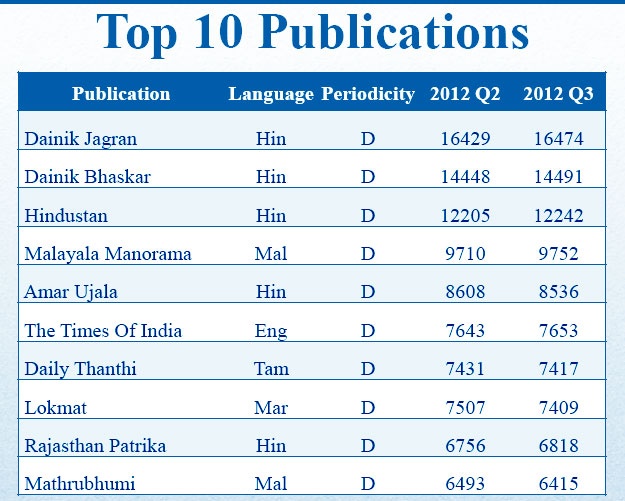
    Jagran leads amongst all publications and dailies. Vanitha leads amongst magazines. The Times of India leads in English dailies and Malayala Manorama amongst regional-language dailies. Pratiyogita Darpan and India Today are the largest read Hindi and English magazines respectively.


    (AIR numbers; All figures in '000)


    There’s been a 0.7 growth in the  print media between the second and third quarters of 2012. However, the growth in television has been 6.1& and specifically in cable and satellite homes it’s 10.5%. The growth in consumption of radio is 6.4% and cinema is at 17.2%. The growth in internet is on expected lines at 27.5%.


  • MRUC releases IRS 2019Q2 data


    By A Correspondent


    For many this week given the number of public holidays meant an opportunity to take a few extra leaves and go for a quick holiday. Yes, there are some part of the country which have been impacted badly by rains – especially for Mumbaikars wanting a quick getaway around Maharashtra, Gujarat or Goa or even coastal Karnataka.


    For a weeks now, the industry is buzzing with rumours that the release of Quarter 2 of the Indian Readership Survey will be released in the second week of August. The MRUC Board and management would’ve reviewed the broad direction and identified the booboos, if any, if given the go-ahead.


    Now the decision to release it: by doing so on August 14, a day before the national holiday of Independence Day, ensures that the backrooms in newspaper offices and their consultants can work unhindered by the daily grind. But, also, if there’s some angst about the survey results, time works as the best healer.


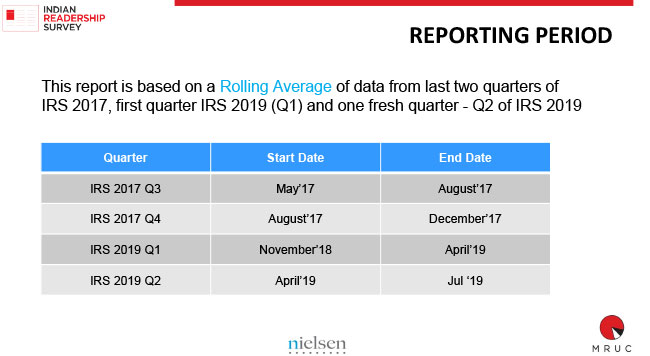
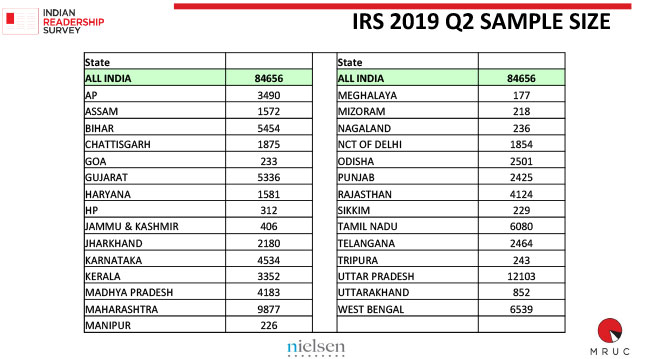
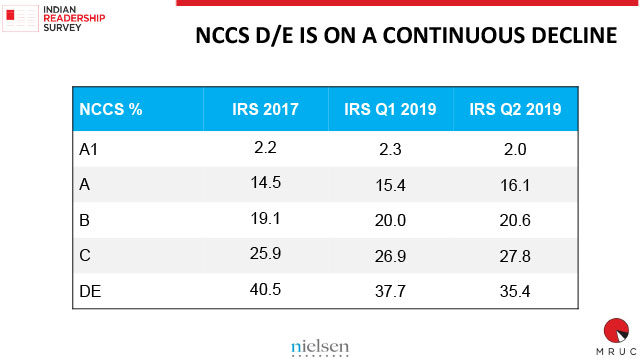
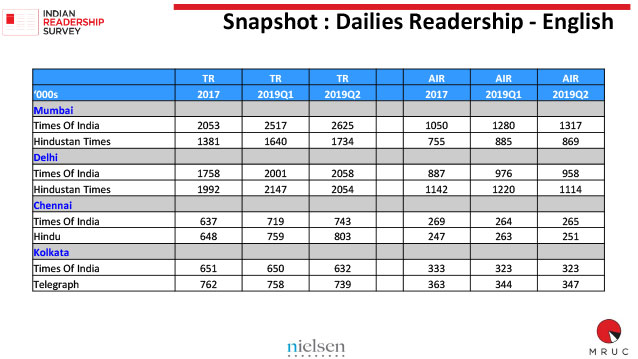
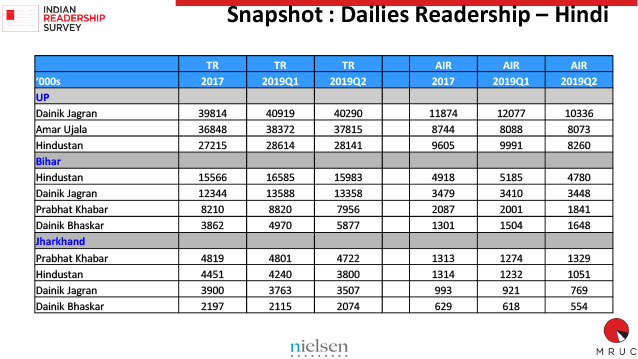
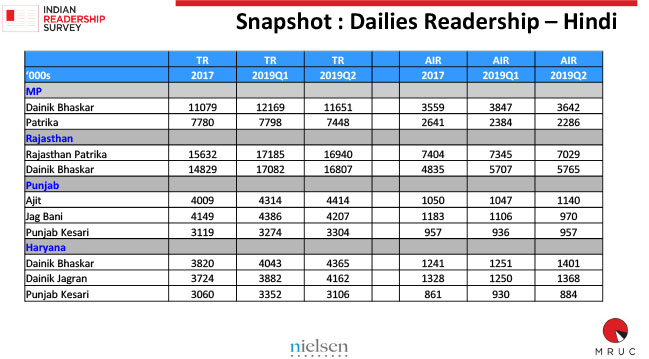
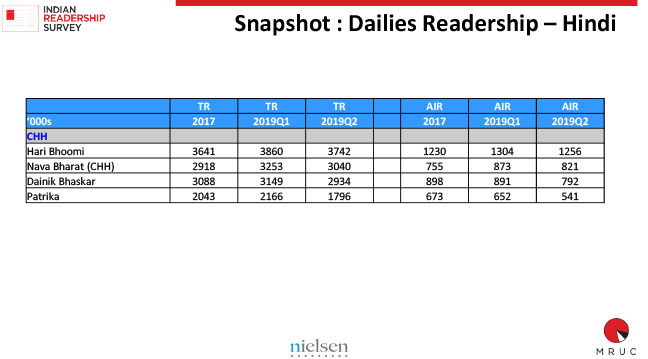
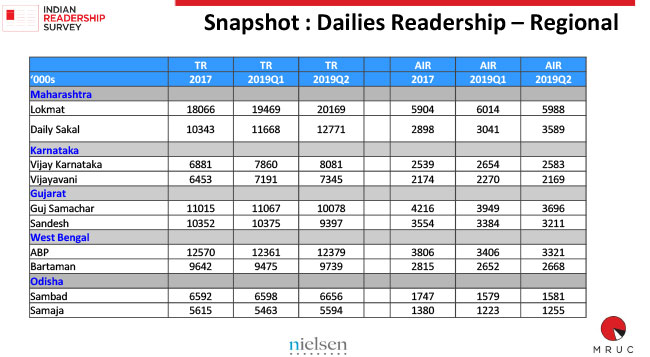
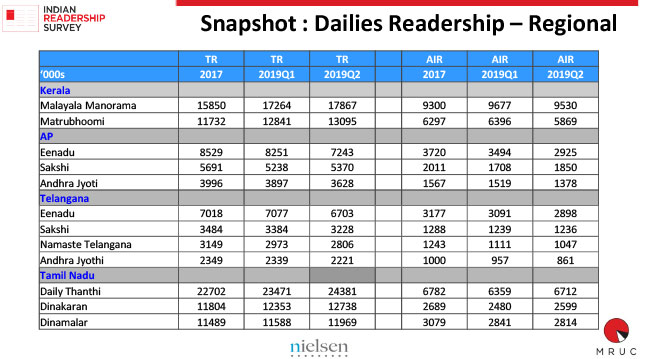
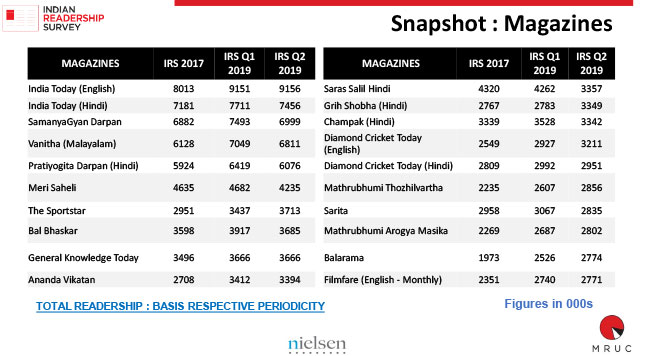
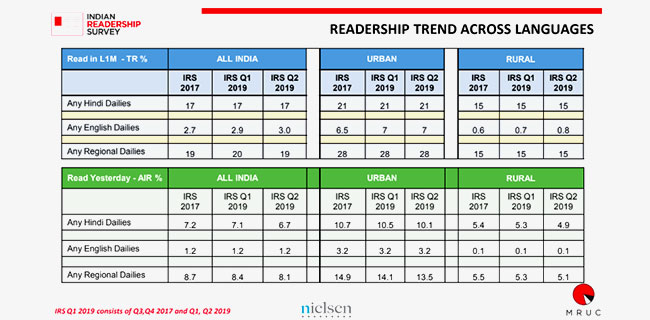
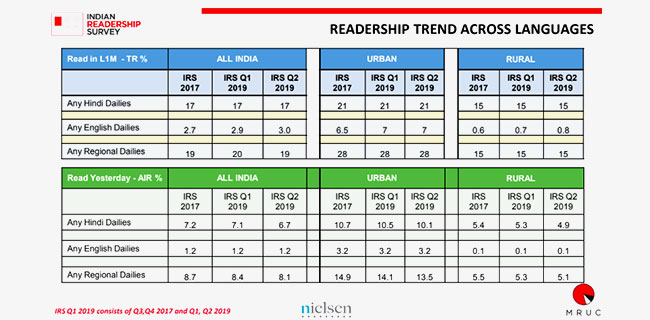
    What reached our inboxes on August 14 afternoon was news of the release of IRS 2019Q2 data. The 2019Q2 data is a rolling average of the last two quarters of IRS 2017 (Q3+Q4) and the first two quarters of IRS 2019 (Q1+Q2). IRS 2019Q2 fieldwork covers April 2019 through July 2019. The reporting sample size for this data is 3.36 Lakh households.


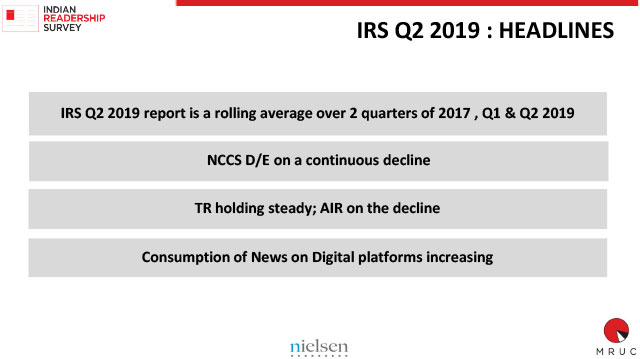
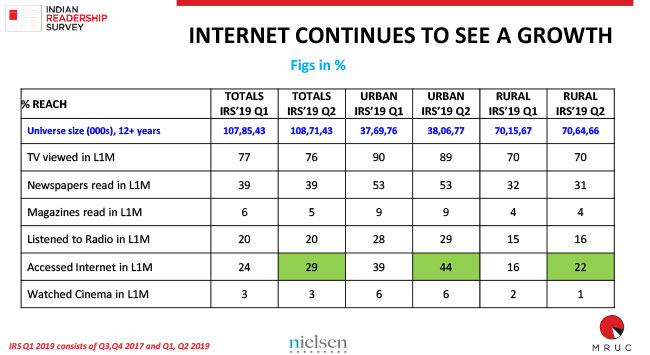
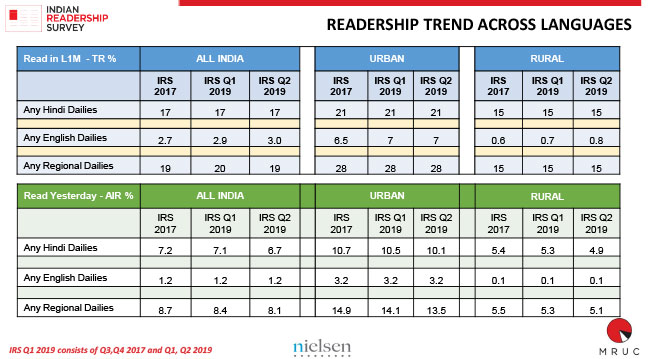
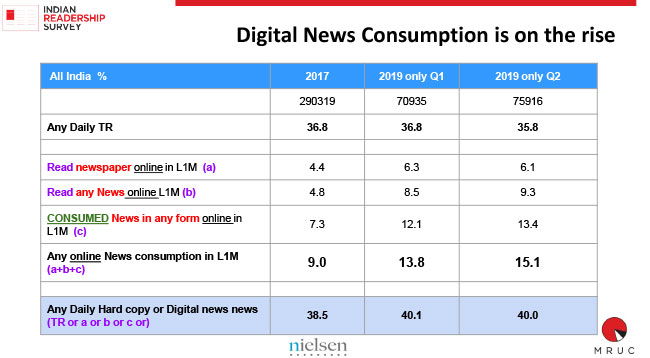
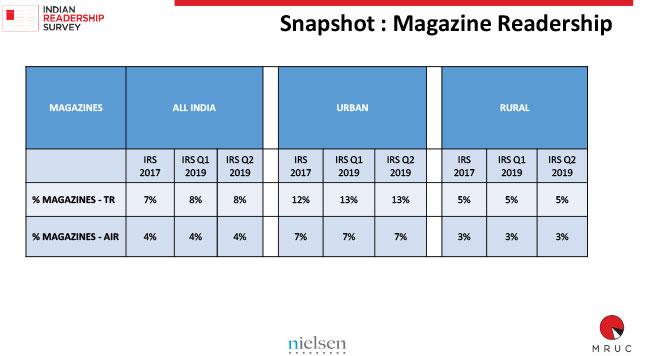
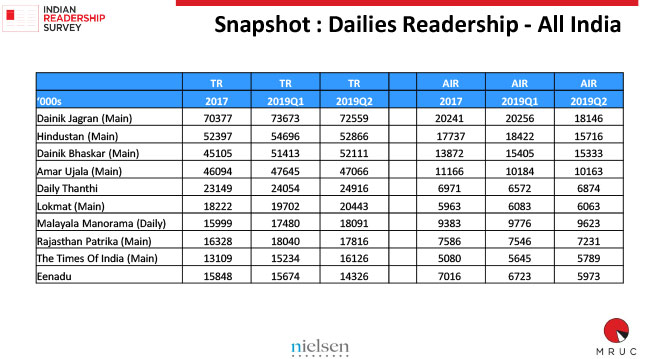
    Here’s the bottomline, in the words used by the MRUC communique, not by us: The reach of print, television, radio and cinema vis-à-vis the previous IRS quarter, largely remains unchanged. Internet as a notable exception continues to grow. Consumption of news on digital platforms is on the rise. And whilst Total Readership (TR) of publication remains steady, Average Issue Readership (AIR) has seen a marginal decline.


    Commenting on the release of IRS 2019Q2 data, Ashish Bhasin, CEO – Greater South and Chairman & CEO – India, Dentsu Aegis Network and Chairman, MRUC, said: “Firstly I must thank the MRUC Board and the IRS TechCom for their steadfast dedication in providing the industry with a timely and robust study. The findings of IRS 2019Q2 gives us a clear picture of the reality we all know – that digital is on a roll and continues to grow at a faster pace. Print readership remains healthy and I firmly believe the future lies in the power of two and not just one. I am very pleased to see IRS release every quarter. Not only is the IRS back on track, but has emerged much stronger and is being universally accepted as the currency for readership in India.”


    Added Vikram Sakhuja, Group CEO Madison Media & OOH, Madison World and IRS Technical Committee Chairman: “We are very pleased with the quality of data that is being released this quarter. India is consuming more media than ever before. Internet is now fast catching up with Print and these two along with TV are the dominant mediums that can be used to reach consumers.”


    The numbers you see here are just the toplines – these are the ones shared by MRUC. For the real thing, one needs to subscribe to the data. Valid point.


    So there’s no real point in us analysing anything. Even the marginal decrease in AIR is an overall number… one needs to look at how the AIR number of a particular genre or publication is to make an informed decision.


    INDIAN READERSHIP SURVEY Q2 2019 HIGHLIGHTS


  • IRSwala Aaya, IRSwala Aaya, IRSwala Aaya Re


    By Sanjeev Kotnala


    The latest round of IRS report is out. The reported readership figures have given soulless Print Rudalies a chance to cry in mourning or smartly find ways to celebrate minor victories.

    The comparative game has begun. Everyone is flogging the tired horse. The fight to sliced the data continues. Everyone is wishing for that somewhat relevant claim which can help them fight the festive season battle. And there will be some lazy advertising for these claims. The biggest game in print is on.

    It reminds me of the Kabuliwala poem that one has read and sung many times. A bit of a twist and a tweak somewhere and the bhands in newspaper title get to sing a new IRS song.

    IRSwala, IRSwala, IRSwala,
    English Newspaper kyun kumhlaya tera mukhda pyara
    Hindi Paper kyun kumhlaya tera mukhda pyara
    Kya khoyi hai Readership teri ya kisi ne circulation me mara,
    Roonth gaya kya tera reader, toot gaya kya hawker,
    Roonth gaya kyat tera reader, toot gaya kya hawker,
    Ya phir tujhse bichhad gaya tera koyi advertiser,
    IRSwala ha ha, kya wo quarterly report wala,
    Abhi mila dey tumko use, dekho khel nirala,
    Chalo readership  ke paar jaha engagement ki hai war,
    Kabhi Number 1 boley koi innovative kahani,
    Chalo readership  ke paar jaha loyalty ki hai war,
    Kabhi Number 1 boley koi innovative kahani,
    Jaane sabka wo haal, usse sabka hi khayal,
    Badi sachchi hai, Readership ki badalti wo syani,

    Everyone wants just that slice of data to help claim a share of advertiser wallet. No one is bothered about its relevance. There is no question about how the numbers match? What do the numbers mean? Will they engage the uninterested advertisers and immune media buyers?

    No one in the print media is willing to change. Something inside has broken. The sales team soul is not into the business. Everyone is looking at the brightness towards the end of rainbow called digital. Is it time to give up? I am not sure.

    There is a strong inertia to change. No one wants to invest in understanding the root cause of the audience behaviour. Everyone has theories which have been strengthened by the multiple nods of heads inside boardroom presentations. Everything is directed towards boosting numbers. It’s different that IRS is a huge (scientific) extrapolation of a robust but limited data. Here is where the print industry has gone wrong. It cannot be the start and end of everything good or bad.

    They have explanations. They have scapegoats. The undeniable truth keeps circulating in the corridors of print powerhouses. The enhanced availability, accessibility and affordability of data. The decreasing concentration of audiences. The fragmentation or multicity of interest.

    In all of this the voice that calls spade a spade is ost. It is print’s inability to continue giving a differentiated, relevant and not necessarily impactful content. Play on its strength of Trust and Faith, which itself is under threat. However, there is high inertia in thinking and ideation. No one wants to move and take a call proactively. Everyone wants safety first. The choice of failing and falling is not acceptable to print stalwarts, and that is the reason they are failing their audience.

    Nothing will change. IRS report will keep coming out. The changes will stop surprising the inert advertisers, media planners/buyers and the print saviours. We will find the IRSWALA and sing the last part of the song.

    Tara rum, tara rum,
    Readers se punchhenge hum, kyu roota hai who
    Tara rum, tara rum,
    Advertiser se punchhenge hum, Kyu badti TV digital se uski doosti.
    Pal pal chhin chhin kum hota jaye,
    Social linkage tode jaye

    Pal pal chhin chhin involvement kum hota  jaye,
    change ke pankh lagaye,
    TV jhoome Digital ghoome, har dam chakkar chalta jaye,
    TV jhoome Digital ghoome, har dam chakkar chalta jaye,
    Pal pal chhin chhin reader segment jaye,
    samay hawa ke pankh lagaye,

    IRSwala aaya, IRSwala aaya, IRSwala aaya.