Category: SIDDHARTHA MUKHERJEE

  • Introducing a new fortnightly column on PR insights – PReamble by Siddhartha Mukherjee

    By Siddhartha Mukherjee


    Advertising is BIG in Size, even BIGGER in Stature. Tracing back many years, one will observe that towards the foundation and gradual development of our Advertising Industry, both in size and aura, the intrinsic role of Public Relations cannot be ignored.


    What has Public Relations got to do with the SIZE of the Indian Advertising Industry?

    Our Indian Advertising Industry would not have been half as rich as it is today had it not been for the Public Relations Industry’s decades of effort to get the multinationals enter the Indian economy smoothly, help them settle and start their operations. I believe that Public Relations has played a key role in transforming our India’s erstwhile Swadeshi Market to today’s India Inc. It is the Public Relations machinery that has worked tirelessly with the media and foreign Investment corridors to ensure the smooth entry of Multinational Organizations before it fell into the lap of the Advertising Industry as prospective Client Revenues.


    Why talk about Multinationals alone? Even the India-based Corporates and Organizations have made a fair use of Public Relations before jumping on the Advertising band wagon. Mergers and Acquisitions, Brand Crisis, Investor Relations/IPOs, CSR, Employee and Trade Relations, Regulatory dynamics, well, many such other dynamics were tackled through Public Relations before those Corporate and Product Brands started using the Advertising tool.


    Ask any PR/Communication professional, especially veterans, and they will have amazing facts to narrate which reiterate the role of Public Relations in creating and stabilizing a brand. PR Consultancy Heads or its Senior Management, Corporate Communication Heads, CXOs, etc., will have an amazingly rich archive of actual, real life PR Effectiveness & Success Case Studies to share – some of which that they themselves ideated or implemented. It is a different story though, that no one has bothered to document these decades of initiatives. All that was needed to be done is to approach the right Industry professionals and Thought Leaders. Case studies will come pouring from various management corridors – Corporate, Human Resource, Marketing, Finance, Manufacturing etc. Function head will have interesting anecdotes to share on how Public Relations helped them in their respective spheres whether it was Business As Usual or Business Not As Usual scenarios.  It really doesnot matter if the case study pertains to a National or Multi-national organization. The important thing here is that every industry vertical will have many case studies buried deep within the wisdom of both veterans & visionary Corporate Business Leaders and Communicators. Each of those stories will somewhere, very humbly, highlight the underlying message of how it helped contribute towards the growing revenues and size of the Advertising Industry.


    Today, if the Indian Advertising revenue size is touching close to 1% of our GDP, well, you know who or rather which Industry to acknowledge!


    How did Public Relations build Advertising Stature?

    My 10-year-old son’s school curriculum has capsules and questions on Advertising, Copy writing, Medium, Slogan etc. It made me wonder & trace back as to what could have been the trigger of all this? Why was my son not being taught about news, news writing, etc. Like advertising, why isn’t he getting the exposure to the world of Journalism as one of the facets of Public Relations?


    Advertising Industry and its Celebrities (well, names like Alyque Padamsee, Sylvester da Cunha, Prem Mehta, Piyush Pandey, Prasoon Joshi, Balki, Vikram Sakhuja, Sam Balsara, Shashi Sinha,…well, it is a long list) have become household names. Parents of employees working in the Industry, their friends and family, social ecosystem, clients, have all acknowledged the  Advertising Industry as a respectable employer, a brand partner and sustainers of brands.


    Well, mind you, this did not happen overnight. This has happened after years of regular use of PR of the Advertising Industry and its Industry Captains.


    Day on day, week on week, Advertising Industry’s credentials, its achievements, plans and yes of course, the Celebrity quotient have an had ominous presence in Newspapers, TV News Channels and Online Networks.


    No wonder then, most of the Management Institutes still continue to believe that when it comes to preparing or revising their marketing course curriculum, Advertising is the nucleus of Brand Communications and Management.


    If anyone doubts on the scientific impact of PR, well, the example is live and all around us. It is one of the best examples to give to establish that PR works, it moves the cheese and how!


    Hopefully! one day, in a similar fashion, PR will have a lot do with PR!


    Siddhartha Mukherjee is a senior PR industry professional and currently Senior Vice President, Eikona – Earned Media Planning, Audit and Advisory. The views expressed here are his own.

     

  • PReamble by Siddhartha Mukherjee: The Shift from “BUY ME” to “WHY ME”

    By Siddhartha Mukherjee


    Talking about “Brand Reputation” and “Reputation Economy” in the Corporate world is becoming a fad. When you come to think of it, well, there’s nothing wrong about it! Compared to our (India Inc.’s and its Agency Machinery’s) state of awareness a decade back, a good start I would say. However, when you look at the reality in terms what we are actually doing towards very crucial dynamics of creating and maintaining Brand Reputation, it very clearly smacks of understanding or seriousness. Very simply put, CEOs, CMOs and all other CXOs need to understand the ground-level implications of what Reputation Economy means. The consumer, our revenue contributor, is no longer agreeing to buy our products/services just because of the Product/Brand’s recall, price promotions, packaging or convenience of place. He/She is no longer getting impressed by our communication push that focuses on “BUY ME”. The consumer has started to flip the product packaging and check who the manufacturer is. Does he/she believe him? The consumer wants to very clearly hear an honest “WHY ME”. They want to focus on the Corporate Brand!


    If one were to look at the total annual Indian advertising spends, advertisers do not spend more than 3-5% of the total on  orporate image. In other words, more than 95% is pure marcom (marketing communication) push. It is a “BUY ME” push. The “WHY ME” part has been missing. By “WHY ME”, I mean information about the maker of the product/service, its philosophy, its business ethics, its culture, its vision & mission, its approach towards the social ecosystem, its governance, quality controls, its commitment to employees, investors, government, society at large, vendors and so on and so forth.


    Corp Comm (Corporate Communications) has to emerge as the frontrunner. CEOs need to be aware that all CXOs, not just the CMOs alone, need to have a say in the brand building process. The long standing excessive weightage on Marcom has to shift and move to Corp Comm! The P/L, toplines and bottomlines simply cannot be the guiding and driving force of an organization’s business and communications planning process. For an organisation/ corporate brand, to put in place a robust reputation management machinery, and further aligning it to a singular reputation building agenda internally is paramount. While CMOs mandate is to obviously focus on BUY ME, the CEO should not do the blunder of losing sight of WHY ME? The onus is on him. In the sense that when the consumer flips the packaging/cover of the product to check on the owner or manufacturer of the product, the consumer should not take much time to recall and thereafter, convinced, place it in his/her shopping cart.


    The potential and deliveries that advertising brought to a brand custodian as a standalone communications tool has lost its firmness. Today, brand custodians need integrated help through earned media. While advertising or paid media, for its own inherent challenges is unable to deliver, earned media/ public relations can well be the custodian of both corporate and product brand reputation going forward. Earned Media/PR can well be the conveyor/spokesperson of not just the brand’s “BUY ME” bit, but more importantly, the WHY ME block.


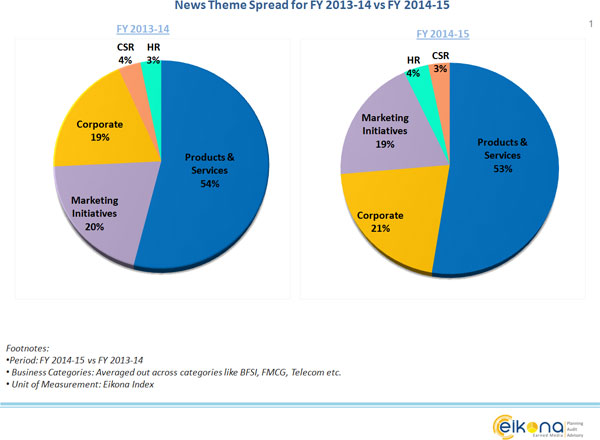
    The Eikona chart, above, gives a sense of what some of the key sectors (averaged out) like Telecom, FMCG, BFSI etc. have focused on. Have they focused on WHY ME or does it continue to be the same story of major focus largely on BUY ME? The following takeaways can be concluded upon:


    a) Things have improved, but Brand ka dil mange more: The above data sets are for the financial year 2013-14 and 2014-15. The above chart splits the total News Push or News Presence of companies across industry sectors and splits them by themes such as corporate image, human resource, marketing initiatives, product and Services etc. If you were to total up product and services and marketing initiatives-related news push, the figure is hovering around a humungous 74%. Which means that a large part of what creates and sustains a corporate brand is missing! However, a silver lining, however, is that these periods are seemingly better when compared with 2011-12 and 2012-13 (not in the chart above). They  used to smack at around 85%. Good news is that the emphasis or push on the “WHY ME” part, comprising Corporate Image, Vision and Strategy, Business Ethics, CSR, Human Resource etc., has increased/improved  as compared to 3-4 years back.


    Further, like I said before, these are averages of some key industry categories. If one were to look at individual sectors, reality in some specific sectors will be harder and much more rude. The message is clear – long-term success is all about corporate brand and not product brand alone! For this, corp Comm has to be in the driver’s seat.


    b) CXOs need to be aware of consumer’s purchase dynamics: Consumer’s purchase dynamics are no longer about Brand Track TOM scores. It is now shifting towards Disposition. It is shifting towards dynamics of strong sustained Messaging which gives away the WHY ME part loud and clear. Any product or service purchase, does’txt matter whether from B2B or B2C category, is about investigating and pivoting the purchase decision on WHY ME. Brand Track survey mechanisms will need drastic revamp. Some of the current ones are archaic and is far from taking care of BTL communication push. Also, the disposition studies will need more robustness.


    c) Why does Earned Media/PR score over Paid/Ad route?: First, the paid/ad route has long lost its credibility. Data sets like ad avoidance, falling Brand Track scores are terrific endorsers of that. Second, the Paid tool is too pricey (let me clarify – I mean money wise! Doesnot justify the ROIs). Third, Ad layout formats doesnot allow me the logistics of laying down details or even relevant snippets of WHY ME. Earned Media scores on ALL!


    d) Can it be measured?: The best part of all this is that Earned Media can be measured neutrally, holistically and continuously and be equated with Corporate and Product Brand Reputation scores.


    Call it Living Company, Loved Company, Successful Company, Lambi Race Ka Ghoda…well, it is time to change. “WHY ME” is the magic wand of long term Business Brand building. CEOs will need to take charge and make amends in the Organizational structure. Communication KRAs and KPIs will need to be recreated with & for all CXOs. Very importantly, they will need to be linked with the Business Objective!


    Siddhartha Mukherjee is a senior PR industry professional and currently Senior Vice President, Eikona – Earned Media Planning, Audit and Advisory. The views expressed here are his own.


  • Siddhartha Mukherjee: It is time for India PRinciples!

    By Siddhartha Mukherjee


    Our fixation with ‘Phoren Maal – Videshi Samaan’ continues even now. It took our PM Narendra Modi to convince us to “Make in India”. India Inc’s marketing and communications machinery has, very successfully, convinced us Indians that definition of words like lifestyle and  aspirations by and large only end with aping the west. Short and simple, Reference = West, copy-paste the West, listen to the West. However, many ground checks are emerging to prove that it is finally those who think local and act global who are emerging as the Dark Horse!


    Let’s talk about our own home turf – the Indian Public Relations Industry. The majority part of our industry has come under the influence of “International” or “Western” ideologies and principles. While the entry and successful establishment of multinational PR firms and associated services in India has been one of the constructive aspects of our industry, my personal view, however, is that the template that we have been applying to plan, execute and measure needs to reflect the personality of India! Western thoughts and principles just do not apply and match up to India! It is a wastage of time for the service provider and wastage of money for the client. It is time for locally customised and centrally localised India PRinciples.


    More so, it is time for the world to know about and learn from India PRinciples. The Indian market, its ground realities, challenges and unique cultural personality makes every stakeholder of the Indian PR/Earned Media Industry – PR firms, evaluation and measurement services and clients – uniquely placed to profess and share learnings with the marketing and brand building community of the world.  It is time we project ourselves inward out. It is time we take centrestage of the world can learn from Indian industry, its adept professionals and the market. It is time India is on the stage…not ‘phoren’ personalities!


    Before I get into some quick thoughts on how we could look at taking this forward, I wanted to share a key reason towards why India should take centrestage in the global arena…Why India principles should be the base of drafting marketing and brand communication syllabus for the western world. A very simple yet key reason is that for decades, the western market enjoyed the advantages of being a homogenous market. Marketing challenges – controllable and uncontrollable, Media Mix and Planning, Targeting, Evaluation etc have been far more smoother and homogenous. Compared to the complex web of heterogeneity of Indian markets, those in the west have been a marketers’ bliss.


    However, now, the same markets have started developing the genetics of heterogeneity. Marketing and communications dynamics have started to convolute. Psychographics and demographics have started to twist and turn. Media and its revolution has been a key trigger towards this change.


    Which is precisely why, our Indian communications industry should start projecting itself as the partner!


    Some quick thoughts on this:

    a. First up, is the belief that India’s PR Industry can take on the world. It can teach and spread its prophecies. While we have had self-created occasions to feel low or belittled, I see no reason as to why we can’t bounce back in the global arena of corporate brand communication and reputation management.


    b. The PR Industry Body (PRCAI) can consider taking up the ownership of authoring the India PRinciples and representing India in the Global arena


    c. Creating India’s PRinciples should include creation of a charter and assigning a character to India’s PR Industry!


    d. The India PRinciples should certainly constitute of principles across key blocks of PR Communication Planning, Execution and Measurement/Evaluation.


    e. While the PR Firms/Consultancies should lead this, it should have healthy representation of Users (Clients) and a Neutral & Holistic Measurement & Audit mechanism.


    f. Communicate (Do PR for) India’s PR capabilities as a Thought Leader in the Global Arena.


    g. Add science of measurement and data authentication to corroborate that why India is one of the benchmark/reference markets to learn from and convert those into Case Studies for Global reference.


    h. Maintain and retain the end objective of INDIA on the Stage, World in the Audience.


    Not just as an Indian, but going by the work PR Firms based in India are doing along with their clients, delivering tangible results despite the ground challenges India offers, I firmly believe that we should not leave any stones unturned to position ourselves in the driver’s seat and on the global stage. It will be a matter of pride and milestone if India and her PRinciples are on stage and the world in the audience.


  • Siddhartha Mukherjee: PR = Jugaad + X + Y + Z…; X = Media Planning

    By Siddhartha Mukherjee


    It is not just Algebra. I believe this is a matter of bringing the “X Factor” into the Indian PR Industry.


    Our Public Relations Industry started and has been thriving on Jugaad. This silent army of PR professionals, certainly for the last two decades, has been quietly helping organisations and brands get “Exposure” in the news space across newspapers, magazines, TV channels, websites and social media. Their ‘Jugaad’ as relationship managers with journalists has actually helped many corporate entities enter India, settle well, understand the market and more importantly trigger the interplay of demand and supply.


    There is certainly no denying that Jugaad is a must! The economy and society that we belong to make it mandatory. However, in the last few years, this standalone art of Jugaad has been fortified with a crying need of science of planning and management of Public Relations.


    The good news is that PR is now getting equated with ROIs. ROIs are with reference to targets. Targets, in turn, have to be supported with Media Planning. In short, PR efforts are a waste if constructed without Media Planning. Whosoever’s objective it might be – the CEO’s set of ROIs, the CMO’s set of ROIs, that of HR, CFOs etc. – these can be achieved only when there is a clear plan, brief and media planning support.


    Why is Media Planning needed?

    – The cancer called EAV/AVE continues to kill and decay the industry. With more than two decades in use, this unit of measurement has not, in any way, been able to upgrade the stature of PR Agencies in the Client minds. Neither has it been able to pull funds for the service providers.

    – PR, like any other tool of Brand Communication, goes through the normal process of:

    o Input

    o Output  (ROI- 1)

    §  Exposure of your Brand and messaging in Media

    o Outcome

    §  Engagement of your Brand and messaging (ROI – 2)

    §  Conversion of your Brand within your Target Audience (ROI – 3)


    – CEO, CMOs and other Function Heads want us to speak the above language


    – Clients have started looking at us as Media Advisors and Partners. No Longer as Postmen or Liaison Officers. They want us to speak the language of Media Planning.


    Who should take charge of this?

    I have always believed that agencies are the catalysts to any change within the industry and especially, in a client’s mindset. At least that is what I have seen with the advertising industry and its agencies.


    Here, I must acknowledge that many of the PR agencies that I am in touch with, have already started this implementation. They are walking the talk! Owners, top management and their team members are, slowly though, imbibing the science of media planning.


    Are there symptoms of Change at the Ground Level?

    – PR Agency employees are moving beyond the Chakravyuh of databases like Publication List, Journalist and Editor List, Ad rate List, etc.


    – They are not only incorporating the topics of readership and circulation but also trying to understand how they are calculated.


    – They are trying to avoid the yardstick of EAV/AVEs


    – PR agencies are asking for smarter briefs stating clear and measurable expectations. PR agencies are working out even smarter deliverables in the client service contracts.


    PR agencies and our industry at large need the X factor. The definition of X factor, well, can be many. For the moment, media planning capabilities will add to or modify our industry’s existing personality.


    PR Agencies have the resource, bandwidth and very importantly, the proximity with the clients. Many have started this movement.


    The question is that when will they make it a viral, Industry wide movement?


    Siddhartha Mukherjee is a senior PR industry professional and currently Senior Vice President, Eikona – Earned Media Planning, Audit and Advisory. The views expressed here are his own.


  • Siddhartha Mukherjee: Indian standalone PR Firms are fighting back!

    By Siddhartha Mukherjee


    There was a time when the advent of multinational PR firms into India was seen as bullish and a fresh breath of air! Clients became happy expecting “international standards”, “western learnings”, “professionalism”, “customisation”, “strategic inputs instead of tactical, table and chair management services” and so on. Which is why, paying a premium service fee did not receive too much of a resistance.


    As for the employee base, they expected better work environment, training and development, a respectable employee identity and fatter pay package.


    Well, the dust is settling down now. The air is clearing up! The reality on the ground is becoming kind-of visible. Basis the feedback I have received from various corporates and industry captains, who have worked with/for both multinational and Indian PR firms, it seems the desi players are fighting back and setting their own innovative standards.


    An eventual conclusion can also be that, if this trend continues, the core business advantage of deep pockets (allowing wait-and-watch patience), that multinational firms have been known to leverage upon, may not be a potent gamechanger any longer.


    Let us look at what the Indian PR firms are doing to fight this battle:

    a. “Dil Dhadakne Do” Zeal: In one of my previous articles, I had spoken about “It is time for India Principles”. Well, this is an interesting beginning! The very fact that Indian PR Firms have realised that “Zindagi Na Milegi Dobara” so “Dil Dhadakne Do” means a lot towards creating a mark in the global arena! The fact that Indian PR firms have started setting up international offices, getting invited to juries of international advertising and PR award functions is a wonderful pat on our back! The fact that they want to LIVE is by itself a great change! Indian PR Firms are wanting to relive life and set the Dhadkan!


    b. Transition of Management Philosophy: The sole proprietorship or mom-n-pop shop approach is dead! Phew! The core postman job of delivering press release copies from publication door to door is fast becoming a small fraction of PR Agency KRAs. Agency top management is no longer just the founder or owner but an array of thinktanks. They are expected to face, answer, guide and counsel the client top management with strategy and direction. Thinktanks from outside the industry – management consultants, auditors, economists, researchers, statisticians, etc – are being enrolled into the thinktank panels. Indian PR Firms have put on the thinking caps!


    c. Professionalism is taking a U-turn, towards Good: Before we take it otherwise, let me clarify that by professionalism, I simply mean basic hygiene factors like punctuality, quality of language (written and spoken), planning skills, creating client briefs, delivering on the expectations, reviews and appraisals and so on. Well, I am happy to see things changing… for the good. To start with, PR firm client servicing teams are reaching for meetings on time! Second, they come much better prepared. Third, they are well-read and have some perspective beyond just “news coverage”, “publication name”, “edition name” and “journalist name”. They have started talking about brand building – and it makes me excited as I write this) – and they are talking about matching their efforts with outputs and outcome. Indian PR firms are professing professionalism!


    d. Strategy & Customisation outweighing Template Culture: Clients are being treated with unexpected yet welcome pleasantries in the form of getting much more increased amount of customised strategic inputs which typically, at least perception-wise, has been the bastion of the multinational firms. Indian PR firms are setting high levels of innovative and out-of-the-box expectations within a client’s mind on what an ideal PR firm should do and deliver. It is no longer about tactical media relations skills. Clients have started realising that Indian PR firms have the inherent advantage of local ground knowledge. Second, Indian firms are (still) not bound by templates that many of the multinational firms are forced to follow because of diktats from the western headquarters. The Indian firms have had the advantage of fighting heterogeneous market situations for decades where templates were no remedy. This gives Indian PR firm thinktanks immense advantage setting expectations and delivering to them. India teaches you the art of living through instant improvisation! It seems, Indian PR Firms are faster and nimble footed!


    The decision is not final yet. The quarters and semis are being played currently. Who the winner will, probably, get decided in the next few years. Going by the trend, it is for sure that a client’s imagination about an ideal agency is set to undergo a sea change! The tide is taking a turn. Top-of-mind recall levels are drifting back – slowly though – towards Indian PR Firms.


    Siddhartha Mukherjee is a senior PR industry professional and currently Senior Vice President, Eikona – Earned Media Planning, Audit and Advisory. The views expressed here are his own.


  • Siddhartha Mukherjee: Humility & Quality wins over ‘Dude’ Culture

    By Siddhartha Mukherjee


    “Why do you want to take up a job in PR Industry?’, a common question a lot of us ask while interviewing candidates. Pronto comes a common answer:  “ …because I like meeting people.” For those who find this response completely normal and healthy, I don’t want to comment any further. This particular column is not for them. However, for those who find this to be a wrong signal or symptom, my response will be – Let’s Talk!


    Till recent times, interviewing candidates used to be a harrowing experience. The various audio and visual symptoms/ signals candidates from PR Agencies, Corporate Communications etc would display have often made me wonder if our Industry’s so called talent pool will be spelling its doomsday.


    While ‘Jugaad/Fixing’, unfortunately though, still continues to be the core ideology behind certain clients hiring PR services, the good news, however, is that a large part of the client set have started gathering around he the need to build brands, nothing short of it. To meet such expectations, PR firms have started attracting “Quality, Well qualified and Humble” talent pool – specifically those who understand brands. Those who do not believe that meeting people or journalists is the mainstay of this business. Those who understand that Public Relations is all about Input, Output and a final Outcome. And that this business requires research and a very systematic measurement/ appraisal system.


    Our PR firms are trying their best to take a positive U-turn, as fast as possible. They are doing everything possible to attract and sustain them with rigorous training processes. They are making it clear to their teams that client servicing is no longer meeting, fixing or just a press release exercise. In short, life is not going to be the same!


    Dassera 2015 marks our Industry’s beginning of the victory march over the following ten evils or hurdles that was stopping our professionals transform from jugaadus/ fixers to brand-building partners:


    1. Agency Professionals have started Reaching Client Meetings on Time: There was a time when the Client Servicing teams of PR Firms were (ill) reputed to never reach on time. Despite pre-decided meeting schedule, clients (corporate communications and its internal customers) have been kept waiting for the (grand) agency team to reach the meeting venue at their own leisure and convenient time. Today, amazing examples of punctuality are being displayed by teams across Agencies.

    2. Agency team is well-prepared for the meeting: For most of the agencies and their team members, the answer to the core question of why the client is doing PR remained a grey area. More so, no one wanted to know the answer. Attendance in meetings was a customary formality. Preparations through research, Asking the right questions, Presenting a scientific plan, etc was a rarity. Today, however, client servicing teams are coming well-prepared. They are asking the right questions, working out a crisp brief, and clearly working out the blocks of Input, Output and Outcome. They know that they have to move the cheese and that they are accountable towards an objective!

    3. Agency team is geared up to meet CXOs: As a continuation from the above, PR firms are getting more reasons and opportunities to meet the CXOs. Earlier, owing to their typical traits of punctuality and (lack of) preparedness, the corporate communications team wasn’t so sure of introducing the agency to his/ her internal CXO customers. Today, that hesitation is slowly fading away.

    4. Agencies are opening up to working with External & Neutral PR Research & Measurement firms: There was a time, when external and neutral PR research and measurement firms were considered as Roman agents by many PR firms. Today, that thought process is drastically fading away. They are opening up to working with such firms not only towards various possibilities of research but also in terms of getting their client work measured and audited.

    5. Clients allocating higher budgets to PR Tool: That paid media (ads and sponsorships) have started delivering declining ROIs is becoming an increasingly known fact. No wonder then, CXOs are being forced to depend equally (if not more) on Earned Media/PR initiatives. Monies are being allocated accordingly. A down-the-line beneficiary of this should be the PR Agency talent pool.

    6. Corp Comm gaining importance over Marcom: Generally speaking, at one point of time, PR industry was known as the product launch machinery. Marcom used to rule the roost. In today’s Reputation Economy, CorpComm and corporate brand is taking centre stage. PR Firms and their talent pool are having to transition accordingly.

    7. Clients are preparing detailed, scientific briefs for PR Agency Teams: Yes, the flipside of all this is that CorpComm teams are getting better and timely briefs from internal CXOs. This, relatively better, brief is bring passed on to their agencies for better ideation and implementation.

    8. Clients hiring and firing of Agencies becoming more stringent: Gone are the days when PR agencies would cakewalk into a new client business with just a credentials presentation. So is the case with clients firing agencies. Recruitment of an agency and firing it is no longer that easy. Stringent metrics are being worked out for entry and exit into a client’s life.

    9. Industry Events and Awards cropping up slowly to acknowledge talent: An average of two-three PR/Corporate Communication award functions are being held each year to highlight work done by Agencies and specific team members.

    10. Course Curriculum & Recruitment process being revamped across Institutes: That a fresher will have spent making news clippings dockets during the first six months (to a year) of his/ her career in a PR agency or CorpComm department is breaking down, though slowly. No wonder, course curriculums, quality of faculty and guest lectures are seeing a drastic change.


    The march towards victory has started. The army of PR professionals are proactively carrying the torch of doing PR for PR. Their audio and visual touchpoints of PR professionals are reflecting thought, sophistication, poise and above all, humility.


    The industry has realised there was a Ravana with sins. Now, they themselves are out there to destroy it.


    Siddhartha Mukherjee is a senior PR industry professional and currently Senior Vice President, Eikona – Earned Media Planning, Audit and Advisory. The views expressed here are his own.

  • Siddhartha Mukherjee: PR Awards: Push for Effectiveness over Creativity

    By Siddhartha Mukherjee


    It is heartening to see the increase in the number of PR Industry Awards around us. Good development! Acts as a much needed motivation booster doze for PR Agency professionals. However, when you step back and take stock of the Big Picture, am not sure if this is helping the PR Industry and its professionals, the way it ideally should, in the long run.


    If you look at most of the entry nominations, one is not always sure if one is to evaluate the creativity or effectiveness aspect. More so, due to lack of authentic, holistic or any data on effectiveness, our judgement gets influenced by the creativity quotient.


    To start with, the purpose behind PR Industry Awards can be as follows:

    • Window for the work done by PR Agencies…does act as PR For PR
    • Great recognition time for the Faces behind the Hard Work
    • Last but not the least, acts as a Good perk for Agency professionals


    However, for me, a very important element missing in the charter, above, is to show that PR works…it delivers for the brand and the clients. For our industry, the immediate need of the hour is to showcase effectiveness to the clients and external world. To maintain our image, we must ensure that these award sessions should not end up being perceived as self-gratification platforms for PR agencies.


    Here is where award initiatives need to quickly move their emphasis from Creativity to Effectiveness.


    Below are some quick thoughts on PR Awards going forward:

    1. Create separate awards for PR Creativity vs Effectiveness awards


    2. Set clear parameters of Creativeness & Effectiveness


    3. Involve PR Consultancies (through its Association), Clients (Indian Society of Advertisers or Association of Corporate Communication Heads could be a good start) and neutral PR Auditors to accredit the systems and processes of evaluation.


    4. Especially on the PR Effectiveness awards, best will be if nominations are sent by the Client and its PR Agency jointly rather than nominations being filed only by the Agency.


    5. While this will create the much needed client interest and ownership of such events, this will also ensure that there is enough and scientific data to establish Effectiveness. That should ideally be mandatory.


    6. Effectiveness should not be about advertising value, number of clips or space occupied in the news/editorial section etc. It should rather be about what the PR effort did to the brand and the client’s business, both during ‘Business As Usual’ or ‘Business Not As Usual’. Each of these should be quantifiable.


    Awards are great platforms to create branding and flagship for our Industry. However, the raison de etré of the awards should be constructed in a way so that it elevates and strengthens PR Tool and its professionals organically. It should not just be momentary gratification avenues but provide acknowledgement platforms to clients and brand custodians.


    Siddhartha Mukherjee is a senior PR industry professional and Senior Vice President, Eikona – Earned Media Planning, Audit and Advisory. The views expressed here are his own.


  • Siddhartha Mukherjee: PR is your Brand’s Immunity Pin from Intolerance

    By Siddhartha Mukherjee


    Honestly, during the last four decades of my existence as an earthling, nothing has made me ponder over the twin topics of ‘Tolerance’ & ‘Intolerance’ more,  as much as what happened over the last couple of months – terrorism, returning of awards, international perspective about India etc. In fact, thanks to our News Industry’s exhaustive campaign on this subject, it made me think about a topic much closer to our home turf – where we are directly responsible for (our/client’s) brand creation and safeguarding it from any damage from unexpected corners. It is about safe guarding our brands from intolerance.


    “What do these all add up to?” – was a discussion I was having with a client. After all the brand communication efforts and investments across Corp Comm and Marcomm, do these really create sound immunity for our brands? India is a market that is known for one of the highest number and types of crisis brands go through – thanks to the political, social, economic dynamics that surround us. Despite all that we do, how can we create tolerance for our brands within its ecosystem?


    As brand creators, when we build a plan, how many times do we start (working backwards) with a basic question of: How to make my brand immune from intolerance? How to make sure that we minimise, as much as possible, the various reasons stakeholders (Government, employees, distributors, investors, suppliers, social observers, consumers, etc.) may have for intolerance towards my brand. That, in other words, people show their keenness to buy, they buy and keep on buying my brand – despite various reasons for crisis and resistance.


    Does a noodle, automobile or a chocolate brand (or even a political brand for that matter) have the immunity (pin) from intolerance…intolerance from consumers, government, activists etc. Does it have the spring to bounce back amidst the Indian ecosystem infested by crisis creators or catalysts? Wherever the answer is unclear, a diagnosis that will be evident is that the brand in discussion (and its management) never used Public Relations in its true sense.


    Public Relations, in its truest sense, by definition, has all the wherewithal to create a robust Immunity Pin for a Brand. It has the potential to immune (crisis proof) every single function and sub-function across the organisation and also partner you towards crisis preparedness. Of course, the precondition being that this function is included and involved in all on-going business planning and operations – HR, Finance, Manufacturing, Suppliers, Government, Social etc.


    Below are some reasons:

    1. 1. PR is flexible to address every Stakeholder: That makes it our truest and holistic Brand Reputation custodian
    2. 2. It has a wonderful agility to synergise Business (Corporate & Marketing) objectives with a holistic Communication objective. Here is where, if given the freedom, it will involve ATL initiatives and synergise it with Corporate Communications initiatives.
    3. 3. Known as the storyteller, Public Relations has the ability to create empathy for a brand.
    4. 4. Being an earned media tool, it has the ability to insulate the brand, through the year, even during the absence of ATL.
    5. 5. It strategically synergises Internal and External communications
    6. 6. It has the ability to read and understand the pulse of (changing) public(s) behaviour
    7. 7. It has the ability to partner Business and Departmental heads in creating crisis proof Business and Operation touchpoints for across stakeholders
    8. 8. PR is the only tool that can influence and synergise the responses of Primary (Stakeholders) and Secondary (Media) audiences. This is a very significant aspect that makes it the Communication and Reputation Management tool of the future.
    9. 9. While ATL is largely aimed at taking care of business revenues, PR function ensures that ATL works well on the consumers and the other stakeholders.
    10. 10. During damage control, Public Relations is the only tool that lends credibility, empathy and reconsideration to the client brand and creates a platform for it to bounce back.


    Notwithstanding whether the brand represents an FMCG, Automobile, Country, Financial or a Political product, amidst growing intolerance, the only way to secure or immune your brand from intolerance is to deploy Public Relations into the central mainframe of the Organization’s behaviour and function. Our brand planning needs to work backwards, assuming that there will be more of Business Not As Usual (BNAU) months. How does our brand withstand the onslaught from various and unexpected corners?


    We can only hope that the future is not about growing intolerance. If otherwise, Public Relations is the actual ally for your brand immunity in the future.


    Siddhartha Mukherjee is a senior PR industry professional and currently Senior Vice President, Eikona – Earned Media Planning, Audit and Advisory. The views expressed here are his own.


  • Siddhartha Mukherjee: PR Measurement & Audit is for the Bravehearted

    By Siddhartha Mukherjee


    When I joined our Industry close to two decades ago, I was made to believe that the PR Agency role is about PR Planning and Execution. PR Measurement, if at all, was by Self or the Agency itself. Also, it started and ended with putting an Advertising Monetary value to it.


    While I am not very sure where the PR Agency stands on the Brand ‘Planning’ bit, we have done a great job of the PR ‘Execution’ segment. The core point, however, is on the last segment – Self Measurement or Evaluation. Has the importance of evaluation/ ROI measurement and audit grown? Have some of us misinterpreted and exchanged self-evaluation with self-gratification?


    Parallely, on the client side, with the ROI dagger dangling on the heads of CCO, CMO and other CXOs, becoming heavier and sharper, Clients have started questioning the very rationale of examiner being the same as the student and vice versa.


    Getting your PR communication initiatives measured regularly and audited by a third party is certainly for the Bravehearted. Why should it be? After all, this exercise requires guts and the ability to hear a spade being called spade. It requires the ability to get evaluated on the basis of this third party data. Not only that, sometimes, even affect your performance bonus payouts. Lastly, it requires the approach of looking at the fee being paid to the Measurement partner as an investment and not a cost.


    Having said that, its heartwarming to see a surge in such Clients who have started believing that their (monthly) PR Communications efforts ought to get measured and audited not by someone internal, not by their Agency, but by someone external & neutral – who understand the client’s business, its agency and a brand’s communication dynamics within the overall IMC mix. They have proven that they are the bravehearts!


    I fully acknowledge that adopting or initiating PR Measurement and Audit within an organisation’s communication framework requires a lot of patience, change and sacrifice. It is not at all easy! Also, I am aware that a lot of bravehearts are trying their best to initiate or start that process internally…but taking time.


    Being a braveheart need not be just about what one has been able to do or implement. It is more of a state of mind. It is more about intent and thought process – what you plan or wish to do.


    Basis my interactions with a cross-section of individuals across the industry, there can be a permutation or combination of some traits or thought processes that differentiates one as a brave heart. One, who believes in the exhaustive process of organisation’s PR Communication Management process being partnered by a third party, neutral measurement and audit service provider:


    1. Differentiates Brand Saliency from Chasing News Space: The Client believes that PR is not for Advertising value but for creating and strengthening Brand Acceptance and Tolerance.


    2. Differentiates & Respects Individual Roles & Functions: The Client believes that roles and expectations cannot be mixed or interchanged. Clients (CEO, CMO & CXOs) should focus on defining the Business & Communication Objectives. PR Agency should strengthen the Communication Objectives and execute the PR ideas. Third Party, Neutral Measurement & Audit service provider should provide the service they are meant to. One should not influence the other beyond the permissible limits.


    3. All three Custodians work together, not in Isolation: In continuation to the above, Client believes that all the above three custodians should focus and work on their given roles together, Inclusion in other words…not in isolation or Exclusion. It should be a regular, monthly phenomenon.


    4. Differentiates PR Tracking from Measurement & Audit: The Client can identify the huge and obvious difference between PR (Daily) Tracking/Monitoring Vs PR Measurement & Audit.


    5. Replaces Advertising Value with Scientific Unit of Measurement: The Client ensures that slowly and eventually, the use of EAVs/AVEs, during the course of discussion with CMOs, HeadsHesjBrand or Business Heads, or with the PR Agencies, ceases to exist.


    6. Uses Measurement & Audit as a Client-Agency relationship fortification process: The Client sees the role of PR Measurement & Audit partner as someone who will fortify the Client-PR Agency relationship and not that of Roman Agent.


    7. Encourages and Helps Agency to deep dive into Data: Client encourages its PR Agency to use as much data to research and analyze. Not only that, they use it to Plan and Deliver.


    8. Uses Measurement to Evaluate Machinery: When PR & Communications function is evaluated on the basis of data provided the neutral PR & Audit service provider.


    9. Knows he/she can benefit or lose out on Performance Incentives: Acknowledges service as The Client acknowledges that there could be times, when basis the data, his/her Performance incentives may get positively or negatively impacted.


    10. Only way of doing scientific PR for PR: The Client genuinely believes that this is the only way can do PR for his/her team’s efforts with the non-PR customers internally within the Organisation.


    Breaking the convention of playing safe, evaluation through a neutral/ third party, letting your department’s appraisal be governed by third party data, changing the rules and expectations from your PR Agency…all these and many more, requires one to be a braveheart. The change is not easy. The good news is that I am seeing more such brave hearts…keeps me going and signals at a faster and sharper Industry growth going forward.


    Siddhartha Mukherjee is a senior PR industry professional and currently Senior Vice President, Eikona – Earned Media Planning, Audit and Advisory. The views expressed here are his own. 


  • Siddhartha Mukherjee: MARCOMM PR: TV Industry offers Learnings!

    By Siddhartha Mukherjee


    The PR and Corporate Communication professionals working for and in the TV Channels – especially for categories such as GEC, Movies, Sports, etc. – are doing fabulous work in the space of MarComm PR. In fact, their work on Programme/ Product PR management can lend learnings for the Non-Broadcast Industry.


    On an average, a non-broadcast or non-media and entertainment sector, has 70-80% of its overall PR output contributed through Product PR. This means, the rest 20-30% represents news across various aspect of Corporate Brand dynamics such as Corporate Image, Human Resource, Finance, Government Affairs, CSR etc.


    However, in the TV Channel space, the Product or Programme PR contribution is a whopping 90-95% of the overall PR coverage output. Well, as a passing mention, this has two implications – a) Focus on Corporate Brand of the Channel is less. However, with eventual digitization, this negligence on Corporate Brand PR is bound to change soon b) Programme/Product PR is very dynamic and works on a very disciplined mechanism of Pre-During-Post communications push.


    What makes TV Programme PR such a wonderful case study for our professionals on what an ideal MARCOMM PR can be? A quick look:

    1. Responsibility does not end with TV Programme Launch PR: The job of TV Programme PR doesnot end with just the launch or media announcement of the Programme. That is one part. The second and real challenge is to do PR to sustain TV viewer’s interest to continue watching the programme, day on day, week on week.


    2. Probably the only Industry vertical where PR effort is getting equated with Input, Output (PR Scores) and Outcome (TV Viewership): While the rest of the Industry is yet to start galloping on the concept of equating PR efforts with Outcome objectives such as sales queries, sampling, sales etc., the TV Industry did the crossover to equating PR efforts to sampling and sales (viewership numbers) many years back.


    3. Programme PR, typically, is a Print supplement or weekend reading: It is not as easy as it looks. Getting TV content news published in limited available editorial space is a matter of big challenge. To explain the challenge, if you look at any single Hindi General Entertainment Channel (HGEC), it has to maintain the viewer interest of at least 6-8 on-air programmes. Over and above this, they look at 1-2 new programme launches every month. That makes the total of about 8-10 programmes (product) requiring PR push. Even if one were to prioritise from this, roughly, on an average, at least 4 programme brands need PR push. To get this in a limited supplement and/ or weekend space needs a long haul.


    4. Rare platforms on TV Channels: TV Channels, nowadays, rarely provide any platform for brand-building or marketing purposes in its true sense. As compared to a small (news space) contribution being given to Non-Broadcasting or Non-Media & Entertainment Industry verticals, the contribution towards TV Program PR is miniscule.


    5. Unlike Toothpastes or Cars or Insurance policies, TV Programme sales happens every day: Elaborating on the sustenance part mentioned earlier, new/fresh programmes are meant to be sampled and consumed (viewed) everyday. Every single day, the dynamics of sales push and purchase take place. Unlike other categories where sales happen ones a week or month or more, TV programme PR push for programme sampling ever y single day. Creating scientifically planned and mapped PR news stimuli every day or every week is tough challenge. This requires tremendous discipline and manoeuvring skills.


    If we dig deeper, we will find more such salient features. The Media & Entertainment sector, TV Industry specifically, is a high maintenance category. It guzzles up a lot of communications, through the year. Let us not categorise it as a Light, Easy Going & Entertaining industry category. There is in fact, a lot of hard work, discipline and planning. It is one of the very sectors where Marcomm PR has happily taken to being brought under the ROI scanner.


    Marcomm PR in TV Industry offers wonderful learnings and case studies for various B2C industry verticals.


    Siddhartha Mukherjee is a senior PR industry professional and currently Senior Vice President, Eikona – Earned Media Planning, Audit and Advisory. The views expressed here are his own.


  • Siddhartha Mukherjee: PR Industry’s Key Challenge in 2016: Bridge the Gap between Demand & Supply

    By Siddhartha Mukherjee


    It will be interesting if our Public Relations industry were to revisit the basic principles of Economics – Demand & Supply. For years now, the suppliers, the PR Firms/Agencies, have always supplied what they thought will be the quantity and quality of demand by the clients. For the same period, clients, on the other hand, have always believed that their demands were not completely understood and therefore never met. On a different note, rarely has there been an effort towards comprehensive reconciliation by the two sides.


    Let us hope that the twain shall meet some day. For the moment, let us focus on the possible demands – some tactical, some strategic – that may come from the clients in 2016. More importantly, are there ways in which suppliers (PR Agencies) can meet those demands.


    TACTICAL:

    1. Be punctual; Come for Office Meetings on Time: While I do know of some agencies where they follow very strict punctuality protocols, by and large, however, the general perception prevails that punctuality is a rarity in our Industry. Respecting timelines, honouring start and end time allotted for meetings, etc. form one of the first basic or elementary requirements by clients.


    2. Be presentable: Fashion is good. Experimenting with Fashion is interesting. However, that need not border towards shabbiness or indecent attire. Let us not forget that a large part of the Industry Clientele, who occupy important Chairs within Client organizations, have risen the corporate ladder through sheer hard work, dirtying their hands, humility and discipline – work attire being one of them.


    3. Be well-prepared – anytime, everytime: The conundrum of PR Agency vs Consultancy may come to halt by this basic tactical move. Orienting and Training the Client Servicing to think and converse as Client partners and not agents or fixers. The ability to ask the right questions and get the right brief often works miracles.


    4. Think beyond Press Releases; 1-on-1s and Conferences: It is not necessary that a Client’s right from its Agency or the latter’s duty towards the Client is restricted within the realms of Media Relations. Think of ways in which Clients Brand will get better exposure, scientific engagement and effective conversion by its Target Audience. You may think of solutions from the overall domain of Integrated Marketing Communications (IMC).


    5. Database Management should go beyond Media List and Ad rates: Why can’t my Agency maintain database that extends beyond Publication/Journalist details to Household level data, Media Penetration, Brand Saliency, Consumption Behaviour, etc.


    STRATEGIC:

    1. Don’t talk EAVs; Tell me something new: My ROIs from Advertising are coming down. My dependency on Earned Media/PR, ideally, should go up. However, the current unit of measurement, EAVs, is not helping me beyond self gratification and making my some of my internal desks happy. I am not getting a sense of how it is impacting my brand or the business at large. Can there be other yardsticks and unit of measurement to achieve this purpose?


    2. Correlate PR with the nodes of Communication Cycle: Establish the correlation of PR effort with Brand Exposure, Engagement and Conversion.


    3. Infuse Account & Media Planning into PR: Planning is not just about sprinkling Client’s monthly plans with some 1 on 1s, Press Conferences and Media Releases. Sadly, even today, some of the largest PR Agencies continue to speak this language of – “…ok, lets get a cover story in a magazine done!”I have never been able to fathom how does this help the client and why do clients encourage such below average approach? Planning is an elaborate process that includes modules of listening, benchmarking, target setting, audit etc.


    4. Can we Fortify or Strengthen the Client-PR Firm relationship: If PR and PR Firms are expected to partner Client growth, there has to be a way towards strengthening and creating long term marriages. While it is a rarity nowadays, however, the PR Agencies will have to position themselves as Long Term partners.


    5. PR and IMC’s interplay: As a Client, internally within my Organization, I will never look at PR in isolation. It is one of the triggers or stimuli or touchpoints for my brand and its target audience sets. How can PR work in tandem with other IMC dynamics.


    6. Can Research be infused into or support PR: Well, Research in Public Relations is an ocean. It can be applied at every step – Listening, Planning, Benchmarking, Target setting, Outcome…well sky is the limit.


    7. How can Measurement & Audit help me justify my PR efforts: Well, a simple yet effective starting point has to be – why do you do PR? One may not believe till they see it! Amazing measurement and audit grids fall in place that can not only reposition Corp Comm on to a pedestal within Client Organization but also bind the Client and its PR Agency into a healthy long term marriage!


    8. Is PR Monitoring/Tracking same as PR Research and Audit: There has always been a difference and right fully so. PR Monitoring and Tracking is tactical. News (Aaj ki taaza khabar) is a commodity. Whether it affects your plans, your long term targets, your brand objectives, your media relations dynamics, competition moves, nothing of these can be gauged through this tactical service. For these and others, such as – budget planning, positioning, key messages, prioritisation, etc. – Research and Audit is key! Research & Audit is for CXOs utility.


    The challenges of 2016 need specific attention. Best if we start with the tactical ones. They are easy to achieve and in a much shorter time. More so, they are internal in nature. Strategic ones are slow burners and will need a lot of external synergies with various corridors of the Industry.


    Demand needs to be collated and documented. On whether Suppliers can meet those demands, well, I know of many isolated cases where some PR Agencies have over delivered beyond a Client’s imagination! It is just a matter of sharing those practices and making it a mass movement!


    Siddhartha Mukherjee is a senior PR industry professional and currently Senior Vice President, Eikona – Earned Media Planning, Audit and Advisory. The views expressed here are his own.


  • Amith Prabhu: Creating Lasting Impressions

    By Amith Prabhu


    Do you remember your first day at your first job? Do you recall that first client meeting? Do you remember the first time you met that Editor who is became a friend for life? Do you remember your last job interview? What is the one common factor that played in all these scenarios? Well, in my humble opinion it is impressions. There is a saying that the first impression is the best impression.


    I spent the last weekend in Goa and the more I visit this state the more I’m inclined to believe India has a great potential to become a more tolerant country learning from this tiny state. The impressions Goa creates in the mind are manifold and it is the collective will of the Goan people that has led to the state being a liberal place for thoughts and ideas to converge. The citizens of Goa are the best brand ambassadors for the state and help a visitor take back lasting memories.


    Last week, I wrote about leaving a legacy. The first step to leaving legacies is creating the right impression that lasts. I began by asking questions that resonate and then wrote about the state I was in over the weekend to bring out the thought that we are what we make out of ourselves. Public Relations people have a role in creating lasting impressions for the brands and organisations they work on.


    While legacies take a long time to be built, impressions are created every moment there is an interaction. Many good impressions lead to a better legacy. Not too many professionals care about creating lasting impressions because they feel they are secure in a job and will only need to create an impression within the environment they work in.


    The reality is that, everyone is being noticed all the time and the collective impressions stands us in good stead when someone is hiring a team member or a consultancy. Therefore, it is our interest to continuously work towards building lasting impressions. How does one do that? It takes some effort but does not require overdoing. Reading, Writing, Listening and Speaking are attributes that come from practice. Add to that a good body language, a smart sense of dressing and great style in grooming are critical. If we pay attention to these we are certainly on our way to creating a good impression. There on we need to focus on working on great campaigns and the work will speak for itself. Have you made plan to creating lasting impressions? There is never the perfect time. Start now. It is never too late.