
Category: PR ETC

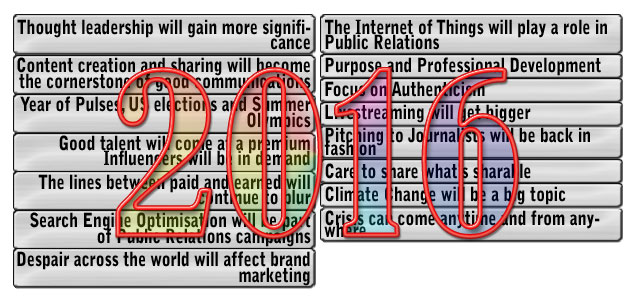
  • 16 Trends in PR & Corp Comm in 2016


    By Amith Prabhu


    2016 will be a year of the unexpected. The communications profession is bound to see a lot of action. Here are sixteen trends that will gain traction during the year.


    1. Thought leadership will gain more significance – There will be a greater demand for credible events to partner with and speak at. Content shared at events will have multiple levels of impact compared to the old school contributory article and interviews.


    2. Content creation and sharing will become the cornerstone of good communications – Thanks to the onset of 4G, video will become more widely accepted. Simple, meaningful content shared in real time will play an important role in communicating.


    3. Year of Pulses, US elections and Summer Olympics – Three major events will take place that will have repercussions around the world. The Rio Olympics in summer, the US Presidential elections in the winter and the UN declared International year of Pulses dominate headlines as they happen


    4. Good talent will come at a premium – Good talent, especially at the entry and leadership level will be much sought after. There will be good offers made galore and the best women and men will take home higher pay packages.


    5. Influencers will be in demand – Influencers from all walks of life, especially those who are neutral, social media savvy and have a huge following will be on speed dial of brand and communications managers. Differentiating between the credible and not so credible among them will be key.


    6. The lines between paid and earned will continue to blur – Advertising agencies will continue offering public relations services for a song and PR consultancies will keep hiring from creative agencies and media planning companies to offer paid media solutions.


    While the six trends above are my perspective in the Indian context I have curated 10 other trends from around the world to look out for.


    1. Search Engine Optimisation will be part of Public Relations campaigns – SEO can no longer be part of a digital shop working in silos. Closer integration between those building earned media will be seen.


    2. Despair across the world will affect brand marketing – The migration crisis, the rise of ISIS, corruption in emerging economies and economic instability will continue have its impact on marketing.


    3. The Internet of Things will play a role in Public Relations – Whether it’s an app to track media output or a website that aggregates influential blogs, there will be innovation galore in 2016.


    4. Purpose and Professional Development – Professionals will continue to seek greater purpose in what they do and look for a higher degree of professional development.


    5. Focus on Authenticism (I just coined that word) – A movement towards being authentic which in turn builds trust and makes it more credible will be keenly sought after.


    6. Livestreaming will get bigger – Tools like Periscope and Meerkat will become more popular and will help in sharing of news and events better than ever before.


    7. Pitching to Journalists will be back in fashion – Over the last few years thanks to the 140-character influence, written pitches lost their sheen. This tool will gain some resonance.


    8. Care to share what’s sharable – Journalists have immense pressure to carry news that will take off on the world wide web. News that can be shared wide and far will get prominence.


    9. Climate Change will be a big topic – A lot of what will be said and written will be linked to one of the all-time big problems on climate change. So keep a ear to the ground on this one.


    10. Crisis can come anytime and from anywhere – After what Maggi went through in India, brands better watch out for similar activism elsewhere.


    If you’d like to add other trends, feel free to comment and also share on Twitter.

     

  • Amith Prabhu: 16 things we hope to see in Indian PR this year

    By Amith Prabhu


    Here is a list of 16 things one hopes to see happen in the Indian PR world this year… the concluding part of the series of
    1. A united communications fraternity – There are several groups online and offline. There is PRCAI, PRSI, PRCI, ABCI. They all need to come together under a Federation for the greater good.


    2. A book or two by PR veterans – We hope Prema Sagar and Madan Bahal or Dilip Cherian and Sunil Gautam bring out a book on Public Relations in India this year. It will be a good for future generations to gain inspiration from.


    3. An Indian PR campaign from a PR firm winning at Cannes – Indian PR firms have never won a Lion at Cannes and we hope this June changes that once and for all. Some great work does happen, some great packaging needs to happen.


    4. A PR professional becoming a corporate CEO – A career PR professional has rarely become a CEO of a corporate organisation.  John Fallon of Pearson, Dave D’Alessandro of John Hancock, and Richard Plepler of HBO have done it in the US. India’s turn now.


    5. The next 100 crore PR firm in India – This can only happen if the second largest Indian firm merges with another global firm, which maybe a difficult proposition but it is still possible. I’m referring to Perfect Relations becoming part of the Edelman or MSLGroup network.


    6. A Deputy Secretary General at PRCAI – PRCAI has great potential but needs more hands and feet. While Jayoti is doing a great job, time for her to have a full-time assistant and potential successor.


    7. A really solid awards system – There are couple of awards systems but these have the same companies on the jury, on the sponsor table and on the winners’ list. The three need to be separated with no further comment.


    8. A PR magazine in print – Print is not dying anytime soon. The profession needs to have its own print magazine so that the profession gets its due with a variety of stakeholders. High time this cat was belled.


    9. A few more women leaders in the top 10 firms – I shared a list of the 16 leading ladies in Indian PR consulting but majority of them are not in the Top 10 firms. We need more women in senior leadership (Top 3) at the larger firms.


    10. An Indian in the global leadership of a Top 20 international PR firm – Very few Indians have gone beyond regional roles. It is time for an Indian to make it to the global leadership of a leading firm beyond tokenism.


    11. Indian consultancies hiring from the top IIMs and from ISB – I hope 2016 is the year when IIMs and ISBs see a beeline for placements on Day Zero from at least five PR firms in India. This will be the day when the profession has truly arrived.


    12. A repository of Indian PR case studies – There is no online or offline repository of great case studies of work done in Indian Public Relations for reference. I hope this year that changes in some form.


    13. An Indian solution to the measurement problem – We have heard the Barcelona Principles for the last several years


    14. A PR professional being appointed by the government as communications advisor – This government may never hire a formal communications advisor like most previous Prime Ministers did. If they do, I wish it will be someone from the PR fraternity.


    15. A better work-life balance for PR professionals – PR often features in the most stressful jobs list. PR people are part of a vicious cycle. Maybe, it’s time to get that act together and focus on better health and less stressful times.


    16. A structured association of corporate communicators – There is no single association that brings together corporate communications professionals. There are WhatsApp groups and Facebook groups. But a registered association could do wonders.


  • Amith Prabhu: The 16 leading ladies of Indian PR consulting

    By Amith Prabhu


    The penultimate in the series around the number 16 is a special focus on Women leaders in Indian PR Consulting. These are the ladies who have built brands and businesses from scratch or have been hired by global companies to lead their India office. If I have missed out on someone you think who ought to have featured here, please bring it to my attention.


    1. Prema Sagar – The undisputed queen of Indian Public Relations consulting. She started Genesis Public Relations in 1992 and has built it into a powerhouse in its own right. Sir Martin Sorrell and Harold Burson vouch for her.


    2. Nandita Lakshmanan – The only PR firm among the Top 10 that is headquartered in Bangalore. The PRactice is linked to the Porter Novelli network.


    3. Archana Jain – Archana is the authority on luxury and lifestyle PR. She has created a niche for PR Pundit that few have been able to match.


    4. Radhika Shapoorjee – This advertising executive made the switch to Public Relations early on and has been at the helm of H+K Strategies (formerly IPAN) for close to a decade.


    5. Radha Roy – As country manager of Ruder Finn, Radha leads client mandates in India which is one of six countries where this consultancy has a presence.


    6. Papri Dev – Papri spent over a decade at Genesis like most of the other leaders mentioned above and then moved as to Danile J Edelman Inc company Zeno Group India as its second managing director.


    7. Bela Rajan – Bela is the original founder of Sampark which her husband later joined and later got sold to Ketchum. She is one of the most down to earth professionals around.


    8. Valerie Pinto – Probably the only CEO of a global company’s Indian operation who is under 40, Valerie made big news when she joined Weber Shandwick from Perfect Relations last year.


    9. Sunayna Malik – Sunayna is one of the few leaders who moved from corporate communications to consulting when the trend was not yet in vogue.


    10. Madhuri Sen – Madhuri runs the iconic Seattle headquartered company’s India operations and has been at the helm of Waggener Edstrom since they launched in India in 2010


    11. Kavita Lakhani – Kavita is President at Golinopinion and works closely with Ameer Ismail in delivering client delight.


    12. Kavita Bhaskaran – Kavita is the brand new head at Ogilvy Public Relations. She joined the firm in late 2015.


    13. Praveen Rikhy – Praveen Rikhy runs Melcole PR, arguably India’s oldest PR firm that is still in existence.


    14. Shivani Gupta – Shivani cofounded SPAG Asia year before last which has gone on to win some major global awards.


    15. Manisha Chaudhry – Manisha is the co-founder of Value 360 which has become the go-to place for startups


    16. Jayoti Lahiri – Last but not the least. This list would have been incomplete without Jayoti featuring in it. As Secretary General of PRCAI she is like the first lady of Indian PR.


    The above list is in no particular order and was long overdue. One more in the series of 16 coming up next week. Happy reading!


  • Leaving a Legacy

    By Amith Prabhu


    After a series of lists – first in December and then in January I’m back to the listless columns. I have got a lot of feedback on the columns that has lists because people enjoy reading lists. May be in March or April I will resort to another series of lists.


    February is a special month for a variety of reasons. And over the next four weeks I will write about concepts dear to my heart both personally and professionally. This week, as the headline states is about leaving a legacy.


    How many of us work to leave a legacy? How many of us aim to create lasting legacies? What is it about legacies that make them difficult to create? I try and meet at least 3-4 CEOs of Indian PR firms and an equal number of chief communications officers every month for one-on-one interactions. Each of these meetings is a learning session for me. Several of these individuals I meet are institutions in their own right and some of them have built companies that are moulded to look and feel like institutions. In January, I had separate meetings with two of the most powerful individuals in Indian PR consulting and the one thing that stands out every time I meet them is that they have built a legacy for future generations by sheer hard work, ample amount of determination and a clear vision. The same goes for communications directors. There are two individuals in different age groups who stand out for what they do at the conglomerates they work for and have created legacies that give the organisations a unique stature.


    They made me ponder on what goes into building and leaving a legacy besides hard work, determination and vision. I think there is no magic sauce and to each his or her own. But there certainly are some ingredients that go into legacy building. I’m hopeful in the next five years before we reach 2020 we will see several men and women who leave behind a legacy in the world of communication consulting and corporate communications.


    I was reading a special coffee table book brought out by Madan Bahal’s colleagues to commemorate his 60th birthday. I’m hoping next year Prema Sagar will bring out a book as the company she founded turns 25. These are individuals who came up the hard way who have built institutions and will leave legacies.


    The purpose of this column is to send out a message to all professionals that while small battles have to be fought day in and day out the war is about creating something that you will be remembered for. And there are plenty of opportunities out there to work on. The question you will ask yourself on completing a milestone in your professional life is “What did I achieve that I will always be remembered for?” And the first step is to start today by asking yourself the question as to what do you want to do in the next 11 months that you want to be remembered for in 2016?


  • Amith Prabhu: Couples in PR & Corp Comm

    By Amith Prabhu


    Public Relations in India has seen over a several couples met each other at the work place. I have had the good fortune of working with some and knowing others. It’s a day after Valentine’s Day. A good enough  reason for another list. I’m listing fourteen couples in three categories. Because love is in the air.


    Those who run consultancies they have built:

    NS Rajan and Bela Rajan – They founded Sampark in the early 1990s which was acquired by Ketchum few years ago. Rajan is an angel investor in India’s first independent school of strategic communications.


    Kunal Sinha and Manisha Chaudhary – These were college sweethearts who later started Value 360 along with another partner. They are bullish on the future.


    Aman Gupta and Shivani Gupta – After a long stint with Perfect Relations they together created SPAG Asia couple of years ago. They are young and raring to go.


    Udit Pathak and Pooja Pathak – This is a couple to watch out for. They are steadily building Media Mantra together.


    Sachin Khurana and Shruti Khurana – Sachin is building on the 17-year-old legacy created by his father to take Quik Relations to the next level along with his wife. This is a leading regional communications firm.

    Those who have their better half working in-house while they are in senior positions in consultancies.


    Nikhil Dey and Deepa Dey – This is the power couple I have known the longest. While Nikhil is President at Genesis Burson Marsteller, Deepa runs communications at GSK Consumer Healthcare.


    Murali Sashidharan and Sarah Gideon – Murali ran his own firm for a while and is now with Adfactors, Bangalore. Sarah manages communications at Infosys.


    Vinod Moorthy and Snehhal Chitneni – Vinod is a Director at Rediffusion – Edelman, which has the Tata mandate. Snehhal is a senior executive at L’Oréal India


    Karan Punia and Garima Misra – Karan Punia is CEO at Cohn & Wolfe Six Degrees. Garima heads marketing and communications at iYogi.

    Those who have made the move to corporate communications after spending their early years either in a consultancy or another domain.


    Manish Kalghatgi and Rashmi Naik – This is my favourite couple of all and I have known them the shortest. Manish heads communications at Jet Airways and Rashmi does the same at Omidyar Networks.


    Vivaan Gideon and Archana Mohan – Vivaan and Archana work at VM Ware and Dell respectively. Disclaimer: This is the only pair that I have worked with in the past. Archana has been a batch mate too.


    Manish Mallick and Shveta Singh – Manish leads communications at Arvind. Shveta who was formerly a trainer is now at the helm of the communications department at Ambit Holdings.


    Pradeep Rajshekharan and Nitisha Agrawal – Pradeep is a globetrotter who heads communications at Franklin Templeton. Nitasha heads Public Relations at Volkswagen India.


    Raza Khan and Pooja Garg Khan – Raza leads group communications at Bharti. Pooja is a vice president of communications at PNB Metlife Insurance.


  • Amith Prabhu: Universal Service Obligation in Public Relations

    By Amith Prabhu


    We have all heard of the concept of USO or Universal Service Obligation where certain services are offered to all sections of society and at times by charging a higher fee in urban areas to offer the service to rural areas. Recently, we all witnessed one of the biggest crisis of 2016 when the government ruled in favour of Net Neutrality. Facebook which was trying to bulldoze Free Basics had to put it in the cold storage.


    This column is about a Walled Garden we are creating in the world of Public Relations. First, by offering services to the elite. Second, by only letting people from more affluent backgrounds to enter the profession. Both, by having a high fee at centres of learning and by expecting a level of sophistication in aspirants that only urban areas can offer.


    I went through to interesting events last week. On Thursday, I was in Ludhiana to address girls from Khalsa College on Careers in Communications and then on Friday I was on a panel to interview students aspiring to do their Masters in Communications. In both these cases, I came across students who came from Tier 3 cities like Jalandhar and Gorakhpur. They were smart, able to speak good English and were eager to make a career in the big cities. But coming from single income families had limited means to pursue higher studies. A student loan would be an option but having only one parent as a breadwinner would make it hard to have a guarantor for the bank.


    We need to change the game and tap into very bright talent that is hiding in these cities because of lack of exposure and limited opportunity. There are two ways to do it. One, is for Public Relations leaders to make a structured plan to visit a certain number of Tier 3 cities that has potential to offer some really outstanding talent and talk about the profession to undergraduates in the final year. Two, is to create internship programmes targeting these cities where every year a few dozen boys and girls get a chance to work in large companies during the summer where both parties benefit.


    If we do not start a Universal Service Obligation for Public Relations with baby steps, we are staring at an entry-level talent deficit in the foreseeable future. I would also appeal to the leading corporate communicators to join the bandwagon of evangelists who commit a day or two in a year to visit the hinterland and inspire a new generation of bright youngsters about embracing career choices that communications has to offer. If not now, when?


  • Amith Prabhu: Securing a better future

    By Amith Prabhu


    This is probably the only column I will write on February 29. Because the next time February has 29 days the last day will be Saturday and Thursday. Not sure I will change my day of writing. And definitely not sure I will be writing beyond 2024.


    Well, a once in a lifetime date calls for a once in a lifetime column. Today also marks the 12th anniversary of 12 others and I starting our formal career in Public Relations at one of the finest management trainee programmes that we were the first to sign up. The Associate Learning Programme at what was then Genesis Public Relations.


    Earlier this month, I wrote about Leaving a Legacy and Creating an Impression. And last week I penned my thoughts on the Universal Service Obligation in Public Relations. All these put together make for a potent mix of ideas that the veterans should run with for the future of the business.


    I still do not understand what stops the largest and most powerful association of practitioners from wanting to replicate an Associate Learning Programme community-wide. Just imagine if the 30 PRCAI members made an investment of Rs 1000 a day or Rs 3.5 lakh a year over five years to produce 150 talented business managers. This is what ‘made of great’ consists of.


    We hear whines of new recruits not being upto the mark. How will they get any better if we do not invest time and resources collectively to make them get better? It requires thinking beyond traditional ways with innovation and courage.


    If we look carefully at the services business in India, two or three players in the airline business got their act together and left Air India far behind. Similarly, two or three banks and a similar number of hotel chains got their act together. Unlike what it was five years ago, it is difficult to count a third consulting firm which has produced talent that is to swear by.


    When will we build a McKinsey among Indian PR firms? How will we secure the future of the business? What is the succession plan at the macro level that we have set up for ourselves?


    All of this needs taking a step back and immense amount of reflection. Every good plan requires swift execution. Opportunities do not keep coming back. Time is running out and great minds need to come together. If we believe that we are creating great talent as an individual firm, that talent will not stay forever. Great talent in consulting firms are usually offered more lucrative deals at in-house departments. The vicious cycle grows and mediocrity thrives.


    I wish we all wake up and smell the coffee and put on our thinking caps. We can only secure the future if we start now. For tomorrow will be too late.


  • Amith Prabhu: How do we make things better?

    By Amith Prabhu


    In the last week I came across two incidents online where a content creator was peeved by a content catalyst. I’m coining these two words to refer to the journalist/ blogger on one side and the so-called Public Relations person on the other. As they say, when the going gets tough, the tough gets going.


    In the first incident there was an exchange of emails between Pratishta Khan of Breakfast Project and Nishant Patel of K Media which looked something like this: https://twitter.com/pratishthakhan/status/703883861978013697. In the second incident there was a blog shared by Tanmoy Goswami of Fortune India on LinkedIn (https://www.linkedin.com/pulse/dear-pr-manager-how-you-make-enemies-less-than-2-minutes-goswami) that has an interesting tale of an interaction he had with a professional from a large Public Relations firm. These are glimpses of what the world of public relations is coming to. I’m not making a judgment call on this. All I can say is that Public Relations companies are not putting enough effort to raise the bar and make things better.


    It is also important to note that there are genuine public relation firms and there are the fakes. This happens in any profession. Even the medical profession has quacks and there are half-baked lawyers and engineers. But since they do not deal with media on a frequent basis, they seldom get exposed. This seems like a perennial problem with no solution in sight. One option is to introduce a code but who will ensure the code is adhered to? Another option is to launch an accreditation system on a war footing to standardise certain practices and increase the quality of the talent.


    In the coming days the four Cs of public relations – crisis counsel, content and community – will become more important than ever before. The professional of today needs to be a jack of all these four and a master of one. I’m not sure if the talent coming into the business is ready to embrace these changes. While the client hires from B-schools where there is a stringent focus on academics, the consultancies are compelled to hire from a mixed bag of institutions and this will lead to a quality deficit in the time ahead. The two examples I shared at the start are just few of the many mishaps that happen on a daily basis. All hope is not lost. I was fortunate to be on the jury to select the 30 under 30 in PR for a second time in a row. And some of the entries were definitely fascinating. It will be important to see how these 30 fare in time frames of five and ten years.


    In the meantime, we will need at least 400 under 40 who do the heavy lifting so that the reputation of the profession is taken a few notches higher. Please share your ideas in the comments section as to how can things be made better? It is better late than never.


  • Amith Prabhu: Of uncomfortable situations and more

    By Amith Prabhu


    Ever so often my inbox receives a CV of a former colleague or professional acquaintance. And it is hard to tell several of them I would never hire them if I had a vacant position. My personal rule of sharing a CV is that the person would have been hired by me if I had the power to do so. Of every five CVs I get, I know that four do not make the cut. But as a formality I send the CV to either a couple of companies of my choice or in certain cases companies they insist I must share the CV with. Thereafter begins my nightmare. The CEO to whom I typically send the CV will call and ask about the candidate in question.


    I would love to share CVs of people who spend time and effort in doing up their CV in a style that is unique and outstanding. I would love to share such CVs if the person has done something remarkable both within and outside his or her current organisation. I would prefer people who pass the Social Barometer test – have an active blog which gets populated 3-4 times a month, have an active Twitter presence – one or two sensible tweets per day and a well-managed LinkedIn profile. More importantly, people should learn to approach jobs in a more straight forward manner. Where they are able to send the CV directly to the intended recipient than through an emissary.


    The worst is when someone gets hired because the organisation is desperate to fill a vacancy and then the person ends up being either a dud or a non-performer. That is when making eye contact with the one the CV was sent to becomes hard for several weeks at a time. This year I have made a resolution that I will only send one CV a month and to people that the creator of the CV specifies as long as they much the criteria above. I’m sure you face the same dilemma so often. Another situation I find it hard to deal with is when acquaintances send request for recommendations on LinkedIn. I have made a rule that I will only endorse professionals who have directly worked with me.


    Another difficult situation arises when people raise their hand to speak at the two events I organise. What many don’t get is an event is like a magazine where the editor or curator decides based on internal inputs as to who speaks without any favoritism. Proposing oneself or nominating someone is fine. But when people hanker for an opportunity to stand behind the microphone it gets messy. Well, this column is not intended at anyone in particular but was written to share a common situation many of you face. I hope people realise on their own that their comfort should not come at the cost of someone else’s discomfort.


  • Amith Prabhu: What are CCOs doing to transform enterprises?

    By Amith Prabhu


    I have avoided writing about the public relations of Sri Sri Ravishankar and Vijay Mallya. May be, we save it for another day. Today’s column is about the new Chief Communications Officer (CCO) that we will increasingly see in 2016.


    For those of you who are uninitiated, the  Arthur W Page Society is one of the most premium associations of communications leaders. Last week, it brought out a 53-page report on The New CCO – Transforming Enterprises in the Changing World. I want to focus on some aspects from the executive summary. The entire report is available on the website of the society. I’m sharing some excerpts:


    The CCO of today is at a critical inflection point. The environment in which enterprises operate is fraught with emergent challenges: new competitors reinventing traditional business models; changing demographic, regulatory, and sociopolitical conditions; new modes of work; and an ongoing paradigm shift in how individuals communicate with one another and engage more actively with organizations.


    In The New CCO, the Page Society proposes a contemporary framework of the CCO role based on three core dimensions:


    The Foundational CCO: The CCO is a strategic leader and counselor to the enterprise, capable of leading and advising with a broad stakeholder view in mind.


    The CCO as Integrator: CCOs are breaking silos and emerging as leaders of and participants in cross-functional collaboration, both within the enterprise and across the C-Suite.


    The CCO as Builder of Digital Engagement Systems: The CCO has an emerging opportunity to devise sophisticated enterprise-wide digital systems for managing engagement with stakeholders at all levels, internally and externally. This includes establishing an ability to engage constituents as individuals, primarily through the application of insights derived from data.


    The research revealed five patterns of how the communication function itself is changing. First, Resources are being directed to owned publishing platforms. Second, Integration is becoming key with a greater emphasis on coordinating with C suite contemporaries for better stakeholder engagement. Third, Employees with new skill sets and responsibilities are being added. Fourth, External partnerships are becoming the new normal to build on capabilities. Lastly, Metrics to measure are evolving to include customer loyalty, employee engagement among other things.


    The report concludes with a Page Model for the new CCO and proposes a call to action which every CCO and CCO aspirant should read and gain inspiration from.  These are indeed interesting times for custodians of reputation and leaders of communications. Go, read the report today!


  • Amith Prabhu: Smart communities will be the bedrock of PR

    By Amith Prabhu


    Word-of-mouth marketing, influencer relations, key opinion leaders, buzz creation are terms that are commonly used and heard of in the world of Public Relations. All these hinge upon a critical aspect of strong communities that can be harnessed for greater good of society. Public Relations is constantly evolving and the next stage of evolution will be linked to how well professionals rally communities around.


    When I toyed with the idea of bringing together the community of professionals in 2012, I had never imagined several things. When I look back today at the years gone by, I feel good that I was able to make a small contribution to the communications consulting business by bringing together fellow professionals both online and offline to enhance the reputation of the profession. Today, practitioners are aware that there is an annual event to look forward to alongside several other touchpoints.


    There are several other communities that are waiting to be bound together. More often there is a link missing that brings together people of a similar background. Public Relations firms have tried doing that in different ways over various periods of time but there always will be a conflict of interest. There is a growing need for companies to get into the business of bringing like-minded people together and thus building smart communities. These smart communities in the short and medium term will play the powerful role of being influencers.


    With influence comes responsibility which very often is not given importance. Influential communities can do a lot in supporting causes, working for justice and offering services to society that go a long way in making a difference. Most importantly, communities of influence will be a great tool for PR practitioners to meet the objectives they set out for their subjects – a subject could be the client or the organisation one works for.


    Media relations and stunts was how PR began to get its prominence, that evolution led to crisis management and reputation counselling. The future will depend a lot on how communities of influence are built and how these communities are harnessed. The key is to understand the opportunity and maximise its potential.


    Communities are built step by step through outreach, content, events and an offer that has never been made before. These communities can only grow if they are nurtured through a healthy mix of offerings. When they begin to get what they had never thought they would get stickiness emerges. Taping into them for mutually beneficial reasons is of utmost importance. Knowing the thin difference between a community and an association is critical.


    Communities build trust. Communities bring credibility. Smart communities will indeed be the bedrock of smart public relations.


  • Amith Prabhu: PR is never about great products alone but about great storytelling

    By Amith Prabhu


    Tesla’s announcement of launching the Model 3 on March 31 sent media into a tizzy with Elon Musk leading from the front via Twitter. The frenzy was so high that only a few days after the announcement did one realise that none of all the hype was created by paid media or what has traditionally been referred to as advertising. In fact, the entire buzz was created by earned media or how Public Relations has come to be known as.


    The best part if the car has neither been reviewed or test driven and yet witnessed an unprecedented advance booking. The fact is, that there was no great product to be seen or felt, only to be heard of. Thousands of people were putting a $1000 down payment with a blind belief.


    The storytelling prowess was winning. In some online discussions I was part of some worthy experts cited how this was not about Public Relations but about a great product. That itself was a self-defeating argument as there was no product at present but there would be one in the future. And people had reposed faith in something they had not seen and touched but just heard of through earned media.


    This happens once in a way. The goodness of a movie is known only when watches it. But more than often some movies are house full for the entire weekend of their release through advance booking just because the producer, director and actors created a great impression on the minds of moviegoers in the days preceding the release. But movies spend heavily on advertising.


    Have you ever seen an advertisement for the Model 3 by Tesla? Despite there being not a single ad the cars sold like hotcakes on the internet creating history. The reasons to own one could be diverse. On Quora there was a thread that suggested that potential buyers wanted to be the first to own one. There were more fans of the company and its founder than believers of a great product.


    It all boils down to great content being created to connect with stakeholders about a product that is easily two years away from hitting the roads. This traction has been carefully built by using media carefully to reach out to future buyers who have put down a thousand dollars without spending a penny on a brand ambassador but using Elon Musk as one instead.


    In the political world, a great example of this situation is Narendra Modi. He was an interesting political product. Most of India had never experienced but only heard of his dynamism. Yet, his powerful storytelling won him a 30% vote share in the summer of 2014. The aftermath is there for all to see. He did spend a lot of money on paid media or advertising but that came at the later stage. His rise to the top was mostly a function of earned media.


    The bottomline is that Public Relations is never about great products alone but about great storytelling. If done properly earned media can achieve much more for a product than paid media can. Time will tell how the Model 3 will perform.