Category: TV

  • Shailesh Kapoor: Myth-or-logical?!

    By Shailesh Kapoor


    We hear it all the time. That India is getting younger. That we should think of the 13-24 years segment as “screenagers”, not as teenagers or youth. That Facebook is bigger than Star Plus, Zee TV, Sony or Colors for them today. That they would rather watch edgy fiction content on Channel V than (what some believe are) afternoon soaps masquerading as prime time entertainment on television.


    Our marketers are obsessed with the young generation. Arguably, they have their reasons. “Consumption” is being increasingly fuelled by the youth, making them the low-hanging fruit for several product categories.


    But when it comes to television, there’s another story we need to know. A story that’s in sharp contrast to the oft-stereotyped tale of the screen-agnostic, gadget-happy youth. It’s the story of religious and mythological programmes continuing to succeed like never before. A story that may appear to be counter-intuitive to the young Indian theory, but is actually firmly grounded in the reality of our fascinating country.


    Over the last two weeks, the newest GEC on the block, Life OK, has scaled new heights, riding on the popularity of its flagship show Devon Ke Dev Mahadev. The recent ‘shaadi’ track, where Mahadev and Parvati get married, has been a runaway success. Mahadev now features in the top 7 Hindi GEC characters on popularity in our monthly research ‘Characters India Loves’, ahead of iconic characters like Akshara and Archana.


    Last Sunday, Zee TV launched the third television adaptation of Ramayan, with a simulcast on Doordarshan. The second adaptation provided a creditable launch pad to NDTV Imagine in January 2008. Sceptics argued that it worked because it came 20 years after the original Doordarshan version. However, that theory has been disproved with the encouraging response to the Zee TV show.


    To their credit, both Mahadev and Ramayan are well-produced programmes that manage to engage and entertain. But that’s not enough to explain their wide acceptance, especially in the wake of the young India theory. But there’s another reason indeed.


    We conducted a nation-wide study recently to understand the profile of the ‘remote controller’ in single TV households in India. The results were anything but ‘young’. In weekday prime time, the median age of the ‘remote controller’ is… hold your breath… 35 years, with almost 70 percent of them being women. So, from 7-11pm on Monday to Friday, when a large amount of advertiser money is being spent, a 35-year old housewife is the bull’s eye answer to “who decides what plays on TV”.


    On weekends, the median age gets a bit younger, but is still 25 years, with a near-equal male-female ratio. Technically, even this audience is outside the stereotypical definition of “youth”. After all, a large section of urban Indian audience (70%+) is already married at the age of 25.


    Can you see the chicken-and-egg question here? Do “youth” prefer Facebook and co. to television because they have no control over the remote, or do they lack control over the remote because they have voluntarily given it up? Complex as the explanation may be for this medium, I can safely say that the former is more accurate than the latter. In the way our family viewing patterns have emerged over the last two decades, the all-important remote control has acquired an ownership configuration completely divergent from what the young India theory should suggest. And these viewing patterns are unlikely to change in a hurry, till the multi-TV phenomenon begins to become a significant factor in India.


    That brings me back to mythology. It’s content made for the 35+ females segment. These are mothers whose kids are on the verge of entering their teenage. Reinforcement of religion, culture and values is of paramount importance, to both her own self and for her child. NDTV Imagine promoted Ramayan as “Ek Achhi Aadat”. Zee TV is promoting it as “Jeevan Ka Aadhaar”. Both messages aptly reflect the mindset of a 35+ woman who is battling generation gap and upbringing issues around her children. She loves to watch the “mythos”, and also hopes that her child watches along. Sometimes willingly, sometimes grudgingly.


    When Ekta Kapoor tried to push the envelope with Mahabharat, the audience rejected her idea of glamorizing sacred material instantly. But give it to them within their values framework, and there’s nothing more potent than good mythology on the small screen.


    So, for all the talk of being a young country, the pre-liberalization generation still decides what gets watched on TV. But then, we have always been a dichotomous country. One where Rakhi Sawant and Mahadev can get married with equal fanfare and razzmatazz.


    Shailesh Kapoor is founder and CEO of media & entertainment research and consulting firm Ormax Media. He spent nine years in the television industry before turning entrepreneur. He can be reached at his Twitter handle @shaileshkapoor



  • Shailesh Kapoor: Film Stars on TV – Free For All

    By Shailesh Kapoor


    The entertainment industry comes alive every time a big budget film releases. It’s one such week. Everyone in the industry is talking about Ek Tha Tiger. Everyone has a view on it. Not just on its content but on its box office prospects too. The “everyone” also includes the television fraternity. Ek Tha Tiger’s fate at the box-office may not concern most of them directly, but it’s a favourite topic of discussion anyway, with a certain ‘coolness’ tag attached to it.


    I have always wondered why television has this keen professional interest in Bollywood, but not vice versa. Last year, when I mentioned Balika Vadhu as a recommended promotional platform to a top Bollywood star who wanted to target female audiences for his upcoming film, I may as well have spoken Greek. He hadn’t even heard of Balika Vadhu. I had to subtly tell him that it gets more audience every single day, than the lifetime audience of the biggest Hindi film put together.


    The historical argument may be obvious. Because films came before television, they continue to feature higher up in the pecking order. Also understandably, Bollywood has a larger-than-life aura around it, creating aspiration for TV stars. But very few TV executives aspire to work in film studios. Yet many wear their fascination for films on their sleeve.


    Things begin to become interesting (not in the positive way) when this fascination begins to influence business decisions. The most common example of this is the appearance of film stars in reality shows (and now even serials). These unpaid appearances are seen as a win-win situation for both sides. You get to promote your film, while our programme benefits from your star power.


    But here’s the catch. The situation may not be win-win in equal measure. We have conclusive quantitative data to prove that reality show appearances impact the box-office prospects of unreleased films significantly. The Monday-after buzz of a big film always show a sizeable jump, especially if the reality shows are in the top league, a la Dance India Dance. This jump is even more significant when the integration is executed well, than just being reduced to the stars making an appearance that adds little to the content.


    Hence, it should make a lot of sense if producers obsess about which reality shows their stars should appear in, and in which week. Some recent conversations with film studios are in the ballpark: “Let’s see what the tracking looks like on Monday, I have got Indian Idol and Jhalak on the weekend.”


    But is the reverse true? Does the viewership of a reality show (or a serial) witness a sizeable jump when a star appears in an otherwise regular episode of the program? Both quantitative and qualitative data suggest that the answer may be in the negative. Such integrations are no longer novel for the TV viewer, and hence, their ability to influence ratings is becoming increasingly limited.


    Then why should a producer, who pays upto Rs 3 million for a print ad, not pay a rupee for getting a wider, more contextual (audio-video and entertainment) medium to meet the same objectives better? Because TV has never asked for it! Because the pecking order is twisted enough for old-school film producers and stars to still believe that they, and not the channel, are the ones extending a favour by making an “appearance”.


    Bollywood has always being savvy when it comes to dealing with television. They track ratings and come up with the most tangential arguments to hike satellite prices year after year, pricing their films far more than what a “fair market price” should be. When the top stars are signed for reality shows as hosts or jury, their fees constitute a major portion of the reality show budget, often unreasonably so. Yet, when it comes to using the medium for their film’s promotion, they know how to get it done free.


    Someone needs to bell the proverbial cat here. If you can charge a brand millions to put its logo on a reality show, why should a producer, who gets to showcase his promo and his film “in-programme” for almost an hour, not pay? Make them pay, and if they don’t, let them skip reality shows as a medium of promotion. Sooner than later, they will get used to the idea. As they must!


    As our TV industry matures, we need to reflect upon our film star obsession. In MasterChef Australia, there are no film stars. In the second season of the Indian version, we didn’t miss Akshay Kumar. In fact, he arguably spoilt the finale of an otherwise well-executed season. We need to see more such case studies. Dance India Dance is indeed a brilliant one, with three unknown judges becoming popular celebrities today, on the back of the show. But we need more than these rare one-offs.


    There are an estimated 400 million people in India who have never been to a theatre, but watch primetime GEC content across various languages every night. Like our film star didn’t know what Balika Vadhu is, majority of these 400 million don’t know who Ranbir Kapoor is. So, if he appears on Balika Vadhu to promote his next film, he will be David and she will be Goliath. Not the other way round!


    Shailesh Kapoor is founder and CEO of media & entertainment research and consulting firm Ormax Media. He spent nine years in the television industry before turning entrepreneur. He can be reached at his Twitter handle @shaileshkapoor


  • Ritu Midha: The second screen… or is it the first?

    By Ritu Midha


    Three screens – television, computer and mobile put together devour Indian urban populace’s maximum waking hours. And, then of course, there are tablets and cinema screens.


    Television, of course, continues to create maximum engagement – and hence the centrepiece of most marketing strategies. In spite of its measurement currency being marred in controversy at the moment – it would continue to be the key medium to reach us.


    Computer as a medium of advertising communication is on the upswing – innovations, interactivity and measurement system all working for it. To add to it, there are learnings from other markets.


    Interestingly, it is the third screen – mobile – that is not delivering on the expectations it has raised as far marketing is concerned. Mobile, in my view, is the first or the second screen for many of us – I would define this target group as SEC A B, male skewed, 18+ populace, studying or working. Though they spend considerable time in front of a computer, they are not really glued to it when out of home, and are hardly home.


    One has been hearing for more than half a decade that mobile would change how the brands engage with consumers. And how mobile marketing would be the ‘in’ thing shortly. However, one daresay there is not much evolution in mobile marketing. Leave aside marketing, it has not even emerged as a powerful advertising medium.


    It is still ‘good morning, I am calling from xyz and your number has been selected for XYZ’. And 99 percent of the time the cold call gets a cold shoulder. In the best of scenarios, mobile advertising is a clone job of television and computer advertising.


    And this despite mobile consumption increasing by the day. As per TRAI data for February 2013, there are 861.66 million mobile connections. Add to it the numbers thrown by Nokia Siemens Networks’ MBit Index study, and the picture becomes all the more interesting.mobile data traffic generated by 3G services increased by 196 percent between December 2011 and December 2012, while mobile data traffic generated by 2G services increased by 66 percent over the same period.


    On to the smartphone users. As per the recent ‘2013 Internet trends’ report by Mary Meeker, partner at the venture capital firm Kleiner Perkins Caufield & Byers (KPCB), India ranks the fifth with 67 million subscribers. The four above it are China, the US, Japan and Brazil. However, when it comes to smartphone penetration it is just 6 percent, pushing it to number 30. Whatever be the case 67million is not a small number – specially if you take into consideration 52 per cent yoy growth rate.


    Despite the staggering numbers mobile fails to be a unique medium – and can be personalized like none other. Do we believe mobile, after all, is not the right marketing medium? Has it got something to do with the screen size, or lack of efficiencies with the agencies and marketers alike? Or, are we reluctant to experiment?


    One of the youngest countries in the world, with more mobile phones than television sets, can definitely do better than agar aapka answer A hae to ekka button dabaen – though one must admit that media owners are doing a far better job of using mobile as the medium of engaging people than others including FMCG behemoths and telecom operators themselves.


    Ritu Midha is a senior journalist and web strategist based in Mumbai. She is also Consulting Editor and Editor – Special Projects, MxMIndia.


  • Ritu Midha: If no TAM TAMming, then what?

    By Ritu Midha


    Flashback to October 2012. DAS was rolled out in the metros. TAM organised workshops – made quite a few modifications in its universe size and otherwise, so that it could keep pace with the changes brought in by DAS.


    LV Krishnan, CEO, TAM Media Research, explained that there could be quite a few changes in television viewing pattern – fall could be seen in the numbers, mainly of big channels. After the initial turmoil – set patterns were expected to emerge again.


    We spoke to many a media professionals – everyone was happy about DAS, and in sync with TAM’s readiness for the new universe. Interestingly, a handful of media professionals pointed out the difficulties faced by them due to the number dark period of 30 days – when TAM chose not to release data for certain markets as DAS was settling in. In a world where television is bought and sold based on TAM ratings – it indeed was a difficult scenario to work in.


    And now suddenly the media space is abuzz with ‘news’ (newsy gossip) that Sony Entertainment television, Times television and NDTV have bid adieu to TAM, while Star, Zee, Viacom18 and Network18 are all set to do so in the next few days. And if everyone does quit, these biggies will not return to the TAM fold in a hurry. As I understand it, they will not subscribe to TAM data, but TAM will continue to measure them!


    To put it in a nutshell, the carpet is all set to be swept from under TAM’s feet this week. The biggest soap opera of the television industry is heading towards a climax.


    One might remember there was TAM and there was INTAM. They ran parallel for nearly eight years (throwing different data sets) before they merged. And as for measurement system, It took quite some time for the industry to see the virtues of people meter, complete roll over from diary system to people meter! And now while BARC is asking for a tender for the new television measurement system globally, the new system will not be in place in a hurry. Considering the sheer size of the country, even if it does not require seeding of people meters in every home and for every television set – it still will take substantial time to capture the width TAM is capturing now.


    Jumping again to early DAS days, all the constituents – channels, media agencies and marketers found it difficult to manage life with 30 data dark days – how will they then manage till BARC gets the new system in place? While every agency has its own optimising and predicting models – the key currency continues to be the data provided by TAM – and television continues to be the backbone of most media plans.


    I distinctly remember seeing ads of competing channels – both claiming to be No 1. And they would be both correct too! TG, markets or some other parameter would be different. Important thing, I assumed (and rightfully) was to prove oneself to be No 1 based on TAM numbers.


    Moving to now, whether the channels are right or not – is not under the purview of this piece (and neither do I, by no stretch of imagination, understand the numbers game better than the media professionals on either side of the fence). My concern is how will television be sold? Do the channels have a Plan B? Or, will the channels sell only on qualitative – which will not mean much, unless and until these are syndicated studies encompassing all channels of a specific genre.


    Digressing a little, on one side we have print – where quarterly research is considered to be a good option – and till it happens, half yearly numbers too are good enough. Collecting this data is a cumbersome process despite the recent changes – and print really does not change that frequently in content- and one does not have the luxury of changing newspaper by pressing a remote button.


    Web, meanwhile, spins numbers real time – and one can track data till previous day on most web tracking systems.


    Television, of course, releases weekly data. And with digitization – possibilities of more accurate, micro, and higher frequency measurement are unlimited – out of these frequency, obviously, does not really need to be enhanced. Transparency, cited everyone, was one of the key advantages of Digital Access System – which also implied more transparent and accurate measurement. And it is the same accuracy of data that is being questioned now – culprit, of course, is said to be the methodology or one can say data slicing.


    Back to my concern: how will the channels sell in the period between the TAM era and BARC system era:

    1. Projections based on historical numbers: What about the ‘coming up’ and ‘upcoming’ shows? Will the new shows be sold based on the previous shows in that slot?

    2. IRS data: Till the time the new system comes in – dependence on IRS data for television viewing pattern – it is a different issue many a show might have ended by the time the data comes out, or an event be long over – changing the entire paradigm

    3. Yearly deals are already closed – so less worry – only thing is the clients would never be convinced they are getting the value committed till they see numbers in their mailbox at regular intervals

    4. Or, they are just hitting TAM – where it hurts the most. Commercially! As media agencies and marketers will continue to subscribe to TAM – there is no need to worry. And continue they will till the time a better system is in place, and it manages to convince everyone that it is a better system

    5. Ironically, convincing agencies and marketers that TAM numbers do not project the complete picture might be the hardest battle channels would need to fight – unless they have a more plausible proof of their pudding being better than others.


    As a parting shot: I believe the most interesting will be the battle of news channels in a GRP-, TRP-, CPRP-free world – the year ahead is going to be the year of news channels courtesy the elections, flip-flopping economy, unfolding mysteries of IPL, and of course the gore! What will it be: my anchor was better than his… or Narendra Modi was on my channel for 30 seconds longer than his channel?!


    Ritu Midha is a senior journalist and web strategist based in Mumbai. She is also Consulting Editor and Editor – Special Projects, MxMIndia.


  • Big RTL Thrill now on Dish TV

    By A Correspondent


    Big RTL Thrill has inked a distribution deal with Dish TV ensuring that the dual feed action entertainment channel will be available on the DTH platform (Channel No 488).


    Speaking on the occasion, Vijay Koshy, Vice President of the channel, said: “By signing on Dish TV, the reach of the channel will increase exponentially and we are certain that it will live up to the expectation of the viewers.”


  • Mukesh Ambani joins Anand Mahindra to back ‘Epic TV’

    By Arijit Barman & Nandini Raghavendra


    Anand Mahindra

    After Anand Mahindra, it’s the turn of India’s richest billionaire Mukesh Ambani to once again turn a venture capitalist and back a new media venture that is due to go on air mid-August.


    “Epic TV” – a niche entertainment pay channel will be India’s first to showcase genre specific content related to history, folklore and mythology. Set up in October 2012, Epic Television Network is being led by Mahesh Samat, former managing director of Walt Disney Company who left the multi-national last year after a four year stint.


    Mukesh Ambani

    But interestingly, through this investment Mr Mahindra and Mr Ambani each have a 25.8% stake in the company and together have financial control. Even though the quantum of their investments and other financial details are not yet disclosed, according to industry sources there is an initial commitment of Rs 100 crore from the group of  “angel investors.” The amount can increase going forward depending on the business and expansion plans. Mr Samat himself has a 48.5% stake in the venture, as per the company’s filing with the Registrar of Companies (RoC).


    A Reliance spokesperson confirmed the development but said the investment by Mr Ambani is “in his personal capacity.” The investment in Epic TV is routed through Reliance Ports and Terminal Ltd, one of Mr Ambani’s personal companies. Mr Mahesh Samat, Managing Director, Epic Television Network refused to comment about his investors.


    Mr Samat in an earlier interaction had said a group of four investors has been instrumental in propping up his unique start-up but refused to divulge specific details. Only the name of Mr Mahindra became public last month. Even though Mr Mahindra or Mr Ambani are neither present in Epic’s board, senior M&M executives Rohit Khattar and Zhooben Bhiwandiwala are going to be the representatives.


    The focus on niche content to be a clutter breaker is what attracted Mahindra at first who subsequently roped in his close friend Mr Ambani to support Epic, said people closely following the developments.  While Mahindra is known for his passion for the liberal arts and had studied film-making at Harvard, Mr Ambani himself is also a movie and entertainment buff. “This is a lucrative investment. Epic will create a new genre altogether and  post-digitization, the scope of pay TV will also grow exponentially, ” said an RIL executive.


    “The idea is to be entertaining. Be episodic and build characters, actually investigate our past, create characters set in history to help us understand our history better and yet be entertaining,” explained Mr Samat. He however is clear that Epic will not be a general entertainment channel (GEC) like Star Plus or Colors. Industry sources add that around six shows have already been commissioned and one of the period shows is based on a Sherlock Holmes like sleuth set in the backdrop of Mughal India.


    Currently Mr Samat’s focus is on creating intellectual property for Epic and then leveraging the IP into verticals like publishing, live events, theatre as well as syndication. While the channel is the first offering, the investors are open to adding other channels, though not in the areas of news, music or youth.


    Analysts see this move as part of a larger trend of primetime corporate newsmakers bankrolling media ventures – news and entertainment – themselves. “Corporate India is actually no stranger to owning media, especially news organisations. That history may have been chequered but their aborted experiments is hardly desisting anybody anymore. Smart CEOs and savvy industrial houses think this is the opportune time to tweak their strategies to relook at the sector either through personal investments or strategic corporate diversifications. In a growing economy with rising discretionary spending, the evolving media and entertainment sector is grabbing unprecedented business eyeballs,” quipped an investment banker, specialising in M&As in this space, on condition of anonymity.


    The road to profitability will come only from clearly segmenting the industry and in finding a niche. Thus Mr Mahindra’s existing venture Mumbai Mantra is scouting for opportunities to create niche content and also at infrastructure that will be like an intersection between media and lifestyle. Mr Mahindra’s family is also involved in several publishing ventures.


    Just like his younger brother Anil, Mukesh Ambani too via several of his promoter group entities has made several media investments, like Rajya Sabha MP of the Congress and a junior minister with the planning and parliamentary affairs portfolios, Rajeev Shukla and his wife Anurradha Prasad’s BAG Group companies. In the past his name had also cropped up as a potential investor behind Peter Mukerjea’s entertainment venture INX News and INX Media. But last year, Ambani’s flagship Reliance Industries hit the headlines after agreeing to fund a transaction that resulted in a sizeable stake for itself in a company controlling two of the industry’s largest businesses, the Network 18 Group and the Hyderabad-based Eenadu Group of Ramoji Rao.


    Source:The Economic Times

    Copyright © 2013, Bennett, Coleman & Co. Ltd. All Rights Reserved

    Licensed to republish


  • MTV launches comedy reality series with Imam Siddique

    By A Correspondent


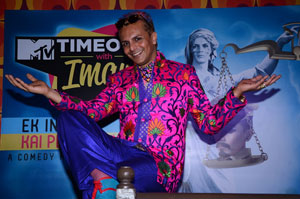
    MTV India has launched a new comedy-reality show with social impresario Imam Siddique. The show titled ‘Time Out with Imam – Ek Insaan, Kai Pehchaan’ will air on Sunday evenings starting July 14.

     

    Speaking on the launch of the show, Aditya Swamy, EVP and Business Head, MTV India, says, “We are opening up a brand new genre – Comedy Reality. Young people are constantly looking for out of the ordinary entertainment and there is no one who is more out there than Imam. Everything about the show is surreal, the situations, the promos and even the marketing. Spending just a day with Imam is full of surprises, 13 weeks is going to be a riot!!! ”


    The thirteen part series will document his journey as he expresses his take on various hi profile events that will be topical – Cricket, films, TV, music, fashion…Nothing will be spared by Imam. From reconnecting with his old Bigg Boss frenemies to making a music video on his favourite city Mumbai and styling an IPL team, Imam will be seen doing it all.


    The show to preented by Swipe ‘MTV Slash’ Fablet will be supported by an extensive 360-degree marketing campaign. MTV will be promoting the show by joining hands with the rickshaw drivers in Mumbai. Adding to the shock value, the entire city will be swarmed with 500 Imams all around them as the rickshaw drivers and promoters will be seen wearing Imam Masks. The channel will also connect with its audience through the launch of a new app, Imamogram, which will help fans say something bold and cheeky to anyone they want with a personalized message delivered by Imam himself. The series will see real time radio integration in an episode for the first time in a show.


  • Face of CNBC TV18 Udayan Mukherjee steps down. Will continue, but Shereen Bhan to be Managing Ed

    By A Correspondent


    Udayan Mukherjee

    Udayan Mukherjee, Managing Editor, CNBC-TV18 has decided to step down from his full-time role, after 15 years of service with the group. “The reasons for this change are entirely personal,” notes a communiqué from Network 18 sent to the media. “Udayan has been facing issues of professional exhaustion and wants to devote more time to other pursuits of personal interest. However, he will continue his exclusive association with the group, albeit in a contributory and consulting role, through a mix of events, shows and appearances, even as he relinquishes his daily responsibilities.” Shereen Bhan, Executive Editor, CNBC-TV18 will take over responsibility of the day-to-day operations of the channel as its Managing Editor from September 1.


    Shereen Bhan

    Widely regarded as the face of the channel given that he anchors its widely watched stockmarket coverage, a media planner who spoke to us on conditions of anonymity said it would be too early to say that Mr Mukherjee irregular presence will impact CNBC-TV18 much. He is not moving to another network so there is no fear on that score, the planner told MxMIndia.com.


    Speaking on the development, Raghav Bahl, Founder & Editor, Network18 said “Udayan has contributed to the emergence of CNBC-TV18 as a benchmark in business news since its formative years. He has ably led the team to many successes and we wish him the very best in his new avatar at CNBC-TV18. Shereen has all the skills and experience to take this mantle forward and we look forward to her leadership.” Added B Sai Kumar, Group CEO,Network18: “Udayan has been instrumental in making CNBC-TV18 the success it is today. We thank him for his invaluable contribution and look forward to his new role with us. In Shereen we entrust the task of leading CNBC-TV18 onto new levels of growth and leadership”


    Commenting on the transition, the 41-year-old Mr Mukherjee said: “I have had a rewarding and enriching 15-year stint with Network 18, but of late the responsibility of running the channel had become repetitive and I had a difficult time motivating myself to continue. At this stage of my life, I need to devote more of my time to other personal passions and interests.”


  • Marathi KBC in spot over computer being called ‘Raje’

    By A Correspondent


    ETV Marathi show ‘Kon Hoeel Marathi Crorepati’, the Marathi language version of Who Wants to be a Millionaire and Kaun Banega Crorepati, has run into a controversy with the computer scorer being called ‘Raje’.


    In the show anchored by actor Sachin Khedekar, the computer is referred to as ‘Raje’ which is normally used in Maharashtra as a revered reference to Maratha ruler Shivaji.


    The Thane district cell of the Sambhaji Brigade has told Marathi daily Sakal that while they respect a senior artist like Mr Khedekar, but it was unbecoming of him to have used this word in the show. The Sambhaji Brigade plans an agitation in case the reference is not changed.


    MxMIndia too has received a few messages on its comments board to a report on the show (see link: http://www.mxmindia.com/2013/03/kbc-is-kon-hoeel-marathi-crorepati-on-etv-marathi/)


    Wrote Sadanand Kulkarni: “In Maharashtra, we call Raje only to our Shivajiraje. Shri Khedekar says, Raje Shikka Maara (Put the stamp to the given option). This is insulting to all of us. We strongly object. Mr Khedkar may say: 1) Shriman Computer or 2) Shri Computerji but not Raje. Urgent change is required.” Another reader, Sumedh Agre, raised the same issue adding that the move to refer to the computer as ‘Raje’ has upset sensitivities.


    At the time of writing, the ETV Marathi spokesperson wasn’t available for comment.


  • Star to consolidate Kannada TV with ‘Suvarna Plus’

    By A Correspondent


    Star India has announced the launch of its second Kannada general entertainment channel to be called “Suvarna Plus”. Suvarna Plus will go on air from Sunday, July 14.

     

    The idea behind Suvarna Plus is to create content which acts as a stress-buster and the content offering will be movies, comedy fiction shows, reality shows, chat shows, film-based shows and Music. The channel will also offer shows like Campus Connect which target the youth.


    Said K Madhavan, MD, Asianet Communications Ltd,” With the launch of Suvarna Plus, we intend to increase our dominance in Kannada GEC market. Karnataka has been a key market for us, we are buoyant and see huge potential in the Kannada television space. Suvarna has been offering wholesome family entertainment to Kannada homes and is the leader in prime time. Suvarna Plus is our new offering which will have a new perspective in terms of entertainment. Both these channels will have distinctive content offering.”


    ‘Masthi Swalpa Jaasthi’ is the tagline of Suvarna Plus capturing the basic tendency of humans to get ‘A abit more’ in everything as it promises the viewer the ‘something extra’ in terms of entertainment.


    Suvarna Plus comes six years after the launch of Suvarna which has women as its core audience. The GEC offers popular shows like Amrutavarshini, Kannadada Kotyadhipathi (the Kannada version of KBC), etc.


    Although both Suvarna ane Suvarna Plus will operate in the same market and catering to similar viewers, according to a communiqué, the older GEC’s key offering is fiction and is positioned as a companion to viewers whereas Suvarna Plus aspires to be a “stress-buster and a complete entertainer”.


  • 1 Minute View: TAM goes monthly for some. And weekly for the rest

    It’s a twist to the tale pulled out from the books of the various soaps that you see on entertainment television. After the tu-tu-main-main like the kind you find on news television, TAM has decided to offer monthly data and in the CPT format to those desirous of it. This is with immediate effect. However, those who don’t want that, will get it weekly.


    Bizarre. We asked a few media agency biggies and bizarre and weird are the words they used. And added: whether you report weekly or monthly, we will use the metric that we  think is appropriate for our advertisers.


    Evidently, we haven’t heard the last on this one. Also, the whole idea of two different sets of numbers coming in – weekly and monthly, could only lead to more confusion. Note this move is not a result of the series of meetings that the various stakeholders (the ISA, AAAI, IBF and TAM) have been having over the last few weeks. There is reportedy no consensus yet from those meetings.


    However, what is a welcome move is that a settlement has been found to the problem and all stakeholders can now wait for the BARC-managed measurement regime to commence.


    On its part, TAM – a joint venture of Nielsen and WPP-owned Kantar, issued a statement from a spokesperson saying: “TAM, purely as an act of professionalism, is fulfilling and respecting its contractual duties and obligations that it is bound by, with individual broadcaster clients. This decision is basis individual client letter requests received by TAM from only specific few TV Channels.  Data for all other TV Channels will be reported as earlier.”


  • Zee Cinema goes aggro to promote Barfi! telecast

    By A Correspondent


    Movie channel Zee Cinema has pulled out all stops to promote the telecast of the award-winning Ranbir Kapoor starrer Barfi! on July 14.

     

    By way of an innovative marketing initiative, Zee Cinema will have ‘volunteers of sweetness’  in the form of young men on bicycles dressed as Ranbir’s iconic character from the film Barfi! to distribute barfi (solidified Indian sweets in various shapes) to people across Delhi, Mumbai, Kolkata, Pune, Nagpur, Lucknow, Kanpur and Indore. In addition, Barfi! masks will be distributed to school students with volunteers getting them to try the popular ‘Barfi!’ dance step or say “Barfi” like Ranbir Kapoor did in the film.


    Akash Chawla

    Said Akash Chawla, Head-Marketing, National Channels, Zee Entertainment said, “This is a feel-good initiative for a feel-good film. With a film like ‘Barfi!’ that warms your heart, our idea is to spread its sweetness amongst our audience. Along with a mass media campaign, we felt a campaign that directly engages with our viewers and puts a smile on their faces would work best!”


    Barfi! will be aired on Zee Cinema on Sunday, July 14 at 9pm. The film had premiered on Zee TV on June 23.