Category: TV

  • Comment: News media must black out netas at Uttarakhand

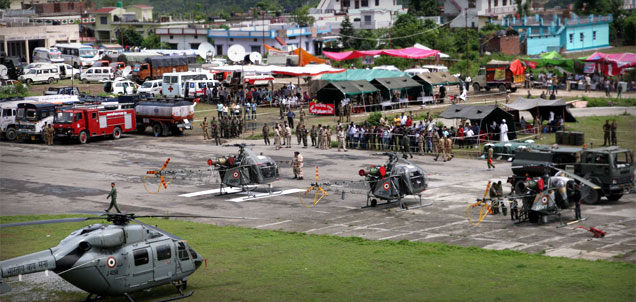
    Representative picture courtesy PIB of the IAF rescue helicopters at Gauchar airport, in flood-hit Uttarakhand on Wednesday, June 26


    It is indeed sad to see several dead and many injured as rescue operations are still on in Uttarakhand. What rages us is the game of one-upmanship between political leaders in grabbing camera time and the importance our news vehicles give to these visits. We present the comment by our Editor-at-Large and senior journalist Anil Thakraney on the issue which would normally appear as Hard Knocks on a Friday. – Editor


    By Anil Thakraney

     

    In the entire television din over the role of politicians on the Uttarakhand disaster, Prasoon Joshi made the most valid point. (Prasoon, if you are reading this post, I would urge you to take part in the tube debates regularly, we need a few sensible voices out there.) While the others were heatedly accusing the netas of seeking photo-ops during the tragedy, Joshi said the media must consider WHO is providing them with these photo-ops. Very true. If the media stopped covering these opportunistic politicians, they will immediately vanish from the scene.


    The defining neta moment so far was the two Andhra politicians exchanging fisticuffs at the Dehra Dun airport, as they fought over who would fly with the ‘cargo’. And no, the cargo in this case wasn’t medical supplies for the victims, but those people who had been rescued, and were anxiously waiting to be flown back home. Absolutely pathetic. And then there is Pheku and Pappu busy scoring brownie points over each other, and the many chamchas defending their actions. At least half of the media time and space gets spent on these jokers. What a bloody waste!


    My humble request to colleagues in the media is this: For the Uttarakhand news, take a firm decision not to provide any coverage whatsoever to the visiting politicians. Not only are they unable to help in any way, with their shenanigans, they come in the way of rescue and relief operations. And there’s no keeping these hyenas away, they will come to feed on the dead, it’s in their nature. Emotional situations like these give politicians a cool opportunity to win more fans, or so they believe. Let’s deprive them of it. And let the entire media effort be focused on the victims, the rescue and rehab. And on the jawans who are doing all the hard work, these brave souls who are putting their own lives on the line so that maximum number of people can be saved. I want to see their faces, I want to hear their voices, I want to know their stories. And this is what the media must provide us.


    Net net: Let’s make Uttarakhand a template for future disasters. No spotlight on any neta. Let it only be about those who matter, and those who do the real work. That done, no politician will ever arrive to disturb rescue operations. Once the oxygen supply (cameras) is cut off, they won’t see any point of jet-setting in. Good riddance.


    Anil Thakraney is a senior journalist and commentator. He is also Editor-at-Large, MxMIndia. The views expressed here are his own. He can be reached via Twitter at @anilthakraney




  • India TV awards creative duties to Eleven Brandworks

    By A Correspondent


    Hindi news broadcaster India TV has awarded its creative mandate to Eleven Brandworks. The win came after a multi-round & multi-agency pitch process initiated in April. Eleven’s bouquet of clients includes Eristoff (Bacardi), Times Brand Capital, Archies, NDTV Good Times, Onjus and Nokia maps.


    Prateek Bhardwaj, Founder Director, Eleven Brandworks, said, “It is truly exciting to partner one of the most influential media brands in this country. We share the vision the management has for the brand, and our mandate is to enhance India TV’s stature within its viewers as well as non-viewers.”


    Ritu Dhawan

    India TV MD & CEO Ritu Dhawan said, “Political reporting is gaining momentum in run up to the elections. In the coming days India TV will present most engaging and interactive news content. Team India TV led by Rajat Sharma is ready to comment, analyze and decode political mysteries. In line with the intent of refreshing the brand, Eleven has been successful in pitching with a few really reassuring ideas. We welcome Eleven & look forward to working with them.”


  • Is Cricket a big hit in Hindi? Time for Tamil, Telugu, Bangla…?

    By Johnson Napier


    After a brilliant display of form in the just-concluded Champions Trophy, the men in blue have made it clear where they intend to be at the moment. And that’s at the top. Having won the confidence of their fans in a big way, their success is now being consumed in a language with an even wider scope – Hindi.

    After sampling preferences over the past few seasons, broadcasters have now taken the plunge by relaying cricket feed in Hindi, which has matched up to its English counterpart and attracted its set of fans too. MxMIndia speaks to a cross-section of experts to analyze how Hindi cricket commentary has fared in the recent past in India (in alphabetical order of their last names).


    P Balakrishna, COO - Allied Media

    I am sure that there has been a positive impact that has been created by broadcasting commentary in Hindi. Let’s not forget that Hindi is the language which has the biggest and largest penetration as far as the pan-India market is concerned. All it has done is brought the game closer to the viewer. At the end of the day, while English commentary has its own charm but in terms or reach and understanding of the language, Hindi is of course the language that can connect with all HSM markets. While I am not sure on the numbers, I am sure that it has resulted in an incremental viewership numbers. What is critical with a game of cricket which has a huge mass connect is that the language of Hindi definitely has its charm of creating a strong impact with the audiences.


    As for it being relayed in multiple languages, I do not see any scope for commentary to be expanded to other markets as largely between Hindi and English most of the markets are covered in India. If you see the non-Hindi markets, English has a very good penetration including in the South and the East. Doing commentary in other regional languages won’t really result in any rise in viewership or even monetary-wise.


    Mona Jain, CEO, Vivaki Exchange

    India has been performing very well so from that point of view there are audiences right now on that medium. In terms of brands who want to reach out to the audience through medium of Hindi, it could be a little low-key as of now as it is not a peak season and only those with deep pockets could be taking the plunge on the Hindi medium.

    Also, cricket is very popular in the northern region so having a feed in that language makes sense; it also is the primary language at the moment. But it’s too early to discuss whether we need commentary in Tamil or Telugu or Bengali. There have to be enough numbers (audiences) out there for broadcasters to take that decision.


    Hemant Kenkre, PR Professional and cricket columnist
    I think it is great to have commentary in Hindi on major sports channels. In the past, All India Radio always combined English with Hindi with noted Hindi commentators like Jasdev Singh. During the Champions Trophy Indian cricket legends like Kapil Dev and Sunil Gavaskar (for the first time in Hindi) reached out to many viewers who are comfortable in Hindi.

    The reach for Hindi channels is much more than that of any other language – which may have prompted Star to hire former Indian cricketers (including non-Hindi speaking commentators) to attract eyeballs. It is too early say how other languages will work but going by the success of Hindi, it is a matter of time before sports broadcasters look at other languages too.


    Ayaz Memon, editor, veteran cricket writer & commentator
    I think Hindi commentary has managed to create a huge impact in the recent past. You can see it happening in the recent India-West Indies-Sri Lanka Series and also the just-concluded Champions Trophy where it was well-received. In the earlier days, and as research would prove while a lot of people used to watch cricket on television in English they used to mute it and hear the commentary in Hindi on radio. So Hindi enables one to reach out to a far bigger and wider audience base which, I am sure, has seen an incremental hike in the numbers in recent past.

    At the end of the day, when you pay the price for buying rights then your objective is to reach out to as large a number of audiences as possible. And if you can do that by broadcasting content in different languages then why not. It would be a sensible thing to do by broadcasters as India is a very diverse country that boasts multiple languages. Unlike countries like England that can air only in English or Pakistan in Urdu, we have an advantage of airing content in multiple languages and we should take advantage of that.


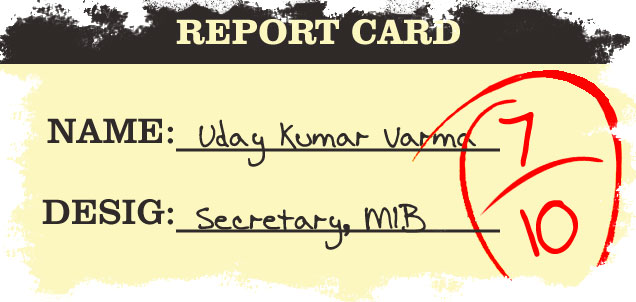
  • Mediaah! Report Card on Uday Kumar Varma’s tenure as I&B Secretary: 7/10


    By Pradyuman Maheshwari


    Uday Kumar Varma

    In October 2011, when Uday Kumar Varma had just been appointed Secretary in the Information and Broadcasting ministry there was much hope from the ace bureaucrat. He didn’t just have sound experience in the administration, but he also had spent a good time in the MIB.


    So he would be plug-and-play given the little time he would need to learn the nuances of the ministry.


    However, it’s one thing to be Special Secretary and another to be ‘the’ Secretary, especially when you know your stint is going to last two-odd years and you will be retiring after the tenure.


    MxMIndia had carried an article as a part of the Anchor with the headline: 5 Things the New I&B Secretary Uday Kumar Varma must do (see link: http://www.mxmindia.com/2011/10/the-anchor-5-things-new-ib-secretary-uday-kumar-varma-must-do/).


    There was a five-point tasklist. Here are the headlines:

    #1 Ensure new digitization announcement is implemented on time.

    #2 Must let self-regulators rule.

    #3 Should ensure paid contentwallahs are punished.

    #4 Push for news on FM Radio.

    #5 Empower government media – Doordarshan and All India Radio.


    I am not going to factor in #2, 3 and 5 here, because in a two-year stint there’s not much that you can expect any Secretary to achieve.


    Phase 3 of the FM radio regime has still not taken off and one can’t see independent news happening in a hurry on FM radio. It requires someone who believes in the medim to push these through with missionary zeal in what’s clearly a non-priority sector.


    Varmaji made the regular noise on self-regulation, measurement and paid content, the kind one expects from a Secretary.


    But it’s with digitization that the former Secretary has received the maximum bouquets and brickbats. At the outset, he deserves all the credit for digitization finally seeing the light of day. When the minister changed less than a week before first phase was scheduled to happen,  it was Shri Varma and his team’s conviction that ensured it takes place.


    But what happened before Phase 1 of digitization was effected was deplorable. The readiness numbers that the ministry declared were in sharp variance with the ground reality.


    It was Varma & Co’s resolve and understanding that the hiccups are inevitable is what led to the digitization been effected. Phase 2 was also pushed through, with its own share of problems, but by then the Secretary knew that it’s not switch-off-switch-on game. Every phase will have its own sub-phases.


    Had it been just the effecting of digitization, Varma would’ve got an 11 on 10, but the fact that the initial process had its share of big problems and that one had huge expectations from him given his knowledge of the functioning of the ministry, we give him a score of 7/10.


  • Aidem to handle Dangal TV adsales

    By A Correspondent


    Media consulting, marketing and advertising sales company Aidem Ventures has been appointed as an advertising partner for Dangal TV, the regional channel reaching out to the core Hindi-speaking belt.
     

    Dangal TV is a 24-hour free-to-air entertainment channel offering a mix of movies and serials in Bhojpuri and Hindi. Dangal has established its availability across cable and leading DTH platforms including Dish TV, Videocon DTH, Airtel Digital TV and DD DTH.


    “Regional channels accounted for approximately 27 percent of total television viewership in 2012, which is proportionate to the advertising market share they commanded during the same period. Advertising interest in regional markets is strong and broadcasters see immense potential for revenues from local advertisers who are willing to pay a premium to reach their targeted audience. From our own experience with regional channels, we have come to realise that a staggering number of advertisers are seeing the benefits of developing localized communications strategies using sponsorships, promotions and integrated branded content around regional TV. It gives us immense pleasure to be associated with the market leader in the Bhojpuri genre and look forward to driving its vision.” said Vikas Khanchandani, Director, Aidem Ventures.


    “We at Dangal have a thorough understanding of the Hindi-speaking belt. That, along with ourhuge investment in acquiring Bhojpuri and Hindi content serves as a strong endorsement of our vision to create a new standard in the Bhojpuri entertainment space. We look forward to a continued association with Team Aidem to help us achieve better yield for the channel over the long term” said Manish Singhal, Chairman & Managing Director, Dangal TV.


    About Dangal TV


    Dangal TV is a 24-hours free-to-air entertainment channel that delivers content suited to the entertainment needs of the Hindi Speaking belt in India. Committed to offer a comprehensive viewing experience and cater to diverse demands of its viewers, Dangal TV offers a strong mix of movies & serials in Bhojpuri as well as in Hindi.


    About Aidem Ventures


    Aidem is India’s leading independent Advertising Sales Company and also offers consulting and marketing services. Aidem has a team of over 100+ trained professionals located across all major media markets in India. Aidem enjoys deep and valuable connections with over 3000 advertisers across India.


    Aidem is also the exclusive media representative for Mi Marathi, Live India, Sahara One, Sahara Filmy, Economist.com, GETIT, Eros Now, KBS World, Al Jazeera English (AJE) and other Al Jazeera channels, Clubbing TV, DanceTrippin, RCK TV, Jukebox, Lakshyya Entertainment, Get Punjabi, Jaya TV Network and Sri Lanka Premier League.


    Aidem, together with eBUS – a Group IMD Company, also offers a complete solution for digital distribution and management of Television Commercials (TVCs) to advertisers, agencies, media owners, content producers and broadcasters. This service is being used by almost all major broadcasting networks in India.


  • BoxTV and Amkette’s EvoTV partner for OTT

    By A Correspondent


    BoxTV, the premium online video-on-demand service from Times Internet, and Amkette have collaborated to make a wide variety of content on BoxTV.com available on Amkette’s flagship product – EvoTV.  EvoTV is a television-connected device that changes the way consumers interact with their television screens. BoxTV has partnered with EvoTV to provide its users with unlimited selection of full-length movies and television content through its app on the platform. Consumers can browse and watch over 10,000 hours of free content across various languages and genres with one click on the big screen.


    Highlighting the relevance of BoxTV partnership with EvoTV, Nikhil Bapna, Assistant Vice President, Amkette, said, Given the rapid rise in consumption of online video in India, we envisioned and designed EvoTV to be a platform that offers users the convenience of watching Over The Top (OTT) content in their living rooms.  BoxTV is a service that has the widest range of premium video content and was a perfect fit for power users and early adopters of OTT services in India.”


    “One of the key objectives for the BoxTV service is to be available across all different platforms, so users can view the content of their choice anywhere and anytime.  We are glad to have BoxTV as one of the earliest apps of this ground-breaking platform,” said Pandurang Nayak, Business Head, BoxTV.


    As a special ‘limited time’ offer, BoxTV and Amkette are providing a one-month free subscription of BoxTV services to anyone buying  EvoTV before July 15, 2013.


  • Shailesh Kapoor: Lest we forget… television is a ‘service’ industry

    Shailesh Kapoor

    By Shailesh Kapoor


    The latest phase of ad cap has come into play from July 2013, limiting inventory to 20 minutes per hour for news and 16 minutes for GECs. Come October 1, 12 minutes may be a reality. Discussions and debates on ad cap over the last few weeks lead to a larger point, which we hardly give our due attention to. That television channels are not products but services. In effect, watching a television channel is closer to visiting a restaurant than using a shampoo. You may not be paying per viewing session (at least not explicitly), but the principle still holds.


    Those in the service industry, such as hospitality, retail and food, among others, will appreciate that the norms and parameters that apply to service businesses are sharply distinct from those that apply to the product businesses.


    Yet, most of the media talk about television is only about content. It boils down to programmes, their cast and crew, and the program ratings. But if we were to detach the product part of the business and look at everything else, we may stumble upon some critical parameters that can shape the way a television channel brand is perceived, consumed and advocated.


    Take for instance the breaks themselves. The break duration, length, timing of the break point and packaging (e.g. the countdown clocks) are service parameters. A long break is, in many ways, the equivalent of a restaurant taking unduly long to bring your food to your table. Yet, these are parameters we have only peripherally worried about, till TRAI stepped in.


    Similarly, we hear a lot about “picture quality” in consumer research. It is that abstract notion which can be borne out of a mix of production budgets, bandwidth and creative execution. The diagnostics of negative feedback on this aspect generally ends up being technical and theoretical in nature, and hence, un-actionable.


    Then, there is a critical service parameter that applies to practically all service businesses: On Time. Television schedules, especially on movie channels and repeats on entertainment channels, are often violated by upto 15-20 minutes. In the era of EPG, and growing viewer education on how to best use the medium, this is simply a case of poor service.


    Of course, there’s the channel packaging, particularly relevant to the news genre, where viewers may have to endure multiple tickers to watch their daily dose of news. Even on entertainment channels, screen space being covered by programme promotions is increasingly becoming an irritant for the purist viewers, and it’s a matter of time before more viewers begin to articulate the same. TRAI has tried to step in here too, but ad cap is understandably taking more attention for now.


    The list of service parameters will be longer, if one was to sit down and make it. At some stage – and that stage is not too far away – television channels will have to move towards taking a holistic brand view, than a content view. And when they do that, they will have to acknowledge that customer service (viewer service in this case, though advertiser service can also be argued to be important) cannot be an unconscious activity. Especially in genres where the product (content) is not too differentiated (and there are many such genres), service quality can create real differentiation and lead to higher subscription revenues, as we slowly but surely move into a true addressable environment where a la carte or smaller channel packages will be real options for the consumers.


    Two bad services back-to-back in tennis are called a ‘double fault’. It costs the player a point, often the game, sometimes the set and the match. Broadcasters may rather have aces up their sleeves instead.


    Shailesh Kapoor is founder and CEO of media insights firm Ormax Media. He spent nine years in the television industry before turning entrepreneur. The views expressed here are his own. He can be reached at his Twitter handle @shaileshkapoor


  • Shailesh Kapoor: What’s Infecting Our TV Industry? Laptops!

    By Shailesh Kapoor


    Conference room. Set for an important meeting that may have a decisive impact on the future of the channel, and by extension, on the future of everyone who works for it. About two dozen team members from various functions have been called to attend to a research presentation. Around the time of the meeting, they begin to saunter in one by one. There is chatter while they take their seats and wait for their big boss to join us.


    In those five minutes, machines are flipped open, one after the other. Some are finishing “urgent” work, while some are checking emails and replying to pending ones. Productive use of time, I wonder. Of course, preparing yourself mentally for a meeting, even if you are just an audience, is supposed to be an old-school thought. There are still others in the room who are on their laptops, but you can see that they are trying to figure out what exactly to do with them. It’s just a medical condition. They have been surgically attached to their machines.


    Then the big boss arrives. Sure enough, he/ she comes without a laptop, with full attention and interest in a meeting that he understands the importance of, more than anyone else. As we get set to start, I’m certain that the laptops will be ‘lid-shut’, either out of interest or because of protocol.


    Curiously enough, that doesn’t quite happen. Only a handful (mostly the senior lot) keep their laptops aside and bring their full presence to the meeting. Others continue to “multi-task”. For the next two hours! The nature of the tasks has shifted too. Many are now using the laptops for note-taking. What they have taken note of, I’m not quite sure though.


    The big boss is not concerned, it seems. He is into the subject material, engaging in discussions that don’t need any technology to support them. He may as well let the geeks carry on.


    Then the big boss asks his team for some data or clarification in the meeting. Confusion erupts. At least 2-3 team members dig into their laptops trying to give him the answer. There is an undercurrent of who-comes-first. But it is more of the I-know-how-to-use-the-laptop-better-than-you kind. At the end of this thrilling race, the big boss has still not got the real answer he’s looking for. He sighs politely, and decides to move on.


    This is the story of 80% broadcasters today, in varying degrees. It is also the story of many B-schools, I’m told, where students attend lectures with their machines “on them” all the time.


    Having started my career in times when laptops were nearly unheard of and an internet connection was available on one shared machine for almost 200 people (which too shall remain mostly unoccupied, as many didn’t know what to do with it besides checking Hotmail), it is natural that I find this phenomenon deeply disturbing.


    However, what concerns me a lot more is the weak foundation being built for the younger lot. Evidently, the laptop culture (especially prevalent in non-creative functions) does not put a premium on the importance of having an uncluttered mind to aid stimulating discussions. It also does not promote teamwork, given the inherently personal nature of the device in question.


    In the old days, when we had a meeting, we’d “prepare” for it. We will read the relevant emails and documents, carry the necessary print-outs to the meeting, even keep our thoughts ready. Today, the laptop substitutes for all that.


    My respect goes to the 20% companies who have managed to stay away from this epidemic. I’m not sure if they planned for it or their culture just ensured they were kept safe. But either way, they have a big advantage to protect!


    Others may do well to take a deep look at their meeting protocols. It’s never too late.


    PS: The mobile phone is another problem of epidemic proportions. But that’s for another day, another post.


    Shailesh Kapoor is founder and CEO of media insights firm Ormax Media. He spent nine years in the television industry before turning entrepreneur. The views expressed here are his own. He can be reached at his Twitter handle @shaileshkapoor


  • Shailesh Kapoor: 2008-2013: The Great Indian Dance Revolution

    By Shailesh Kapoor


    Three dance reality shows are currently vying for viewer attention on the weekends. Last week, Zee TV aired ABCD – Any Body (sic) Can Dance, India’s answer to Step Up. Backed by some innovative promotions featuring the channel’s homegrown stars, the film scored higher than biggies like Race 2 on the (much-maligned) rating charts.


    Circa 2008. India almost didn’t know what dance was about. It was a fancy Western idea restricted to the upper echelons of the society, such as the celebrities in Jhalak Dikhhla Jaa, or a boring old-fashioned tradition of the Indian classical form. Bollywood had been using dance liberally for years. But unlike some of the other Bollywood inspirations, most famously the hairstyles, filmi dance didn’t make it to the mainstream.


    But we are a country of celebrations. Wedding functions often involve girl gangs performing to Bollywood hits. And as we got more liberal (relatively, of course), wedding dances became an important expression of an Indian woman’s desire to be free.


    The stage was, therefore, set in 2008-09, when two television shows, none boasting of big budgets or high profile launches, brought in a revolution. Nachle Ve With Saroj Khan has arguably been the most under-rated show on Indian television if you look at its social impact vis-à-vis its media buzz. The show made “learning dance” legitimate, even cool. Simple, middle class girls and boys would watch this incredibly deglamorized show to prepare for their next wedding sangeet performance. There was nothing inaccessible here. It was as mass as ‘infotainment’ could get.


    Then came Dance India Dance (DID), which brought fancy foreign words like Hip Hop, Popping & Locking and Slow Motion to Indian parlance. DID gave wings to the aspirations of a small-town India, which was enthralled seeing three average-looking judges encourage young talent from across the country.


    I’m not sure if someone has exact statistic on the increase in the number of dance academies in India over the last five years, but some crude estimates peg it at 400 percent.  In researches, we now hear mothers and daughters dancing together to Bollywood songs at their homes, and for some curious reason, “in front of the mirror.”


    Bollywood may not admit it, but the dance revolution started by television has impacted it too. For one, the quality of commercial dancing has gone up several notches. But even more importantly, viewers today are looking at dance steps with a critical eye, comparing them to what they have seen on TV, expecting the next level. It’s a win-win-win, as the viewers, the TV industry and Bollywood have got into an effortlessly symbiotic relationship here.


    Yet, we have certainly not seen it all when it comes to dance. ABCD came almost three decades after Mithun Chakraborty’s Disco Dancer and Dance Dance. It remains the only dance-based film in our contemporary cinema. ABCD 2 or EFGH (Every Friend Goes Hip-Hopping) should not be a bad idea. And DID is still discovering new pastures, with its superbly executed Supermoms show that’s doing very well currently.


    So be prepared for more, because the Dance Revolution is well and truly here. All it took was five years!


    Shailesh Kapoor is founder and CEO of media insights firm Ormax Media. He spent nine years in the television industry before turning entrepreneur. The views expressed here are his own. He can be reached at his Twitter handle @shaileshkapoor


  • Shailesh Kapoor: If You Had To Choose: Bad Ratings or No Ratings?

    By Shailesh Kapoor


    It’s been an eventful week for the television industry, the unfolding of which has been nothing short of a taut Hollywood thriller that promises to keep you on the edge of your seat. The backstory started with NDTV’s lawsuit against TAM last year, but the real action began last week when a top broadcaster (MSM) decided to hit TAM where it hurts the most, by simply pulling the plug. Times Television and a few others have followed suit. And the second act has not even started.


    There have been many points and counterpoints, both from the broadcasting and advertising fraternity. BARC’s ratings design is not going to see the light of the day before 2014, and hence, there is a sizeable time window to handle.


    The real question that should define the framework for this debate is: “Are the current ratings credible?” For me, the question is that and only that. Credibility is not graded. Here, there is no concept of “mostly credible”, “more credible than others” or “perhaps credible”. If the ratings system is going to influence the size of advertising revenue that it does, it has to be credible in absolute terms.


    Anyone who follows ratings closely (many people) and understands statistics (only a handful) will agree that the current ratings system has error margins which lack statistical robustness the moment you begin to look at markets or segments which are narrow, e.g. C&S 25+ SEC A Males in 5 metros. The error margins could be as high as 30% in such segment, which means that a rating from 2.1 to 3.9 may in reality represent the same viewership, i.e., 3.0%. Now imagine doing the same for C&S 25+ SEC A Males in Bengaluru. The error margins would cross 100%.


    In a way, TAM may have shot itself in the foot by reporting such data and allowing it to be analyzed. This attitude towards error margins could definitely not have been a result of ignorance, given the company’s rich heritage. But it seems to be a result of over-confidence, even arrogance, resulting out of being a monopolistic player in the television currency research space.


    Understandably, you cannot install more meters because your business model prohibits the same.But is that a justification to report data that could statistically be a result of pure chance, than a reflection of reality?


    The television industry has perhaps been guilty of going soft on the issue in the past, taking tough stands only on occasions that suit their business. Over a decade, I’ve been hearing the fig-leaf argument, i.e., “in the absence of anything else, TAM at least gives an indication”. Now that’s a compromise on the principle of credibility. That argument should have never been admissible in the first place.


    What’s the solution, then? It’s surprisingly simple. TAM should define an “error margin” or “confidence level” at which it will report data, e.g. maximum error of 10%. It should communicate the same to the entire industry, and then report only the data that clears this filter. If this means that certain markets and audience segments cannot be analyzed, then so be it. Some channels, especially English channels, may find the results irrelevant because they won’t be able to look at certain desired TG cuts, but it’s better not to look at error-laden data in any case.


    This may understandably result in much lesser “data” in the system, but less data of good quality should win over more data of bad quality any day. Of course, in doing this, TAM will have to admit that their error margins have been rather abysmal in the past. But the taste of a humble pie is not that bad, is it?


    Yes, a ratings-less system will create confusion. But if I had to do the ranking, I’d say: Good Ratings > No Ratings > Bad Ratings. For those suggesting Bad Ratings > No Ratings, a masterclass in statistics is highly recommended.


    Shailesh Kapoor is founder and CEO of media insights firm Ormax Media. He spent nine years in the television industry before turning entrepreneur. The views expressed here are his own. He can be reached at his Twitter handle @shaileshkapoor


  • Shailesh Kapoor: Arnab Goswami: The Superhero We Need

    By Shailesh Kapoor


    I have to admit that my only serious weekdays appointment viewing these days is Arnab Goswami’s Newshour on Times Now. Earlier this week, I watched more than 90 minutes of one such Newshour show entirely focusing on the IPL spot-fixing scam. As I surfed out at the end of the show and started watching news programming on some other English channels, the contrast was unmistakable. It was like walking straight out of a rock concert into a classical musical one. Everything seemed to move in slow motion and I had to raise the volume considerably, probably because I had kept it at a lower level for the last 90 minutes!


    I felt a similar contrast when I watched Iron Man 3 and Aashiqui 2 back-to-back about five weeks ago. The worlds of the two films had nothing in common. But you can like both, as I did. But in the case of Newshour, there are reasons to like the show more than most other prime time options on English news channels; reasons that get adequately amplified when a story of “national interest” gathers momentum for about a week or two, like the current IPL controversy.


    In his opening remarks at a recent event, Arnab Goswami candidly admitted: “I tend to forget that I’m an anchor. I have assumed the role of an analyst much too often.” This contrasting approach to anchoring is what makes him stand out, both in a good way and a bad way. Almost all Newshour debates start with Arnab’s position being defined loud and clear. The show, then, is about him playing the captain of one of the teams in a debate competition, who has been given the advantage of moderating the debate too.


    In classical journalism, such as approach, evidently biased as it is, may have no space. But we don’t live in a classical world, do we? We live in a world of scams and bad governance, where newspapers and news channelsoffer little to cheer about anyway. As a result, television news today has gone beyond being an information source to delivering more inclusive benefits, like that of becoming the voice of the ‘common man’, who has been watching one scam after the other unfold, with a sense of helplessness and cynicism.


    As many of us watch the champions of scams and bad governance being grilled on Newshour every night, we feel a certain sense of empowerment. There’s someone asking the tough questions. There’s someone who has the gall to talk them condescendingly, even insultingly at times. After all, they deserve all the insult they can, if how our mind justifies it.


    I have always wondered why certain guests, especially those from Pakistan, even agree to feature as guests on Arnab’s show, given the consistent track record of being spoken down to. Perhaps because they want to better their Newshour performance from last time? Alas, they never succeed!


    I don’t have the slightest doubt in my mind that a decade from now, Arnab Goswami would have acquired a cult, near superhero status in Indian media, when his reputation of a feared anchor would have spread itself wide and across in the inner corridors of power. To borrow from cinema, he may evoke reactions like: Do your job honestly, nahin toh Arnab aajaayega. Or: Zulm mitaaneko ek maseeha nikalta hai, jisey log Arnab kehte hain.


    This iconic status, which is well on its way of getting formed already, may not meet the gold standard of “good journalism”, but most superheroes are flawed and therefore interesting, right? But once you get used to liking them, you like them unconditionally.


    Yes, it may take you a while to like Arnab Goswami and his show. Newshour is acquired taste. But then, so is India!


    Shailesh Kapoor is founder and CEO of media insights firm Ormax Media. He spent nine years in the television industry before turning entrepreneur. He can be reached at his Twitter handle @shaileshkapoor


  • Shailesh Kapoor: The Next GEC revolution is round the corner

    By Shailesh Kapoor


    Since the start of the Hindi GEC genre in 1992 with the arrival of Zee TV, there have been two distinct events that can be termed “revolutionary”, in that they changed the dynamics of the genre significantly, impacting all stakeholders – broadcasters, advertisers and viewers – in turn.


    The first such revolution came in 2000, with the launch of Kaun Banega Crorepati on Star Plus, shortly followed by Kyunkii Saas Bhi Kabhi Bahu Thi and Kahaani Ghar Ghar Ki – daily serials that made their way to primetime, with a distinctly different visual and narrative treatment than what had been seen before. This revolution had “risk” written all over it, tales of which are now are a part of industry folklore.


    The second revolution came eight years later, in 2008, with the launch of Colors. This was a revolution borne out of consumer dissatisfaction. The same Kyunkiis and Kahaanis, which had sparked off a paradigm change in 2000, were now considered hackneyed, and the consumer was starving for something new. But all she was getting was more of the same, barring an odd Jassi. Left with no options, she continued to watch what was being dished out, resulting in decent ratings for content that consumers positively hated at that point of time.


    Finally, with the arrival of Colors, the much-needed alternative was there. Serials went out of palatial homes into the heartland of our vast country. Reality television made its presence felt like never before. Movies were finally being shown with sane amounts of break advertising. Colors offered all that was missing, opening up a new world for the GEC viewers. Other channels too followed suit, and reinvented themselves, moving away from the much-abused K-serials. Ironically, the channel that started it all, Star Plus, managed to make the transition beautifully in 2010.


    1992. 2000. 2008. Get the eight-year pattern? Give or take a couple of years, and the next big GEC revolution is set to happen anytime 2014 onwards.


    But it’s not just this eight-year math that I base my forecast on. There are substantive, almost telltale, signs that we are ready for the next big change in the Hindi GEC space. Here are three such signs:


    1. Declining interest in existing content: There is a perceptible decline in interest in fiction content at the consumer’s end, especially in the bigger metros. This loss of interest is not with the genre, but with specific shows that they watch. A sense of sameness has come in, not so much in terms of stories but their treatment. Everything drags, is a common perception. Like 2008, this may not mean an immediate drop in ratings, but the dissatisfaction is fast growing.


    2. Viability of big-ticket fiction: With digitization, broadcasters seem more equipped and confident to invest in big-ticket fiction. Initially, these may come as clutter-breakers or differentiators, such as 24 on Colors and Amitabh Bachchan’s recently-announced fiction show on Sony. But if the idea works, big-ticket fiction can become staple prime-time diet, not just the “other” option, bringing with them fresh talent and treatment.


    3. Changing mood of the nation: There has been a visible change in the mood of the country over the last few years. We are way past the economic liberalization phase, that we now take for granted. The angst generated by governance issues, such as inflation, poor infrastructure and corruption, has been in the forefront in recent times. In a way, we may be in a new, digitally-packaged version of the 70s, when the ‘angry young man’ emerged as an iconic prototype. The equivalent today can be even more layered and interesting.


    The question, hence, is not whether we will see a GEC revolution soon or not. The questions are, how soon will it happen, and who will benefit from it the most. The answer, if anyone had a definitive one, would be worth a million dollars.


    Shailesh Kapoor is founder and CEO of media insights firm Ormax Media. He spent nine years in the television industry before turning entrepreneur. He can be reached at his Twitter handle @shaileshkapoor
