Category: TV

  • No comebacks on Tariff Order: TRAI chairman

    By A Correspondent


    While the News Broadcasters Association has protested against the tariff order for digital cable TV issued by TRAI on April 30, saying that the order ‘legalized’ carriage fee, TRAI Chairman JS Sarma has maintained that there is no cause for dissatisfaction on carriage fee.


    In an interview to NDTV 24×7, Mr Sarma said: “Carriage fee is now a well-regulated issue and it should be transparent. We will intervene if required but we won’t relook at the recommendations.”


    The NBA claims, “The primary purpose of digitization was to increase the number of channels broadcasted. The objective was to give consumers greater choice and to eliminate the phenomenon of ‘carriage fees’, which were being charged due to capacity constraints. However, the NBA is distressed and disappointed that TRAI’s new notification has actually legalized the practice of ‘carriage fees’ and given distributors the freedom to unilaterally set the amount of ‘carriage fees’ broadcasters must pay.”


    The TRAI has also prescribed that the MSOs increase their channel carrying capacity. In its recommendation, MSOs have been mandated to carry a minimum of 500 channels by January 1, 2013. TRAI stated in its order, “The Authority has mandated MSOs to carry a minimum of 500 channels from January 1, 2013. However, keeping in view that smaller MSOs having less than 25,000 subscribers may need some additional time for building capacity, they have been given time up to April 1, 2013.”


    The TRAI has prescribed that every MSO should have a minimum capacity to carry 200 channels by July 1.


    The Indian Broadcasting Foundation (IBF) convened a board meeting to discuss the issues pertaining to the TRAI order. A press statement is scheduled to be released on the issue later today.


  • Divya Bhaskar’s Green Chronicles

    By A Correspondent


    Dainik Bhaskar Group’s Gujarati newspaper Divya Bhaskar has released a coffee table book – Green Chronicles – on the green initiatives adopted by corporates in Gujarat.


    Unlike what many people think that the power to curb pollution, to save precious resources, lies in the hands of experts, the real power lies in the hands of organizations which have the power to design and promote cleaner products and technologies and help society evolve to more sustainable lifestyles.


    Green Chronicles is an attempt to acknowledge the green efforts of the organisations in Gujarat. It brings alive some of the success stories of green technology and process aimed at better environment. It showcases 14 companies in Gujarat which have focused on eco-friendly sustainable development. The book talks about case studies such as AdaniPortsand Special Economic Zone, Gujarat Ambuja Exports, Naroda Enviro Projects Ltd, Gujarat State Electricity Corporation, ONCG Petro Additions Limited.


    Mr Saras Sethi, COO – Dainik Bhaskar Group, Gujarat , believes: “Green is the voluntary pursuit of any activity that encompasses concern for energy efficiency, environment management, water management, waste management and recycling. Green practices ultimately leads to sustainable development and equitable growth”.


    He commented on the release of the book: “This coffee table book is an attempt to highlight the environment-friendly approach adopted by the organizations in Gujarat, and thus, encouraging more people to understand the importance of keeping our nation green.”


    The book is circulated among the advertisers and business fraternity of Gujarat. It is one step ahead in celebrating and acknowledging the efforts of green organizations in Gujarat. Environmental responsibility is no longer just about donating money and services to needy groups. Business process, product development, and partnerships can all be perceived for better, more responsible alternatives. And if the responsible choice saves money in the long run, adds value to the product, and creates a positive culture, then it is definitely a good thing.


    The Dainik Bhaskar Group has a strong presence in newspapers, radio, event marketing, printing, short code, Digital, services andMobileapplication. Its flagship Hindi daily newspapers are Dainik Bhaskar, Divya Bhaskar, Divya Marathi and DNA. It covers 13 States with 64 editions reaching across 19 million readers every day.


    Additionally, it publishes 3 other newspaper – Business Bhaskar, DB Gold, DB Star. In magazine sphere it publishes Aha! Zindagi, Bal Bhaskar for young readers and Lakshay. The other media businesses includes MY FM ; FM Radio station network across 17 cities and IMCL (Digital services).


  • Star to go solo in sports, buy ESPN from JV

    By Nandini Raghavendra & Ratna Bhushan


    Broadcast major Star Group’s 16-year-old equal joint venture with sports broadcaster ESPN is being dissolved with Star buying out ESPN’s stake in the JV, three people familiar with the development said.


    Once the transaction is complete, Rupert Murdoch-owned Star will become the owner of ESPN’s India business, the people said. Two of them said the companies were finalising details of the deal and an announcement was likely to be made shortly. They declined to disclose details.


    ESPN Software India, which operates ESPN Star Sports’ India operations, generates revenues of about Rs2,500 crore through channels that include Star Sports, ESPN and Star Cricket. ESPN Star Sports owns television broadcast rights for the ICC World Cup Cricket and T20 Champions League.


    ESPN’s Singapore office said they did not comment on speculation. A spokesperson for ESS said, “We do not comment on speculations and rumours. ESPN Star Sports continues to run the business as usual. Two partner companies frequently discuss business plans and both the companies, ESPN and News Corp, are proud of the success ESS has made since its inception, and the relationship it shares with fans and business partners. They extend complete assurance for delivering value to our partners as committed by ESS.”


    Star India Chief Executive Officer Uday Shankar did not respond to an email and text messages sent to his mobile.


    “Star wants a bigger play in the sports broadcasting space,” one of the people quoted earlier said.


    “Star’s recent Rs4,000-crore acquisition of the rights to Indian cricket from the Board of Control for Cricket in India, beating rival Sony, are indications of its ambitions in this space,” one of the people quoted earlier said.


    It is not yet clear how many of the 200 employees of ESPN, who work for the joint venture, would be retained by Star. An ESPN official, requesting not to be quoted, said employees were uncertain about their future after the deal.


    A deal between the two companies could potentially be a complex one as they have a bouquet of advertising deals and cross-sponsorships. But senior executives at two leading media-buying companies, who deal closely with both broadcasting networks, said they did not foresee any impact on advertising deals and sponsorships.


    ESPN, Star Sports and Star Cricket either sell airtime and sponsorship inventory independently or as bulk package deals, they said. An analyst from one of the big four audit firms said the battle for the rights to various cricket events will now be fought out between Star and Sony, with the latter holding the rights for Indian Premier League, the 20-overs cricket tournament. ESPN Star Sports was formed as a 50:50 JV between two of the world’s leading cable and satellite broadcasters – Walt Disney, the owner of ESPN, and Rupert Murdoch’s News Corporation – in 1996 for Asia.


    It has offices in China, Hong Kong, India, Malaysia, Taiwan and Singapore, and employs more than 650 employees across the region. Star is fast changing gears in India. In the past two months, the broadcaster has launched its second Hindi movie channel under its new brand ‘OK’, called Movies OK. It recently exited its television news business and dissolved its JV with the ABP Group. It also purchased the broadcast rights to Indian cricket for around Rs4,000 crore.


    Star seems confident of making money from its cricketing ventures. Speaking to reporters a few days ago, Mr Shankar said the deal for cricket rights would not affect the JV with ESPN. However, the market has been abuzz with the latter’s exit. “Many permutations and combinations of the deal have been worked out, which has taken this long, but ESPN is now fully exiting,” said an official from a firm with knowledge of the deal.


    Source: The Economic Times
    Copyright © 2012, Bennett, Coleman & Co. Ltd. All Rights Reserved


  • 58 Days to D-Day | Analysis: TRAI’s Tariff Order will make channels bleed more

    By A Correspondent


    In another major blow for TV channels, the Telecom Regulatory Authority of India’s (Trai) recent tariff order for digitization has a loophole that allows distributors to surreptitiously charge ransom-like placement fees from broadcasters. While this would be true for all tiers, it would be especially compounded in the Basic Service Tier (BST) where around 80 private free-to-air (FTA) channels are to be offered at Rs100 a month.


    This makes for a crippling double whammy for TV channels and makes the “must carry” proviso meaningless as Trai has also legitimized the usurious carriage fee racket which has turned multiple system operators(MSOs) and cable companies into the most profitable part of the Indian TV industry, even as it has bled nine-tenths of the TV channels into sickness.


    Over and above their other costs, TV channels annually pay over Rs3,500 crore as carriage fees alone, but collectively receive around Rs4,000 crore only of the approximately Rs20,000 crore paid by India’s viewers to cable companies and distributors.


    Trai’s own report had said that there was evidence of tax evasion in the cable industry while independent industry estimates have routinely put under-declaration by this cash-rich industry at a whopping four-fifths of its subscriber base – all of which allows for thousands of crores to be denied to the exchequer every year.


    According to an estimate, the government had lost around Rs5,950 crore in 2006-2011 in service tax alone due to under-declaration even as it posited the income tax evasion during this period at Rs17,413 crore, besides the loss of entertainment tax by states.


    In this situation, industry sources said, Trai’s move to force TV channels to pay carriage fees to distributors, ostensibly to enable them digitize their systems, was totally unacceptable. “There is no justification for robbing the already impoverished TV channels to pay the rich distributors, as they have had a favourable business model for years, and in any case, would reap the rewards of digitisation far more than any other segment of the TV business,” said an industry source.


    Adding that there was no justification for making the broadcasters pay for upgrading the infrastructure of the MSOs, they pointed out that upgradation was a one-time investment, but the carriage fees would continue to be an annual recurrence for broadcasters who, in any event, could not be suddenly made the medium to fund distributors.


    Broadcasters are especially aghast by this move as the prices of their channels are regulated and have been frozen for years, even as distribution costs have been allowed to rise unchecked in the garb of scarcity of bandwidth – problems which were supposed to have been addressed by digitization.


    Industry sources told ET that while they welcomed the Rs100 BST for 100 channels as being in consumer interest, there was a hidden minefield in the Trai tariff order that had come as a further shock. They said that the new order had no rules banning placement fees for channels in any tier, including the BST, and hence, this would again allow cable companies and distributors to fleece TV channels by demanding huge sums of money.


    Distributors already demand placement fee for placing the channel in a particular slot – by a process known as Electronic Programme Guide management. However, they had hoped digitization to end this malpractice.


    This problem is especially compounded, with the BST having only a restricted number of private free-to-air channels in its basket of 100 channels, compared to the large number of channels in the market place. As per the rule, at least five channels are to be carried in each of the following genres: movie, general entertainment, children’s content, news and current affairs and sports. This would allow distributors to cherry pick the minimum five channels in each genre and demand a huge placement fee to carry them since there are many more channels in each genre, language or market. In addition to carriage fees, this would be a crippling double whammy for broadcasters, sources specified.


    The solution, sources said, would be to increase the numbers of channels and also ensure an equitable, but not equal, split between genres, since there is a larger proportion of news channels to, say, sports channels.


    They also said that there was another burden in store for TV channels that Trai did not appear to have foreseen: Since every broadcaster would like to place its channel in the BST, the distributor could potentially subvert the letter and spirit of the Trai digitization order by fixing the carriage fee of the BST much higher than the carriage fee of its platform.

    CARRIAGE FEE

    Earlier, the News Broadcasters’ Association had slammed the Trai move to legitimize the ransom-like carriage fees charged by distributors, which have now been made a mandatory payment by all the broadcasters to the MSOs. Under this order, the MSO will not be bound to carry the channel of a broadcaster unless it pays carriage fees – which means that the broadcaster would have to pay carriage fees to the MSO to be carried on its platform – which would be decided solely by the MSO and would differ from MSO to MSO even in the same geography.


    Industry sources said legitimizing carriage fees could sound the death knell for small broadcasters, particularly the regional channels. The Trai move also goes against the concerns showed by the government for small regional channels. Information and broadcasting minister Ambika Soni, in a Parliamentary motion to discuss the Cable Television Networks (Regulation) Amendment Bill, 2011, had said: “This process of digitalization, I feel, would have a major impact on regional channels. They do not get on to national carriages. They cannot pay the high (carriage) fee. There are small channels catering to different states…”


    MUST CARRY

    However, the nub of the matter was that the evil of carriage fee would be abolished only if the capacity constraint was adequately addressed by mandating MSOs to increase their capacity to 999 channels instead of just 500 channels.


    India currently has around 800 registered channels available in the market and more are lined up for approval in the information and broadcasting ministry.


    Despite this, surprisingly, Trai has put the minimum number of channel at 200 for small distributors and 500 channels for large distributors, which frustrates the purpose of “must carry” as outlined in the regulation. “Assuming for a moment that every broadcaster is willing to pay the carriage fee declared by the MSO in its RIO, how is the MSO going to carry all the channels on its platform if it has no capacity to carry all the channels,” sources asked.


    They feared that the end result would be increased litigation between the broadcasters and distributors, thus potentially adversely affecting the smooth rollout of digitization. They said the situation can be salvaged only if Trai increases the numbers of “must carry” channels to atleast 500 channels by June 30 and 999 channels by January 1, 2013.


    Industry sources also pointed to other major systemic issues which the Trai order had failed to address.


    First, MSOs have been given the unfettered rights to decide the maximum retail price of the channels they carry- a move that would adversely affect both consumers and broadcasters as the MRP of the same channel could be different at the platform of every MSO. This would not only create confusion among the consumers, but would also increase the number of disputes apart from potentially allowing distribution platforms having their own channels a distinct advantage to manipulate for their own benefit. Sources said the solution to the peculiar situation was in allowing the broadcaster to have a say in fixing the MRP as is the right of manufacturers in all other sectors.


    Second, the freeze on the price of a TV channel – which had been introduced as a temporary measure – had not been lifted even after eight years. This has seriously affected broadcasters as many have not been able to recover their basic cost of operation. Given that there are more than 800 channels, with more in the pipeline, market forces should be allowed to play out.


    Source: The Economic Times
    Copyright © 2012, Bennett, Coleman & Co. Ltd. All Rights Reserved


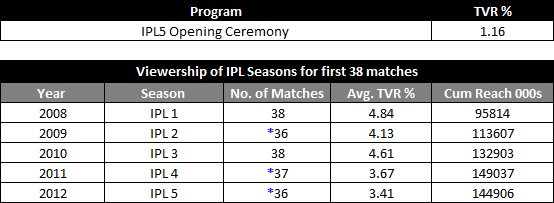
  • IPL 5: 38 matches later, ave TVR touches 3.41

    By A Correspondent


    The ratings for the first 38 of the Indian Premier League (IPL) season 5 continue to be lower than the previous seasons. According to TAM Sports, CS 4+, All India, IPL 5 delivered a TVR of 3.41 per cent in the 36 matches played so far during the tournament. Interestingly, media planners point out that one of the plus points of IPL5 is that it has been consistent in its ratings, which will lead to better ROI for advertisers.


    It may be recalled that first 27 matches of season 5 delivered a TVR of 3.53 per cent and the first 16 matches, a TVR of 3.65 per cent. The inaugural season (IPL1) however continues to remain the highest viewed season with a TVR of a whopping 4.84 per cent. Too much cricket in the past few months,India’s dismal ODI and Test match performance and too many matches in season 5 leading to cricket fatigue are said to be the possible reasons for the low ratings.


    Media planners believe that as the tournament progresses, especially towards the semi-finals and the finals, the ratings are expected to further increase. According to Mr Dinesh Vyas, GM, MEC India: “IPL 5 may have been receiving the lowest TVR as compared to the previous seasons, but it is also the only programme on television which has been delivering consistently. Therefore a TVR of 3.41 per cent for the first 36 matches is a good. In fact, now is the time that we will see more and more people viewing IPL matches and the ratings will only further increase.”


    Mr R Venkata Subramanian, Senior Director-Investments, MPG India was of the view that one of the plus points of season five is its consistency: “There has been consistency in the ratings which is certainly beneficial for advertisers however the numbers continue to be lower than the previous seasons. Despite some really good matches, the numbers have been low, probably because of too many matches leading to cricket fatigue. Nonetheless as the tournament progresses, I do expect the viewership to grow but, I don’t expect a dramatic increase.”


    Source : TAM Sports, Period : First 38 matches of all IPL Seasons, TG : CS 4+ yrs, Market : All India, Channel : MAX


    * In IPL 1 one match (47th) was abandoned due to rain
    * In IPL 2 two matches (7th & 13th)were abandoned due to rain
    * In IPL 4 one match (20th) was abandoned due to rain
    * In IPL 5 two matches (32th & 34th) were abandoned due to rain


  • Disney Channel launches “Jet Set Go” summer initiative

    By A Correspondent


    Disney Channel has begun its one-of-a-kind initiative “Jet Set Go” this week. It is partnering with Jet Airways to give kids and their families a unique opportunity to win a magical all-expenses paid trip to the ‘happiest place on Earth’- Hong Kong Disneyland. The on-air contest will run throughout the month of May on Disney Channel and will give 30 kids and their families an opportunity to go toDisneyland.


    In celebration of “Jet Set Go”, Disney Channel is wrapping a Jet Airways aircraft in Disney favourite characters – Mickey and friends – to be unveiled on the May 9 in a special ceremony in Mumbai. “The aircraft wrap is a unique way to quite literally take one’s brand to the sky,” said Mr. Manish Dureja, vice president, Marketing at Jet Airways. “Disney’s focus on kids and families is aligned with our focus in catering to the needs of children and families in flight.”


    The children can enter by watching Disney Channel during the month of May and spotting the animated Jet Airways aircraft which will appear until May 28. Children can accumulate points each time they spot the aircraft by dialing a toll-free number flashing on the screen, absolutely free of cost, and leaving a missed call. Those who spot the plane the maximum number of times per day earn the maximum points and at the end of each day, the highest scorer will be announced as the winner on Disney Channel.


    “At the heart of Disney DNA is our passion for telling the world’s best stories and providing unique experiences for kids and families. We are pleased to work with Jet Airways and Hong Kong Disneyland Resort to bring our fans this fabulous opportunity to experience Disney magic first-hand,” said Vijay Subramaniam, business head, Walt Disney Television International,India.


    One winner will be picked each day, over the period of 30 days with the winners and their families going onto Hong Kong Disneyland Resort for a unique two day Disney experience. “Since opening in 2005, Hong Kong Disneyland Resort has welcomed more than 31 million guests from around the globe. It is the perfect destination for our Indian guests and we are thrilled to be collaborating with the Disney Channel on this campaign. We look forward to welcoming the winning families in July to enjoy all the magical experiences at Hong Kong Disneyland. We hope that they take home with them a lifetime’s worth of memories”, said Wendy Chu, Director of Marketing, Hong Kong Disneyland Resort.


    Disney ChannelIndiaoffers an unparalleled blend of quality Disney entertainment and distinctive, originally produced programs that kids love and families trust and enjoy. This includes Disney’s movies and series, sitcoms, family dramas and live action adventure stories. The channel’s multi-genre programming is designed to meet the under-served needs ofIndia’s preschool, kids and family audiences.


  • Spark 2B ultimate music destination: Rally

    By A Correspondent


    At a time when the numerous music channels are fighting to survive, it’s a big deal to turn one. Big CBS Spark, part of the Big CBS Network – the JV between Reliance Broadcast Network and CBS Studios International, completed one year on May 2.


    The channel, which has positioned itself as a youth channel with the core target group of 10-24, boasts of having an intense understanding and research of the entertainment requirements of their target audiences. “The transition to a music channel has helped, as the music content has increased and now people are able to relate to the channel as we are doing more and more stuff on Indian music scene,” said Vishal Rally, business head, Big CBS Networks.


    To stand out of the clutter and to reach out to the correct audience,  the channel conducted an extensive research study on various time slots catering to different age groups (what time of the day which age group (TG) prefers to listen to what kind of content). “We have created music time bands like Hip Hop MCs (for rap, hip hop music), Indie Rock Mania (for rock music and independent bands) and Hot Hitz. As we had the music library of major labels, we had the content. Our concern was planning and finding out the right kind of audience. Besides music, the channel also airs shows like the Cheaters, Maximum Exposure, Smash Cuts, Oblivious and Real TV targeting the youth audiences,” added Mr Rally.


    Apart from international music, the channel is also concentrating in providing a unique platform for independent artistes of the country to make Spark “the ultimate music destination”. “We offer original local content too with properties like Indie Music and The Great Gig in the Sky. The channel is attempting to incorporate almost every genre of music so that it has something to offer to everyone,” said Mr Rally.


    Talking about the channel’s future plans, Mr Rally said: “Our plan is to ensure the channel reaches the best content to its target audiences and strengthens its positioning as the ultimate music destination.”


    The first anniversary celebrations kicked off with a jam session between the pioneers of Sufi rock music, Junoon and the Indie Rock artist, Ankur Tewari.


  • IBF welcomes Tariff Order, seeks clarity on Carriage

    By A Correspondent


    The Indian Broadcasting Foundation (IBF) has welcomed the initiatives taken by the I & B Ministry and TRAI in bringing about much needed reforms in the cable sector.


    The Tariff amendments and the new Interconnect regulations for Digital Addressable Cable brought about by the Telecom Regulatory Authority of India (TRAI) will inject necessary transparency across the value chain. With a slew of consumer friendly measures – namely choice of packages and introduction of Basic Service Tier, TRAI has ensured that all subscribers of varied socio economic background are duly taken care of and provided for. IBF also welcomes the mandate to enhance the channel carrying capacity to a minimum of 200 channels wef July 1, 2012 and 500 channels wef January 1, 2013.


    The new interconnect regulations have brought within its wake the much awaited specifications for digital addressability while at the same time laying down the eligibility criteria for availing signals. The reporting requirements will help the government in plugging leakages while the provisions on disconnection of signals will ensure that all stakeholders are aware of their rights and obligations.


    Overall the Tariff Order and the Interconnect Regulations read with the amended Cable TV Act and Rules are steps in the right direction and will help the country to make the digital transition.


    However, a big area of concern for Broadcasters is Carriage Fee. The Broadcasters have taken up this issue in various discussions with the TRAI and the Government in the past. Carriage Fee has crippled various broadcasters, especially the smaller sized companies, and it has restricted a broadcaster’s ability to invest in content and other activities of a channel. Therefore, there is an urgent need to revisit this issue and IBF will seek clarity on this matter from TRAI.


    India is on the threshold of a digital makeover and IBF trusts that this will, over a period of time, make way for more freedom to stakeholders as digitalization acquires critical mass and the country gains more confidence in bridging the digital divide.


  • Full report of Assocham ‘focus’ on M&E

    By Shruti Pushkarna


    Assocham organized the 6th annual summit on entertainment and media, Focus 2012, inNew Delhion May 4 where the topic in focus was Digitization for Inclusive Growth. The event began with a keynote address by the Chairman of Press Council of India, Justice Markandey Katju, who came down heavily on the media once again, in his address.


    Justice Katju referred to the role played by the European media between the 17th and 19th century. He talked about the sacrifices made by writers like Voltaire, Rousseau and Thomas Paine to uplift the society and help it convert from a feudal state to a modern society. He criticised the Indian media for promoting superstition in form of cheap astrology shows on news television channels all day instead of promoting rational and scientific ideas. He said: “The function of the media is to uplift the intellectual levels of citizens, but our media instead has stooped down to the level of Indians, of which 90 per cent are fools.” He said that in the race for TRPs, the television channels focus on entertainment which constitutes 90 per cent of programming and leaves only 10 per cent room for real issues to be telecast.


    Justice Katju urged media professionals to play a socially responsible role at a time whenIndia, likeEuropein the 17th century, is going through a transitional phase. He emphasized on the need to promote rational ideas in this period of transition in Indian history. He also emphasized on the need for regulation as opposed to self regulation. He said, “I am the greatest fighter for freedom for press and that’s why I am not recommending control but regulation. In control, there is no freedom but in regulation there is reasonable restriction in the public interest.”


    Self regulation is no regulation, he added: “You cannot have absolute freedom to harm society. There is need for regulation, and this regulation cannot be from the government, it has to be from an independent regulatory authority which has penal powers.”


    Broadcasting & Digitization: India Goes Digital- Challenges & Way Forward

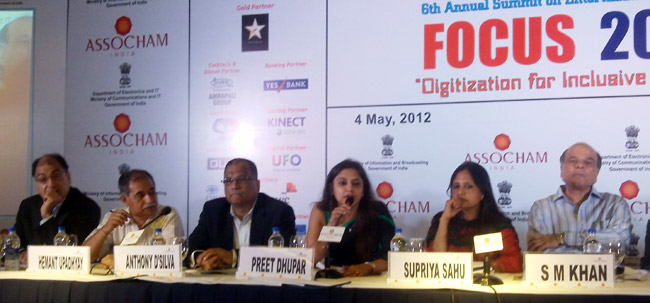
    The session on broadcasting and digitization was chaired by Supriya Sahu, Joint Secretary (Broadband & Policy), Ministry of Information and Broadcasting. The session was moderated by Preet Dhupar, Director, BBC World,India. The panelists included Anthony D’Silva, Group CEO, Sun Group; Hemant Upadhyay, Advisor, VOICE; Jehangir S Pocha, CEO, INX News; Roop Sharma, President, COFI; Vishal Mahajan, Sr. Director, Yes Bank; Himanshu Patel, COO Videocon D2H; Ashok Mansukhani, President, MSO Alliance; Joy Chakraborthy, CEO, TV Today Network; Pulak Bagchi, VP, Star India and SM Khan, DG, DD News.


    During the discussion, Ms Sahu said that the work on digitization, especially Phase 1, which looks at the four metros, was on track and with help from all stakeholders the government should be able to push digitization to happen in time. She defended the TRAI tariff order: “It is a win-win situation for every stakeholder. The clear winner, of course, is the consumer.” She said that the cities were almost ready for digitization, the government had made good progress as far as procurement of set top boxes (STBs) is concerned and the only area that needs attention is the seeding of these boxes. She agreed that for the target date to be achieved, around 20-25 lakh STBs have to be seeded and that makes it 1 lakh STBs to be seeded every day.
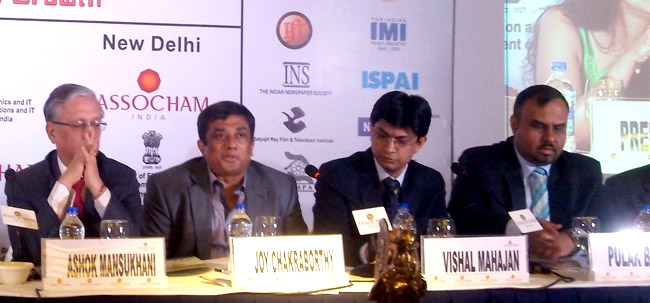


    Representing the MSO Alliance, Mr Mansukhani congratulated the government on taking up the challenge of digitization. He agreed that there were some concerns and issues on which they will seek clarification from the TRAI. He reiterated the commitment to digitization on part of MSOs and urged newspapers and business channels to clearly present all points of view to the debate on digitization.


    Ms Roop Sharma, President, COFI expressed hers and the cable operators’ disappointment at order issued by TRAI. She claimed that the order was unfair to LCOs and will result in putting them out of business: “Regulator wants to be the controller of the industry…the role of the regulator is very bad. We are all for digitization, but we are unhappy with the revenue share that has been decided in the order.” She added that 60 days are too less to meet the challenges of digitization and it is unlikely that the sunset date for Phase 1 is achievable.


    Jehangir Pocha, CEO INX News shared the plight of the broadcasters with the panelists on the issue of carriage fee. He said that a channel like Times Now had to pay a carriage fee of Rs50-55 crore to reach the viewers. He said: “I can’t applaud this order. Those who applaud this regulation perhaps benefit from it. It is the first time in the history ofIndiathat carriage fee is legalized, institutionalized and not regulated.” He said that the government claims to have taken the views of all stakeholders involved but their views were taken only in theory and not in spirit.


    The TRAI in its recommendations stated: “Keeping in view the fact that substantial investment for implementation of Digital Addressable Cable TV Systems is made by the MSO and the cost involved in carriage of channels, the Authority has decided that every MSO may fix the Carriage Fee.” But Mr Pocha argued that why should a channel pay for MSO investment. He said he would like the government to issue a white paper that looks at the earnings of all players.


    Sun Group CEO Anthony D’Silva said that the need of the hour is to get down to the nitty-gritties: “The lessons learnt from DTH are applicable to any other digital system. We need to look at how the subscriber management systems will work, what are the service parameters and who’ll set up the call centres because that involves huge costs.” He added that the government needs to look at  digitization as any other infrastructure project and support it by whatever means, whether its tax holiday or any other subsidies.


    Pulak Bagchi, VP, Star India expressed a need to recognize the challenge government and the regulator had in thinking through the entire process of digitization and the fact that it’s difficult to make everyone happy. He said: “Government and regulator are out there to protect the public interest and not to add to company bottom lines. We entrepreneurs need to work out our own course.”


    Responding to the issues voiced by the various panelists, Ms Sahu said: “All concerns are genuine and we would try and address them as well as we can but please read the fine print to clarify some of the concerns.” As for cable operators, she said that if cable operators don’t move to digitization fast enough, they will be wiped out by competition from DTH.


    Films, Animation and VFX: Digital Cinema- Present and Future

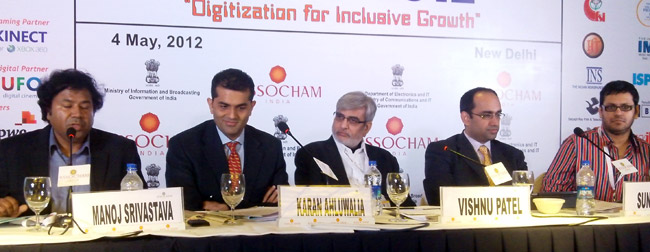
    The session was moderated by Karan Ahluwalia, Executive VP, Yes Bank and the panelists included, Ramesh Meer, CEO The FX Factory; Sunaman Sood, Co-founder, Director, Acendo Capital Advisors; Siddhartha M Jain, Producer@iRock; Vishnu Patel, CEO-Special projects, UFO Moviez and Manoj Srivastava, CEO, Enternainmentt Society of Goa.


    Siddhartha M Jain of iRock started the discussion by talking about the paradigm shift occurring in cinema: “Low budget films without stars which used to be niche earlier are picking up. We’ve had hits like Ragini MMS and Vicky Donor. So there is huge investor appetite, provided you have the right content. The key lies in keeping the budgets low and using the latest technology.” He added that there is also a huge power shift happening from Bollywood movies to movies outside Hindi cinema.


    Sunaman Sood said that producers have now begun to treat regional cinema with some seriousness, realising its potential. But Manoj Srivastava added that there is no platform or agency in the country that promotes regional cinema well enough.


    Speaking of digitization’s benefits to cinema, Vishnu Patel said that digital technology has helped revive the industry which was otherwise on a decline. He said that regional cinema has also benefitted from digital technology because digitization has cut down the distribution cost in terms of prints. Now regional film producers can distribute their films better without having to worry about prints’ costs.


    Print Media: Challenges and Opportunities in Digital Age

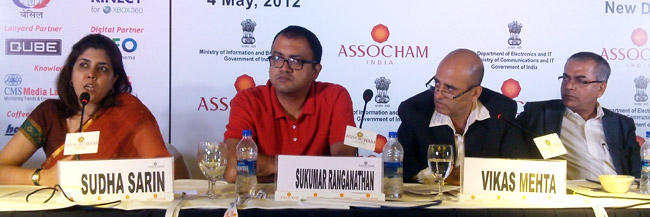
    The session was chaired by Suprio Guha Thakurta, MD, The Economist Group India. The session was moderated by Vikas Mehta, VP & Executive Business Director, JWT Delhi. The panelists included, Sukumar Ranganathan, Editor, Mint; Vandana Das, President, DDB Mudra;Sudha Sarin,MD, Ipan Hill & Knowlton and Raghav Subramanian, COO, Lintas Initiative Media.


    Sukumar Ranganathan initiated the debate by making a strong point that print is here to stay: “We often look at the western trends to decide the future of print in the country but we forget that the dynamics of the western market are very different from the Indian market.” He said that Mint has never defined itself as a newspaper; rather it looks at itself as a ‘newsroom’. Talking about integration of content, he said: “We update a story online as soon as it breaks. We also use social media to amplify the news. And in the paper, we value add with analysis and so on. I think integration is key to what a newspaper needs to do to survive in a digital area.”


    Suprio Guha Thakurta echoed Mr Ranganathan’s views but he also emphasized on the fact that content for every platform needs to be looked at differently: “You can’t just cut and paste from print to online or any other device.” He added that The Economist, which at present has about 85 per cent of subscriptions from print, aims at converting these into at least 50 per cent in digital in the next two years.


    Raghav Subramanian said: “It’s not that print is going to go away but it’s being increasingly threatened by digitization. Print is slow as a medium and now with news all over the place, the tangible paper is eroding in terms of the first choice for the younger generation.”


    Concluding the debate, all panelists agreed on the need to integrate content across different media to reach out to consumers/viewers/readers at different touch points.


    Radio and Music: New Avenues for Revenue/ Social Media & Gaming: Creating New Markets

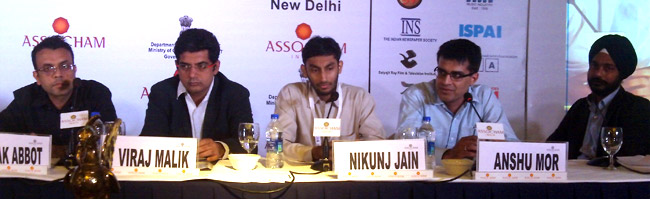
    The last two sessions on radio and gaming were merged into one discussion. The session was moderated by Uday Chawla, Secretary General, AROI and the panelists included, Anand Raj, Head- Non Traditional Revenue, Red FM; Geetanshu Anand, Head- Content, Mystica Music; Pallab Mitram Head- Consumer VAS, Tata Teleservices; Deepak Abbot, Head- Product, Zapak Digital Entertainment Pvt Ltd; Nikunj Jain, CEO, Inoxapps; Anshu Mor, Lead Entertainment & Media, Microsoft; CP Singh, CTO, Possible Worldwide; Akhilesh Saurikhia, Consultant, Department of Electronic and IT, Govt of India and Viraj Malik, CEO & MD, PK Online Ventures Pvt Ltd.


    Anand Raj of Red FM talked about alternate revenue avenues that radio stations can look at. He said that audio production is an unorganized market right now and if radio stations start looking at doing audio productions in-house, there is huge potential for revenues. He also pointed out initiative like the Mahabharata or Ramayana productions done by Fever and how radio stations can look at making money by selling productions like these to VAS mobile operators. Another area that radio stations haven’t exploited properly he said was social media. He said that radio can look at building communities on social media for commerce.


    Geetanshu Anand of Mystica Music said: “There is no lack of avenues for revenues; all we need to do is fill up the loopholes for revenues.” Radio industry, she said, plays a crucial role in promotion of music but when it comes to rights sharing then both radio and music companies get selfish and each wants a larger pie. She said that the need for the hour was to review the statutory licenses. She also said that it is important for radio to start promoting non-film music alongside film music.


    Talking about gaming and creating new markets for it, Anshu Mor of Microsoft said: “It’s important for us as an industry to change the concept of gaming and how we look at gaming.” He added that social media provides with an opportunity to promote the ‘Brand Me’ and hence plays a huge role in marketing.


    Viraj Malik added that mobile gaming is on a rise and will turn into a larger opportunity inIndiabecause mobile is fairly big in terms of reach and affordability. And this creates a huge opportunity for content and app developers, he said.

     

  • MCCS channels unveil new look

    By A Correspondent


    MCCS will be relaunching news channels Star News as ABP News  in Hindi, Star Ananda as ABP Ananda in Bengali and Star Majha as ABP Majha in Marathi on June 1.


    The relaunch process begins today with a massive communication campaign  developed by Lowe Mumbai. The media buying plan has been formulated by Mindshare.


    The campaign would be, over the next 8 weeks, aggressively communicating the change, using a combination of TV, Print, Radio, Outdoor and Internet, to all the viewers and stakeholders about the new name and logo.


    The three news channels have helped MCCS evolve as a strong and respected broadcast news company. The theme of communication is simple and to the point: Our Stars don’t change, our News does not change, only our name changes.


  • Satyamev Jayate reports gr8 Chrome numbers

    By A Correspondent


    Aamir Khan’s Satyamev Jayate has reported  “unprecedented” launch episode numbers, reports Chrome Data Analytics and Media.


    Says Chrome founder Pankaj Krishna on why it’s unprecedented, “Conventionally, KBCs have premiered on weekday evening primetime when the overall TV viewership is at peak and so have most other big promotables across channels where one shows rides on the back of another during the three hours of evening peak prime (8-11pm) as against a Satyamev Jayate that’s going solo on a Sunday morning.”


    The Chrome Television Panel Audits indicate the following numbers. Note this is only Star Plus and the Hindi Speaking Market (HSM). Since SMJ was aired across various channels and languages, we could see a healthier story if those are taken into account.


    Satyamev Jayate, Sunday May 6, 2012, 11 AM, Star Plus, HSM:


    Show Distribution Availability

    99%

    Show Reach

    11.8%

    Show Average Stickiness per viewer

    39 Mins

    SHOW TVR –

    5.12


    SOURCE : CHROME TELEVISION PANEL AUDITS, C&S 4 +( DIGITAL + ANALOG) – SAMPLE 2847 Individuals, HSM


  • Nearly 10 lakh STBs ready for Kolkata

    By A Correspondent


    The Cable Television Networks (Regulation) Amendment Act, 2011 has made it mandatory for switch-over of the existing analogue Cable TV networks to Digital Addressable System (DAS) by December 2014, in a phased manner. In respect of four metros of Delhi, Mumbai, Kolkata and Chennai, the digital switch-over is to be completed by June 30.


    The ministry is very closely monitoring all the activities for the timely implementation and the quality of the Digital Cable TV service. During the high level review meetings by the Ministry, it was revealed that in the case of Kolkata, out of total requirement of about 35 lakhs STBs, over 5 lakhs STBs have already been installed, about 4 lakhs STBs are available in the stock which are being installed and the orders have already been issued for the balance requirements of STBs.


    Further it came to the notice that all the MSOs already have digital head ends and the existing channel capacity in each of the case is over 200, which is the mandatory requirement as per the Telecommunication (Broadcasting and Cable Services) Interconnection Regulation, 2012. The channel capacity is being augmented by the MSOs.