Category: MEDIA

  • NXT Digital gains impressive foothold in just 3 weeks

    By A Correspondent


    Three weeks back, in mid-July, the Hinduja Group had announced the launch of Headend In The Sky (HITS) service, called NXL Digital, which has been built as per cable fraternity needs, to help the cable distribution fraternity make a smooth transition from analog to digital as Digital Addressable Services (DAS) roll out in Phase 3 and 4 markets. In the brief period since, NXL Digital has already signed up a large number of subscribers.


    Tony D’Silva, MD – Grant Investrade Limited, announced, “In just over three weeks since NXL Digital was announced, it has already been signed up to reach 1  million analog TV households in Phase 3 markets through LMOs and MSOs who have opted for its services. In the past 21 days, we have reached out to the cable fraternity across several cities, and I am delighted to share that they are extremely excited about NXL Digital.”


    Adding further, he said, “The LMOs and MSOs see it as a partner that will not only help them make the mandated transition from analog to digital, but remain independent and owners of the networks they have built with sheer dint of hard work over the years.”


    The roll-out of Digital Addressable Systems in Phase 3 and 4 markets across 110 million TV households is being seen as the biggest and the most significant step for the Media and Entertainment industry in India, and in the scenario, NXL Digital, from Grant Investrade Limited, a subsidiary of Hinduja Ventures Limited, will empower the cable distribution fraternity  working with an estimated 110 million* analogue TV households in the market to help them make the transition to digital by end-2016.


    The Hinduja Group has made significant investments in the NXL Digital platform: a state-of-the-art broadcast facility in Noida has been designed and purpose-built to provide top quality service, which will roll out in end-August this year. While the satellite-based service will have a national footprint, in view of the deadline for DAS rollout, Grant Investrade Limited is concentrating on the Phase 3 and Phase 4 markets for its marketing and subscription drive to enable the cable fraternity provide digital services there.


    D’Silva said, “NXL Digital will empower and enable the distribution fraternity including Last Mile Owners (LMOs) and MSOs to offer a world of exciting Digital services to their end-subscribers in all the analog households across markets. Crucially, NXL Digital will not only help the LMOs and MSOs go digital as per government mandated standards and within the set deadlines, but, throughout the process, help them be independent and retain the ownership of their network.”


    This has been made possible because when work first began on finalizing the NXL Digital offerings, the company undertook in-depth research to find out the requirements of the distribution fraternity. It reached out to over 2000 LMOs, MSOs and their representatives across 120 cities in Phase 3 and 4 markets, and asked each, separately and in person, what they wished they could be able to do with their businesses when it was time to offer television broadcasting – along with other value-added services — through encrypted digitally addressable systems.


    “The research threw up six major requirements of the LMOs and MSOs,” D’Silva said, counting them out. “They wanted to retain ownership of their network; drive broadcaster deals; package and price their offerings according to the needs of their market; they wanted the facility to acquire Set Top Boxes (STBs) according to their convenience; the ability to insert local channels for their end-subscribers, and a sophisticated digital service that could help them compete with other digital platforms like DTH to ensure their digital offerings were future-ready so that their subscriber-bases would only grow.


    By signing up for a NXL Digital service, a network owner in a Phase 3 market can be saved the burden of having to make huge investments in the technology and highly skilled manpower required to convert his analog households to digital.


    A NXL Digital headend will help them provide 500+ MPEG-4 encrypted services including HD channels with the ability to insert local channels as per requirement, robust SD and HD STBs with PVR functionality, world-class conditional access and subscriber management systems, a 24×7 call centre in multiple languages for customer support, a user-friendly operator terminal and the ability to provide VAS, OTT and other add-on digital services as and when rolled out.


    The NXL Digital service will provide Television channels to cable operators through a satellite instead of the traditional cable television headend where multitudes of satellite dishes and antennas are used to grab cable stations from dozens of communication satellites. The low comparative capital investment is expected to be the biggest draw for the network owner, apart from the additional revenue opportunity through VAS services – something which is not possible with DTH. Hence the network owner will no longer have to worry about high investment costs to provide Digitized cable TV services.

     

  • DB Corp completes multiple edition roll-outs in Bihar

    By A Correspondent


    D B Corp (Dainik Bhaskar Group) has successfully completed its roll-out in Bihar. The publication launched the Muzaffarpur edition on August 8th and Gaya edition on August 4th alongside the simultaneous launch of 7 district editions in Hajipur, Purnea, Biharsharif / Nalanda, Arrah, Chhapra, Samastipur and Darbhanga.


    In Bihar, Dainik Bhaskar now has presence in Patna, Bhagalpur, Gaya and Muzaffarpur. With these launches, Dainik Bhaskar Group now publishes 6 newspapers with 61 editions in 14 states across India.


    A similar launch strategy was adopted for the Muzaffarpur and Gaya as followed in Bhagalpur and Patna. The success of both launches hinged on the intensive pre-launch personal contact campaign implemented to achieve target circulation that also directed the launch marketing strategies to create high-impact brand recall and visibility amongst local readers.


    For Muzaffarpur, a total of 165,643 commercial establishments and households in Muzaffarpur were contacted through the personal contact programme which was the first phase. This was critical in setting the momentum of the launch by understanding core insights of readership behavior, preferences, needs, while also highlighting the Dainik Bhaskar brand values and strengths and utilising the opportunity to build strong reader connect.


    Key inputs of the personal contact program in Muzaffarpur, have been distilled to create the Muzaffarpur edition of Dainik Bhaskar that addresses actual reader’s needs through issues they have identified as core and significant to the development of the local region and State. Some of these issues span urgent need to stem corruption, bring strict law and order control, better focus on hyper-local news and issues like consistent challenges of water-logging and growing traffic impediments, in addition to better coverage of national news and quality political analysis. The survey also revealed issues preferred by women readers who spend quality time reading the papers in the afternoon and weekends – with demand for better quality supplements covering parenting challenges, international news on education and overall well-being.


  • Ranjona Banerji: Was there fair reason for govt to send a showcause to news channels

    By Ranjona Banerji


    The Information and Broadcasting Ministry, an anachronism if there ever was one, issued a showcause notice against three news channels on August 7. Aaj Tak, ABP and NDTV were asked to explain why action should not be taken against them for their coverage of Yakub Memon’s hanging. Memon, an accused in the 1993 Bombay bomb blasts case, was hanged at the end of July after losing all his chances for clemency.


    The hanging set off a series of articles and comments and debates on the death penalty and the particular details of Memon’s case. Many news channels also covered details of the hanging live, although they could not show the actual event of course. There was some criticism that while Memon’s hanging was covered live, there was not enough attention paid to the funeral of former President of India, APJ Abdul Kalam.


    But the “crime” committed by the channel is something else. It is “showing disrespect” to both the judiciary and the President of India. The showcause notices refer to three sections of Rule 6 of the Cable Television Network Rules, 1994. The greater threat is that the channels will be stopped from broadcasting for some period of time as a punishment.


    Press and broadcasting associations have reacted swiftly and angrily, protesting against the notice. The Mumbai Press Club, Indian Womens Press Corps, Press Club of India, Guwahati Press Club, Brihanmumbai Union of Journalists and Delhi Union of Journalists issued a joint statement condemning the move. The Broadcast Editors Association was quick to respond and the Editors Guild followed.

    There is a discrepancy here in the way the practice of journalism is perceived, depending on its medium: that is, 24-hour broadcast journalism is subject to more stringent laws because of its reach and possibly its influence. This is unfortunate because no matter what you think about TV news, it cannot be less free than print. (The flip side of course is that no one cares what happens in print journalism!) It is one thing to try and stop TV channels from revealing operational details of a terrorist attack or an army response while it is going on. But it is better when news channels themselves restrict themselves. Government control and regulation has to be resisted and rejected.

    But what we have here is something else and something far more dire in its larger consequences of all journalism in India. It is a government trying to impose its own views on the media and trying to stop the public from knowing about something it does not like. But the purpose of journalism is to do precisely what the government – any government – does not like. The unacceptable action taken against cartoonists under the last UPA government using the disastrous 66A provision against internet freedom is a good example of government overreach. You do not have to go as far back as the Emergency to look at government attempts to muzzle the media.

    Several legal experts have also condemned this notice by the Information and Broadcasting Ministry, another Emergency relic which needs to go. Oddly in this case, instead of going through regulatory bodies like NBSA or BCCC, the ministry has sent the notices directly to the channels.

    Freedom of expression remains the bulwark of a free media and a proper democracy. There are laws to deal with transgressions. Government disapproval is not reason enough to invoke this or any law. You do not like what is being shown on TV, use the remote, read a book or just take a hike. There is no law that forces you to watch non-stop TV or indeed, anything that you do not like.

    While there was outright condemnation of this showcause notice from most journalists, there was one noticeable exception. Sudhir Chaudhary, editor of Zee News, felt that these channels had threatened his love for the nation and deserved what they got.

    He tweeted thus:

    “Freedom of expression cant b used to promote terrorism/anti India sentiments.Viewers should show these channels their actual place. ‪#‎decide”

    I agree. Choose your channels wisely…


  • Have an idea? Paytm karo!


    By Anandita Singh Mankotia


    Alibaba-backed online e-tailer Paytm has readied a war chest of half-a-billion dollars as it scouts for acquisitions across the ‘local commerce space’, in line with its Chinese investor’s vision that the offline-to-online business category would be the biggest segment in the ecommerce space.


    “We have about $200 million in cash and the remaining $300 million could be through equity,” Paytm’s founder and Chairman & Managing Director Vijay Shekhar Sharma said. “We have also kept aside $50 million for investing in logistics and warehousing.”


    The $300-million equity could translate into a less than 10% stake in Paytm, based on the valuation of the latest investment by Alibaba Group Holding.


    Paytm, which has applied for a payment banking permit, is expanding into the ecommerce space as it tries to focus on the offline-to-online (O2O) businesses, in part via acquisitions. “We want to get into local commerce, which we feel will become the biggest segment in the ecommerce space,” Sharma said.


    O2O is a fast-growing business segment which combines the benefits of online retail with brick-and-mortar transactions. For example, food-ordering or grocery-ordering apps are expected to be large segments in ecommerce, Sharma said.


    The plan is in line with the global vision of Alibaba, Paytm’s biggest investor, of going big on the O2O segment.


    O2O helped Alibaba grow in India

    Offline-to-online (O2O) services have allowed Alibaba to tap shoppers even at brick-and-mortar stores. Customers can check their apps for discounts and promotions and pay with their mobile wallets to order goods from local stores.


    “O2O is a huge opportunity in India. It is a much bigger opportunity than ecommerce itself. The model allows a digital shopper to be driven offline. For instance, buy online and pick instore. Or buy online and return instore,” said Ashish Jhalani, founder of retail consultancy Etailing India.


    India’s Internet market is expected to become the fastest-growing in the world and reach a size of $137 billion (Rs 8.7 lakh crore) by 2020, according to Morgan Stanley. Consulting firm AT Kearney said earlier this month that it expects the Indian retail market to grow to $1.3 trillion by 2020. Paytm, the consumer brand of mobile Internet company One97 Communications, had raised $200 million from Ant Financial Services, an affiliate of Alibaba, for a roughly 25% stake earlier this year.


    As reported, the Alibaba group could invest some $600 million more in Paytm for another 20% stake, which would subsume an outstanding tranche of the previous transaction under which Ant Financial was to have pumped in another $375 million.


    The new infusion of funds could see Paytm valued at close to $3.7 billion (Rs 23,600 crore), compared with the $1-billion valuation of the previous funding round.


    The latest investment in the company, once complete, will result in investors diluting their equity by about 20%, bringing the stake of founder Sharma to under 23% from 28%.


    Source:The Economic Times

    Copyright © 2015, Bennett, Coleman & Co. Ltd. All Rights Reserved

    Licensed to republish


  • Interface creates new TVC for QuikrCars

    By A Correspondent


    Quikr announced that it has gone live with QuikrCars, its vertical with a sharp focus on all kinds of automobiles, i.e. cars, bikes and commercial vehicles. The first of Quikr’s verticals being launched, QuikrCars is a unique one stop destination for India’s car buyers and sellers, combining Quikr’s large transaction flow in the category with everything related to vehicles, including automobile news, reviews, information, tips and tricks.


    In this regard, two separate sets of TVCs highlighting the central role cars play in people’s lives have been created. They feature Quikr’s new brand ambassadors; leading Bollywood actor and youth icon Ranveer Singh and critically acclaimed Southern star Suriya.


    The theme TVC tackles the fact that cars mean different things to different people and emphasizes the comprehensive services offered by QuikrCars. The two subsequent TVCs individually introduce QuikrCars exclusive features, i.e. Maximum Selling Price (MSP) and Verified Inspection Reports.


    The TVCs will be aired across GECs and regional channels and will be supported by print, radio, OOH and digital media.


    Pranay Chulet

    Commenting on the association, Pranay Chulet, founder and CEO of Quikr, says, “Ranveer is an innovative, self-made star who stands out from the crowd. These qualities resonate with us and our journey towards market leadership. With his enormous talent and massive popularity, Ranveer’s association with Quikr will give our platform more visibility with a wider audience.”


    “As the leaders in the online classifieds space, our task is to expand the market, and as a well-established actor, Suriya has built enormous credibility and trust over his illustrious career. We believe that his association with Quikr will further increase people’s confidence in online buying and selling in India,” adds Chulet.


    Joemon Thaliath

    Joemon Thaliath, Chief Operating Officer at Interface Communications, says “People think of cars as more than just vehicles, forming special bonds with them. The fact that cars do mean vastly different things to people is a strong insight that we leveraged strategically in the commercials for QuikrCars. Thus, the TVCs amplify the features and advantages of the platform in an interesting and delightful manner.”


  • OOH in the times of Digital


    We may skip the occasional YouTube ad and attend to some chores while the television commercial is on, but Out-Of-Home advertising is one form of promotional activity we cannot avoid. It is right there whether we are on our way to work, out for a party or even when we are driving away for a holiday. In this interview at the Outdoor Advertising Convention 2015 last month, Amit Sarkar, Chief Operating Officer, Kinetic India talks about the growth of OOH in India and what lies ahead.


    Can you give us a broad idea of how OOH has been growing over the years in India especially at a time when there’s so much buzz about digital.

    Anything that is new will always have a buzz. So digital has been growing at a larger pace because it is a new evolution of media format. And a large part of digital is growing because you look at the age groups which are digitised, they are our larger consumers today. If you look at the larger shifts from consumer-centric age groups, young people are more prone to digital. OOH has been growing at a logical pace, 5 percent, 4.5 percent, except for last year towards the end of the second quarter when elections happened and we saw a lot of money in OOH. I think that’s an interim situation which actually took the pie to about 10-12 percent growth last year. But, if you have to keep that out of the event of normal spending pattern, I think we grew about 4.5-5 percent.


    So would you say that this digital buzz has stolen the thunder of OOH and other mediums as well?

    I really don’t buy that story, because when digital was not there, OOH still grew at the same pace. Which means OOH has its own independent challenges of growth and decline. Digital is something that is new, so obviously there is a perception that that is pulling out more monies. I can tell you with assurance that digital has pulled money out from television and they would be having the same sort of concern which OOH may have. I think OOH’s problem is independent of whether digital or mobile advertising is going out or not. And these are very uniquely positioned over the last one decade that we have been seen in OOH as a business. It’s very independent. I mean OOH doesn’t grow because of larger logical reasons like we have become pretty format-driven, we have regulation problems, different cities and different municipal corporations and revenues from OOH is different. While there is tremendous opportunity, but a slow pace of growth is largely to be blamed in the way media has been consumed, and also position perception. If you look at it, it’s more of positioning.


    What is the difference in the growth of OOH in a metro like Mumbai versus a Tier 2 or a Tier 3 city?

    If you look at it, about 75-80 percent of consumption today is all in the urban cities. While Tier2, Tier3 is extremely growing and that’s because of any other reasons of all businesses.
    If you see telecom as a category, these are pockets that are growing too. If you look at FMCG as a category, these are pockets that are growing too. New acquisitions have been drying up in our own cities. So OOH thereis more an evolved format, better environment, but if we look at core OOH in terms of visibility perspective, Tier2, Tier3 and Tier4 towns are the ones which provide us business. Because more as we progress, when you look at rural India where there is a lot of purchasing ability for people who are just farmers in the context of it. Gradually when their behavioural pattern changes in the way they consume something from a media format perspective, OOH in those markets will evolve, but need wise, there is tremendous potential. I have seen double digit growth inside that 5 percent, coming only from Tier 2 and Tier 3 towns.


    Does that have anything to do with the fact that internet penetration is also slightly lower in a Tier 2, Tier 3 city compared with a metro?

    I think they are two independent points, but all independent points from a consumer’s perspective have a correlation, which means more internet penetration, more exposure, therefor more knowledge clearly, more aptitude towards media. So similarly, just take an example I would say, if you would have looked at a city like Mysore about 10 years back, till the time Infosys actually made a game-changer there and all of us know that Mysore is great for Mysore palace. Today if you look at a lot of people who have migrated to Mysore, from Bangalore and other large cities, your consumption pattern of that particular city has changed. Your real estate prices have gone up. Almost everything around it is a newer ecosystem. That proves ability and OOH would actually work with it.


    Measurement in OOH, unlike digital and other mediums, it still a weak point. In your opinion what is the best way to tackle this?

    Every media format has its own challenges. Not to say digital for clicks could be measureable, because clicking and getting absolute time to consume an advertisement are two different things. Just because of clicks, it doesn’t mean that your attention towards an advertisement in digital is great. OOH has challenges of currency and ROI. But the reason for it is also that it is more difficult to measure OOH because of the nature of the business, the geographical spread, the immense amount of unorganized formats across different markets. If you look at television, you would actually take a smaller sample size to determine what will be your viewership pattern. In OOH every market works differently, vendors are different, formats are different, cultures, languages are different. Just to give you an example, in Karnataka if you ever do OOH, you have to actually put a sign of the creative in the local language. Without that you will not be able to display. The same thing is not really applicable in Delhi. So it has perennial challenges, however to build a currency, it has to have industry initiative and investments have to come in. So that’s the larger challenge. There’s no trial. There has been trial for the last 10 years that I know of, but everytime you progressed. So I’m hopeful it will happen sometime tomorrow, and it has to happen, otherwise the trade matrix will die. I mean our margins are shrinking, investments are not coming in, regulations are a challenge. You have to have a modelling of ROI which will move you fast. In closed environments like the airports and malls, it’s still addressable, because you can assure walk ins, profile a TG, it’s a closed environment you know how things are. It becomes very difficult on roadsides, on larger platforms.


    In this perspective do you think it’s good to have competition between mediums, or do you think that all need to work in synchronisation to ensure sales for the brand?

    OOH all of us realise has become more environment-driven. So whether it is an experience to be combined with digital, social, or anything to do with word-of-mouth as well, which amplifies it to a larger extent is OOH. So, just because digital and OOH can combine together to give a larger proliferation, it may not be a right story, all forms of media, together form an OOH ecosystem today. And that’s where the importance and the opportunity lies.


    From the perspective of your clients, what are the spends on OOH versus other mediums?

    On an average 5-6 percent. Some categories actually would be more spendthrift. So telecom is high spendthrift in OOH, FMCG to an extent yes, but largely on an average it is about 5-6 percent.


    So according to you is that fine, or should clients allocate a larger portion of the budget to OOH?

    OOH is the most seen medium according to TGI consistently for years together. But if you look at commitments of budgets, it’s still very vague, because at the end of the day everyone needs to understand what is an ROI. I’m not debating the fact that every media ROI is absolutely correct, but it is the time we have a matrix and if we keep on selling OOH in the way it is positioned today, there are challenges. So from the way I look at it, OOH has to shift from its current positioning. So that proposition becomes robust and therefore currency will still matter, but what will matter more is experience with consumers. And that will actually drive it.


  • Twitter eliminates the 140-character limit for Direct Messages

    By A Correspondent


    Users can now chat onin a single Direct Message, and likely still have some characters left over. This change is another big step towards making the private side of Twitter even more powerful and fun.


    Twitter has eliminated the 140-character limit for DM, and users can now exchange messages privately of up to 10,000 characters – with the idea being that Direct Messages should seem limitless! Twitter aims to improve users’ messaging experience to give them the real estate to express themselves more freely and getting rid of the 140 character limit is just another step in that direction.


    Private messaging is definitely a core part of the Twitter experience, and earlier in 2015, Twitter launched Group Direct Messages, where multiple users could chat at once and any user could message another user privately irrespective of the fact that they might not be following each other. The aim of these changes is to help users connect more easily and directly on Twitter with other users, causes and businesses they care about most.


    Twitter aims to improve the messaging experience of users to enable them to express themselves freely with limitless boundaries. There is incredible content on Twitter every day, from breaking news to live events and the aim is to create an experience that allows users to discuss powerful moments in an environment they’re comfortable with. The aim is to make the private side of Twitter just as fulfilling as the public side.


  • Bharti Airtel partners ErosNow for Wynk Movies

    By A Correspondent


    Bharti Airtel Limited (“Bharti Airtel”) announced a partnership with ErosNow, the cutting edge OTT (Over-the-top) Bollywood entertainment network of Eros International Plc, the NYSE-Listed leading global company in the Indian filmed entertainment sector, for its carrier agnostic mobile application – Wynk Movies.


    A first-of-its kind video marketplace, Wynk Movies offers a specially curated library of thousands of movies and other popular videos from host of partners including ErosNow. With this partnership, users of Wynk Movies can access ErosNow’s premium Bollywood content offering thousands of new and classic Bollywood movies. ErosNow also offers a vast selection of audio and song videos, television content and ErosNow originals in the form of drama series with young and contemporary themes. While the app content can be accessed across 2G, 3G, 4G and Wi-Fi services, users can enjoy the app best on 4G given its seamless internet capability.


    Kartik Sheth, CEO – Wynk said, “We always partner with the best and are confident that having Eros’s premium content as one of channels on our app will help drive faster adoption for video services in the country. As smartphones penetrate deeper leading to a surge in the consumption of videos on mobile, Wynk Movies will further empower users to seamlessly access the best of video content on the move”.


    Speaking on the collaboration, Rishika Lulla Singh, CEO Eros Digital said, “Armed with our content library and first mover advantage, our vision for ErosNow is to fulfill the growing consumer need for endless premium entertainment on-demand and on-the-go, whether on their smartphones, tablets, laptops or internet enabled devices. An important part of our strategy is to be platform-agnostic and we are delighted to tie up with Airtel, a leading player in its space and a front runner in the 4G revolution where we believe our content and distribution synergies will create a win-win consumer proposition.”


    Kumar Ahuja, President – Business Development, Eros International added, “ErosNow has already garnered over 19 million registered users worldwide for ErosNow and we believe our integration with Airtel for their Wynk Movies platform will further give momentum to our customer acquisition strategy”.


  • Shailesh Kapoor: Hindi GECs’ Latest Itch: 4% Rating

    By Shailesh Kapoor


    The ratings provider may have changed, but the definition of the central programme performance measure remains the same. Called TVR % (TAM) earlier, and Rating % (BARC) now, it is a time-weighted measure of the % of universe that watched a programme, effectively connoting the “viewership” of the program.


    In primitive days of measurement, TVR % of 25-30 was not uncommon, delivered by blockbuster films such as Hum Aapke Hain Koun. Through the decade of 2000, the best of daily fiction on Star Plus scored in the 13-20 range, led by the K triplet of Kyunkii, Kahaani and Kasautii.


    With time, touching 10% became harder, as more channels meant higher fragmentation. An odd film premiere like Main Hoon Naa or 3 Idiots would get close, but even at its most masterfully manipulated high point, a fiction show (I speak of Hindi here, down South is a different story), would hit a glass ceiling at 7-8 TVR.


    Over the last two years, the benchmark continues to reduce. No Hindi programme has crossed an average weekly rating of 4% over the last two weeks. For a huge film premiere, 7% is an excellent result, perhaps an equivalent of 10% not too long ago. Even big-ticket cricket doesn’t rate like old times anymore.


    In my opinion, GECs have not spent enough time understanding this area over the last five years or so. Yes, there are more channels and the consumer has more to choose from. Much of the trend till 2011-12 could be explained on account of this fragmentation. Digitisation further fuelled fragmentation, acting as a level-playing field for smaller channels, which would lose out in the analogue environment because of poor placement.


    But instead of looking at it as a trend, what if we just asked the question: Is it so impossibly difficult to create a programme (daily, weekly, whatever) that only 4% of Hindi-speaking India watches?


    For every show that goes on-air, at least five, often more, are considered. That means that there are more than 150 daily fiction shows alone that enter a stage of serious consideration in Hindi GECs every year, not to speak of the weekend options.


    A diverse set of producers, some of them channel employees in the past, churn out these concepts. The writer pool that is engaged to work on them is not too diverse though. It’s the same set of writers that freelance for multiple producers, sometimes working on 2-3 running shows, while working on pitches for another couple. The seamless movement of plot points from one show to the other is easy to catch for anyone who follows the category.


    It seems, then, that we have caught ourselves in a seemingly vicious circle of the current output becoming the input for future output, and thus, both the current and the future looking remarkably alike. For a consumer, that means “nothing new”.


    The Hindi GEC category has been steady at about 1,100 GRPs over the last two years. But no superhero shows have emerged in this period. Admittedly, there is no magic formula to churn out one. But the best bet will be to infuse fresh writing talent into the industry. It’s easier said than done, because a lack of understanding of the daily fiction audiences and its grammar can be genuine roadblocks, as seen in recent examples like Yudh and Everest respectively.


    I’m convinced we’ll have a consistent 4+ TVR show sooner than later. I’m curious to see what it will be and how soon it will come our way.


  • Rovio appoints Anurag Sachdeva Country Director for India and South Asia

    By A Correspondent


    Anurag Sachdeva

    Rovio Entertainment, the creator of Angry Birds,  announced the appointment of Anurag Sachdeva as its new Country Director for India and South Asia.


    In his new role, Sachdeva will focus on consolidating Rovio’s strong presence in the market, driving global partnerships and strategic alliances while strengthening the organizational capabilities within Rovio. He will also lead telecom operator relations for South East Asia while focusing on the expansion of the company’s market base.


    Previously Sachdeva served as Rovio’s Associate Director, Business Development for India and Southeast Asia.
    “Anurag has proven to be an asset steering the growth of Rovio in this very important market,” says Alex Lambeek, Rovio’s Chief Commercial Officer. “He brings valuable experience to our Flock’s leadership in South Asia and he will be key to helping us raise our game even further in the region.  We look forward to working closely with Anurag and supporting him in this new journey.”


    Sachdeva has worked previously with Vodafone, Bharti Airtel, Virgin Mobile India and Aircel. He  holds a degree in B.Tech from GAU.


  • Discovery Channel completes 20 years in India on Aug 15

    By A Correspondent


    Discovery Channel will complete two decades of existence in India, and to do that it has arranged for a line-up of its most iconic programmes on August 15 and 16, from 8am to 6pm.


    Rahul Johri

    Said Rahul Johri, EVP & GM-South Asia, Discovery Networks Asia-Pacific: “Discovery Channel has had a life-changing impact on millions of viewers in India. The tremendous affection that it enjoys in India continues to fuel our passion to relentlessly push the boundaries of factual entertainment and uncover the finest stories from across the world. On this occasion of completing 20 great years in India, on behalf of the entire team, I would like to express our gratitude to the viewers and clients who have expressed their admiration through this remarkable 20-year journey.”


    Discovery is watched in five languages in India including English, Hindi, Tamil, Telugu and Bengali.


  • Debt is OK for Millennial Rich Kids


    By A Correspondent


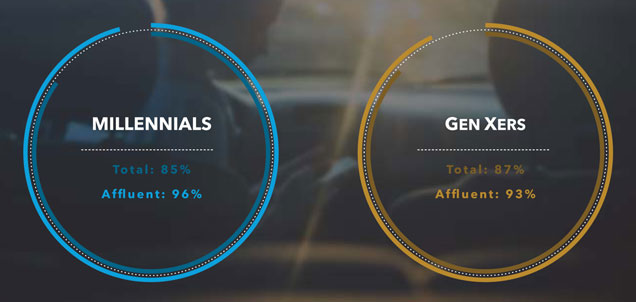
    Online professional network LinkedIn and leading media agency MEC have released ‘The Affluent Millennial Opportunity’ study in partnership with research firm Ipsos. The study reveals how the behaviour and attitudes of Affluent Millennials could reshape the future of the financial services industry.


    The study revealed that Affluent Millennials are more likely to facilitate their entrepreneurial and life goals by opting for debt related financial products. According to the survey, 68% of this group owns at least one credit card and 52% have a personal loan. Given their entrepreneurial spirit, it is not a surprise that 27% have a business loan.


    The dynamic, self-empowered and technologically advanced generation is a key driver of India’s economic growth. To help financial institutions nurture and deepen their relationships with the Affluent Millennials, here are some interesting insights from the study:

    Independent and hungry for information

    • 54% of Affluent Millennials said that they conduct their own research before making an investment, but consult with an advisor to validate before they take a decision
    • 68% Affluent Millennials expect to be successful and advance quickly in their career through their own hard work – not through their country’s prosperity
    • The study revealed that 86% of the Affluent Millennials use social media for obtaining financial information. They look for financial institution which offers a great degree of privacy and has a positive buzz online
    • Peer opinion (93%), thought leadership (92%) and informational resources (90%) is the content Affluent Millennials want from accompany on social networks


    Low dependence on salaries

    • The source of affluence for this group is changing.Salaries are losing prominence as the primary source of wealth ascompared to the GenX Affluents**. Affluent Millennialsare 1.8 times more likely to have gained their wealth from royalties, 1.6 times from self-employment and 1.4 times by way of grants and scholarships.


    High on loyalty

    • They are highly loyal and trust the financial institution they work with and more than three quarters of Affluent Millennials with multiple checking accounts hold all of them at the same financial institution.This is much higher compared to GenX (31%)
    • More than half of Affluent Millennials (51%) are more likely to say they are VERY loyal and plan to do more business with financial institutions they work with.


    “Millennials are an incredibly crucial audience for marketers and that makes this a very important study. For the very first time, we have deep insights about how this generation views financial matters”, says T. Gangadhar, MD, MEC India


    “Majority of the millennials consider themselves global citizens who are digitally savvy and constantly looking for information. Our study revealed that, 60% of this group consider social networks as a must have for making a financial decision. For financial services providers this translates into two key takeaways,building stronger relations with the Affluent Millennials and generating relevant content online,” said Ashutosh Gupta, Director of Marketing Solutions, LinkedIn India.


    Given the unique and dynamic behavior patterns of the Affluent Millennials, there are a number of opportunities available to financial services companies to alter their marketing strategies. They need to personalise and socialise their approach, provide expert advice in order to establish trust and enable independence and build a loyal customer base at an early stage.