Category: MEDIA

  • Havas announces global partnership with Facebook’s Atlas

    By A Correspondent


    Atlas, Facebook’s ad serving and measurement platform that allows brands to reach people across multiple devices, has agreed a global partnership with Havas Media Group. The global deal will have a heavy focus on US and Western Europe and will see the communications network offering the ad server to its clients during 2015.


    The partnership will see Havas Media Group offering Atlas to clients across Latam (Q2), Middle East (Q3) and APAC (Q4). Havas Media Group becomes the first company to announce a partnership with this scale and geographical focus.


    The connection of Atlas with Havas Media Group’s Artemis data platform gives clients the opportunity to accurately track all interactions people have with a brand up to (and beyond) the point of purchase, as they experience a variety of brand messages across all media.


    Dominique Delport, Global Managing Director Havas Media Group said: “Havas Media Group has spent the last 15 years investing in market leading data driven solutions through Artemis its proprietary data platform. This partnership, coupled with our clients’ data, will enable us to find out how people are interacting with brands and then purchasing products as they travel across devices. We have been working with the Atlas team now since June 2014 and are delighted that we have partnered with a platform that can take our analysis beyond previously limiting cookie based offers. It will allow us to filter, clean and manage data with unprecedented granularity. This relationship with Atlas, including our participation as a member of the Atlas Product Council, will enable us to offer best in class, tech neutral solutions for our clients.”


    Erik Johnson, Director, Atlas commented: “This is a great step for Atlas and Havas Media Group, bringing the power of people based marketing to more brands in more countries. Havas Media Group has been a supporter of our approach that helps brands reach real people across devices and publishers. The geographical focus and depth of potential client absorption makes this partnership significant for the industry.”


    The partnership takes immediate effect with more Havas Media Group clients expected to work with the new platform in the coming months.


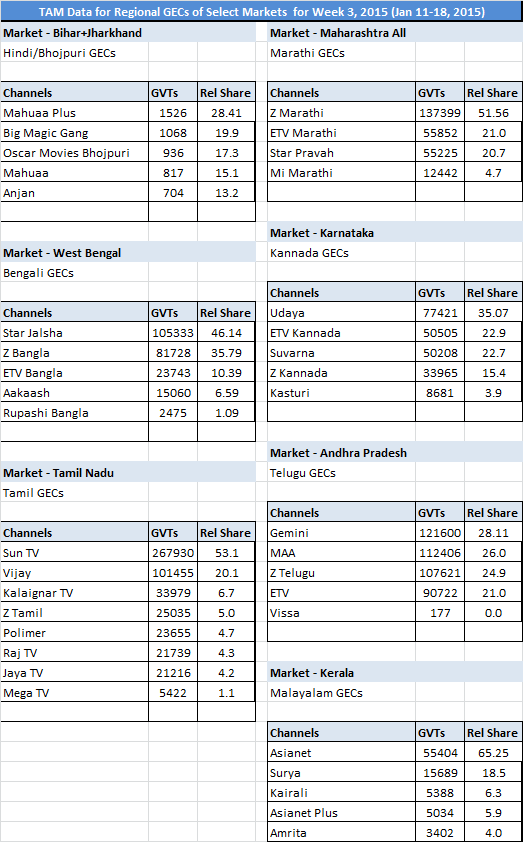
  • TAM numbers for Hindi & Regional Channels in Week ​3​

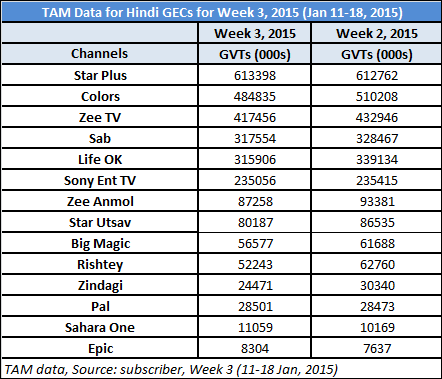
    Namaskaar, Vannakkam, Hello. It’s that TAM, er, time, of the week when we bring you TAM ratings for the key GECs. So here we are presenting you TAM data for various Hindi and regional entertainment channels for ​Week 3 of 2015 (that’s for January 11-18, 2015).


    Note this list is not exhaustive and does not include some key and growing regional markets. Also, as you possibly know, this data is not sourced from TAM. So we’ve sourced it from a friendly subscriber. While we are confident that the numbers are correct, we urge advertisers and our readers in general to verify the data.


  • Farewell, Uncommon Man


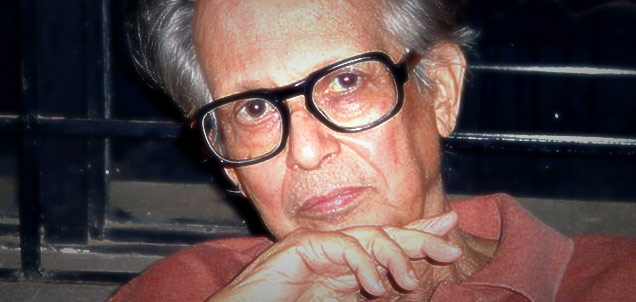
    R.K. Laxman, India’s legendary cartoonist and creator of the Common Man passed away on Monday. Writer and cartoonist Dev Nadkarni, who knew the genius and his wife Kamala closely for several decades, pays this intensely personal tribute


    By Dev Nadkarni


    It has been my good fortune to have known two R K Laxmans: the unspeaking Common Man on Times of India‘s front page, who legions of readers like me adored, and the uncommon man who made me wonder whether he was indeed the creator of the balding, bespectacled, dhoti-clad gent, generating a zillion laughs a day, every day for six decades.


    I was introduced to the first Laxman when I was about 10 years old. My dad, Mohan Nadkarni, was a longtime Times columnist and on one of my visits to the Times with him, we ran into Laxman on the long third floor corridor. Dad and he chatted a bit and then we trooped into his cabin on the far side of the building. It felt great to meet the man who actually drew the cartoon on the Times‘ front page. Sifting through his pile of sketches next to his drawing board, he picked an inked sketch of a street urchin and gifted it to me, which to this day is among my most prized possessions.


    Over the years he knew me as ‘Mohan’s boy’ and seemed quite fond of me stopping by to chat with me if I ran into him while running dad’s errands in the Times building. Then, in 1984, when my first cartoon strip appeared in the Sunday Magazine of the Indian Express, I asked my father if I should mention it to Laxman. He hesitatingly assented. A few days later I was in the building again, saw Laxman and showed him a copy of my first published work. He looked at it for all of five seconds, handed it back, said nothing and went his way. That was my brief introduction to the second Laxman. We never discussed my cartoons ever again. Neither did he like to say anything about any other cartoonist’s work.


    In 1987, when, as part of the Festival of India, some 10 Indian cartoonists were invited to exhibit their work at the Bande Dessinee festival in Switzerland, he declined to join our contingent. Because of my acquaintance with him, I was asked to persuade him but he had made up his mind. So we had Mario Miranda, Sudhir Dar (Hindustan Times), Ram Waeerkar (Amar Chitra Katha/Tinkle), noted freelance cartoonist Vins (Vijay N Seth), a few others and me, but India’s greatest wasn’t there. We were hard put to explain the show’s visitors why his work wasn’t there.


    My associates in the business of communications and media knew about our friendship. I was therefore able to drum up quite a few lucrative special assignments for Laxman, including a diary for a leadinginternational bank and a calendar for a major Indian IT outfit, besides many smaller assignments like traffic and law and order education booklets for Mumbai Police. It was also great to have facilitated his meeting with over 1000 adoring software professionals of my friend Anand Deshpande’s company, Persistent Systems, in Pune. My encounters with Laxman grew few and far between over a number of years until my family moved to Pune.


    Pune days

    One weekend, as we strolled through our quiet, leafy street, Laxman spotted me and called out. We knew the Laxmans had a flat somewhere hereabouts but had no idea that it was a mere stone’s throw away, just about 50 metres from where we lived. We clambered up to his commodious flat and were warmly welcomed by his ever-affable wife Kamala and treated to idlis and some superb filter coffee. He told me he was contemplating living and working in Pune and that the Times was setting up some scanning equipment so that he could send his cartoons electronically.


    We were delighted to have him live so close by. Our meetings grew more regular – the couple would visit us and we would visit them. On many evenings he would insist I join him for his customary regimen of Black Label. He would simply call and say, “Come over for a drink.” I’ve lost count how many Johnny Walkers we’ve downed between us. He would often invite me to walks around the area, which were almost always interrupted by wide-eyed fans and autograph-seekers.


    We talked of many things – his love of black, why he liked to paint crows, his favourite comic strips, illustrators and artists, his huge collection of twigs and stones, his fascination for Lord Ganesha’s iconography even though he openly claimed to be an atheist, at least in those days. He also told me why he refused excellent offers to work in the UK, how he went about planning his cartoon for the next day and so much more. He related fascinating personal anecdotes of his travels around the world and his encounters with famous people – from the Shankaracharya to Indira Gandhi.


    Someday, perhaps soon, I’ll put them to paper. But I can see it will be a rather long piece…


    The uncommon creator of the common man that I came to know better was typically brooding and critical. There hardly was any humour in most of our conversations, though there was the odd joke or funny gesture. It made me wonder if this was indeed the man who would produce a rip-roaring comment with an economy of brush strokes and a less-is-more approach to captioning, the next day. But then again, maybe that sullenness was actually the fuel that propelled his creative genius to produce such incredible work: Drawing his ‘You Said It’ daily pocket cartoon was like trying to “fill your tummy now by thinking of yesterday’s meal,” he once said.


    On the morning of my fortieth birthday, Laxman and Kamala turned up at our home quite unexpectedly with a box of sweets for our girls (he didn’t know it was my birthday). We were to host a party that night and had a few friends over, helping out. Laxman asked what the preparations were all about. The couple wished me, had a cup of coffee and left. Later that day, Laxman came back with a most gorgeous drawing of Ganesh as a birthday gift to me. “Specially for you, my friend,” he said. That framed masterpiece has had pride of place in all the homes I have lived in since.


    Over the past decade, I met Laxman only a few times – whenever I visited Pune. His health declined steadily. Then, a stroke paralysed him and took away his speech. His last years have been spent quite like his unspeaking common man who indeed has immortalised him. He would speak in gestures, lovingly interpreted by Kamala. When it was possible, he would write what he wanted to say. He mainly stayed at home, confined to a wheelchair but every evening, a longtime faithful friend took him on a drive around parts of Pune for about an hour. Visiting a Ganesha temple was part of the routine.


    I last met him just over a month ago in December 2014. I told him about dad’s passing. He remembered they were of the same age, he gestured (dad was a year younger). He then insisted I join him on his evening ride (I had to reschedule an appointment, which I am so glad I did). We visited a Ganesha temple in Aundh. An attendant brought forth a red hibiscus, which Laxman touched and was then placed at the feet of the God of Creativity. The rest of the trip was spent in silence, my left hand gripping his right forearm. I glanced at him as we passed by the statue of his Common Man at the Symbiosis Institute Complex on Senapati Bapat Road. He didn’t seem to notice.


    Back home, we sat around for a while as Kamala chatted with the unending stream of evening visitors. Not long after that, I said my final goodbye. It felt like the final flourish with which the great master crossed the ‘x’ in his ‘Laxman’ signature before handing in the picture that would launch a million laughs the next morning.


    R I P, Laxman.


    Dev Nadkarni has been in the media industry for 30 years and has worked as writer, journalist, editor, cartoonist, teacher and communications consultant in the development, corporate and IT sectors.


    Currently, Dev heads communications and stakeholder relationships functions at a regional economic development agency working with 14 countries. Born and raised in Mumbai, he now lives with this family in Auckland, New Zealand.


    In his earlier years in India, he was a cartoonist and created a couple of popular cartoon strips, ‘Fekuchand Garibdas’ in the Indian Express and Mid-Day and “Doldrumms Limited” in the Economic Times. He was also an Associate Editor at Amar Chitra Katha and Tinkle magazines.
     

  • Zee gets author Rashmi Bansal to curate book based on ‘Ummeed’ stories

    By A Correspondent


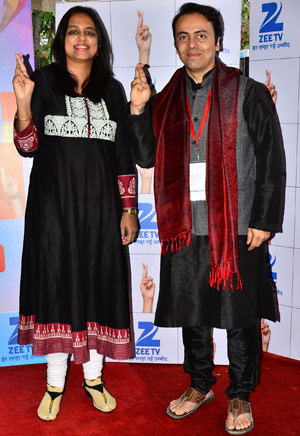
    Ms. Rashmi Bansal & Mr. Pradeep Hejmadi, Zee TV Business Head, announcing first of its kind crowd sourced book on Ummeed

    Zee TV recently announced an evolution in its core proposition to ‘HarLamhaNayiUmmeed’– a line that captures the beauty of re-discovering a new ray of hope with every moment of life. The channel, with its rich programming content that resonates with this proposition, has emerged as a beacon of hope to millions of viewers over the years. Apart from setting inspiring examples for the masses through the journeys of its strong, resilient fiction show protagonists and lending a national platform for celebrating the common man’s talent through its non-fiction formats, Zee TV’s endeavors of spreading hope have extended beyond the realms of just television content – the most recent case being ‘Hum Hai … Ummeed-e-Kashmir’ where the channel, along with its philanthropy partners, organized star-studded charity concerts to raise funds and provide shelters for the rehabilitation of flood-afflicted citizens of Jammu & Kashmir, Assam & Vishakhapatnam. As an interesting extension of its constant mission of spreading Ummeed, Zee TV recently invited its viewers to share their personal ummeed stories – real life accounts of their journeys of hope, successes and triumphs over any daunting obstacles and challenges life posed them with.


    The channel has received a good response and some very intriguing and inspiring stories of tiding over trials with the power of hope. Zee TV believes that the country has a lot to benefit from reading about these motivating accounts of Ummeed and plans to bring them to the masses in a book specially written and curated by author Rashmi Bansal — a writer, entrepreneur and a youth expert with six best-selling books on entrepreneurship, each of which have sold more than 1 million copies and been translated in 10 languages. She is also one of India’s most sought-after motivational speakers. Her books – be it I Have a Dream, Poor Little Rich Slum, Follow Every Rainbow, Take Me Home or Arise Awake, have captured the journeys of enterprising women, students, slum-dwellers and small-town entrepreneurs.


    Every single Ummeed entry shared by Zee TV’s viewers will be showcased on the channel’s official website, 10 entries per week will be featured on air through astons on Zee TV, the top 25 will make their way into the special book being curated by Rashmi Bansal while perhaps a select handful of the best stories will go on to inspire Zee TV’s upcoming shows.


    In an announcement of the book launch made at the Jaipur Literature Festival, the channel’s Business Head Pradeep Hejmadi said, “Zee TV has and will always stand for Ummeed. It is its articulation that will change to reflect the changing times. So, as we recently evolved our core proposition to HarLamhaNayiUmmeed, making it even more relevant to our viewers’ daily lives, we set out in search of inspiration. We called out to our own viewers to share their most moving, motivating accounts of triumphs and victories – stories where they held on to Ummeed and stayed afloat, tiding over tribulations and challenges, only to emerge winners. We’ve received an overwhelming response with thousands of people writing in with diverse subjects and issues. These are stories waiting to be told, as they have the potential to inspire. With Rashmi having made a significant contribution towards encouraging India’s youth, shaping careers and fostering entrepreneurial spirit, we are pleased to partner with her in bringing alive some of these most impressive crowd-sourced stories of Ummeed. Rashmi will curate and author a special book for Zee TV that will tell each of these truly inspiring Ummeed stories in the way only she can!”


  • State funeral for Laxman. Prez, VP, Prime Minister condole passing

    President Pranab Mukherjee has condoled the passing away of eminent cartoonist RK Laxman.


    In his message, the President has said, “I am extremely saddened to learn about the passing away of Shri R.K. Laxman.


    I feel personal loss because I was both an avid follower and subject of his cartoons. India will miss the genius who made the common man into a national icon. He conveyed important social messages using humour as a tool and reminded the public that people in authority are fallible and human.


    Honoured by the government with a Padma Vibhushan, Shri Laxman was a conscience keeper to the nation through his cartoons. His death leaves a void in the world of creativity and social commentary which will be difficult to fill”.


    The Vice President of India M. Hamid Ansari has also condoled the death. In his condolence message, he has said that Laxman, best known as the creator of the “common man” touched the lives of millions of our countrymen by his incisive humour  and  socially relevant messages expressed through his immensely popular cartoons. He has conveyed his heartfelt condolences to the bereaved family.


    “I am deeply saddened at the passing away of Shri R. K. Laxman, the most eminent cartoonist of our country in recent times. Laxman, best known as the creator of the “common man” touched the lives of millions of our countrymen by his incisive humour  and  socially relevant messages expressed through his immensely popular cartoons. I convey my heartfelt condolences to the bereaved family. I pray to the Almighty to give them strength and fortitude to bear with their loss.”


    Prime Minister Narendra Modi has condoled the demise of Eminent Cartoonist RK Laxman.


    “India will miss you RK Laxman. We are grateful to you for adding the much needed humour in our lives and always bringing smiles on our faces.


    My condolences to the family and countless well-wishers of a legend whose demise leaves a major void in our lives. RIP RK Laxman”, the Prime Minister said.


    Meanwhile, the Maharashtra government has announced a state funeral for Mr Laxman.


  • Dentsu Webchutney unveils #HappyHourRewind concept

    By A Correspondent


    Dentsu Webchutney Innovation Labs has launched a campaign that gives the category of Happy Hours a much needed twist. Launched at Turquoise Cottage, a youngsters frequented pub, #HappyHoursRewind allowed people to, simply, turn back time. With a quick tweet, they could rewind the clock and make sure that happy hours never ended.


    “Hundreds of bars all over the world run the same old schemes of extending Happy Hours, which begs the question – what does a bar have to do to stand out?” said Gurbaksh Singh, Chief Creative Technologist, Dentsu Webchutney Innovation Labs.


    Elucidating on the campaign he said, “The aim was to infuse freshness into the concept of ‘Happy Hours’ through technology.  For this idea, we experimented with an old school analogue clock, and integrated it with the digital sphere through twitter. We hacked into the clock and engineered it to move anti-clockwise when specific tweets were sent, giving us a way to rewind time.”


    This innovative campaign received more than 250 tweets in a single night, and resulted in Happy Hours going on till midnight even though the clock still showed 9pm!


    The installation was set up in Turquoise Cottage and patrons were invited between 7pm – 9 pm to tweet with their views on ‘Why happy hours shouldn’t end’ using hashtag #Happyhoursrewind.


    This is a pilot campaign that was undertaken at Saket outlet and will be replicated at other locations too, shortly.


  • BCCI extends deadline for IPL media rights bidding to Feb 10

    By Ravi Teja Sharma


    Potential bidders for the IPL media rights will get a week more to decipher the Indian cricket board’s well-crafted doosra in the form of new terms.


    The BCCI on Tuesday announced that it has extended the deadline to submit bids for IPL media rights to February 10.


    The board recently invited bids for media rights for the 2015-2017 editions of the cricket tournament. But in contrast to terms in the previous bidding round in 2011, it excluded the lucrative television and digital rights for the UK, US and Africa and also audio rights, which will be offered separately.


    Media planners and broadcasting executives say this is likely to drive down bid value since the US, UK and Middle East together account for anywhere between 60-70% of Indians who watch the game outside the country.


    The rights offered by the BCCI this time include Internet and mobile rights for the Indian subcontinent and exclusive television, Internet, mobile and audio rights for the rest of the world, excluding the Middle East, Africa, Europe and the US. Segregating it further, Internet rights for the Middle East have been kept non-exclusive while mobile rights in the region are exclusive. “This takes away a large chunk of money,” said a top executive with a broadcaster, not wanting to be named.


    Viewers in the US and UK are high-value consumers and these territories are valuable in terms of rights for anyone who bids, he said.


    A media planner said these territories accounted for close to 50% of the total bid value in 2011.


    Internet and mobile rights for the Indian subcontinent, however, are likely to be valued higher this time because Internet and mobile coverage has risen over the past four years. “From a monetisation perspective, the bet will be on improved advertising revenues from (Internet) streaming,” said the media planner.


    “However, mobile revenues which are usually earned by partnering with telecom companies have declined in value as the VAS ecosystem has not done as well.” Times Internet Ltd, part of the Times of India group, had paid just over Rs 260 crore in 2011 for IPL rights that covered mobile, radio and Internet along with TV rights for certain territories for 2011-2014.


    According to industry sources, the likely bidders for these rights are Star India, Sony, Times Internet and Zee group. TV rights for the Indian subcontinent are held by SET Max till 2017.


    Source:The Economic Times

    Copyright © 2015, Bennett, Coleman & Co. Ltd. All Rights Reserved

    Licensed to republish


  • Zee World launches in South Africa

    By A Correspondent


    Zee Entertainment Enterprises Limited (ZEEL) announced the launch of a new television channel, Zee World, at a glittering event in Johannesburg. The channel aims to offer its viewers an extra-ordinary world of entertainment, and will be the first-of-its-kind to showcase television series, Bollywood movies, reality shows and more action packed content. Zee World is a GEC and is the first offering from ZEEL for mainstream viewers in Africa.


    Subhash Chandra

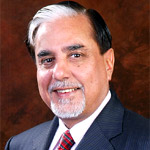
    “The corporate positioning of ‘Vasudhaiva Kutumbakam’ meaning ‘The world is my family’ is the driving force that enables us to bring authentic and entertaining content to global audiences, with a vision to reach a billion viewers by 2020,” said Essel Group & ZEEL Chairman, Dr. Subhash Chandra.


    Zee World is a customized channel experience for mainstream audiences in Africa and will be available from February 03, 2015 on DSTV channel 166. All content that will be aired has undergone extensive research and customization including editing and dubbing with most of the channel’s content dubbed in South Africa using local talent.


  • Growth prospects for Indian Media in 2015

    Base: All respondents, Source: Nielsen Primary survey, 2014


    By Umesh Jha and Dharnidhar Bapat


    As far as the media industry in India is concerned, the landscape is going to witness a lot of changes in the area of content offering.The changes are likely to be driven by the expansion of TV content viewership measurement and consumer evolution with respect tomedia content access. Increasing penetration of smart phones,Internet and social media contribute to media content access beyond traditional media vehicles, resulting in opportunities for broadcasters,publishers and brands to experiment with content as well as marketing.


    There are three major trends foreseeable in the near future besides several other smaller yet significant ones.


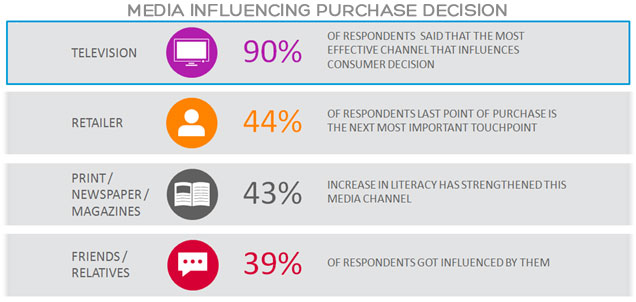
    First, there is an anticipation of the new measurement system which is expected to roll out in the near future. The new measurement system is expected to cover smaller towns (LC1) and rural areas. Moreover, the system is also attempting to measure content consumption beyond TV sets, ie on other screens such as mobile, tablets, laptops, personal computers (PCs) etc, making it possible for even niche content genres to get a big pie of the advertising spend. Therefore, to meet the diverse content needs across consumer segments, broadcasters are experimenting with different topics, newer channels and distribution of content on digital platforms.A lot of broadcasters and producers of content are looking to understand the rural consumer in a bid to widen outreach, and the expectation from the new measurement system is that it will facilitate that. A research conducted by Nielsen helps understand the rural consumption patterns, in which television emerges as the most effective channel in influencing purchase. The target group for this study was NCCS AB, farmers and non-farmers (50-50) across 4 states (AP, Gujarat, Punjab and Maharashtra).


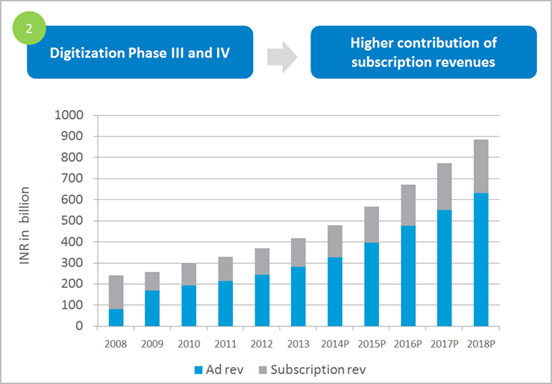
    The second big trend we foresee is the Phase III and IV OF Digitisation. The sheer numbers are staggering, with a total of140 million Set Top Boxes (STBs) required to complete the final phases of digitisation across India. Of these, according to industry sources, about 110 million would be needed by the cable industry, and 30 million by Direct to Home (DTH)* services. In anticipation of this development, DTH operators are keen to understand key choice drivers of broader and newer audiences. Broadcasters see a higher share of subscription and are working out their pricing strategiesin order to boost bottomlines. With digitisation, contribution of subscription revenue to the total revenue is expected to increase from 67% in 2013 to 71% in 2018. Digitisation should also lead to a drop in carriage fees significantly. (As per FICCI Frames 2014).


    *Industry Estimates


    However, a fallout of digitisation can be that broadcasters may choose to go a-la-carte, and lead to standoffs between TV networks and cable distributors. However, given the significant role played by channel packages, it is unlikely that mass channels would take the a-la-carte route.


    The third major trend is the shift in video content consumption. While the web widens across the nation, rural internet and smartphone incidence is shooting up. In a trend driven by an increasingly young demographic, videos are being viewed on the move, and on far more compact screens than the traditional television. This trend presents a fantastic opportunity for broadcastersto mobilise digital advertising revenues. Figures already show thatdigital media advertising in India grew by 38.7% in 2013, faster thanany other ad category, and digital ad spends accounted for 8.3% ofthe total ad spends of Rs 362.5 billion in India in 2013 (As per FICCI- Frames 2014). Though digital adspends have grown, broadcasters have failed to monetise the full potential of their content viewership on the digital medium.


    A paradigm shift in content consumption is expected. Controlon content distribution in digital media, viewer profiling and customisation of content specific to this medium are some avenues to boost revenue.


    The 2014 Budget proposed a Phase III licensing for radio expansion to 294 cities and 839 private channels.


    The possibility of permission for news content on radio has the potential to reach a far bigger audience with deeper involvement and time commitment by consumers towards radio.


    EXPECTATIONS FOR THE MEDIA INDUSTRY IN 2015

    The industry is on tenterhooks as far as the implementation of some old promises are concerned. With the current government looking conducive to progress and coming out in support of a digital and connected India, the media industry hopes for some sweeping changes to facilitate a boom.


    1. Implementation of the long delayed phase III rollout of the broadcast expansion for private FM channels will help expand the market for the radio sector.

    2. The industry had demanded 49% FDI in news media as opposed to the current 26%. The government is currently mulling over industry views on 100% FDI in news media.

    3. 12 minutes per hour advertisement cap by the Telecom Regulatory Authority of India (TRAI) is another issue that industry expects to be resolved urgently – currently the Delhi High Court has put a stay on this order.

    4. There is a need for simplification of the framework of taxes in the media industry.


    In conclusion, 2015 promises to pack in all the excitement of an entertainment blockbuster and change the game for good. Changes are expected across the two broad areas of context and content. In terms of context, the new measurement system and digitisation will push broadcasters and DTH service providers to focus on consumption patterns among smaller markets and rural India. In terms of content, genre experimentation and cross-platform integration are expected to define the coming year.


    Umesh Jha is Director and Dharnidhar Bahat is Associate Director, Nilesen India. Pubished with permission of Nielsen India.


  • Rajan Srinivasan, others launch content marketplace

    By A Correspondent


    Former IBNLive CEO Rajan Srinivasan along with Moneycontrol.com VP Sales Mahip Singh have teamed with a bunch of tech brains from the Indian Institute of Technology to launch a unique content market proposition with Spiral Content Solutions and their offering called Scatter, billed as India’s first content marketplace – “Scatter.”


    In its current avatar, Scatter addresses three stakeholders: marketers, content publishers and digital consumers.  Says Mr Srinivasan who is designated CEO of Spiral Content:  “Content engagement is clearly multi-layered and Scatter currently addresses just one of these layers. It helps brands connect with consumers on the back of superlative content which consumers want to read and know more about”


    Unlike a pure trade based market place, Scatter adds intelligent layers for the marketers to ensure that they are constantly able to access relevant and potential conversation points. The platform took around nine months to build out and this effort was led by their CTO Pratik Poddar, who found this an interesting problem to work on. Adds Mr Poddar: “Scatter makes sure that the marketer never falls short of things to say. The platform addresses brand attributes, consumer passion points, a great editorial calendar tool and a real time opportunity to plug into LIVE conversations. Our efforts will always be focused on making Scatter a compelling tool in the marketers arsenal”


    Says Spiral Content COO Mahip Singh: “We have received an overwhelming response from the publisher community. Scatter allowed publishers an opportunity to resurface their content and today it boasts of more than 80 publishers of Indian and International repute. We create opportunities for publishers and marketers to come together to service the needs of brands seeking to engage better with their customers.”


    Scatter has already been launched and is working closely with leading publishers, bloggers and other content generators, informs Mr Srinivasan.


  • Blue Lotus Communications strengthens leadership team

    By A Correspondent


    Blue Lotus Communications has strengthened its leadership team by getting Amitesh Banerjee as Senior Vice President and Rahul Lakhpati as Vice President.


    Amitesh is a communications professional with 30 years of multi-country experience including stints as Head of Communications in the Seychelles Marketing Board, Associate Director Strategy & Market Development with Perfect Relations, General Manager – Comma Consulting, Managing Partner West – Genesis Burson-Marsteller and Vice President-Adfactors.


    Rahul has a cumulative experience of over 14 years comprising PR and journalism and has serviced clients across various sectors and domains. Some clients he has worked on include Volkswagen, Western Union, Suzlon Energy, Raymond, Citibank, Hyundai Motors, Mahindra Group to name just a few.


    N. Chandramouli, CEO – Blue Lotus Communications, averred, “2015 has been good for us with many account wins in the beginning of this year with the environment positivity converting into substantial retainer business. Strengthening of our leadership team is a key step towards consolidation and growth.”


  • Social Media Week to focus on ‘Upwardly Mobile – The rise of the connected class’

    By A Correspondent


    Bangalore will host the fourth edition of Social Media Week (SMW) in India with the theme being Upwardly Mobile: The Rise of The Connected Class. Multiple sessions through the week will explore the dynamic ways of how social media strategy is converging in multicultural market and how mobility devices like laptops, tablets and smartphones along with social technology have transformed the way we work.


    The international festival is hosted twice a year, in India, by R SQUARE Consulting, an integrated marketing services firm.


    The five-day event will bring together brands, agencies, influencers, practitioners, academic thinkers, entrepreneurs, public officials, celebrities and international experts, who will provide a blend of information and ideas through panel discussions, debates, master classes and more. Some interesting events in this edition of SMW include the Social Media Strategy Challenge, ‘App’athon, Tweetathon and Blogging Challenge. SMW’15 February edition is scheduled simultaneously across the world in seven cities– Bangalore, Copenhagen, Hamburg, Jakarta, Lagos, Milan and New York.


    Speaking on the initiative, P. Krishnakumar, Executive Director & General Manager, Consumer & Small Business, Dell India said, “The marketplace today constitutes of a dynamic set of consumers who are constantly evolving the manner in which they engage with brands and with each other. Social media has been one of the pillars of this evolution and Dell has embraced it as a key medium for outreach to keep in step with them. A consumer brand must recognize the value in being able to reach out to its audience in the manner that they prefer to connect.. We believe that SMW is a platform which explores the dynamic nature of social media. We also see it as the right platform to demonstrate that technological innovation is imperative in this context; and that a successful experience comprises of both the right technology as well as the right medium.”


    Rohit Varma, Founder R SQUARE Consulting & Director Social Media Week Bangalore said, “The aim of SMW 2015 is to understand how technology will impact the way we Live, Work and Create in a connected world and also how new ideas, innovations and technology will change our lives. The change is happening quite fast and platform like Social Media Week becomes very important to discuss, understand and implement social strategies for the connected class.”


    Globally, 30,000 people came together to be a part of this mega event which was held simultaneously in 11 cities. With 2500 speakers and more than 1000 events, the festival reached out to 555 million people in 2014. This edition of SMW Bangalore will have 60+ events with a league of eminent speakers both national and international joining. Attendee registration will commence at the beginning of February, 2015.