Category: MEDIA

  • Prashanth Challapalli exits Jack in the Box

    By A Correspondent


    Prashanth Challapalli

    Jack in the Box has announced the quitting of Prashanth Challapalli, Business Head, Jack in the Box Worldwide & Executive Vice President (Digital), 120 Media Collective.


    Mr Challapalli was instrumental in setting up Jack in the Box as the content-for-brands arm of Bang Bang Films, which evolved into the digital agency brand of The 120 Media Collective. Adds a communique: “As the Founding Employee of Jack in the Box, Challapalli led its growth from startup to one of South Asia’s most respected and heavily awarded digital agency brands. Additionally, he oversaw the development and setup of video content production capabilities; fashion media brand, STRUT120 and other digitally rooted initiatives at The 120 Media Collective.”


    Roopak Saluja

    Roopak Saluja, Founder & Chief Executive Officer, The 120 Media Collective says, “Jack in the Box is what it is today thanks to Prashanth and the passion he put into building the brand. Our trajectory from hereon will be a testament to the foundation he built since 2009. That aside, his support and partnership to me has been of paramount importance in transforming what was just a commercials production company into a multi-platform content creator strongly rooted in film and digital capabilities. His next company has no idea how lucky they’ve gotten in getting him to join them. I wish him unlimited success ahead.”


    On his move, Mr Challapalli said, “It has been a fantastic experience building Jack in the Box and the other verticals within The 120 Media Collective. The people, the awards, the brands are some of the best in the industry.”


    Prior to joining Jack in the Box, he was Associate Vice President, Publicis Ambience. In earlier assignments, Mr Challapalli has been with Dentsu, Bates, Rediffusion Y&R, Lowe and Ogilvy.


    According to the company release, announcements on next steps at Jack in the Box Worldwide and The 120 Media Collective will be made public over the next few days. In the interim, Abhishek Razdan, Head of Business Management, will run things at JITB reporting directly to Mr Saluja.


  • IAA Webinar with Julie Roehm, Chief Storyteller, SAP


    The International Advertising Association (India Chapter) hosted its fourth webinar under the ‘World Goes Digital’ series. Julie Roehm, Chief Storyteller, SAP was the guest who joined in from New York.


    The IAA Webinar series is spearheaded by Abhishek Karnani and director, Free Press Journal group and Manish Advani, head – marketing and public relations, Mahindra Special Services Group as co-chairs. *


    The panellists included:  Ashish Mehra (Mahindra Holidays), Abhishek Karnani (Free Press Journal group), Manish Advani, (Mahindra Special Services Group), Gaurav Mendiratta (Sociosquare), Pradyuman Maheshwari, Editor-in-chief and CEO, MxMIndia moderated the discussion:


    We know that storytelling is all about emotions and while you are an organization that’s essentially into technology, one doesn’t really need emotions because there’s technology that does it for you, right? How do you get the two to work for you?

    I think it’s interesting you said that because you know where my background is concerned I have been with SAP for 20 months and before coming here I had my own consulting business and had worked with companies like Wal-Mart, Chrysler, Ford…and as you may have gathered none of that resume included big technology software companies. I came here because Bill McDermott – who is going to be our CEO starting May of next year – had found me by reading something about me at some point of time and we had a dialogue for multiple years and he had asked me to come to work for SAP doing what I really like doing. I think to your point he also is a man who obviously has an interest in the success of SAP and has also been a technology executive himself. So he saw the need to bridge the fact that we are a technology company but sometimes big technology companies are seen as cold and very process oriented and therefore to try and be more human in approach. So when we came one of the big terms that we track and we try to fulfill is to humanize the brand because we believe that with this world the technology, maybe unlike 20 years ago, wasn’t something like a cool and slick kind of thing and nice to have in the background. Technology is pervasive in all our lives whether you work in a technology company or whether you are housewife you use technology everyday; you count on it and it is a part of the fabric of our lives. So to not to be able to connect that human element even in the big business scale that’s what technology enables companies to do. For example, we think about procurement and how it helps them to source products better. Okay, there is not a lot of humanization in that but if you go deeper then maybe there is because if you care about where you source your product from and who is it on the other end that is making that product then there might be a human story there and may make you think more about how technology improves the lives of employees every day. I mean think about the technology in the cloud that we are deploying all over the world where for example, you think of an HR person who is using it to help with the talent recruitment… So we know all, particularly the fact that you are all sitting in India with brilliant minds and the fact that we are very short of having bright strategic technologists to work in these high-tech companies. So the war on talent is big. Certainly money is the big thing but it’s not the only thing and technology can help us do that. So there is a lot of emotion that is available to us to connect and I’ve always believed that people who are trained in technologies and they always like to talk about that but everybody has a greater kinship and a feeling of connection; when you can connect something to a story or something that touches them personally. Those are the kinds of stories I think that will help us use this humanizing idea and get us to that next level by opening the doors maybe to the other industries and even to other types of businesses. People who have used our technology in the past understand that we actually do have solutions that’s going to help them in their positions too.


    What we have been trying to do essentially is look at storytelling by way of soaking in experiences as shared by the users. From the surveys that we conduct, we found out that customers were calling our call centres to share their experiences about the holidays and similar such sentiments. It was an incredible feeling because I’ve never heard customers actually talk to a tele-marketing executive or customer service representative that our holiday was fantastic; all they spoke about was individual moments during their holiday that made them elated. My question to you is whether you can share experiences on similar lines from your end and reference it against what we have experienced till date.

    Yes most certainly, I am not surprised at all. We see this all the time. It’s probably more expected in the travel & lodging and the entertainment world where one expects to hear great stories because if you go on a holiday you hope there is a good story that comes out of it and the fact that there isn’t always a place to communicate that unless people are tweeting or putting pictures on social platforms. We see the same thing in our business and maybe our challenge is even greater than what you are speaking of and that’s why we try to talk less about the actual technology itself and more about the experience and the impact. There are a couple of things that we have done and also that we are about to do – ideas that would be useful to you to think about. We’ve created an app for iPad that is called Customer Journey. It opens up on a series of stories. The reason we call it a customer journey is because it is the voice of our customer and in your case the traveler, but maybe it’s an opportunity for you to put across various entities or hotels or whatever to be able to capture some of the stories that people tell them and put them on here so that people like a little bit of trip advice or any of that third-party apps that are out there. One of the things we are in progress of doing is we are trying to create a movement, which I know is a very lofty goal, but it’s a movement around the idea that I mentioned about our first app which is to make the world better and improve people’s lives. Well, to run better means a lot to a lot of different people so what we are trying to do now is looking at creating our own social space through “Run better”. For instance in New York the fashion week is coming soon and we are thinking of capturing people talking about how fashion impacts their lives. Now you would be thinking what does it have to do with SAP? Well for Levi’s, especially for women who walk away with low self esteem because a certain pair didn’t fit in right, we have created a technology that helps them to image a women and tell which Levi’s jeans is gonna be best for them. We are talking about filming two girls chatting outside the dressing room where you can tell that they are trying to un-jean themselves by looking under their feet, under the curtain and then they come out and their faces are glowing because they’ve found this great pair of jeans and they feel so good about themselves. So when people feel so good about themselves they have energy or an aura that is very contagious to the people who they run into. So if we can capture that in other people’s movement by saying what does “run better” world look like to you it may have nothing to do with us in the long run but we can be associated with making the world better.


    I think today the social aspect is probably our most powerful tool and I would say it’s the same for you in the entertainment and the travel industry as well where it is about creating places where you empower not only your customer to be able to put their stories up but also your employees in all those hotels, restaurants etc. And I think the more angles you can have at a story out of personal experiences the more impactful it will be.


    How do you develop a talent pool of people with a right skill for storytelling? And in the era of ROI, how do you convince management and owners to invest in storytelling?

    From a talent perspective and something which I find interesting is that the team which started on customer storytelling was new – it’s not that people weren’t telling stories but to have an organization focus on that was new. What was interesting in that was what comes out from the woodwork of people who have a passion for telling stories whether it’s through writing or verbally or creating video or you know whatever method they use…it’s actually easier to find talent than you think. That said, once people get the notion that this is an option for them and that there is a commitment to this you will find a lot of people who actually have more of a talent face for it than you might have thought existed especially in a technology-oriented company. Secondarily, we set up storytelling training last year in as simple a way as possible. I did a five-step approach to storytelling which we did through a presentation. It is always easy to do five steps because to train people has to be a story in itself so it was like who was the customer, tell me a little bit about what they do, what is the problem or opportunity that they have…then the third step is how can technology help them either tackle their problem or realize their vision. Four, what kind of an impact does it have or they are hoping it has on their company and five, what is the impact it has on their customers? So if you can give a very prescribed list that is very simple, very logical to anybody out there to be able to capture that. What I did then is when we started to actually roll out these stories and when I was teaching my own team, I would have them follow that and then they would come back and read it to me. So I would say okay, if I am reading it or you are reading it to me and when I read it it reads like a Harvard Business case to me. Nothing wrong with the Harvard Business school mention, but it’s not necessarily highly consumable for everybody. It feels like I am in class and I got to read for school versus it’s a piece that I am reading in my favorite magazine or website that I am enjoying. So there a way to write and I really teach my team how to be more casual in language in writing these kinds of stories because otherwise it would become very professional. So that training has been super successful and was started last year; this year we mandated for all of our Marketing team. So there are 1600 people in Marketing at SAP so all those people are going to be trained in it. It’s a simple training just 30 minutes but when we know our marketing force understands what it means to tell a story or capture a story we know that we definitely are making a difference.


    How do you ensure all customer-facing departments within SAP walk their talk presented through storytelling to all their stake-holders?

    Well, it’s like 365,000 people so I am not magic but I think the best way to be able to do it is through word of mouth. First of all, none of this would event successful if our CEO at the time wasn’t committed to this. I mean he wanted to do this and in fact now he is pushing me very hard to give him stories from customer’s perspective. So instead of filming the CEO, COO you have Suzy who uses this out on the street and you need to have commitment from the top for anything like this to work. Secondarily, the training that we have implemented is like one group at a time and what we has also done is we ork closely with our head of Sales, Rob Enslin who also believes in capturing these stories. It’s like being introduced to a whole new way of doing things. So being able to talk to my customers about a handful of other customers who are in a like industry or a like situation and wow that’s really impactful and I really need to get more of that. So when we talk to our head of sales we share what we are trying to do and they were able to input tons of things that were helpful     to them when they are meeting with customers. More importantly, they also give us feedback that allows us to constantly grow and optimize what we are delivering. I think they are finding that now that they have tried it out it’s a much easier way to be able to talk about what we do.


    How does the art of storytelling change with demographics and culture?

    When we get pushed back in terms of whether our customers are willing to share their stories or be video-taped, it’s usually less because of cultural issue and more because of the fear that if they talk about what they do it somehow gives away their intellectual property. But from a cultural standpoint, you certainly have to take that into consideration but with the social world, even though people don’t want to have a picture of themselves there are other pictures that they can put to express themselves…to express who they are without actually having a image of them. So I think, more the choice that you give people to be creative on their own the more you can overcome some of the cultural barriers. Sometimes it’s cultural – country culture and sometimes its personal culture. Some people just don’t feel comfortable in any walk of life; it doesn’t matter where they live. They are just more introvert but if you give them an outlet to express themselves in a way that’s more comfortable to them I think what you will find is they do it so. So for me the moniker is choice…you have to give them choice…you know film yourself, take images, words whatever it is. We need to create interesting platforms where people can engage. There are lots of ways to generate engagement and I think the engagement component is lot more important even if not everybody is willing to jump on and create something for themselves.


    Very broadly, are there any other industries where storytelling works very well and where it doesn’t?

    Well you are talking to a purist so I don’t think there isn’t a place where it doesn’t work. I think the only time it doesn’t work is when it hasn’t been tried or done well so that would be my answer to that. When I give a talk on storytelling there are two examples that are relatively modern that I use. One is Google. You think about Google and you say well, it’s search. You may probably think I use Google all the time but it’s interesting to storytell. There is a beautiful video on youtube that is basically shot from a perspective of a father whom you cannot see but what you see is him putting something on search and then finding images and you hear him talking where he is writing an email to his daughter who is young. It basically chronicles her key moments in life like her first house using Google maps…then the day when she lost a tooth and such things…It’s all kinds of things using different Google tools but it never feels like a Google commercial because you are so involved with this man writing this touching email to his daughter that he is preserving for her. I find that it is great and I am really impressed with their storytelling because they have done a really nice job of telling their story from their perspective.


    Do you think that the government in India can use this technique to talk about what they are doing and communicate with the masses? For instance, do you think President Obama could have adopted the storytelling approach in the election year in the US?

    Yes I think he did that. I think how Obama uses it is to some extent to tell their personal story. I just find that at least in the US the political actions are so scripted that it lacks true feeling and I think that’s why people run towards Michelle Obama or the kid because they come across to us as being more authentic because when they speak as long as you are not behind the podium they are not typically as scripted as Barack Obama is. He has got lot of things that people have to say but Michelle to some extent comes across as much more national figure. When she goes on TV shows and when she talks about the clothes and the like it creates a very human personal connection and she does it better than he does it not because he can’t but I think “the handlers” believe it’s too great a risk because they put themselves out to be attacked on whatever personal things that they would share. So yes, I do think it would be a much better opportunity but I have low expectations that they will do it.


  • &pictures also acquires Besharam, Ghanchakkar & Zanjeer!

    By A Correspondent


    Soon after the report on MxMIndia that Zee Entertainment Enterprises Ltd has acquired the much-awaited Shah Rukh Khan film ‘Chennai Express’ for its proposed channel &pictures, ZEEL has now announced some more new films for the soon-to-be-launched channel.


    It has got the Ranbir Kapoor-starrer ‘Besharam’ produced by Reliance Entertainment, the Priyanka Chopra- and Ram Charan-starrer ‘Zanjeer’ and UTV’s Vidya Balan–Emraan Hashmi-starrer ‘Ghanchakkar’, &pictures is being billed as India’s first interactive movie channel


  • Shailesh Kapoor: India-Zimbabwe: As Dull As It Gets

    By Shailesh Kapoor


    In my almost 30 years of cricket following, this week has been a new low. India is playing a five-match ODI series in Zimbabwe. Out of sheer habit, I tried sampling one of the games. Within seconds, I was out of it. Dead grounds, players going through the motions and commentators from the B-league… There was nothing on offer at all.


    I have written a few months back on ‘Too Much Cricket’ and how pointless cricket creates that perception. But here, the question is even larger. It makes one wonder: Who funds this cricket? And whether indeed any such cricket can ever make money?


    In our IPL advertising equity research Ormax Trac20, we found that only about 20 brands managed to attract viewer attention over the course of the 45-day tournament, out of the 200+ brands that associated with IPL or its franchises in various ways. The 2011 World Cup was not very different, where about a dozen brands controlled 80% of the recall share.


    So, even in the most high-profile, high-interest tournaments, only the big sponsors and innovators stand out. Why should any advertiser, besides at best the title sponsor (that too arguable), buy onto an India-Zimbabwe series, by paying rates that would be at significantly higher CPRPs than most other genres?


    And if indeed no one should, why should such a series be held in the first place? If it were to promote cricket in Zimbabwe, an India A team would have been a good idea too.


    This brings me to the larger question of media bias, where media choices of several brands are influenced by individual perceptions. I know of brands who would like to be on cricket, because certain senior executives, including the CEO at times, “feels” cricket is the right choice for them. And if they can’t afford the IPL or an India-Pak series, they settle for whatever comes their way.


    In an interesting case a few years ago, I heard about a CMO who bought into cricket series and then planned an extensive travel itinerary for himself, so that he can give out the Man of the Match awards. This, while his new product launch, which was being advertised in the series, should have taken his time and attention at the marketing office.


    I wonder if CMOs sometimes buy into such properties to make their CVs more attractive. “Spearheaded the launch of the new handset through the title sponsorship of an India-Sri Lanka series” sounds more attractive than “Delivered the most cost-efficient TV campaign in the mobile phones category in 2012-13”. Maybe not!


    In another case, a sales executive at a channel (not a GEC) managed to sign a 30 lac sponsorship deal for a reality show by luring the MD of the brand to be the “Chief Guest” in the season finale, where he will give out the cheque to the winner, and speak about the brand. The MD spoke for about three minutes, and all of that had to be retained in the actual show.


    Even as the big agencies continue to grapple with larger questions related to measuring advertising effectiveness that goes beyond just CPRP benchmarking, we have a universe of ad hoc advertisers providing us enough entertainment on the sidelines.


    Come to think of it, if you watch the fifth India-Zimbabwe ODI tomorrow like you watch a B-grade film that’s so bad, it’s good, you may end up having a good time anyway!

    Shailesh Kapoor is founder and CEO of media insights firm Ormax Media. He spent nine years in the television industry before turning entrepreneur. The views expressed here are his own. He can be reached at his Twitter handle @shaileshkapoor


  • 1 Minute View: Is anyone interested in India-Zimbabwe cricket?

    Yes, that’s the question which we’ve been asking ourselves ever since Virat Kohli and team left Indian shores last fortnight. India has won the series, but other than help identify the weaklings as it’s clear that those who are consistently poor in Zimbabwe do not deserve a place against stiffer opposition, the series has served no major purpose for the channel, the advertisers, the viewing public and our cricketers.


    Coicincidentally our columnist Shailesh Kapoor has also written on the same issue, and we would strongly recommend a good read of his column.


    We reproduce excerpts from the column


    So, even in the most high-profile, high-interest tournaments, only the big sponsors and innovators stand out. Why should any advertiser, besides at best the title sponsor (that too arguable), buy onto an India-Zimbabwe series, by paying rates that would be at significantly higher CPRPs than most other genres?

    And if indeed no one should, why should such a series be held in the first place? If it were to promote cricket in Zimbabwe, an India A team would have been a good idea too.

    This brings me to the larger question of media bias, where media choices of several brands are influenced by individual perceptions. I know of brands who would like to be on cricket, because certain senior executives, including the CEO at times, “feels” cricket is the right choice for them. And if they can’t afford the IPL or an India-Pak series, they settle for whatever comes their way…

    Even as the big agencies continue to grapple with larger questions related to measuring advertising effectiveness that goes beyond just CPRP benchmarking, we have a universe of ad hoc advertisers providing us enough entertainment on the sidelines.


    Read the full column here: http://www.mxmindia.com/2013/08/shailesh-kapoor-india-zimbabwe-as-dull-as-it-gets/


  • Colors gets act together for Bigg Boss Season 7 with Salman Khan as host

    By A Correspondent


    Over the last six years, Bigg Boss has earned the reputation of being Indian television’s biggest reality show. It’s the most controversial and creates a buzz like no other TV programme, is huge in terms of scale and resources deployed and there is an effort made to raise the bar every year.


    Leading general entertainment channel Colors has announced Season 7 of Bigg Boss, unveiling a glimpse of what is in store with Salman Khan as host yet again.


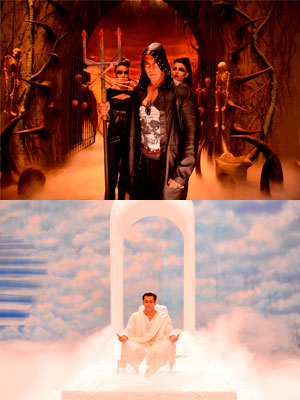
    The concept planned is of ‘Heaven or Hell’ with the megastar seen in the guise of an angel personifying the pleasures of heaven, as well as in the garb of a devil, representing the negative world of hell.


    Speaking on the promos, Rajesh Iyer, Marketing Head, Colors said: “The message is simple – pleasure or pain, both are inevitable and there is nothing to be taken for granted this season.”


    The television campaign has been created by Orchard Advertising in association with Prashant Issar of Tubelight Films. It comprises a series of creatives with fun stories enacted by Salman on the theme of the show this season.  Said Hemant Kumar Sivan, Executive Creative Director, Orchard Advertising on the effort: “We worked with the simple truth of life that, Heaven and Hell are of man’s own making. It all depends on how one deals with what life has to offer.”


    To add to the fun element, the promo lines have been improvised by Salman himself as he says ‘By God’ in his inimitable style


    There have been rumours of the actor being paid Rs 5 crore per episode, but sources close to the channel say that the actual amount is not even close to that figure. Industry sources suggest the amount is more in the region of a crore and each episode will be shot live on Friday. But what if Salman is indicted in the 2002 Mumbai car accident case (popularly referred to as the hit-and-run case, but Salman and his family strongly contest the reference saying he did not run away)? The actor’s camp is hopeful that he will not be indicted.


    The format stays the same with 14 strangers in the house over 90 days and captured by 70 cameras in the Bigg Boss house.


  • Marathi telefilms on Star Pravah Premiere

    By A Correspondent


    Marathi GEC Star Pravah announced the launch of ‘Star Pravah Premiere’ last week with televised versions of new and original short stories with feature film-like production quality. The first of these was aired last night (Sunday, August 4).


    Said Shrabani Deodhar, Creative Director – Star Pravah, on the occasion: “Short stories is a new format for us and we are looking at working with subjects that are not easily adaptable to a serial format. We will try and present a fresh and new aspect to relationships in every story that will be showcased under the Star Pravah Premiere initiative.”


  • P V Narayanamoorthy joins OOH analytics firm Proof of Performance Data Services

    Media agency veteran P V Narayanamoorthy has been appointed Director at Proof of Performance Data Services (PoP), leading out-of-home analytics firm. Mr Narayanamoorthy will spearhead the technology-based analytics platform which PoP has created for measurement methodology and accountability in the outdoor media business.   He will be advise advertisers on outdoor spends and how efficacy can be maintained and enhanced in outdoor media utilization.


    Mr Narayanamoorthy has already conceptualized and implemented a metric called ‘The Visibility Index’ for PoP provides vital info on “hitherto untracked metrics like visibility distance and time for which a particular asset is visible”, notes a communique.


    Speaking on the occasion, Harjaap Singh Mann, Founder CEO and Managing Director, PoP said “Mr Moorthy is  considered an institution in the media planning space and his prowess is unparalleled and universally acknowledged by peers. We are sure it would be a new chapter of success for POP and are glad that he has joined us in our endeavor to revolutionize the OOH industry.”


    In his career spanning more than 35 years in media and advertising, Narayanamoorthy has worked with several advertising agencies including Clarion Advertising, Ogilvy Benson & Mather, RK Swamy, Ulka Advertising and McCann Erickson. His last assignment was with Carat where he worked across the Asia Pacific region spanning 13 countries. He was a member of the regional board with responsibility for new business, strategy, tool development, training and research.


  • Guest column: Building brands through regimens

    By Ashita Sarin


    I was at the supermarket on a recent weekend, replenishing some of my skin care products when I came across products to cleanse, exfoliate, and scrub, moisture as well as serums, pore refiners, and masks. These were sold in a range with specific instructions to use them in sequential order of 1, 2 and 3.


    This got me thinking about the phenomenon of regimen. There has been an influx of products in the market, which seemed to be packaged as a combination deal, which will then provide optimum results.


    Regimen speaks to an outcome that is in fact tangible, but only if the process is followed or as defined, regulated. It helps one get positive results, quite a motivator, indeed.


    How has this come about?

    Quite simply it is owing to enhanced disposable income. Based on this marketers have invested in product development and launched products that cater to these “new needs. They get to package a number of products with the promise of greater efficiency if used in combination. L’Oreal, Estee Lauder, Kiehls, Clinique are just some of the  brands that boast a cleanser, a serum and a moisturizer to be used in combination to get the desired results of beautiful, glowing skin.


    Increased media exposure reinforces the focus on “glowing, flawless, youthful appearance” and consumers have a keen interest in additional products that will deliver. One cold cream doesn’t suffice. The consumer has access to and wants more for “perpetual youth”. Yesteryear’s cream has been replaced with serum, lotion, and sunscreen, and pore minimize or radiance boosters.


    Amongst categories wherein regimen is more prevalent, skin care pops up as a top runner.
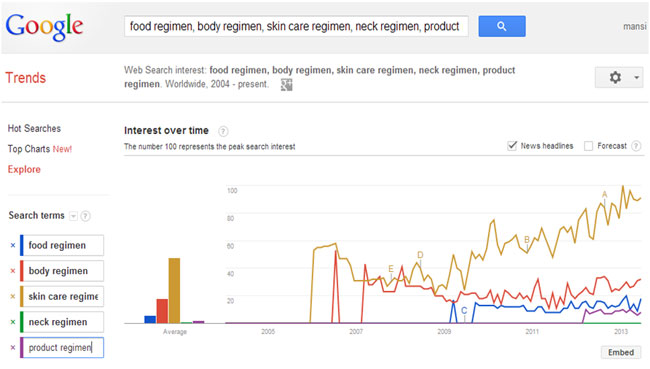


    The study above shows that the online search is highest with regard to the skin care category.


    There is an influx of products and brands for hair and skin care. Brands like Garnier, Vaseline, Nivea Olay, Lakme, Sunsilk, L’Oreal have all infiltrated the market with regimen based product lines.


    With skin care as opposed to body care, the “visibility” factor is high hence willingness to invest is much higher.


    The space is now occupied with products that promise to cleanse, tone, exfoliate, hydrate, protect, moisturize,


    The primary focus is on anti aging care. The Indian consumer is not only aware of more than a cold cream, but she is concentrating on safeguarding her youth. Serums, creams, lotions and capsules together promise to arrest the clock.


    So what makes this promise believable? Why are women willing to believe that not one but a combination of six (somewhat expensive) products will give them the glow, radiance and plumpness associated with youth?


    A combination of high research molecules, naturals, exotic ingredients, high advertising expenditure and brand credibility elevates believability. Cosmetic companies spend millions every year on product research and marketing.


    Regimen based products do a few things very well.  They create a combination platform. It is difficult to be informed enough to chose one part from a brand and another from a different brand. This creates a preconceived platform in the consumers mind in terms of efficacy and the need to purchase all products to get the desired effect. Anti aging range from brands such as Ponds, Garnier, Olay, Kiehls, Body Shop all communicate the need for products to work in tandem,


    These products also carry tangible cues such as additives like amino acids, retinol, hyaluronic acid, sirutin technology, RX technology, antioxidants, more organic like narcissus, lavender, primrose oil, rose essence etc all of which are either patented or awaiting patenting. These terms lead consumers to believe that the regimen recommended products do in fact have the right ingredients to come together and create paramount benefits.



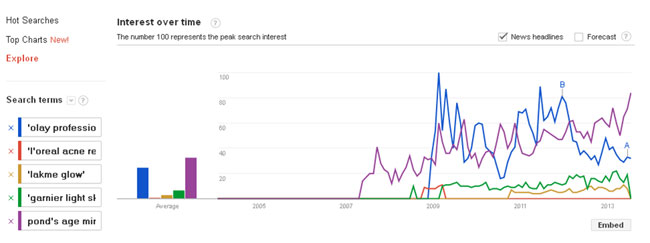
    Brands in India that have created a niche for themselves in the anti ageing regimen range are Olay and Ponds Age Miracle. Studies below show, that in terms of awareness as well as brand penetration, these two brands and their product lines are well received.


    So what are they doing differently to the other players in the market? Consistency and an established frequency of communication across media ensure that consumers get the same message at all times. The benefits attached to a regimen where step 1, 2 and 3 contribute to an overarching effect not achieved by any one product but all recommended is what helps create a convincing platform for consumers.


    But this has to be based in something deeper, something more in tune with who we are as human beings. Do we like regimen because we like order? As children we are taught – when to wash, brush, bathe, drink milk, go to school, do homework, play, go to bed, etc. Regimen seems to be established at an early age. Is the stage for 1, 2, 3 set very early in life and is this something that marketers are cashing in on?


    Would this move into other categories like oral care? Could we establish principles for brush, floss, gargle, whiten, brighten and create different products for these functions? Or even for fabric care. Detergent, softener, dryer sheets, black, stain remover.


    I guess it depends on product research that will establish a sequence for optimum benefit and then plug into our desire for regimen.


    For now I’m warding off old age, with my 1, 2, 3 step skin routine.


    Ashita Sarin, Senior GM – Marketing at DY Works

     

  • 1 Minute View: Reaching adults via kids

    There’s no rocket science to it. You can reach people best in the places they cohabit. Or patronize. Like parents do with kiddie channels. They are on it because of their children, and they are on it because the channels help transport them to their younger days. They are also on it because some of the content is excellent.


    Whether it’s the toons on Cartoon Network, the adventures on Discovery and Nat Geo, the wild stuff on Animal Planet, Chhota Bheem on Pogo,  Disney, Hungama etc etc, parents don’t mind watching the content. And even if they won’t admit it, they are often hooked to the programming.


    So we weren’t surprised to learn that some big-name advertisers are putting their monies on the children’s channels. And this isn’t because the kids are decision-makers (well, many of them are), but it’s because their folks watch the shows.


    Three cheers to that!


    PS: Starting tomorrow, and until further notice, we will be carrying the 1 Minute View in our Daily Digest or ‘AM Newsletter’. Look out for it there!


  • Now Steve Marcopoto to step down at Turner

    By A Correspondent


    Steve Marcopoto

    It’s almost like one of those cartoon films where big cats keep jumping out from the barrel at frequent intervals. Turner International has announced one more major exit, and this is concerning the big man himself. Yes, Steve Marcopoto has announced he will step down as President and Managing Director, Turner International Asia Pacific at the end of his contract in December 2013. He’s not going away immediately though as he will stay on as a Senior Advisor to Turner International President Gerhard Zeiler to ensure a seamless transition and provide continuity on current new initiatives. The succession will be announced in due course.


    Said Gerhard Zeiler, President Turner Broadcasting System International: “I thank Steve for his outstanding achievements in his 15 years with Turner Broadcasting. Steve has guided Turner Asia Pacific through a period of rapid change.”


    Steve Marcopoto added: “Turner is poised for a great run and now is the best moment for the company to put a fresh set of hands in charge. It feels right to initiate the handover now as I complete 15 years in this job, and I intend to hand over Turner Asia Pacific to my successor in an optimal state.”


  • Bloomberg TV India back with Havas

    By A Correspondent


    Sriram Kilambi

    Havas Media India has won back the media mandate of Bloomberg TV India. For a short while the account was with Aegis Media’s Vizeum India.


    “Bloomberg TV India is all about catering to the elite key decision makers. Havas has demonstrated expertise in using media innovatively and we look forward to a great new relationship,” said Sriram Kilambi, President, Bloomberg TV India in a statement.


    Anita Nayyar

    “It is wonderful to renew ties with Bloomberg TV India. We are closely tuned in to their brand philosophy and keen growth path. Our meaningful brands framework is perfectly suited and will increasingly be applied to create connections to further enable Bloomberg TV India to talk to their audience on this trajectory”, said Anita Nayyar, CEO Havas Media Group, India & South Asia.


    Mohit Joshi

    “We are glad Bloomberg TV India thought us the correct people to partner with for their future plans. It is an interesting product and they are good people to work with; it is wonderful to have them back,” added Mohit Joshi, Havas Media Managing Director.