Category: MEDIA

  • HomeShop18 appoints Vikrant Khanna as CMO

    By A Correspondent


    Vikrant Khanna

    HomeShop18, the ecommerce and homeshopping TV channel network of the Network18 group, has announced the appointment of Vikrant Khanna as Chief Marketing Officer for its TV, Web and Mobile business. In his new assignment with HomeShop18, Mr Khanna will lead a 360-degree role which includes marketing and communication, CRM, B2B Sales and Alliances.


    Mr Khanna has a 19 years’ experience in marketing and business roles across FMCG, Telecom, IT and Paints. He has worked with brands like Airtel, Dabur India, General Mills and ICI Paints. At Airtel he was the VP Consumer Engagement and Digital, where he was involved with award winning campaigns such as the “Har Friend Zaroori” across integrated platforms and also India’s first Grand Prix – 2011 Formula 1 sponsorship.


    On the appointment, Sundeep Malhotra, Founder and CEO, HomeShop18 said: “We are glad to have Vikrant head our marketing team. He brings years of rich experience in Business & Marketing roles across various industries. Vikrant will work towards building stronger consumer orientation across various touch points, shape a solid consumer franchise and take HomeShop18 brand to newer heights.”


  • Max goes 360-degree for Aashiqui 2

    By A Correspondent


    It appears to be the time when movie channels are going big on promoting the films they are airing.


    Max from the MSM/Sony stable has deployed a 360-degree marketing campaign for Aashiqui 2 that’s set to be aired on July 28. The campaign entails the use of various tools like Television, Print, Outdoor, Digital, DTH and Cinema.


    Said Vaishali Sharma, Marketing Head, Max on the campaign: “We have strategically and creatively used different media effectively to create experiential and interactive opportunities for our audiences. Building on the theme of romance and the music of the film that has captured hearts of millions, we have recreated the magic of Aashiqui 2 across outdoor, digital and on air. We have got the stars of Aashiqui 2 to enhance this experience further, inviting and enticing audiences to be part of the experience on Sony Max.”


    On the social media platform, the Sony Max Facebook page has a daily love tip for all its followers where fans get advise on their love life. It has created a special ‘Aashiqui 2 Lovemeter’ which calculates the love quotient between you and your partner. A contest called ‘Aashiqui 2 Moments Contest’ where Facebook fans can upload their best romantic pictures. Shortlisted pictures will be showcased in the end credits of the premiere.


    On July 26, Aashiqui 2 roadblock videos is set to greet all Youtube viewers. A contest will also happen where audiences would be asked questions related to the movie. Lucky winners will meet Aditya Roy Kapoor and Shraddha Kapoor.


    With outdoor, a movie poster will be installed on a rotator at various major drive-heavy roads of Mumbai. A hoarding outside National College in Bandra will be covered with real roses which has to plucked by spectators revealing the Aashiqui 2 poster.


    Then there’s the musical bus stand which will play live music from the movie for the benefit of commuters.


  • Epic gears up for August launch, appoints iContract, Madison, MSLGroup & Jack in the Box

    By A Correspondent


    Epic, the proposed Hindi entertainment channel that will offer content centered on Indian history, mythology and folklore, is gearing up for launch next month subject to regulatory approvals. And in order to do that, it has collaborated with specialized creative and communication agencies to initiate a comprehensive launch campaign.


    IContract, a part of Contract Advertising and the WPP Group, has been appointed to manage the creative and brand building duties for the channel; while Madison Media has been assigned the media buying and planning mandate.


    MSLGroup will be been handling the channel’s public relations, while Jack in the Box Worldwide, the content-for-brands arm of Bang Bang Films, has been selected to manage all digital communication for Epic.


    The decision comes after a month-long process of agency pitches for each of the mandates. Commenting on these partnerships, Business Head Aparna Pandey  said “Epic is a differentiated channel that will present meaningful entertainment against an innovative backdrop. Therefore, we were searching for partners who would exemplify fresh and enlightening approach in ideas and thought process. There was so much of creativity in all the agencies we met; however our selected partners had something different to offer, which appealed to all of us at EPIC. We are confident that our brand will be portrayed exactly like we perceive it, with the help and support of our partner agencies”


    Rana Barua

    On the assignment, Rana Barua, COO, Contract India said: “I am excited that the management of Epic Television Networks has entrusted iContract with their trust and faith in launching the channel in the country. iContract is one of our key offerings which merges the world of Digital, Experiential and Mainline with powerful and effective media neutral ideas and am confident that the launch will be successful”.


    Said Vanita Keswani, COO, Madison Media Sigma: “We are delighted to be helping India’s first digital channel with their launch strategy in the dynamic digitizing cable TV scenario and we are looking forward to a long and mutually beneficial relationship”.


    Vanita Keswani

    Speaking on the win, Prashanth Challapalli, Business Head, Jack in the Box said, ” India has a rich history and the possibilities of telling these stories in the digital medium is really exciting. Our mandate is to create awareness and more importantly relevance for the brand in the online space”.


  • Hathway ties up with D-Link to offer routers

    By A Correspondent


    Hathway Broadband Internet has tied up with D‐Link to offer wi‐fi routers bundled in the market under the “Wi‐Fi Broadband Homes” initiative.


    All existing and new customers of Hathway Broadband across the country can avail this offer and convert their wired homes into “Wi‐Fi Broadband Homes ” with speed of upto 15mbps.


    The company intends to leverage on its robust Hybrid Fibre Coaxial (HFC) network to deliver a superior connectivity to its users.


    “Consumer broadband usage has shifted to concurrent multiple wireless device consumption at homen” said Mr Jagdish Kumar, Managing Director & CEO, Hathway Cable & Datacom Ltd.


    Said Tushar Sighat CEO D‐Link (India) Limited: “With the mydlink cloud router on the offering we are confident to bring alive a never-before secured Wi‐Fi broadband experience ”


    Kunal Ramteke

    “A typical modern family by using the Wi‐Fi Broadband Home solution at home can save upto Rs. 500 per month,” said Kunal Ramteke, Business Head, Hathway Broadband.


    Hathway will not charge any one time fee or monthly rentals for the Wi‐Fi device. D‐Link Wi‐Fi router will be given to the customers at zero cost. However customers would be charged a nominal fully refundable security deposit, a communiqué notes.


  • Oh boy! How the entire British media went ballistic about the royal arrival


    Ranjona Banerji, who was in England to cover the Wimbledon tennis championship and a short holiday thereafter (which explains a few misses of her column on Tuesdays and Fridays), has been witnessing all the frenzy about the birth in the British royal family. Here’s her despatch:


    After days of reporters baking in the hot sun and features editors tearing their hair out, the “royal baby” finally conceded to arrive at 4.24 pm after 10 hours of labour but it was announced to the public only at 8.30 pm. In the meantime, a series of inane and nonsensical stories have been put out, which included statements like this from Sky News online: “Former Midwife Clare Byam-Cook told Sky News: “The Duke and Duchess will be as excited as any other new parents”.”

    Meanwhile, according to The Guardian, reporters started interviewing each other in desperation.


    But once the announcement was made, the news media was finally given something to go on. Unfortunately for television, the nature of the beast means banal speculation is foisted on viewers. Lots of expert commentators who know nothing share their expertise. The parents will be happy, tired, overwhelmed, the baby will have a name, the baby will behave like other babies and here are some other babies… which last bit of news is usually the first sign of giving up.


    Since I have nothing to tell about the baby you want to know about, I shall now tell you about the baby you are not remotely interested in. For Sky News, it was baby Henry who was born 20 minutes before “Baby Cambridge”.The funniest scene on Sky News was when the main anchor Eamonn Holmes almost choked on his early morning breakfast when a “parenting expert” talking about how a nursing mother’s breasts can feel like cabbages!


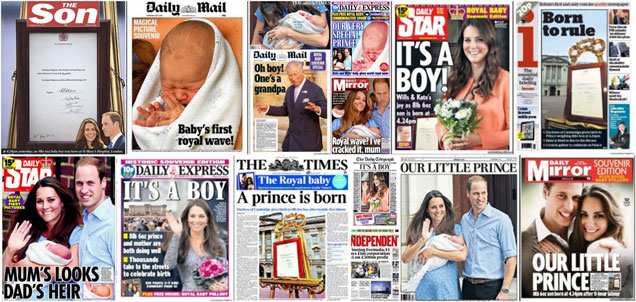
    Newspapers in Great Britain put a lot of thought into their headlines. The Sun wins this one, changing its masthead to “The Son”. The Daily Telegraph, Star and Daily Express got stuck with “It’s a boy”. The Daily Mirror went with “Our little prince”. The London Times was gracious with “Welcome to the world”. The Daily Mail focused on the first in line to the British throne with a picture of Prince Charles and the headline “Oh boy. One’s a grandpa”.


    The Guardian was profoundly portentous with “A birth a boy, a prince, a king”. The Independent headlined with British prime minister David Cameron’s war on child pornography on the internet but had flyer saying “Special delivery”. The Financial Times had the baby as its lead picture captioned, “Royal arrival”.


    The i, the very successful tabloid version of the Independent went with a grand “Born to Rule” while the free tabloid Metro just said, “Oh boy!”.


    The biggest news spins for the media will now be the name (bookies are betting on George), when the parents will show themselves, which royal will visit first and so on. The newspapers told the public that the baby was born four hours before the announcement but even till Tuesday morning, TV channels were going with the time of 8.30 pm. Somehow, that equation between TV and print never changes!


    **


    The only thing competing for space with the royal arrival is the British weather. After weeks of baking hot sun, the island finally saw some rain. The connections with the birth have not yet been made but perhaps one only has to wait!


  • Vijay Mukhi: Are Narendra Modi’s Twitter followers fake? And what about Shashi Tharoor’s?

    By Vijay Mukhi


    The best job on the planet is being a columnist on Politics and Technology, because no one in this space  talks sense or hard facts and numbers. Breaking news everyday is about Narendra Modi’s Twitter followers being fake, but no one is offering any credible evidence on either side of the debate, fake or real. So, before I throw my hat in the ring and get egg all over me (which is all in days work for me) let me tell you that I believe in the maxim Trust but Verify so before you cast the first stone, please download all the data that I have gathered from Twitter from my website www.vijaymukhis.com. We are also comparing only Narendra Modi and Shashi Tharoor as the other politicians are pygmies on Twitter compared to these two giants.


    Modi, today,  has 19,34,170 followers on Twitter compared to Tharoor who has  18,42,046,  a lead of just under a lakh. Modi and Tharoor share  447,920 followers in common which is around 25% of their followers , Modi and Kiran Bedi share 408,401 followers and Modi also shares 2,98,005 followers with Arvind Kejriwal. Thus, we can safely conclude that there are about 4 lakh people on Twitter who just like following politicians from India — why, we have no answer. This leaves Modi with a maximum of 15 lakh fake followers as fake followers would not share politicians from different groupings.


    How do we define a fake follower? Simple answer, someone who does not tweet. Modi has 6,77,296 followers who have never ever tweeted. Now imagine, why would someone join Twitter and not tweet at all! This is very extremely damning and conclusive evidence, we need no judge or jury to convict that these have to be fake followers. Thus if 35% of Modi followers have to be fake, what more evidence do you need! But, do not open the bubbly to celebrate, Tharoor has only 5,23,843 followers who also have never ever tweeted , which make up 28% of his followers. Can we thus draw a line in sand that says that if up to 28% of your followers have never ever tweeted then it is okay but any percentage above that makes these followers a fake? A more charitable explanation is that there is a silent (in terms on not liking the sound of a keyboard) majority out there on Twitter who do not tweet at all, but simply read tweets. If you take a step further, 12% of Modi and Tharoor’s followers tweeted only once and 7% only tweeted twice. A simply addition tells us that over 46% of Tharoor’s followers and 54% of Modi’s followers do not like to tweet or cannot tweet for various reasons. We need to accept that not everyone likes putting pen to paper even though we have to write less than 140 characters.


    The best evidence of popularity or influence on Twitter is how many people follow you. About 4,85,077 or 25% or a quarter of Mod’s followers have 0 people following them. Aha, this nails Modi finally and this is enough  proof that these followers are fake! The obvious answer is that if you do not tweet then obviously no one will follow you and for Tharoor the number is 2,61,883 or 14%. The percentage of the number of followers who have only 1 or 2 followers following their tweets, sort of remains the same. Thus like sending tweets , we have a whole community of users on Twitter who are so important that nobody follows what they do. Twitter Orphans can well be a new addition to the English language, what say?
    The obvious conclusion is that about half your followers would be inert or inactive or to use the TV analogy, coach potatoes who would surf from politician to politician.

    One sureshot way of finding out whether your followers are fake is to look at how many followers did you add every day of the year. During the month of July 2013, Modi added on a average around 5000 followers per month and Dr Tharoor about a 1000. For May and June, these numbers were also similar. The only conclusion we can draw here is that Modi’s team is very smart, had they added 50,000 followers on one day, they could be caught in the deserts of Rajasthan. But what if I paid an agency (millions on the web that do this for a small fee) to increase Modi’s followers count by a lakh on a certain day, the media would go ballistic and say that Modi was caught with his hand in the desert sand.


    I agree we are getting nowhere. So let’s look at another metric. When did  your Twitter followers create their account on Twitter or an ageing analysis. A whopping 1,02,385 of Modi followers were born on Twitter in April 2013, 94,874 in June 2013 or better still 502, 918 of his followers are under 180 days old on Twitter or created in the year 2103. For Tharoor, this number for 2013 is only 171,459. For 2012, the equivalent numbers are 595,656 for Modi and for Tharoor 360,540. A non-convincing explanation is that India is the youngest country in the world population wise and therefore all of your followers must represent this trend of being young. More than half of Modi’s followers have joined Twitter nearly a million , in the last 18 months only ,maybe just for him. This is why Twitter should give Modi an award for bringing so many people to Twitter!


    Where Tharoor leaves Modi biting the dust is when it when to the quality of followers, and that also by a factor of 2. We simply added up all the followers of people who follow Tharoor and the number was an astonishing 27,89,94,347 and for Modi it was half that at 10,87,44,125. We have not removed duplicate followers from this list. So theoretically when Tharoor tweets and if all his followers retweet his tweet around 27 crore people would see that tweet. Tharoor followers have tweeted over  52,26,34,885 times but Modi’s followers being newer and weaker are half that at 27,57,99,883. On a average, a Tharoor follower has 150 followers who tweets 282 times and a Modi follower would have only 56 followers and tweets much less at 143. Thus an average Tharoor follower would beat a Modi follower in a virtual fist fight as Tharoor has a long and khandhani history on Twitter.  Maybe and we have no evidence for saying this, but a Modi follower may have more pets (aka puppies) than a Tharoor follower. It a foregone conclusion that Tharoor’s followers are twice as strong as Modi’s followers and no guesses who would win a twitter slugfest, in spite of what conventional wisdom says that Modi’s followers are winning on Twitter.


    OMG, read over 5000 characters ie 35 tweets (my editor decides column length in tweets and not characters)  and yet no conclusion on whether Modi has fake followers or not! So, let’s muddy the waters even more. Go to the Twitter page of a user vijaymukhi712 by typing www.twitter.com/vijaymukhi712. This user bears my name and I have actually tweeted 86 times, a pretty active user one would have to admit, to a fake user under any yardstick. Every day my internet avatar ( not sure of the sex as you will soon see) quotes a love tweet so has his heart in the right place. But if you check further, say the 19th of every month, you will see the same love quote. This user is a creation of a computer program (which is why I cannot determine the sex)  which wakes up at 7 in the morning GMT and depending of the day of the month sends out a tweet. I did not have the time to create a database with 365 tweets. Is this a fake user or a non-human user, a word that will enter the human lexicon very soon. Twitter makes it very easy to create a user that needs no verification and we all tweet using some computer a program written by a programmer. Will there be a way to distinguish between a fake user from a machine-created one? May be and a big may be in my next life!


    Finally, all fake things must come to an end and so we come to our real conclusion.


    It is in the best (commercial ) interests of the social web to make it very easy to create fake followers as greater the number of Twitter users, the more money Twitter and the rest of its ilk charges for ads. It’s also is in the best interests of the social web that we have no way of determine a fake from a real user. It helps politicians as it make them more important in cyberspace than they really are. I seriously stopped getting women to date me when they realised that my Twitter followers was around 300. We must realise that a large majority of Twitter users will not tweet, they are readers nor writers. If politicians hired the right technology hackers, they will never ever get caught while massing millions of fake followers. Our Internet population will triple from 120 million today to at least 400 million in the next 1000 days thanks to 4G and this problem of fake followers or fake identities or fake tweets or fake anything will never ever be resolved. This emboldens all of us to say what we want about anyone or anything on Twitter and the social web as verification of any type is a miracle and we all know when the last miracle too place.


    My last two bits: Modi’s followers are as genuine or as fake as Tharoor’s followers are. Take your pick by doing the obvious, by tweeting.


     

  • 1 Minute View: Twitter kahin ka!

    Phew! That’s the one-word response we had on reading Vijay Mukhi’s ‘PoliTech’ column today. The information on how many followers that Narendra Modi and Shashi Tharoor have is known to everyone. However, the digging in that Mr Mukhi has done in his analysis is an eye-opener.

     

    The followers of followers, the number of tweets sent by followers, how many followers have joined in the recent past, how long have these followers been on Twitter, etc etc etc.


    It’s also interesting to see the number of common followers that both Messrs Modi and Tharoor have.


    Mind you, it’s not that Mr Mukhi had some special access to data provided by Twitter. It’s information that’s available in the public domain and you just need to know how to dig into it.


    The bottomline is that if you thought Politician X is going to win the forthcoming elections just because he or she has hajaar followers, perish the thought. If you thought Politician Y has a great connect with the youth, perish the thought. What he or she may have is connects with is a slew of human robots whose only job it is to be on Twitter. They could be sitting anywhere in the world and have no real linkage with the election process.


    Yet, there is the Congress which feels the need to deploy much energy and monies to be active in the social media.


    All of this is good news for those who specialize in the craft. And if nothing else, the enthusiasm that our political order has ensures good business for digital and social media players. Cheers to that!


  • Mah Times, Navbharat Times & Ei Samay launch helplines for students

    By A Correspondent


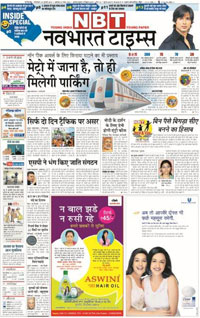
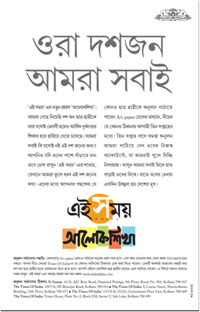
    Three language brands from The Times of India Group -Maharashtra Times, NavBharat Times and Ei Samay – have launched a Readers’ Helpline called ‘MaTaHelpine'(Maharashtra), ‘NBT Help A Star’ (Delhi) and ‘EiSamayAlokshikha’ (Kolkata) respectively. The initiative enables the educational dreams of deserving students from humble backgrounds- by inviting, encouragingand managing monetary contributions from its readers, notes a communique.


    Rahul Kansal

    Explains Rahul Kansal, Executive President, The Times Group. “With a footprint of over 50 lakh premium readers in 14 cities, BCCL Languages have the vision, the scale and the credibility to conceptualize and execute such initiatives. We felt that a differentiated initiative like Readers’ Helpline not only enriches our readers’ lives but is also true to our brand philosophy.”


    Under the initiative, deserving students from Delhi, Kolkata and Maharashtra were selected by the editorial boards of NavBharat Times, Ei Samay and Maharashtra Times on basis of their academic performance and backgrounds.


    Launched in the first week of July for a period of around five weeks, the print ad campaign appeals to readers to support the dreams of these students. An editorial campaign profiles the students – their backgrounds, their potential and aspirations for the future. A special helpline and a microsite have been created where contributors can connect to nominate a particular student. There is no minimum or maximum limit for contributions that are being accepted through cheque payment mode.


    The respective BCCL Language brands will collect the fund for each student and deposit respective amounts into individual FD accounts, free of cost. The students can re-encash the certificates as per their need.


    Interestingly, Maharashtra Times has been conducting Mata Helpine successfully for the past 6 years and has helped scores of students achieve their dreams. Last year alone, the Mata Helpline initiative generated 2.5 crores for the students from its readers. This year, BCCL Languages has extended this popular and noble initiative to its other two language brands (Navbharat Times and Ei Samay).


  • Josy Joseph & Ravish Kumar win Ramnath Goenka Journalists of the Year awards

    By A Correspondent


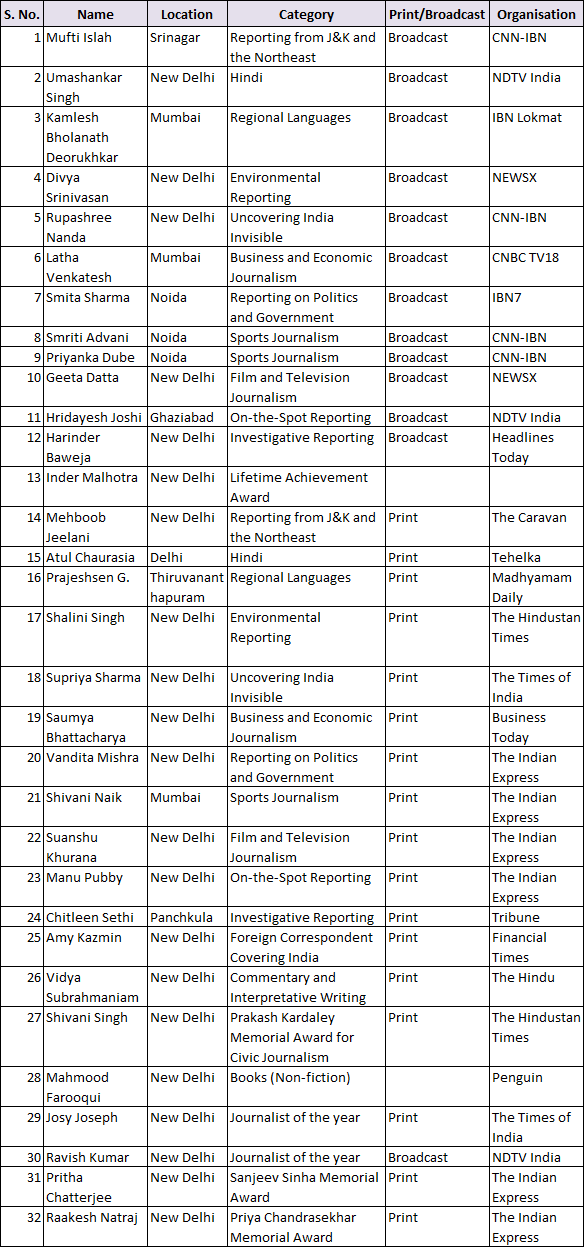
    The sixth Ramnath Goenka Excellence in Journalism Awards were presented on Tuesday (July 23) in New Delhi by Chief Justice of India P Sathasivam. Celebrating excellence, courage and commitment of print and broadcast journalists, the awards acknowledged the outstanding contributions of 29 of the country’s finest journalists.S


    peaking on the occasion, Chief Justice P Sathasivam said “The momentum of journalism is due to two reasons – one, the award is in the name of a kingpin of journalism and two, the prominence of the awards is because of the winners.” A free and strong media is indispensable and journalism “empowers people with information and keeps the democratic process going on,” he added.


    As part of the centenary celebration of its founder Ramnath Goenka, the Express Group instituted the Ramnath Goenka Excellence in Journalism Awards in 2006. The awards stand for the highest standards of accuracy, fairness and ethics in reportage.


    The Journalist of the Year Award for print went to Josy Joseph of The Times of India, for his expose of the Adarsh Housing Society scam, which forced a chief minister out of office and the government to order a probe.  Ravish Kumar of NDTV India won the Journalist of the Year Award for broadcast journalism. His programmes, Ravish Ki Report and Hum Log, stood out for their sensitivity, seriousness and research.


    The awards were given for work done in 2010. The winners were handpicked by a 10-member jury. Comprising: N R Narayana Murthy, Executive Chairman and Founder, Infosys; Deepak Parekh, Chairman of HDFC, N. Chandra, leading civil servant; Dr M S Swaminathan, agricultural scientist and Rajya Sabha MP; Shobhana Bhartia, Vice-Chairperson and Editorial Director, HT Media Limited; Bakul Dholakia, former IIM-A Director; Rama Bijapurkar, leading management consultant; Shyam Benegal, filmmaker; legal luminary Fali S Nariman and Keshub Mahindra, Chairman, Mahindra & Mahindra.


    The Express Group also released ‘The Prize Stories’ on the occasion – featuring stories and reports that won the fifth Ramnath Goenka Excellence in Journalism Awards. The book showcases some of the best journalism on politics, environment and business, sports and films, reports from conflict zones and ‘invisible’ India; stories that helped shape public opinion.


    RAMNATH GOENKA EXCELLENCE IN JOURNALISM AWARDS 2010


  • IBF, AAAI, ISA and TAM reach a consensus. Finally!


    By A Correspondent

    Representatives of advertisers, media agencies, broadcasters and TAM have finally been able to iron out their differences and agreed to agree on an agreement.

    The media and public will now get to know television viewership in thousands, colloquially referred to as TVT. TVT captures and reflects growth in TV audiences in the country in terms of absolute numbers. TVT will be the sole currency in the public domain.

    In addition four-week TVT rolling average will be provided every week. The rolling average is statistically more stable data on viewership, especially for smaller audiences in niche channels, regional languages, English language programs and news.

    For internal evaluation including planning and buying, %TVR weekly will be available to advertisers and advertising agencies.

    The three constituents have also agreed that TAM will make all future audience measurement changes based on inputs from the joint-industry BARC Technical Committee.

    Commenting on the changes IBF President Man Jit Singh said: “We are delighted to have reached this agreement. We believe it is important for the industry, and from the perspective of our social responsibility, we must reflect both the growing television audience and the data in a more stable and useful manner. We want to thank AAAI and ISA in collaborating and working out a solution acceptable to all constituents”.

    “As three concerned constituents, who believe in working together, we have decided to refer all future currency related changes to the BARC technical committee. I’m glad that now we will have an effective guide and monitor for ratings in the country,” said Hemant Bakshi, Chairman of Media Committee and Managing Committee of the Indian Society of Advertiser.

    “Getting weekly TVR% is important for media planners and buyers to effectively plan and buy TV and do mid- plan course corrections and post analysis. We are glad that we have been able to agree that the agencies and advertisers will have access to this data as in the past. From tomorrow, we look forward to being able to focus back on our clients businesses and effective planning and buying for their brands,” said Arvind Sharma, President of the Advertising Agencies Association of India.

    A TAM spokesperson has also issued a statement saying: “TAM is happy to receive a common brief from the three Industry Stakeholders (IBF, ISA and AAAI) and will work very closely with them to ensure its smooth roll out.”

  • Goodbye, GRP. Welcome, TVT!?

    By A Correspondent


    So, reps of advertisers, media agencies, broadcasters plus TAM have finally been able to smoke the peace pipe and agreed to the way forward for the TV audience measurement ratings process currently being administered by TAM.


    This is good news for all of us in the media, because we can finally move on and concentrate on other more meaningful things in life.


    However, it’s critical to interpret the press release that has been issued jointly by the ISA, AAAI, IBF and TAM sent to us by the AAAI secretariat.


    What it basically says it is that it’s going to be business as usual for broadcasters and agencies and advertisers, but for the media and public at large, the data that will come is not in the form of TVRs, TRPs or GRPs or channels shares, but in a new currency called TVT. Short for television viewership in thousands.


    It may be good for one to point out to the powers that be is that the media doesn’t and didn’t manufacture these rating numbers out of thin air. These numbers are given to it (in recent times not by TAM) by broadcasters themselves. Or they are used by broadcasters in their publicity material – in print or electronic media ads or as mailers on various trade portals including MxMIndia.


    We understand that the broadcasters have agreed to not use GRPs for a certain week/period in their information to the media. So at one level we don’t think it’s going to be difficult to figure a week’s numbers given the four-week average numbers, but it’ll be interesting to see how much of this information broadcasters keep to themselves.


    Also, it will be good to see how ratings of individual programmes or shows are communicated to the trade.


    These are interesting times. Perhaps the next time BARC/ ISA/ AAAI/ IBF/ TAM have a meeting on dissemination of ratings numbers, a few reps of the media should also be invited. And, no, it needn’t be anyone from MxMIndia.


    Meanwhile, MxMIndia has just decided to send the journalist working on the Measurement TAMasha for a well-deserved weekend break.


  • Ritu Midha: Of FCT, CPT and data frequency….

    By Ritu Midha


    July is an important month in television advertising. The first TV ad – aired on the WNBT channel in the US in 1941 – was for Bulova, a watchmaker.  The 10-second spot, showing the picture of a clock with a US Map, had a voiceover ‘America runs on Bulova time’.


    That was 73 years back, and the face of television and advertising on it has  seen a complete makeover since. It would be interesting to take note of the changes… some other time though. At the moment, any thought on television advertising immediately brings to mind FCT and measurement, issues the industry is grappling with.


    FCT first: ad time per hour to be precise! While in the US, it is (or was till 2011 – as per the information I could dig out on the web) 15 to 18 minutes per hour, in Europe it is 12 minutes. Australia too averages out to 12 minutes per hour – but interestingly, there it is not about ad minutes per hour, but ad minutes per 24 hours – these can be split as per the requirements.


    In India, the decision is to bring the FCT down to 12 minutes and it is already work in progress with gradual reduction of ad minutes per hour. It, obviously, is a cause of concern for broadcasters. It is anticipated that some of the revenues channels would be made up by the subscription fee. However, for that DAS has to be on schedule, and roll out be completed by December 2014. One does tend to tilt towards broadcasters here – and wish that any decision pertaining to FCT is implemented only after the complete post DAS roll out.


    And then too, why not try out the Australia model, with an upper cap on ad minutes in the prime time? And perhaps, gradually settle at something that works for India, and not necessarily what Britain does!


    As for marketers, they must look at in-programme placements more aggressively – to reach not only a more involved audience, but also not to feel the pinch of changed demand-supply equation commercially, and otherwise.


    The second issue bogging television advertising at the moment is measurement – data frequency on one side (weekly/ monthly/ rolling weekly/ fortnightly) and CPRP vs CPT on the other. Battlelines are drawn with buyers and sellers on either side of fence!


    An argument here is that daily ratings are the way forward, and we should not regress to monthly ones. Just curious, are media plans and buys based on a week’s ratings? Or for that matter, predictions?  The discussion, however, is said to be headed towards a compromise formula – fortnightly, and rolling weekly being the two models flaunted as the best options by many.


    By the way, if marketers are so keen to continue with weekly ratings for perfect planning and buying, why are they hesitant to adopt the CPT model? Wouldn’t cost per thousand help in getting the exact numbers?And is it not what the world is headed towards?


    A totally disjointed thought here, would the reader experience not be enhanced in print too if the number of ad column centimetres in a publication is pre-defined by a Government body – and the publications are disallowed from putting more than a fixed number of ads on every page – including their ‘prime’ pages?


    And, at the moment, is print hoping some spillover from television if its current troubles continue for an extended period of time – many an advertiser would have after all put aside a chunk of their budgets for festive season and elections precursors.


    Ritu Midha is a senior journalist and web strategist based in Mumbai. She is also Consulting Editor and Editor – Special Projects, MxMIndia.


    This column by Ritu Midha was written before the consensus formula between the ISA, IBF and AAAI with TAM was worked out