Category: MEDIA

  • In TAM’s absence, Whats-On-India search rankings show some trends

    By A Correspondent


    It’s been a little over a month since TAM Media Research stopped releasing its weekly ratings following a decision taken jointly by broadcasters, advertisers, advertising agencies and TAM, that the release of the data will be held back until December 19 given that it would take some time for the mandatory digitization process to settle down.


    The general entertainment channels genre would’ve been impacted most as the date of the announcement was the Wednesday when the ratings of the Bigg Boss opening episode were to have come in.


    Given that there is no other body conducting a Peoplemeter-based research in the way TAM does, MxMIndia asked What’s-On-India for a summary of the top programmes as it would at least give an indicator of the what Indians searched for via their EPGs and that India searched for and via a variety of other devices and applications.


    TV TRENDS has been built using specialist and proprietary algorithms that collate, analyze and compute millions of observations across multiple platform. It provides cues and powerful insights on the potential consumption and intention-to-view of content by Indian TV viewers.  The sources from where observations are aggregated include What’s On India platforms like:  Web, Mobile portal, Apps (Android, iPhone, iPad, Blackberry, Windows Mobile, Nokia Ovi), EPG-on-the-Cloud (MobileTV and IPTV).


    Atul Phadnis

    Said Atul Phadnis, CEO, Whats-On-India, “Given our multiple consumer touch-pointsm, we been been able to observe what viewers are searching for on TV. These viewer actions, now cumulating to several million per week, get used to sharpen our search-&-recommendations algorithms. On several requests from the industry to release toplines of these observations, we have started sharing daily and weekly TV-Trends for key genres such as Entertainment, Movies and Sports. The industry reactions to TV Trends have been very enthusiastic with queries and suggestions continuously coming in from industry leaders especially broadcasters.”


    The report gives the Top 5 Programmess of the Week for the following genres:  English Movies, Hindi Movies, English TV Shows, Hindi TV Shows, Regional TV Shows, Regional Movies, Sports and Kids, Documentaries, Lifestyle & Food.


    Let’s look at how the Hindi Entertainment, Hind Movies and English Entertainment genres in the last three weeks.


    Powerpoint source: Whats-On-India

    Note: Number of Airings is the number of times a particular programme was aired/going to air on any Broadcast TV channel in that period


  • Jaldi 5 with Sachin Kalbag: Upholding civil liberties…

    The arrest and eventual release of a young lady living in Palghar in suburban Mumbai thanks to a Facebook post as also her friend who ‘liked’ it sent shockwaves across India’s urban set who happily post their comments on social networks and microblogs. Leading English daily Mid-Day has announced a People’s Freedom Charter in defending the citizen’s right to free speech. MxMIndia interviewed Mid-Day executive editor Sachin Kalbag and asked him on what the paper hopes to achieve with the Charter.


    01. How do propose to ensure your Charter reaches its logical conclusion… as in ensure that students are not found to be on the wrong side of the law for exercising their rights, as stated by you?

    There will be no “conclusion” to this process. This is the first step in a long journey to defend freedom of speech. MiD DAY will, stridently and on a sustained basis, defend the freedom of speech of India’s citizens. It will mean that we give stories pertaining to this issue wide play. Of course, due to constraints of space in the print medium, we cannot be talking only of freedom of speech-related stories, or even all stories pertaining to the topic. But yes, it will be a large focus area.


    2. One of the biggest problems is the interpretation of how any speech or action will affect law and order and the social fabric. Don’t you think that what’s needed is public opinion against age-old laws and getting them changed eventually through the Executive or the Judiciary?

    In a true democracy, freedom of speech must be absolute. It is something we do not have right now because Article 19(2) of the Constitution puts “Reasonable Restrictions” on freedom of speech. Those restrictions are the sovereignty and integrity of India, the security of the State, friendly relations with foreign States, public order, decency or morality or in relation to contempt of court, defamation or incitement to an offence. If you read between the lines, practically anything can constitute as an offence (I calling someone ugly, or, for that matter, saying Sachin Tendulkar is an ordinary batsman). This is where the arbitrariness of “reasonable restrictions” needs to be highlighted. Another example of arbitrary interpretation and application of law is Section 66(A) of the Information Technology (Amendment) Act, 2008. Once again, anything can constitute as “offensive” and I could lodge a complaint with the police against you because I found your email or your Facebook post offensive. This is what we need to be guarding against. As right-minded citizens, we must oppose this arbitrariness. We should stand up against laws that can be used to settle scores or wrongfully applied.


    Through our Freedom Charter, we want to build public opinion in this regard. Ultimately, it is Parliament (the lawmaking body) which will have to debate and pass laws that do leave nothing to arbitrary interpretation. It is a tough challenge, but someone needs to be a catalyst.


    03. It’s been seen that not just the government, but also otherwise well-meaning, educated and well-read individuals do not take very kindly to criticism, especially when it’s on social media (and Twitter)?

    Not taking kindly to criticism is a universal trait. Who wakes up in the morning and says, “Come on, world, criticize me.”? The point is not about criticism, but my freedom as a citizen to speak my mind without any fear. If the person on the receiving side feels that the critic has no basis for what he or she said, the “affected party” can sue the critic for defamation so that the critic can prove whether his allegations are accurate or not. There are these laws that give the affected party a platform for redressal. But we cannot sit on a high horse and say, “No one can criticize me,” or “No one will oppose me because I am the government and I know what is best for the country.”


    04. Your report mentions that the Charter will be the guiding principle in your paper’s reportage. Could you give an example of how this will happen?

    We will ensure in reportage that civil liberties are upheld at all costs. You will see this in all our stories.


    05. This also means that in case of a situation where you or your paper are subjected to criticism, you’ll take it in the right spirit?

    Of course, we will take in the right spirit. We are an irreverent, anti-establishment, ideologically neutral newspaper. No matter what we do, our stories offend someone or the other. We believe that as a responsible newspaper, we will investigate our stories thoroughly, and that we will not carry stories without proper documentation to prove we are right. If in that process someone is offended, so be it. We are ready to defend our stand. And if we are wrong, we shall apologize and take steps to ensure that we do not repeat our mistakes. But at no point in time shall we say that, “We will not carry the story because it will offend someone.”


    Interviewed by Ananya Saha


  • Are we really Free to post online?

    Cartoonist Hemant Morparia’s take on the controversy. First appeared in Mumbai Mirror. Republished with the permission of the cartoonist


    By Ananya Saha


    “Everyday thousands of people die. But the world still moves on. Just due to one politician dead. A natural death. Everyone just goes crazy. They should know. We are resilient by force, not by choice. When was the last time did any one show some respect or even 2 mins silence for Shahid Bhagat Singh, Azad, Sukhdev, or any of the people because of whom we r free living Indians. Respect is earned, not given. N definitely not forced. Today, Mumbai shuts down. (sic)”


    These are the words, posted as her Facebook status, that got a 21-year-old girl arrested. Not only that, her uncle’s hospital was ransacked in protest. If you cannot say ‘what’s on your mind’ on Facebook, and share with your friends, what good is social media? Well, you could have ‘Liked’ the status, and landed up in jail too. That is what happened to her friend. Both have now completely logged off Facebook. And everybody is left asking, what is wrong with the system?


    Maheshwar Peri

    Maheshwar Peri, Chairman, Pathfinder Publishing opined, “It is ridiculous whoever accepted the complaint based on a Facebook status. Social media is all about interaction with my friends and whoever subscribes to or believes in my opinion.” According to him, if the private discourse on internet or otherwise has been intruded upon leads to a police complaint and the police acts on it, it is ridiculous.


    The girls were charged with 505 (2) of the IPC and 66 A of the IT Act, arrested and later granted bail. The last few months have seen some interesting places in this regard, whether it is Aseem Trivedi, Karthi Chidambaram or the present case, which only point to the inefficacy of Indian cyberlaw.


    Pavan Duggal

    Pavan Duggal, Advocate, Supreme Court of India and President, Cyberlaw Asia, explained, “The entire case has demonstrated the complete inadequacy of the Indian Cyberlaw. The language and scope of provisions used under Section 66A are very wide and are capable of distinctive varied interpretations. Seen from another angle, Section 66A can be effectively used as a tool for gagging legitimate free online speech. The problem under Section 66A is that it comes up with extremely wide parameters which have not been given any specific definition under the law. These parameters are capable of being interpreted in any manner possible, by the law-enforcement agencies. As such, while Section 66A talks about sending any information that is grossly offensive or having menacing character, the law does not give any guidance as to what is grossly offensive or information having menacing character. Thus, it is left to the subjective description of the law-enforcement agencies in this regard. Further Section 66A(b) talks about sending any information by means of a computer resource or a communication device which a person knows to be false, but has been sent for the purposes of causing annoyance, inconvenience, obstruction, insult, injury, criminal intimidation, enmity, hatred or ill-will, persistently by making use of such computer resource or a communication device. All these wide meaning terms used under Section 66A have not been defined, which itself provides huge amount of flexibility in Section 66A to be used in any circumstances perceivable. Thus, huge portions of legitimate free online speech could also be brought within the ambit of Section 66A of the amended Information Technology Act, 2000.”


    The present case has once again brought to the forefront as to what is the concept of liking on Facebook and its legal ramifications. Mr Duggal further pointed out that when a person clicks on “Like” button on Facebook, it does not constitute an offence under Section 66A. “Technically speaking, a person is only clicking the button of “Like” but is not per se either sending any information that is grossly offensive or has menacing character. Neither is the said person sending any information which he knows to be false but which has been sent for the purposes of causing annoyance, inconvenience, obstruction, insult, injury, criminal intimidation, enmity, hatred or ill-will. In the present case, Section 66A has been erroneously invoked,” he pointed out.


    While Pranesh Prakash, Policy Director at Centre for Internet and Society, maintained that just because something is published ‘online’, it does not mean that it is exempt from law, he added, “The online laws in India are even worse than the laws applied offline and some of those laws that are applied online, are unconstitutional.” The fact that people were posting their views about Mumbai Bandh on various other media, it remarkably shows the unconstitutional application of the applied laws.


    “Indian cyberlaw is only aimed to be an enabling legislation for promoting growth of e-commerce, m-commercial and online free speech. Indian cyberlaw should not act as an impediment to the evolution and growth of online free speech, nor should it be seen as a handle to suppress free online speech. Section 66A needs to be serious quickly reviewed and amended so as to ensure that it does not become a tool for silencing genuine legitimate online free speech, under the garb of the parameters detailed therein,” said Mr Duggal.


    But that is exactly what it is doing, according to Mr Peri. He said, “If you look at the entire ecosystem we are living in, you have a govt which enjoys control, you have a law which can be misinterpreted, you have law enforcement agencies which are not as free as they are supposed to be and you have a mainstream media which is fearful of the big and mighty. Three of the four pillars of democracy are fearful of repercussion. How can you and I enjoy personal freedom then?”


    However, as Mr Duggal explained, certain restrictions have been put online free speech. “For example, the online free speech does not give the license to defame. Similarly, the entire issue pertaining to the Facebook status needs to be examined more carefully. There are various nuances under the Information Technology Act, 2000 which could be applicable,” he said. The present controversial action arose because Section 66A provides parameters for its inherent misuse. There are tremendous loopholes under the existing law. There is a need for ensuring that the Information Technology Act, 2000 needs to be amended in such a manner so as to ensure that the provision like Section 66A of the amended Information Technology Act 2000 are not used to the detriment of online free speech.


    Mr Duggal asserted, “In this particular case, it is well possible for the Government to have adopted the route available under the Information Technology Rules, 2011. In this case, Facebook is an intermediary under Section 2(1)(w) of the amended Information Technology Act, 2000 and could be mandated by virtue of direction by the Government under the Information Technology (Intermediary Guidelines) Rules, 2011 to remove such content. Such an action could have been done best in a manner that would have ensured minimal disturbance and yet would have ensured that the relevant language is removed.” However, what we are now seeing on the Internet is that more and more people reproducing the same lines and content that the girls posted.


    Section 66A also brings up the huge conflict that it has with the Article 19 of the Constitution of India. Article 19 (1)(a) of the Constitution of India guarantees to all citizens the fundamental rights to freedom of speech and expression. The restrictions given under Article 19(2) are the guiding lights for regulating free speech including online free speech. However, the parameters and restrictions granted under Section 66A are far more broad and wider than Article 19(2) of the Constitution of India. “Seen from another angle, Section 66A appears to be perfect tool to promote and propagate the concept of Internet censorship and censorship of free speech inIndia,” said Mr Duggal.


    The complexity of India may make it easy for such assaults on freedom of expression. But the democracy of India is where the solution lies. Is India’s social fabric strong enough?


  • FoxyMoron asks Femina readers to slow down

    By A Correspondent


    In an attempt to shut off from the streams of opinions at Twitter, unceasing parade of people living their lives in fast-forward on Facebook, to enjoy life and to relive the great moments without rushing, Femina roped in Foxymoron for their digital campaign.


    Femina’s anniversary issue, which hit the stands in November, celebrates slowing down, choosing the scenic route and taking a deep breath. Tanya Chaitanya, the editor of Femina, said, “Exhale! Femina’s anniversary issue tells you to do just that. In a world where time is at a higher premium than real estate, it’s smart to invest time in yourself — to find a hobby, to catch up with friends, read all the books in your bucket list… Femina’s 53rd anniversary issue asks you to relax, revel, recharge.” Soela Joshi, brand publisher, Femina, added, “The issue won’t tell you how to make more time; you’re already a pro at it. But it has a few ideas for what you can do with all that time you’ve saved up from years of rushing around.”


    Aiding Femina in communicating this message was the digital agency, FoxyMoron. Starting November 14, FoxyMoron brought this message alive on the digital platform via an innovative and comprehensive campaign on a variety of mediums like Facebook, Twitter and Pinterest.


    Harshil Karia, Founder & Online Strategist at FoxyMoron, said, “The brief was about rewinding and going back in time. Femina creates digital campaign for its every issue. This time, however since it was the anniversary special, we created the campaign in three phases. The first phase asked the women to switch off from browsing the internet, women to make time and enjoy the smaller pleasures of life and unwind. The second phase was about completing the story wherein, Femina released two lines, which started to a story. Fans, followers and pinners continued that story from there and take it forward to their desired end.” A new story was released every day, According to Karia, this gave the readers a chance to ponder and do something they always wanted to do but didn’t have the time for.


    The third phase is yet to come. Femina will be running a contest on its digital channels that ask women to express a moment in their life that they wish they could rewind and relish. And three lucky winners chosen by Femina will be given the chance of a lifetime to actually relive that special moment that they did not do justice to the first time around.


    The contest targeted at 25-40-year-olds has garnered fantastic response, according to Karia. He said, “On the first day of the campaign, about 650 women took part. We had a special application built around this campaign, which helped us to create higher engagement rate. Till date, we have received about 600 stories asking to relive the moment. “The content performed well for the brand,” he asserted. The 15-day campaign will end on November 30 as Femina gets ready for the next issue.


  • Reliance Broadcast launches new multiple-media campaign

    By A Correspondent


    Reliance Broadcast Network Limited (RBNL) has announced the launch of a Multiple Media Customer focused campaign across its bouquet of English and regional channel offerings. This campaign, targeted at key marketing decision makers, media planners and buyers, aims to demonstrate the unique advantages of leveraging the different channels in the RBNL bouquet. While RBNL’s joint venture with CBS Studios International – the Big CBS Network – has announced ‘The Choice is Obvious’ campaign, it’s regional offerings – including Big Magic and Spark Punjabi are also executing similar campaigns to reach out to their relevant customers.


    The Big CBS Network’s ‘The Choice is Obvious’ campaign highlights key entertainment options available across the network, like American Idol, The X Factor USA, India’s Sexiest Bachelor Season 2, Bridelicious and International Music Favourites among others, which pose as ideal platforms for marketers to showcase their respective brands to the urban elite.


  • The Anchor: 5 non-conventional ways of financing and marketing television properties

    By Akash Sharma


    #1 Online marketing for television properties has been in the scene for quite some time. But what makes it unconventional is that it can be done for a cost or for free too. Social media campaigning of the property and utilization of online assets of the entities involved can bear fruits in reaching out to the target audience. This is exactly what we did with People’s Choice Awards (PCA). The voting activity for PCA was predominantly online. Hence, apart from on-air and other media, a major weightage of the campaigning happened online through the official website and social media.


    #2 Crowd funding & partnership: Getting similar minded people who have conviction in the property to invest in it has been executed in producing movies. A similar principle can be applied to television properties. Also, the broadcaster and sponsor can also be roped in as a partner in the venture. This rouses the parties to bring in more interest towards the project and the execution shouldn’t suffer due to financial reasons. In reciprocation, the format, themes & storylines can be matched with the funders’ market.


    #3 Merchandising: This is one of the most nascent ways of marketing a television property in India. During the making of ‘Kya Aap Paanchvi Pass Se Tez Hain’, Bulldog launched the biggest merchandising program for a TV show ever. From stationery to quiz books to game DVDs, we knew that our target audience was communicated and reminded about the show through the merchandise. We even had a ‘Paanchvi Pass’ ice-cream flavour, partnered with Baskin Robbins. You get to advertise your product to the consumer, and what’s even better is that the consumer is also willing to pay for the same.


    #4 Incorporating an unrelated industry which can be a sponsor for the show: Tapping an industry for sponsorship which may not be a direct fit with the property can be a tough task. But, once cracked, this opens sponsorship opportunities for the property and thus for similar properties in the market.


    #5 Pre-air distribution: Giving exclusive sneak peek video content to one of the online media partners can also be beneficial. These can be few minutes long or maybe entire episodes. This not only increases the curiosity amongst the loyal viewers towards the next episode, but also interests people who are not familiar with the show to watch it and thus expanding viewership.


    Akash Sharma is Co-Founder & Managing Director at Bulldog Media & Entertainment


  • Must-read book on advertising


    Trying not to see
    By Kurien MathewsWikipedia describes Elephant in the room thus:

    “Elephant in the room” is an English metaphorical idiom for an obvious truth that is either being ignored or going unaddressed. The idiomatic expression also applies to an obvious problem or risk no one wants to discuss.


    It is based on the idea that an elephant in a room would be impossible to overlook; thus, people in the room who pretend the elephant is not there have chosen to avoid dealing with the looming big issue.


    All of us in advertising, for almost as long as I have been in it, have suffered and have been greatly affected by ignoring or not addressing some very obvious truths that have been staring us in the face. Forget about addressing it; we never even spoke about it, and went about our lives pretending that everything was just fine, and if there was a problem it was just temporary and would soon go away.


    Around the time I joined advertising, nearly three decades ago, everything was in fact just fine. No too many elephants in the room. If they were there, they were baby elephants, the playful kinds.


    In those days talent was good and abundant. Advertising was glamorous. Money was plentiful. Clients respected agencies, and thought of us as people who generally knew much more than them. We wined and dined. Almost everything was done in English, and then translated. Commercials were broadcast on one channel. No one asked for discounts. It was fun with many other such wondrous things in place.


    In his book, Anant Rangaswami speaks of many, many Elephants in the room today. All carefully chosen. All well articulated.


    These Elephants started emerging, one by one, somewhere in the mid 90s- perhaps with the arrival of satellite TV and the birth of the AOR. Suddenly the sacrosanct 15% was thrown out of the window. Before you knew it, agency revenues started shrinking and the demands on them started increasing. Simultaneously, the brighter MBAs found that there were other fun jobs that paid better, and then the vicious downward spiral of low pay, lower quality talent, suicidal discounting and the need to find revenue at any cost started.


    Soon more Elephants started appearing in the room and by the beginning of the new millennium the room was beginning to fill up, fast and furious.


    But no one cared. No one wanted to talk about it either.  If there was the odd murmur, it was quickly rubbished. Ostriches, all of us.


    In ‘The Elephants in the room’ author Anant Rangaswami not only points out to all the Elephants so glaringly visible to him, but he does so without holding back or being polite or gentle. He tells it like it is. He names names, speaks of incidents, and at places proposes action as well.


    If you have anything to with the business of building brands then this book is a must-read for you. While it is about serious business it is a fun read. Best of all, it is free - comes only in the form of an e-book, which can be downloaded from www.firstpost.com


    Kurien Mathews is Chairman & Managing Director, METAL Communications Pvt. Ltd, Director, Rage Communications Pvt. Ltd and Director, Conscious Food Pvt. Ltd


    Trumpets and snorts: A book review of sorts
    By Paritosh Joshi1984. That was the other book with a date in it that popped into the mind. A book that caused a proper noun, Orwell, to be recast as an adjective, Orwellian.


    And so to “Elephants in the Room – The Future of Advertising in India, 2016”, Anant Rangaswami’s self-published book launched with minimal fanfare on November 19.


    Prognostication is often grim business. With a date in the name, you are sort of prepared to deal with dystopic speculations on where Advertising is headed. The author doesn’t disappoint. This is sentence no. 1. “Let’s not fool ourselves; it’s going to be a tough few years ahead”.


    It is not unusual for business professionals at a certain stage in their lives to turn to writing and wish to be published. A few decades spent winning more business battles than they lost and they fancy themselves to be keepers of recondite truths that are hidden from the little people. Hindsight, a self-congratulatory attitude and a desire to elevate banality to wisdom compel them to couch their “insights” in prolix prose.


    Anant’s book, refreshingly, is at the exact opposite pole.


    The ‘elephants’ that populate this book are incipient problems that the Advertising industry will face over the next few years. The author has the journalist’s insatiable appetite for conversation. From the lowly Account Manager to titans that bestride the narrow world like Sir Martin and Sir John, he talks to them without fear or favour. His inquisitiveness is unbridled and uninhibited. The ‘elephants’, therefore, are distilled from empirical knowledge and documented anecdote, not idle speculation. From the endless hand-wringing over talent scarcity, through the challenge that digital specialists pose to the traditional creative agency to a near future where many of today’s marquee names from the advertising industry may retire, each ‘elephant’ warrants a chapter where the author attempts to lay out the problem as he sees it, a prognosis of where it will go next and prescriptions that may alleviate or remedy that problem.


    What makes the exercise utterly unusual is the author’s unabashed willingness to name names, individual and corporate that are the protagonists in this unfolding epic. To be clear, there is not one reference that might be considered libelous or intemperate, though there will be several that will cause people to squirm.


    Now while the author is almost consistently objective in his assessment, he is human enough to let some deeply held beliefs; they are logically constructed so they cannot be labelled prejudices; show through. One such, which I have had the pleasure of debating with him on many occasions, is the role and functioning of the Advertising Standards Council of India. He devotes a sizable chapter to the theme and in the interest of full disclosure I record my vigorous disagreement. There will be a rejoinder in these columns soon.


    Here is my big problem: The urgency that informs the book, while making it a real page-turner, does it a huge disservice. This is not a rash pamphleteer whipping up a mob to frenzy but a thoughtful commentator’s significant contemplation of important questions that plague, arguably, the wider Communications industry and not Advertising alone. Identical or analogous problems exist, inter alia, in the broadcast industry. And none of these problems will suddenly disappear in 2016. Media & Communications professionals, particularly those holding senior responsibilities would all be well advised to read what Anant has to say in “The Elephants In The Room”, now and for many years to come.


    And finally this. I wish, I really wish, that I had bought this book and not got it gratis as I left the launch party. Content creators, particularly when they create content as important as this, have the right to demand fair economic value for their work. Now Anant will almost certainly see this as his responsibility towards the industry he calls home, we will be unable to show our appreciation and gratitude if we can’t pay for the cry of the conscience keeper.


    Elephants in the Room: Essential reading!
    By Pradyuman MaheshwariI’ve read the book twice over. Well, actually, two-and-a-half times. First to decide what part to pick for an extract… that was a pdf which Anant shared with me a few hours before the formal launch. I did a rapid read, like the ones you do when reading those tomes that come out from government or regulator documents posted online.


    So how many enemies will I make, Anant asked me at the launch. I muttered a couple of names but also told him that the book was brilliant. And unputdownable.


    The half-read was when I had to actually pick the extract. I decided on two to give MxM readers a perspective on what to expect from it. The first on whether it should be a suit or creative who should head an agency. And the other on Goafest.


    The last time I read it was after Paritosh Joshi suggested the idea of this joint review.


    The Elephants in the Room is not an academic account of what ought to be done by the industry. It’s no white paper. Yet, in its chatty style, it highlights all that needs to be stated about the business. Racy in style, it’s almost like some of his blogs on Campaign India put together. Except that here they are longer, and the issues are dealt with in detail.


    I tend to agree with his views on industry associations – the AAAI and ASCI specifically. There is much scope for improvement, in fact what’s needed is an overhaul. The Advertising Club also needs to get into activities that attract the youth. And above all: Goafest. Why have it in Goa in April?


    So, my sub-140-character review continues to be what I gave on the morning after the launch: Unputdownable. If you’re in the biz of advertising, download now!


    I wouldn’t want to get too much into the book, and would urge readers to download it off Firstpost, but I have two peeves about the book. Or possibly three.


    The first: In the attempt to make it quick-and-racy, I think Elephants in the Room rushes through some of the issues that impact the business. For instance, corruption. I could list a few more.


    Second: The focus is Creative. It delves into digital, talks a bit about media, but it’s essentially the big creative agencies and gods who have been discussed.


    And, third: why the hell has Mr Rangaswami not priced the book. Why offer it as a free download? Printing a book doesn’t take an arm and a leg. I would’ve been happy to have MxMIndia publish the book. Or possibly Firstpost could have.


    The Elephants in the Room is an excellent book. It’s essential reading for all those in advertising, and all those who deal with creative folk and creative agencies.


    Pradyuman Maheshwari is Editor-in-Chief and CEO, MxMIndia


  • Mediaah!: What’s not right with Arnab Goswami

    By Pradyuman Maheshwari


    Many months back, even ahead of the November 26 terror strike in Mumbai which transformed the English news television landscape entirely, I had written that Arnab Goswami was the best anchor on primetime news TV.


    He was different from Rajdeep Sardesai and Barkha Dutt who were stars of the nightly bulletins. He was direct, he asked the tough questions and didn’t let his guests get away easily.


    In many ways, just as Angry Young Man Amitabh Bachchan mesmerized the nation in the 1970s, the Angry Young Man Arnab Goswami grew big on television. Rajdeep and Barkha (and Prannoy Roy etc) were journalists… this guy was like one of us.


    November 26, 2008 onwards was when he was at his peak. Some may say he took the easy (and if one may add uncharitably: safer) option of being in the studio as his reporters went closer to the hostage drama. But it was a wise decision. While it’s good to have your trump cards in action  – whether they should be on the field or off is a call that’s got to be taken. By staying in the studios, Arnab ensured that the 60+ hours of the hostage crisis was covered the best on Times Now.


    Arnab Goswami

    It’s been no looking back thereafter. He took the nationalistic line and the longevity of the terror discussion ensured that he would go on and on and on. Then there were border concerns in China and immigrant problems in Australia and wherever there was an issue where there was an Indian case to be fought for, Superman Arnab came to the rescue.


    A variety of political scandals and multiple scams ensured that there were enough ratings for news on television. Plus a packed sporting season.


    However, Arnab appeared to have got greedy. Or was forced to not see reason and hold back. He stretched his nationalistic debates a bit much.


    Agreed the nation wants answers and is happy that Arnab asks for them too, but the shrillness with which he goes about his task makes it a charade. There is a hardly a night when there is peace among his his panelists.


    There are other problems with the Arnab we see on Newshour and beyond. His body language as he faces the camera shows that he gets in with a view. And he wants to lead the discussion as per that.


    He gets carried away. Like he failed to see reason when Anna Hazare was at his peak. Like he did last Sunday as anchored a newsroom discussion through the day for Shiv Sena chief Bal Thackeray’s funeral procession. While one didn’t expect him to damn him, the death of a political leader like Thackeray offered enough reason for a debate on his policies and style of functioning.


    Arnab’s ‘Frankly Speaking’ with Raj Thackeray may have seen him raise some probing questions, but he let him get away. Raj even had some fun at Arnab’s expense.


    Last night (on Tuesday, Nov 20), we had a discussion on the two girls in suburban Palghar being arrested over a Facebook comment. The arrest as well as the vandalism thereafter must be damned. Those who committed both the crimes ought to be taken to task.


    I hold no brief for any of the three Mumbai women guests present, but Arnab was being offensive. At least allow Shaina NC to speak and move on if she’s not making a direct reference to the Sena, though later she did make an oblique reference!


    Arnab is fortunate that his competition, save Rajdeep Sardesai’s CNN-IBN, is not formidable. The NDTV 24×7 coverage of the Bal Thackeray death and funeral procession was pathetic. Sreenivasan Jain is poor with live news TV. His performance has been consistently below par: he was no great shakes when he was the Mumbai bureau head some years back, on Profit and now with the Thackeray coverage. Yes, on-off documentaries are great as are his exposes.


    As for Headlines Today, I think I have the solution to how it can be a force to reckon with. Let Rahul Kanwal be around for interviews et al, but get another primetime anchor-editor.


    Since I don’t have NewsX piped in through my digitized signal, I don’t watch the channel, but to my mind, CNN-IBN is by far the best English news television channel.


    Mind you, Rajdeep also gets shrill at times and Sagorika Ghose is a dozen times his decibel levels, but what makes the channel stand out is that it’s got multiple faces.


    Times Now appears happy to have not created a face beyond Arnab. But that’s their internal policy, though I am not sure if it’s a wise one.


    As for NDTV 24×7, it’s sad to see a wealth of talent often being wasted. Although I didn’t see much of the channel after a point last weekend, perhaps getting Barkha Dutt on would’ve been better with the Bal Thackeray coverage.


    Back to Arnab. If he really wants the viewing masses to find him spending their primetime with, he must switch tracks, get less combative and chill.


    A 10-day Vipassana course perhaps?


    Mediaah! Is written by Pradyuman Maheshwari, Editor-in-Chief, MxMIndia. The views expressed here are his own. If you don’t want to use the messageboard below, inbox your comments to him at pradyumanm@mxmindia.com. Or BBM 29FEA79C.

    File Photo: Fotocorp


  • Azim Premji wins Forbes India’s inaugural philanthropy award

    By A Correspondent


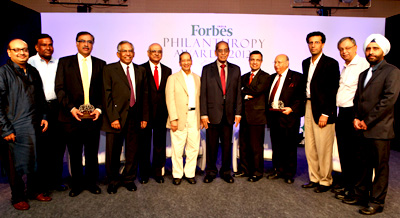
    Azim Premji with the jury (L-R): Abraham Moses, Sanjiv Sarin, MV Subbiah, AN Singh, Bhawarlal Jain, Narayanan Vaghul, Nachiket Mor, Lord Raj Loomba, Ashish Dhawan, Dr Madhav Chavan, Gurmeet Singh

    Azim Premji, chairman of Wipro Ltd, won the inaugural Forbes India Philanthropy Award in Outstanding Philanthropist category for 2012. Mr Premji, 67, the third richest Indian with a net worth of $12.2 billion, has pledged close to $2 billion from his personal wealth to Azim Premji Foundation, which is working to improve elementary education across India. He was among the ten outstanding individuals who received the award under different categories.


    The philanthropy awards were instituted by Forbes India to recognize the efforts of individuals who have given time, money, skill and expertise to solve some of the most pressing societal issues, to create model institutions and to inspire others. The winners received their awards – metalwork keepsakes depicting the Mubhi Tree, which symbolises the art of giving – at an event in Bangalore on Wednesday.


    “Our hope is that business should emerge as a strong force for good in this country and that our list of nominees for each of the ten categories will continue to grow as more and more people from the world of business step up and find new exciting ways to give back to society,” Indrajit Gupta, editor of Forbes India, said during the event.


    Mr Premji spoke about how his foundation’s university, which has 230 students and 70 professors, complements the field work they do in education. “Our objective is that we have to get more results and to scale up much more significantly in the grassroot level in the field,” he said. Later, he joined his fellow winners N Vaghul, former chairman ICICI Bank and MV Subbiah, former chairman Murugappa Group in a fireside chat to discuss what it takes to build a network of engaged corporate citizens, deepening the culture of giving back, galvanising corporate action, and how to take philanthropy in India to the next level. The session was moderated by Subroto Bagchi, chairman and co-founder Mindtree.


    In yet another fireside chat, Nachiket Mor, Chairman of the Board of Directors, SughaVazhvu, Ashish Dhawan, Founder and CEO of Central Square Foundation and Ramji Raghavan, founder Agastya International, discussed the challenges that philanthropists face when they work with multiple stakeholders, especially the government, in bringing about change. Ajit Rangnekar, dean of the Indian School of Business in Hyderabad, moderated the session.


    The event was attended by entrepreneurs, executives and academics with interest and passion for philanthropy and social good. They shared their views on themes related to philanthropy. Kiran Mazumdar Shaw, chairman and managing director of Biocon said that philanthropy is about making changes, and partnerships play a crucial role in that. Mr Mohandas Pai, Chairman of Manipal Global Education, and one of the driving forces behind Akshayapatra a mid-day meal programme, said he was motivated to do more when he realised that he was lucky to have won ‘the ovarian lottery’, many others aren’t so fortunate. Lord Raj Loomba, founder of clothing company Rinku Group, whose foundation works for the cause of widows, said his inspiration was the story of his mother, who became a widow when Raj Loomba was just 10 years old.


    The latest edition of Forbes India devoted to philanthropy was also released. Containing features on philanthropy with detailed case studies about each of the award winners, the special edition has four covers, featuring four of the winners Azim Premji, N Vaghul, MV Subbiah and Ashish Dhawan and a caption that runs across four covers: Philanthropy, done right, is too important to restrict to one cover.


    Speaking on the occasion, Gurmeet Singh, CEO, Forbes India said, “We at Forbes India strongly believe that Wealth and Philanthropy are two sides of the same coin. Therefore it was logical that we scaled up our earlier events on “Purpose Of Wealth”, “Business as a Force For Good” and “Conscious Capitalism” into a full-fledged Philanthropy Awards Evening.  Forbes India Philanthropy Awards and Dinner was a very well attended evening bringing India’s biggest philanthropists, guides and catalysts on the same platform and exploring what motivates leaders to embrace philanthropy and how India Inc needs to bring a stronger giving culture”.


    The winners were selected by a jury comprising of Narayanan Vaghul, Former Chairman, ICICI Bank, Madhav Chavan, Founder and CEO, Pratham, Shashi Tharoor, Member of Parliament and Dr Devi Shetty, Founder Chairman, Narayana Hrudayalaya Hospitals.


    The complete list of award categories and winners:


    Outstanding Philanthropist:

    The flagship award recognises an outstanding individual whose leadership and contributions of time, money, skill and expertise has brought in new thinking into solving complex social issues.

    Winner: Azim Premji, Chairman, Wipro Ltd


    Outstanding Corporate Foundation

    This award honours foundations that have taken up a social issue and have long term vision, strategy, a sustainable model and have created significant impact in their chosen areas.

    Winner: Tata Trusts


    Distinguished Family of the year

    This award honours families who have dedicated their private wealth for public good and benefited an institution or organisation in recognisable and sustainable ways across different generations

    Winner: Murugappa Family


    NextGen leader in Philanthropy

    This award recognises the accomplishments and contributions of emerging leaders in philanthropy, those who have signaled their intent through meaningful giving, have also begun to contribute significant time, skills and resources to the causes they have helped advance.

    Winner: Ashish Dhawan, Founder, Central Square Foundation


    Cause Marketing

    This award is for a company that has successfully marketed products or services in conjunction with a charity and brought significant benefits to both parties.

    Winner: Tata Tea – Jaago Re


    Corporate Catalyst

    This award is for a senior business leader who has used his influence to promote the cause of giving back not just in his or her company, but also across the entire industry.

    Winner: N Vaghul, Former Chairman, ICICI Bank


    The Good Company

    This award recognises pioneering strategic initiatives undertaken by large business corporations, where they have used market-based models to balance the twin objectives of doing well, while also doing social good.

    Winner: Jain Irrigation Systems


    The Good Samaritan Award

    This award is for an exceptional individual at any level in a company who has successfully led and galvanised support within the organisation to mount programs that help more people within that organisation to support worthy causes and give back to society.

    Winner: Abraham Moses, Director, Administration & Facilities, MindTree Consulting


    Distinguished Non-Resident philanthropist

    This award is for a non-resident Indian who has contributed significantly to a social cause in India, by giving wealth, time and expertise.

    Winner: Raj Loomba, Loomba Foundation


    The Crossover Leader

    This award seeks to recognise a professional who has successfully made the transition from a thriving career in the corporate world to work for the social or not-for-profit sector and has served as an inspiration and role model for others.

    Winner: Nachiket Mor, Non-Executive Chairman of the Board of Directors at SughaVazhvu

     

  • IAMAI announces 3rd annual India Digital Awards

    By A Correspondent


    The Internet & Mobile Association of India (IAMAI) has announced the third annual India Digital Awards for the internet and mobile value added service industry. The awards night, to be held on January 17, 2013 at New Delhi, celebrates excellence in originality, effectiveness, communication and creativity, and applauds work in the following six main categories: Digital Advertising, Website, Mobile VAS, Digital Payment, Digital Social and Economical Empowerment, and Special Awards.


    Covering the entire gamut of commercial activities around internet and mobile, the India Digital Awards are the only comprehensive awards for the digital industry in India.


    The nominees and winners of the awards will be selected by members of the jury which include Rajan Anandan, Managing Director & Vice President, Sales and Operation, Google India; Abdul Khan, Senior Vice President and National Head of Business Marketing, Reliance Industries, Dinesh Agarwal, Founder & Chief Executive Officer and Alok Mittal, Managing Director, Cannan Partners, among many others.


    The last date for submission of entries is November 24. More information and registration details are at www.iamai.in.


  • Jaldi 5 with Sunil Punjabi: Action, drama, entertainment

    Sony Pictures Television Networks Asia is geared up for its next original production, The Apprentice Asia, which will premiere on AXN across 21 countries in Asia in the first half of 2013. Call for participation for the India region began on November 15. We asked Sunil Punjabi, Business Head, AXN India Networks, why the channel needs The Apprentice.

     

    01. Programmes like The Apprentice and reality shows in the same genre have not done very well in India earlier. And this series will premiere across Asia. What was the rationale behind bringing the show on board?

    As far as The Apprentice and other reality shows are concerned, programmes that have some amount of interactivity built in tend to do better than plain shows that go on air. We ourselves did India’s Minute to Win It two years ago, and we built in a fairly large amount of interactivity. With the amount of interactivity and local presence, content offtake is higher because the viewer also starts engaging with the programme. Hence, engagement at the consumer level with localization is going to be the big differentiating factor for such shows.


    For The Apprentice at the Asia level, participants will be taking part from India in the selection process. It is where we believe local flavour comes in. Apprentice Asia should see better traction on the ground.


    02. How is AXN planning to create buzz around the show?

    We have pushed in the online campaign, apart from opening for entries on November 15. We are doing a lot of ground activation, contacting some 150-odd corporates across six cities with the aim of reaching working people one-on-one.


    We will reveal more plans as we come close to the airing of the show.


    03. Does The Apprentice or Minute to Win It gel with the programming of AXN, which essentially is Action TV?

    We have always been a thrill channel, and thrill can be action or drama. Or even dance. If you look at our top shows like So You Think You Can Dance, it is all about excitement. It is a very high-energy show and it gets the eyeballs, apart from other top-rated high-drama series like CSI and CIS, Leverage, Supernatural and Amazing Race. These are content blocks with lots of thrill built in, and that is the positioning that we’ve always maintained.


    India’s Minute To Win It – every activity that you look is based on the excitement. For that matter, Apprentice is going to be one challenging task. If you see the US and UK versions, every task that participants go through is time-based and there is heavy involvement in these episodes. And that is how it fits into AXN.


    04. Is AXN aiming to include all genres in its programming, and thus moving away from the original concept of an action channel?

    We have broadened the perspective. We have broadened the content line-up because at the end of the day we believe that there is a lot of International content, which can be brought to the India viewer. Apprentice has never been done in India, it has been done only in the US and UK. Actually, we are looking at an Indian version of Amazing Race soon. These are high-intensity formats.


    We believe that consumers want different types of content. The revised positioning of AXN is based on the consumer feedback that we have got over a period of time saying that they need more programmes that are high-energy.


    05. Apart from The Apprentice, which other non-action shows is AXN targeting?

    Amazing Race will start in January. There is Voice 4, which is slated for March. A strong drama series of Steven Seagal called True Justice 2 will be coming up also in January. It is a 12-part one-hour series that we are launching as part of Big Thrill Fridays, which is positioned around fresh and as-close-to-US-launch content. There is a new series of Leverage, a modern-day Robinhood series, which will begin in the month of Feb-March. An original production of Sony Pictures, Hannibal, will debut in March. It is an original AXN US production.


    It is a fairly good mix of high-drama, high-action, high-energy entertainment.


    As told to Ananya Saha


  • Jaldi 5 with Apurva Purohit: ‘Great networking with fantastic women’

    The lack of networking is also seen by women themselves as one of the top three impediments in their progress. Leading radio station netword Radio City decided to make building connections between women easier by launching a forum where the women can all come and spend time with one another. Apurva Purohit, CEO, Radio City 91.1 FM explains the rationale of starting ‘Women at Work’.


    01. Do tell us more on Women at Work all about?

    Women at Work is a platform where women from all walks of life can come together and optimize their networking time to further their professional and personal growth. It is a networking forum where the members use the platform to connect and explore possible opportunities related to their profession/ business.


    02. And how did Radio City get down to developing this forum?

    As an organization, Radio City has quite a few women leaders, who fulfil their responsibilities equally or sometimes better than their counterparts. While it is a fact that men have several occasions to interact with each other through formal or informal networks, women don’t have such opportunities. Whilst multi-tasking with their responsibilities at work and at home, there is no room left for after-office networking. Women also often do not find a support group to seek solutions to their problems or enough networking opportunities to excel professionally. The senior women at Radio City thus decided to create an opportunity for women to interact and this was in fact the driving factor behind developing this online forum.


    03. How many forums is ‘Women at Work’ planning to hold, and in which cities?

    Our first on-the-ground networking session was held in Mumbai a few months ago and witnessed participation from nearly 100 women. It was amazing to experience the energy it created, through re-forging old connections and building new ones. Many women who attended the forum shared intimate parts of their lives with each other, and this turn helped them forge important relations. The next on-ground forum is being held in Delhi on December 1, and we are looking forward to some great networking with some more fantastic women. Though we are all virtually connected with each other, we plan to conduct one such on-ground meeting in different cities once every quarter.


    04. So how many women have become members of Women at Work?

    The forum has more than 800 users from across the globe and many more joining in daily. In fact, we have started receiving proposals from like-minded women from the US to start an international chapter too.


    05. What can one expect from the Women at Work forum?

    Apart from building connections, the members of the forum can look forward to sharing successes and learnings from each other. The forum has been created with the motive of building a bridge, an umbrella where working women across different cross sections can come together and talk about anything related to our work lives – from bad bosses to office spouses, from stilettos to mojitos, from babies to boyfriends!


    Interviewed by Ananya Saha