Category: MEDIA

  • Colors, Sahara brave MNS diktat, to simulcast Sur-Kshetra with Geo from Sept 8

    By A Correspondent


    The threat of an MNS agitation is not going to see musical frontiers being bridged. At the time of writing, MxMIndia learns that Colors and Sahara One are going ahead with the broadcast of the cross-border Indo-Pak musical reality show – Sur-Kshetra. The Chitrapat Karmachari Sena of Raj Thackeray’s Maharashtra Navnirman Sena (MNS) is said to have sent an alert to the channels to not air the show as also to noted playback singer Asha Bhosle to step back from being on its jury though. The reason: the MNS wing believes that Pakistan had banned ‘Ek Tha Tiger’ and thereby not reciprocated India’s desire to forge relationships via the arts.


    The press conference held at the Taj Land’s End in Mumbai happened on Thursday with Ms Bhosle later making a clarion call to the MNS to call off the stir as the show attempts to promote peace and harmony between the two countries.


    Interestingly, while the MNS has said it would disrupt the shooting of the show, MxMIndia learns that the preliminary episodes have already been canned and only the finale – which will happen at an international destination – remains to be shot.


    Also being simulcast on Pakistan’s Geo TV, Sur-Kshetra starts September 8 and will air every Saturday and Sunday.


    Said Raj Nayak, CEO, Colors, “This is the first time ever in the history of television that a show will be simulcast across national and international networks of Colors, Sahara One and Geo TV, making it the biggest show to hit TV screens – ever. Unifying audiences across the globe, Sur-Kshetra will bring hearts closer as it builds an exciting viewing experience much like that created by an India-Pakistan cricket match.” Speaking on the timeslot, he further elaborated, “With Jhalak Dikhhla Jaa going strong on weekends, the inclusion of Sur-Kshetra will further strengthen our weekend content lineup providing our audiences with variety entertainment that appeals to them.”


    Sur-Kshetra’s two teams will be mentored by Indian music director-cum-singer-cum- actor Himesh Reshammiya and Pakistani music sensation Atif Aslam. Judging the musical flair of the contestants will be the three legends – Asha Bhosle (India), Abida Parveen (Pakistan), and Runa Laila (Bangladesh).


    Boney Kapoor – Director, Sahara One Media and Entertainment Ltd said in a communique, “Sur-Kshetra is a mega reality music show that brings together the best of singing talents from two arch-rival nations, India & Pakistan, competing against each other.”


    Produced by Sahara One in association with Saaibaba Telefilms, the will be sponsored by Dabur Amla Hair Oil and Videocon. A 360-degree integrated marketing campaign will engage multiple mediums like print, television, outdoor and radio through tie-ups reaching out to target audiences across the globe.


  • I-Cube Report: Mobile crucial for rural India to access Net

    By A Correspondent


    There are about 38 million claimed internet users in rural India today. The penetration of claimed internet users in rural India has grown from 2.6 per cent in 2010 to 4.6 per cent in 2012, a CAGR of 73 per cent. On the other hand the penetration of active internet users has grown from 2.13 percent in 2010 to 3.7 percent in 2012. These are some of the findings from the latest I-Cube Report on ‘Internet in Rural India’ which was released by the Internet and Mobile Association of India (IAMAI) and IMRB.


    According to the report, the number of claimed internet users in rural India is expected to reach 45 million by December 2012. The report further states that mobile phones are fast emerging as an important point of internet access in rural India. As of June 2012, there were 3.6 Mn Mobile Internet Users in India, a growth of 7.2 times from 0.5 million in 2010.


    In a prepared statement, Dr Subho Ray, President of IAMAI stated, “This is just the tip of the iceberg, in the next two years, a combination of affordable smart phones, optic fibre backbone and local language content is likely to change the beat all projections of internet growth in rural areas.”


    Anurag Gupta, Founder and MD, DGM India explained the possible impact of a growing rural internet usage on digital advertising. He was also of the view that local language contents, hyper local information etc will lead to higher internet usage in rural India. “Internet penetration is growing in the urban areas and now it is percolating to the rural areas, this is very good news as it bridges the digital divide across the country and empowers dual India with a level playing field of knowledge and information. There will be a growth in digital spends as the users grow, so for the digital advertising industry this is a very heartening sign.”


    Usage of Indian language or local language content is also said to be on the rise. According to the report, the availability of content in local language encourages the rural user to go online and although 79 per cent of the users access content in English, 32 per cent of the users access content in Hindi.


    A whopping 42 per cent of the respondents said they were not aware of internet. This is also one of the reasons for the non-usage of the internet. As more and more people begin to use the internet, infrastructure facilities is also bound to grow. While more initiatives are certainly needed to build the internet infrastructure, evangalising of the medium to the rural masses is equally the need of the hour for further growth of the medium. In addition to this, local language content is also said to play a critical role in order to fuel the growth of internet usage in India.


    Point of Access:

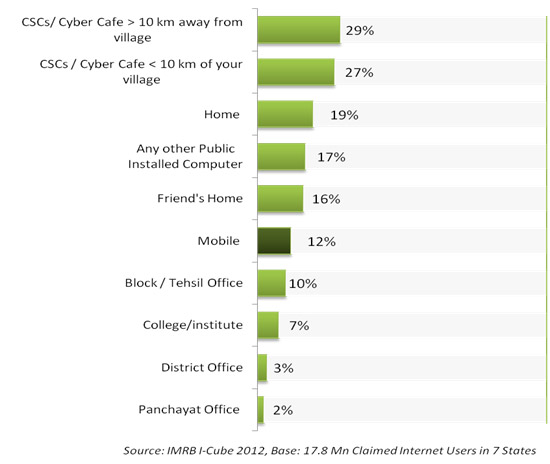
    One of the reasons for the increase in rural internet usage is probably because of the availability of cyber cafes and community service centres. Interestingly, majority of internet users in rural India (i.e. 57 per cent) have access to internet via cyber cafes and community service centres, only 19 per cent are said to have internet access at home and 12 per cent of the internet users access internet through their mobile phones.


    Purpose of Internet Access:

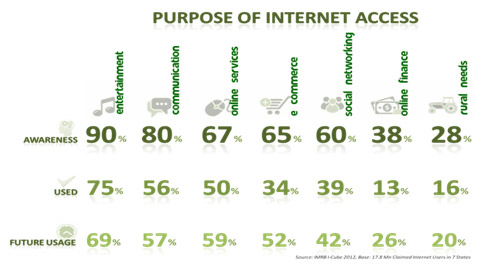
    Entertainment is the primary driver of internet use in rural India. 75 percent of rural users use internet for entertainment while 56 percent use it for communications Users like to access Music, Videos and Photos for entertainment.


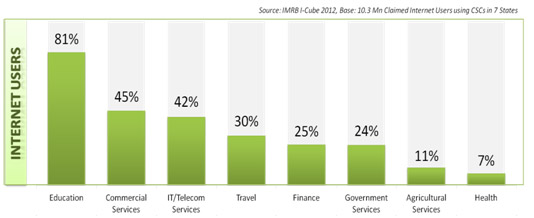
    There is a growing interest amongst the rural constituents seeking information on education. 81 percent of claimed internet users seek information pertaining to school / university and exam centres.


    Primary research is said to have been conducted in line with ‘I-Cube’ reports, an annual syndication of eTechnology Group, IMRB International. The syndicated research is based upon a primary research survey that interviewed about 15000 people from various age groups, across SECs and genders from the states of Assam, Maharashtra, Orissa, Tamil Nadu, Andhra Pradesh, Rajasthan and Uttar Pradesh.


    The Internet and Mobile Association of India (IAMAI) is an association which is said to be representing the entire gamut of digital businesses in India. It was established in 2004 by the leading online publishers. IAMAI is also said to be the only professional industry body representing the online and mobile VAS industry in India.


  • Bengal (paper) tigers set to roar


    By Ananya Saha


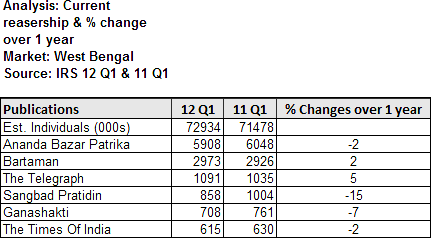
    Once the domain of Ananda Bazaar Patrika,West Bengal is now readying itself for an emerging newspaper war. The Times of India has trumpeted its entry into the traditional market with the announcement of its Bengali broadsheet Eyi Shomoy, and is putting its marketing muscle behind the promotion of the product. The Bengali broadsheet from BCCL will have to fight for numbers with Bartaman, Pratidin, Ganashakti and of course Ananda Bazaar Patrika.


    This is also for the first time that ABP’s dominance is facing a huge challenge. Whether as a gameplan or a coincidence, ABP has announced its evening tabloid Eyi Bela at the same time. The industry veterans are calling it mother of print battles: BCCL’s strong marketing and distribution against ABP’s loyalists. ABP currently dominates the print market with many of its publications aimed at each segment: Ananda Bazaar Patrika (Bengali daily), The Telegraph (English daily), Desh (Bengali magazine), Anandamela (Bengali children’s magazine), Anandalok (Bengali cinema magazine), Sananda (Bengali women’s magazine) and Sportsworld (English sports magazine).


    While some may argue that ABP is entrenched in this polarised Bengali market, others say that TOI will be able to make a definite dent in the market. Call it retaliation or just a good act, but ABP is said to be lowering rates, and increasing the pages of the newspaper. This is something that the Bengali newspaper has not ever done to counter any of the other newspapers’ entry. Meanwhile, it remains to be seen if TOI’s youthfulness will reflect on its Bengali broadsheet as it takes ABP on home turf.


    So far, the Bengali print market has been without any incident, and nobody has been able to impact it. A media veteran said that TOI will not have it easy. Why? “The Kolkata market is biased and opinionated. With its regional paper, TOI will not be able to address the local Bengali readers… It may do well in a Delhi or Mumbai where people do not have the time to read opinions.”


    ABP, moreover, has emerged as a clear (and consistent) leader in the market. It is true that when the English daily Times of India entered, ABP’s Telegraph did feel the jolt. Currently, in the market of 15-16 lakh readers, APB’s readership is close to 12-13 lakh, according to an analyst who has been observing the market keenly. But media specialists are sure that the TOI Bengali edition will pick up well when it launches, and managing two lakh copies initially will not be difficult for Eyi Shomoy. However, a media veteran noted that even with its marketing muscle, TOI’s Eyi Shomoy may find it tough to get the numbers until it  addresses the Bengali janata the way ABP’s Bengali daily does or is capable of.


    Currently, 70-80 percent of newspaper revenues are lapped up by ABP of the Rs 250 crore (rupee/advertisement) Bengali print market. The share of revenue by ABP is much more than readership, noted the media analyst. The idea of ABP’s launch of Bengali tabloid Eyi Bela is probably to target the lower-end advertisers in various districts and smaller cities. This may well become the golden opportunity of revenue for the paper, since it could attract a bulk of advertisers who are not able to advertise in high-priced media vehicles.


    Also, Eyi Bela is aiming to attract the growing youth population of the city. Industry analysts are divided given that the commuting culture in the city is different from Mumbai’s. “The evening segment dynamism is missing in this market,” noted an analyst.


    However, Sundeep Nagpal, Director, Stratagem Media, differs. He said, “I am actually surprised that no one launched an evening tabloid earlier in this market. Wherever there is a commuting culture, the tabloid can succeed. However, in this case, it is going to be the case of high distribution since an eveninger’s content cannot guarantee readership.”


    Even as the politically aligned market is going to see new entrant, the dynamics within the market is also undergoing a change: the rise of double-income couples, the need of smaller retailers to reach out to the aspirational class, evolving youth and rising city phenomenon. The evening tabloid may cater well to this segment.


    Media veteran Sajal Mukherjee shared his observation, “The West Bengal market is one of the oldest traditional markets inIndia. One might argue that the Bengali community is loyal to ABP but it is also true that readers want value for money. And loyalties shift depending on the value they get. In the Karnataka market, Prajavani had a stronghold where Vijay Karnataka challenged it and succeeded. Similarly, Divya Bhaskar was able to make a clear dent in the Gujarat market, which was led by Gujarat Samachar and Sandesh.”


    “If there is good marketing support in the new market, combined with good benefits to the readers, the loyalty will obviously be dislodged. TOI has had enough experience in the local markets, and it will be a good war to watch in Bengal,” Mr Mukherjee noted.


    What may also act in favour of TOI is that they will be able to offer a 360-degree national bouquet on good rate to advertisers. Mr Mukherjee opined that Eyi Shomoy has huge scope to gain the second spot in the market. TOI is already making itself familiar to the local audience by sponsoring ground events. This might work in the favour of the new broadsheet since people will be ready to subscribe to it. TOI is clearly aiming at growth for the future, and is not looking at short-term benefits. The industry veterans note that after Eyi Shomoy hits the 3-4-lakh mark, it might get troublesome for ABP.


    But ABP will not let go of its domain so easily. Will it result in a new strategy? Can Eyi Bela actually make a new market in Bengal? And will Eyi Shomoy’s challenge to ABP be tackled more forcefully? Advertisers and analysts might differ, but it is readers who are bound to get the sweetest deal.


  • Radio Mirchi appoints Starcom as media partner

    By A Correspondent


    Starcom Worldwide has bagged the media mandate of leading radio network Radio Mirchi. The account will be handled from Starcom’s Mumbai office. It was previously with Madison. The agency is reported to started work on the new business.


    The win adds to a series of new business wins at Starcom MediaVest Group (SMG) since the middle of last year, among which are Aircel, Dabur, Axis Bank, Zee Learning, Supermax, Sterling Holidays etc. SMG has also been aggressively strengthening their media product in India. The agency recently launched its proprietary Web+TV optimiser, billed as the first of its kind in the market.


    Confirming the news, G G Jayanta, National Head of Marketing, Radio Mirchi said: “we are pleased to appoint Starcom since we needed a partner who is future focussed and can help us navigate the new media landscape. Their in-house research and tools are very impressive and their media product and philosophy are pretty solid. We look forward to a long and rewarding association with Team Starcom”.


    Commenting on the win, Malli CR, CEO of SMG India said: “We are thrilled to win the Radio Mirchi account. Given the developments in this sector, we look forward to exciting times. We have planned some specific research and insights projects using our proprietary tools and optimisers”.


  • Colors launches Jhalak Dikhhla Jaa online game

    By A Correspondent


    General entertainment channel Colors announced the launch of a first-of-its kind online game allowing viewers to be a part of the popular dance reality show, Jhalak Dikhhla Jaa. Exploring digital avenues to enhance the popularity of the show, the initiative allows fans to partake in the Jhalak Dikhhla Jaa experience online. Designed by BBC Worldwide Productions India, the game takes fans on a whirlwind ride while allowing them to learn and experience different dance forms that makes the show a hit among audiences.


    Commenting on the launch of the game, Vivek Srivastav, Digital Head – COLORS said, “With the Jhalak Dikhhla Jaa game, we aim to connect with our strong online fan base which elevates the show to a higher mass platform. The more virtual formats we explore, the more it enables us to tap newer audiences across the world.”


    Elaborating about extending the Jhalak Dikhhla Jaa experience across digital platforms, Myleeta Aga, General Manager & Creative Head – BBC Worldwide Productions India, said, “We are very excited to explore newer avenues in the digital media space and bringing the television experience of Jhalak Dikhhla Jaa to the virtual world. We believe that with the launch of this game, the overall experience will create an addiction among the Jhalak Dikhhla Jaa fans and dance lovers.”  The game can be accessed at http://colors.in.com/in/jhalak-dikhhla-jaa.


  • MxM Mondays | Why do we love to hate Media Measurement?


    By Ananya Saha


    Media measurement in itself is a very sensitive topic. Every data is looked at with apprehension. Why is it that all measurement statistics are scrutinized with apprehension? Why is it that objections are raised time and again, with regard to the findings? Have we lost faith in media measurement tools? In this edition of MxM Mondays, we spoke to a cross-section of industrypersons on the issue. TAM Media Research did not wish to participate given the current controversy and Nielsen Managing Director-Media was unavailable for comment, though he did speak to MxMIndia on the issue last week – see link)

     

    Lynn de Souza

    Lynn de Souza, Chairman and CEO, Lintas Media Group (also Chairman of the Readership Studies Council of India)

    Ordinarily, it is the ones who are measured who do not like what the measurement index throws up – because in any index there can only a few leaders. So, the majority could have some issue or the other.


    It is human nature to then pick on the messenger rather than the message.


    Santosh Desai, MD & CEO, Futurebrands

    Santosh Desai

    There are issues with media measurement in its current form. But it is also true that any form of measurement is always resented. The resentment stems from the fact that one, it is quite shallow in approach when it comes to reach and importance. Secondly, it stems from when the mental picture of your media’s reach and influence does not match with the reality of the numbers. It then becomes difficult to reconcile with reality. Third, what with the anecdotal stories about how numbers are arrived at, you tend to believe that you are on the wrong side of the great picture and the statistics are unfair to you.


    Personally, I believe that TV needs a new measurement currency. The current currency is also influencing the quality of TV that we watch. The media measurement does not account for engagement and reach, which from advertisers’ perspective is a huge injustice.


    On the other hand, the clients need to be ready too to pay for it in case they wish for more clarity in measurement results.


    Media measurement, in its current form, needs to be modified. The issues that are highlighted with the current measurement system need to be tackled in a very transparent way. Conceptually, what is being done is not adequate. What can make it less contentious is including more people in the process, and make it much more transparent.


    Bharat Kapadia, Chairman, Whatuwant Solutions (also until a few years back:Vice-Chairman, MRUC)

    Bharat Kapadia

    We do not love to hate media measurement. But we are usually put in such a situation that we hate it. There are two reasons for this. One is ‘legacy’, which we have been following. We have learnt and built the media measurement architecture learning from international models, which are not very suitable for Indian conditions. Secondly, the problem of ‘investment’. We believe in not investing much cash into the measurement system. Like the famous saying goes, ‘If you cut corners, all you get is a round zero.’ This has resulted in the current plight against media measurement. There is, however, a great possibility for change and an opportunity to improve the research methodology and structure. It is not as if current media measurement systems are in bad shape or in pathetic condition. One needs to understand that the current measurement system captures only certain segments, and thus turns unfair since it becomes the currency that everyone abides by. This currency can harm somebody’s business too. The main problem is to have a robust mechanism to check the data collection from where all the problems start.


    Sriram Kilambi, President, Bloomberg TV India

    Sriram Kilambi

    There is a lot that rides on media measurement of the current media industry, which is about Rs 15,000 crore of television media, 10,000 crore of print media and 10,000 crore worth of radio and other media. The industry does not seem to invest in proper measurement tools and mechanisms.


    Media measurement currently is sub-optimal. Since there is no other mechanism currently present, we have no option but to trust the numbers presented. The standard errors in the media statistics are too high, that is why the industry cannot seem to trust the data. The media measurement needs more investment.


    Why cannot the advertising industry and the media industry come together to formulate and create a coherent measurement system?


    Sanjeev Kotnala, VP, Dainik Bhaskar Group

    Sanjeev Kotnala

    ‘When did you quit smoking?’ is the classic trap question. ‘Why do we love to hate media measurement?’ falls in the same category.


    ‘Love to hate media measurement’ is an involuntary reaction. We all hate report cards. The foundation for that was laid while we were studying. At least for me, this holds true.


    Media measurements need to be accepted as an industry yardstick with constructive participation by stakeholders in the process of measurement. Not a Black Box that opens at a regular frequency to decide your fate. Till the process and the results meet expectation, everything is fine.


    But when we use media measurement as the final verdict, the problem starts. More so, with a lot at stake on a non-transparent extrapolation of small set of data points. Actually media measurement should have had a wider role in product health measurement and for that people should have been pushing transparently for the qualitative enhancement of methodology and matrices. Sadly, current media measurement systems have not kept pace with industry growth and changing needs.


    So it’s not me. And at the stakeholder end when each and every element of media measurement in terms of width and depth, process and transparency does not seem credible or transparent or reflecting ground realities, it is bound to give rise to debate and that normally ends with a love-to-hate situation.


    The stage we find ourselves at in the industry is not something new. I believe that objections have been raised by section of users at different point of times in forums and formats. Some media measurement process owners have shown just openness to ideas and changes. Mostly they have been feeling good. Unfortunately, with many fates riding, more questions than answers will be available. Net take out: Not Being Heard? Definitely it will not breed Love.


    More so when it is a single monopolistic currency, media measurement tend to lose its credibility. And anyway that only has a B2B importance. For the common men it makes no sense. They do not read, see or listen based on media measurement. They do that when the content touches them. And this traction is visible on ground level much before media measurement can reflect it. This lag makes media measurement redundant and at times irrelevant.


    It will always be debated till such time as measurement remains restricted to just the size – a numeric tag and not about impact.


    Trust, all stakeholders want a participative, constructive, transparent, collective process. And in that case these bodies must be completely neutral with all relationships at arm’s length. (*This is a personal view and not that of any company/brand, Mr Kotnala represents).


    Lloyd Mathias, Director, Greenbean Ventures (Former CMO, Tata Taleservices & Motorola and  Immediate Past Chairman, MRUC)

    Lloyd Mathias

    Media measurement – whether it is TAM for TV channels or IRS for newspapers – has always been a contentious issue. Usually it’s the media owners who feel aggrieved — especially when the results do not meet their expectations. They then want to shoot the messenger.


    There is a strong case for tightening media measurement tools. Often results tend to be inaccurate because media owners try to influence the respondents or the research company. Yes, the measurement methodology and samples need strengthening. For instance, TAM’s sample of 8,500 homes – measuring the television viewing habits of 1.22 billion Indians – is definitely limiting.


    Industry stakeholders – advertisers, advertising agencies, media owners and media agencies – need to come together and work towards effective media measurement that benefits all.


    It’s currently the advertiser who bears the brunt of the impact as it is their advertising moneys being wasted.



    Maheshwar Peri

    Maheshwar Peri, Chairman and CEO, Careers 360

    When there are very obvious mistakes, acknowledged by the research agency and also all parties, it is also accepted that the continuance of such mistakes is hurting stakeholders badly, but when no concrete step is taken to solve it, we lose faith. Besides, each measurement benefits or hurts each stakeholder and they will continue to question it.


    We haven’t yet questioned Google or ComScore as they are scientific. However, if it is sample-based, not foolproof and very obvious errors have been detected, they must be corrected.


    This dogfight between the stakeholders would continue till we find a way to make it more objective and scientific.


  • Sujoy Ghosh quits BCCL as Joy Chakraborthy returns

    Joy Chakraborthy

    By A Correspondent [updated from Friday]


    It’s now official. Bennett, Coleman and Co Ltd’s long-serving Director-Response Sujoy Ghosh has decided to move on as Joy Chakraborthy is set to take the position. Mr Chakraborthy will report to Arunabh Das Sharma, President, BCCL. A mail is said to have been circulated to senior employees on Friday evening.


    Mr Ghosh was not reachable for comment, but is rumoured to be keen on pursuing entrepreneurial interests. Mr Chakraborthy is scheduled to join today (Monday, September 3). This will be his second stint with BCCL.


    Meanwhile, there have been rumours that Dr Bhaskar Das, President and Principal Secretary to the MD at BCCL was also not planning to pursue his service extension following his retirement. Dr Das has denied this to MxMIndia.


  • i next launches Indore edition

    By A Correspondent


    Adding yet another city to its kitty, i next is launching its 14th edition (13th being inextlive.com) in the ‘sweet’ city of Indore on 2nd September. This edition allows the leading compact daily from Jagran group, which already has big presence in four states (UP, Uttarakhand, Bihar and Jharkhand), to spread its wings across Madhya Pradesh, a key Hindi speaking territory. To the readers, i next Indore edition would reach in combo with Nai Duniya, which is already an established name in newspaper industry in MP.


    Set to complement Nai Duniya, i next as a relatively new and youthful daily offers a right balance to the mix; the former being a part of Indore’s famous journalistic traditions and its socio-cultural journey for more than six decades now.  The development is likely to slake the rich and diversified tastes of Indorians.


    Commenting on the launch, Shri Mahendra Mohan Gupta, CMD Jagran group held, “In the past six years, i next has moved from strength to strength. Its presence will also consolidate the already strong position of Nai Dunia.”


    Recently in news for winning World Young Reader ‘Newspaper of the Year, 2012’ award at WAN-IFRA summit, i next eyes for market expansion through an aggressive integrated campaign completing the loop between the readers, advertisers and the agencies. The development is set to alter the industry equations. Revealing the strategy behind the move, Salil Tandon, VP marketing, Nai Duniya said, “Indore is an education hub and a well read city. There is a huge variety in tastes and preferences of the readers here. We would try to leverage on this by giving our readers the combined advantage of a regular newspaper and an exciting compact daily.”


    He further emphasized the relevance of a tabloid like i next in the young city like Indore. “There are a lot of well off and progressive youngsters out here which have always been a core Target Group for i next. With its unique style of presentation and storytelling, I am sure, i next would be able to win their hearts.”


    Shailesh Gupta, Director, Marketing, JPL provided a perspective, “Indore is a very active market. A vibrant mix of traditional and modern attributes; be it entertainment, fashion, food, education or real estate. The infrastructure development has triggered a spate of growth in almost every industry here. From marketing point of view, Indore presents a huge retail market to benefit from.”


    The launch is being actively promoted through the campaign ‘Indore is my next’, supported by outdoor, radio, digital promotions, print Ads, banners and road shows. The targeted communication is being undertaken to introduce i next to the young audience of Indore.


  • Divya Marathi now a case study at IIM Bangalore

    By A Correspondent


    The fast paced growth and unique new market launch strategy of Dainik Bhaskar Group, an Orbit-shifting innovative process featured as a case in IIM Ahmedabad, and the successful launch of Divya Marathi, the group’s Marathi newspaper, this time has attracted IIM Bangalore to study and create a classroom case on group’s success through the years.


    Seema Gupta

    Prof. Seema Gupta of IIM Bangalore did a detailed analysis of Dainik Bhaskar group processes in her attempt to understand what makes this group succeed. She met with the senior management across verticals; Editorial, Production, circulation and marketing to deep dive into their independent and cross-functional working. Result; ‘Dainik Bhaskar group: Aspiring Growth’ a case study by IIM Bangalore.


    The case delves into the history of the group, the aggressive launch strategy, accelerated business growth and robust marketing plan. It strongly points out that launching of a newspaper and venturing into a monopolistic market space is definitely a decision that is governed by the faith in the brand. Considering the nature of the category, where reading habits are relatively strong and the market leaders create high entry barriers including the competition-intensive cut-throat ground zero strategies, it makes for an interesting study in management strategies, processes and execution. Success in such situations cannot just be attributed to the business acumen, understanding of market dynamics and identification of the need-gap within the market. There are other elements like agility, empowerment, passion and high ambition across the employee set that is a real differentiator and helps convert strategies into reality.


    Elaborating on selecting Dainik Bhaskar Group for the case, Prof. Seema Gupta said, ‘Dainik Bhaskar with its ambitious growth plans exemplifies gutsy business strategy and marketing. It changed the contours of the marketplace by entering into markets with strong and entrenched incumbents. This task was even more arduous considering the nature of the category as it is difficult to change the habit of readers. Newspapers touch the life of every consumer and hence the case would drive strong emotional connect and animated discussion in the classroom. The focus of the company on tier II towns makes it an apt material for case study as small towns would be the drivers of future growth of Indian economy.’


    The case in detail traces the sustained leadership strategy adapted by Dainik Bhaskar Group over the years. It places importance on the way the group evaluates and  identifies the gap between supply and demand. And the process of creation of a product that truly answers the overt and latent needs in the ever evolving market. It identifies that the core business philosophy of the group remains a singular focus on close in-depth understanding of the consumers’ pulse and being consumer-centric in its product creation.


    Girish Agarwaal

    Speaking about this development, Girish Agarwaal, Director, Dainik Bhaskar Group said, “It is always a moment of pride when an institute of repute like ‘Indian institute of Management Bangalore’ seeks to study the organisation and creates a case study. We do believe that in the process of the case creation and discussion, the group also benefits in getting some raw, unbiased and unfiltered views. We attended the first classroom sessions held on July 20 at IIM-B, where second year students discussed the case. It has been a healthy experience and we respect the level of analysis that the students presented in their understanding of the challenges faced by the group.”


  • Investment Watch from moneycontrol.com

    By A Correspondent


    Moneycontrol.com has recently launched Investment Watch, a real-time alert service that will keep subscribers updated about the markets and will also let them stay updated with their portfolio.


    With this service, users can get stock quotes, commodity prices, currency rates, Indian and global market indices as well keep up with the ups and downs in their portfolio.


    Subscribers can get the alerts through SMS, Emails and desktop notifications, which they can customize according to their preferences.


    Commenting on the launch, Joyson Thomas, COO, Web18 said, “Investment Watch keeps its subscribers constantly updated about the markets and their portfolio. This is an extremely comprehensive product that covers all major financial instruments and also manages to reach users through all devices viz desktops, laptops, tablets and mobile phones.”


    Investment Watch can be accessed at http://investmentwatch.moneycontrol.com/.


  • DisneyUTV brings Gameloft’s mobile games to India

    By A Correspondent


    The digital business of DisneyUTV has associated with Gameloft, a leading international publisher and developer of games to distribute their mobile games in India via operator channels and UTV Indiagames’ destination sites.


    Gamers in India will now have access to global hits like Asphalt 6: Adrenaline – from the blockbuster Asphalt franchise, Prince of Persia Forgotten Sands – an epic adventure game from the Prince of Persia saga series, along with some latest releases like The Dark Knight Rises – an action game inspired by the movie trilogy’s final chapter. Further the tie up will also bring the Indian audiences blockbuster MARVEL titles like Ironman, The Avengers and Amazing-Spiderman – the official web-slinging adventure game. These games will be available on Java phones with select titles available on Android as well. Gamers can download the exciting titles in the price range of Rs. 30 / 50 / 99.


    “This is one of the most strategic alliances that we have made especially in light of some of the MARVEL franchises that we will be able to engage Indian audiences with, in addition to the world class repertoire of Gameloft IPs. The gamer base in India is expanding rapidly and at this critical juncture we believe the right content offering will catalyze growth further,” said Samir Bangara, Managing Director – Digital, DisneyUTV.


    Sarabjeet Singh, Country Manager Gameloft India said, “Gameloft has been distributing its games for over 5 years in India, and we are thankful to our Indian fans for the strong interest and appreciation they have shown over these years. We are now pleased to partner with the digital team of DisneyUTV who will be distributing our mobile games via the various operator channels in India. We are confident of their rich experience and local expertise in the market and will be working closely with them to bring our Indian users an even better gaming experience.”


  • Govt may set up own body if it doesn’t see action on BARC by November

    By A Correspondent


    Even as I&B secretary Uday Verma met stakeholders of the three industry bodies who are setting up the Broadcast Audience Research Council (BARC) – the Indian Broadcasting Foundation (IBF), the Indian Society of Advertisers (ISA) and the Advertising Agencies Association of India (AAAI) – yesterday, MxMIndia learns from sources that the government is exceedingly upset with the delay and if it doesn’t see any action by November 2012, it may set up a joint government-industry committee to take things forward.


    Other than the collective pressure of the News Broadcasters Association, the NDTV case against TAM and its principals and Doordarshan’s own misgivings on the issue are among the compelling reasons why the I&B ministry is in a rush for the formation of the BARC. The government is aware that like in the case of content regulation, it would not like to play a role in the issue, however it believes that precious time has been lost. MxMIndia was told the pressure consumer/advocacy groups and Members of Parliament have also been asking for a look-in at the ratings process.


    While representatives of the IBF, ISA and AAAI have reassured the Secretary that all is well, the fact is that misgivings are still simmering given the recent charges that have been traded between the IBF and the ISA and AAAI.


    BARC was mooted way back in 2008 and the formation process had started in 2010, with an announcement on the setting up earlier this year – in March at FICCI Frames, to be precise. However, there have been stumbling blocks, all of which have been are said to have been cleared.


    BARC and consequently an all-new system of data collection could mean investment of around Rs 1000 crore, depending on the number of measuerement boxes to be installed. To start with, a CEO needs to be appointed as presently all stakeholders have their own business responsibilities, the demands of which are increasing with the festive season coming up.