Category: IRS

  • IRS 2011 Q3: TOI still the No1 newspaper, India Today lead the magazines pack

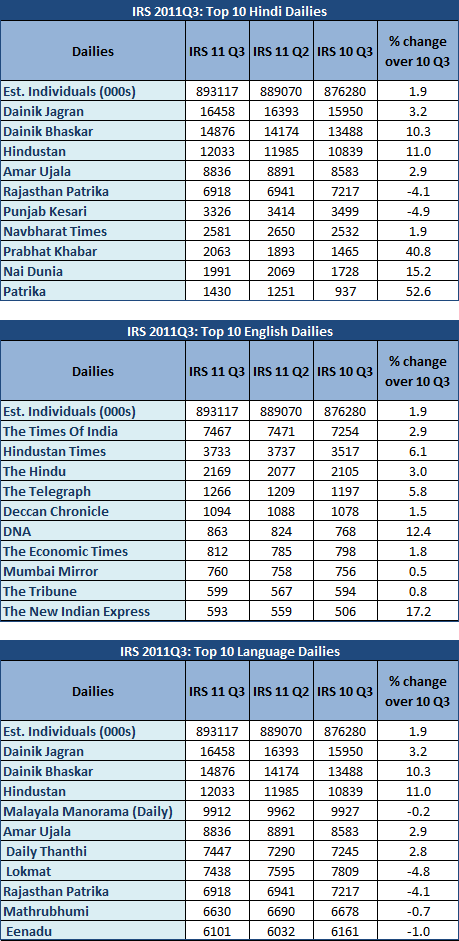
    Top 10 English Dailies:


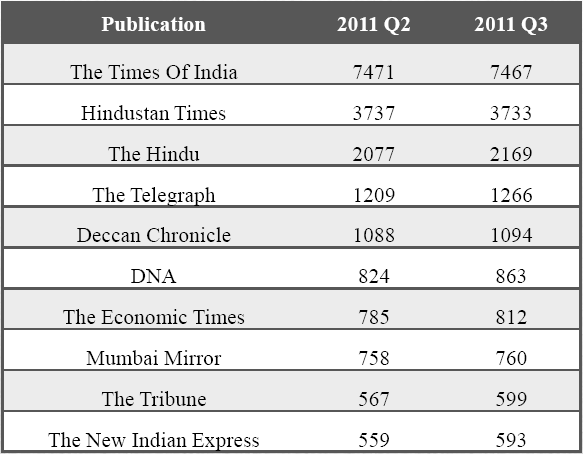
    Besides Times of India and Hindustan Times, all the other English Dailies in the top 10 have witnessed growth in their AIR (Average Issue Readership) figures. The decline in Times of India and Hindustan Times AIR is however marginal.


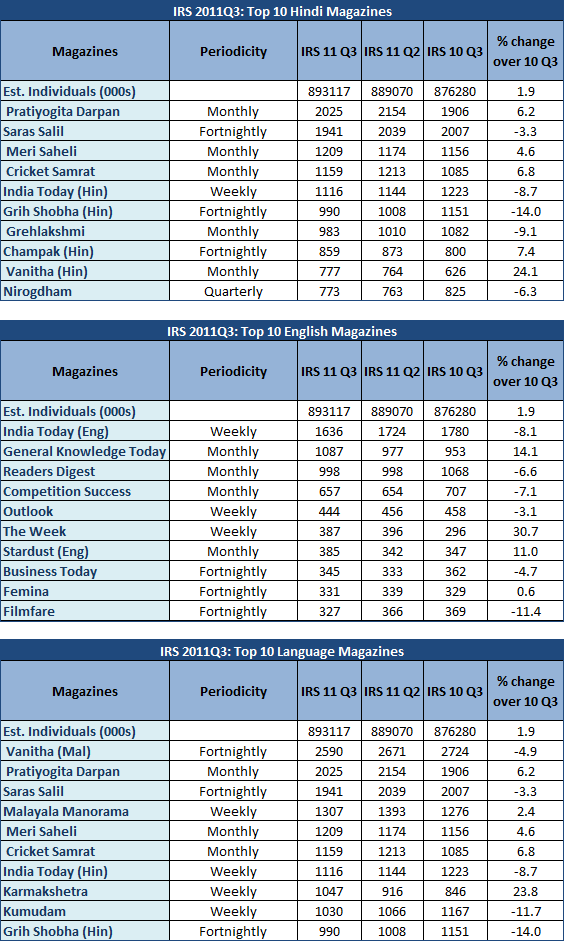
    Top 10 English Magazines:


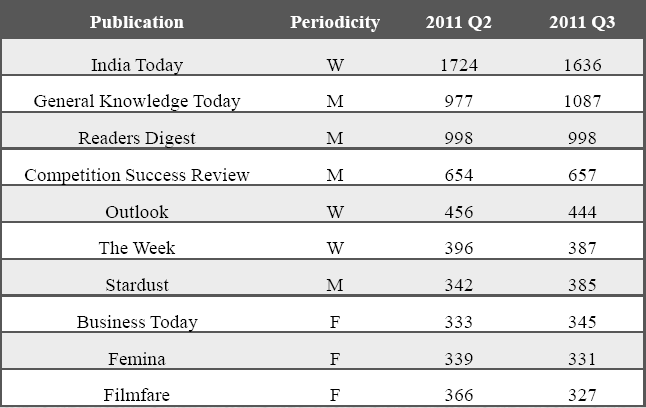
    Five out of the top 10 magazines, namely General Knowledge Today, Readers Digest, Competition Success Review, Star Dust and Business Today saw growth in their AIR. General Knowledge Today climbed up to number two with a growth of 11.26 per cent whereas Readers Digest slipped to number three and remained stagnant in their readership.


    All figures are in Average Issue Readership. Like media buyers, MxMIndia only endorses Average Issue Readership as the currency for readership measurement. Please note that these are only topline figures which have officially been supplied to the media. Sensible buying and planning happens when more data is available.

  • IRS 2011 Q3: Top three Hindi dailies witness growth in AIR

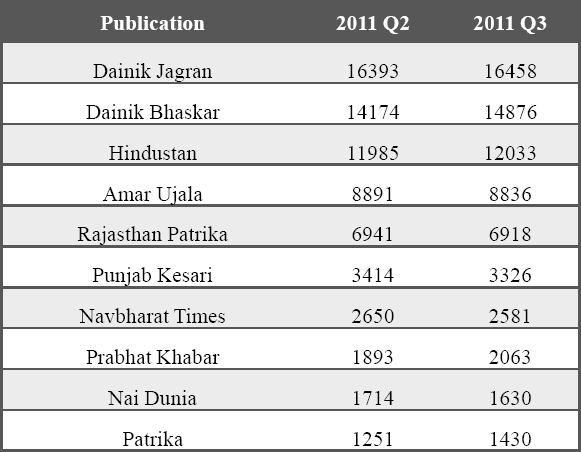
    Top 10 Hindi Dailies:


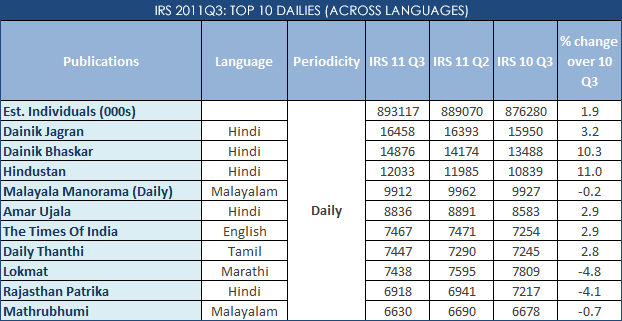
    There is no change in the pecking order here. Dainik Jagran rules, Bhaskar is second and Hindustan is third, and all three have shown marginal growth in IRS 2011 Q3 as compared to IRS 2011 Q2. Amar Ujala, Rajasthan Patrika, Punjab Kesari occupy the fourth, fifth and sixth slot respectively. Amar Ujala, Rajasthan Patrika, Punjab Kesari, Navbharat Times and Nai Dunia are the only publications in the top 10 Hindi Dailies to have shown negative growth in their Average Issue Readership (AIR). Patrika, a new entrant at the tenth spot, emerged as the fastest growing Hindi Daily with a  14.31 per cent growth.


    Top 10 Hindi Magazines:


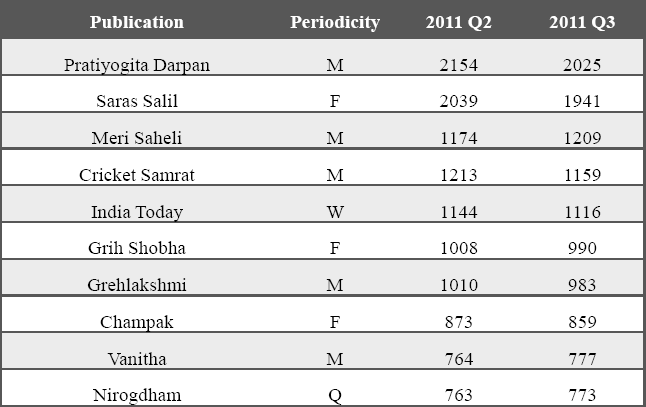
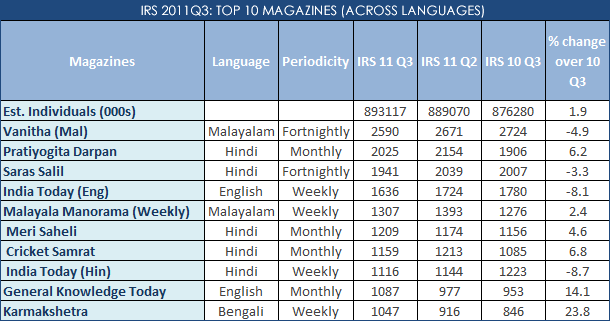
    Most of the top 10 Hindi Magazines showed decline in their AIR figures. Pratiyogita Darpan and Saras Salil were the top two magazines, but their AIR declined marginally in IRS Q3 2011. Ranked third Meri Saheli, is the only Hindi Magazine in the top five to have witnessed growth. The other Hindi Magazines to have witnessed some growth in their AIR are Vanitha and Nirogdham.


    India Today, ranked five, is the only Hindi weekly to have established itself among the top 10 Hindi Magazines. With an AIR of 11,16,000 in IRS 2011 Q3 as compared to an AIR of 11,44,000 in IRS 2011 Q2, it saw a decline of 2.45 per cent.


    All figures are in Average Issue Readership. Like media buyers, MxMIndia only endorses Average Issue Readership as the currency for readership measurement. Please note that these are only topline figures which have officially been supplied to the media. Sensible buying and planning happens when more data is available.

  • IRS 2011 Q3: Malayala Manorama and Vanitha top language daily and magazine

    Top 10 Language Dailies:

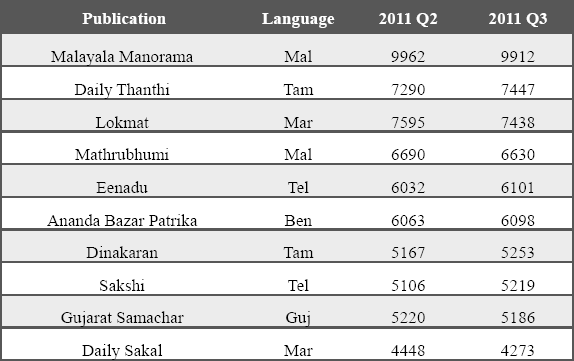
    Malayalam daily, Malayala Manorama has maintained its leadership position among the language dailies, with a marginal decline of 0.50 per cent in IRS 2011 Q3 as against IRS 2011 Q2. A distant second is Daily Thanthi which grew 2.15 per cent in Q3 2011 from IRS 2011 Q2. Daily Thanthi, Eenadu, Ananda Bazar Patrika, Dinakaran and Sakshi are the five Language dailies to have witnessed growth in IRS 2011 Q3 as compared to the AIR figures in IRS 2011 Q2.


    While Daily Thanthi and Dinakaran are the only Tamil dailies in the top 10 rankings, both these language dailies have witnessed growth in AIR when we compare IRS 2011 Q3 as against IRS 2011 Q2. The Malayalam dailies, Malayala Manorama and Mathrubhumi, ranked one and four respectively, witnessed marginal decline in readership.


    Top 10 Language Magazines:

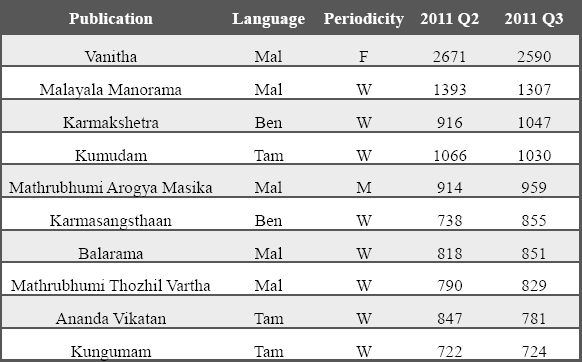
    The language magazines may bring some cheer in the magazine community as six of the top ten language magazines have witnessed growth in readership. Karmakshetra, Mathrubhumi Arogya Masika, Karmasangsthaan, Balarama, Mathrubhumi Thozhil Vartha and Kungumam have witnessed growth. Karmakshetra and Karmasangsthaan, both Bengali weeklies, witnessed a double digit growth of 14.30 per cent and 15.85 per cent respectively.

  • IRS 2011Q3. Digital growth bestest. Cinema, Radio decline

    By A Correspondent

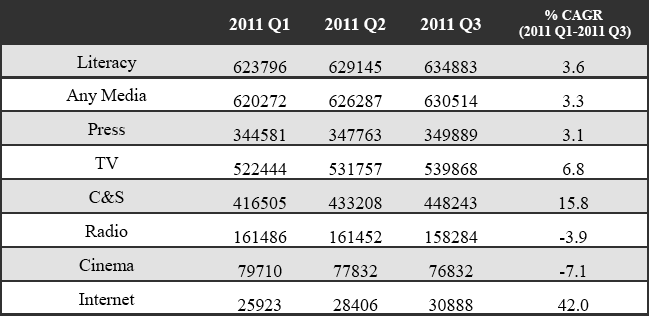
    As per the Indian Readership Survey (IRS) 2011 Q3 data, Cable & Satellite (C&S) and Internet are the two sectors which have shown the maximum growth in total reach. Radio, on the other hand, showed negative growth of 3.9 per cent CAGR with numbers declining from 161.45 million to 158.28 million. Internet, the fastest growing sector, recorded a growth of 42 per cent CAGR with the reach going up from 28.41 million in Q2 to 30.89 million in Q3.

    The total reach of the television media has also gone up by 6.8 per cent CAGR to 539.87 million in Q3 from 531.76 million in Q2 making it the third fastest growing sector.


    The Cable & Satellite (C&S) sector recorded a growth of 15.8 per cent, the only other sector to record double digit growth. C&S total reach is up at 448.24 million in Q3 compared to 433.21 million in Q2 2011. Cinema also recorded negative growth of 7 per cent with reach declining from 77.83 million in Q2 2011 to 76.83 million in Q3.


    All figures are in Average Issue Readership. Like media buyers, MxMIndia only endorses Average Issue Readership as the currency for readership measurement. Please note that these are only topline figures which have officially been supplied to the media. Sensible buying and planning happens when more data is available.


  • Claims, counter-claims rule IRS again


    By A Correspondent


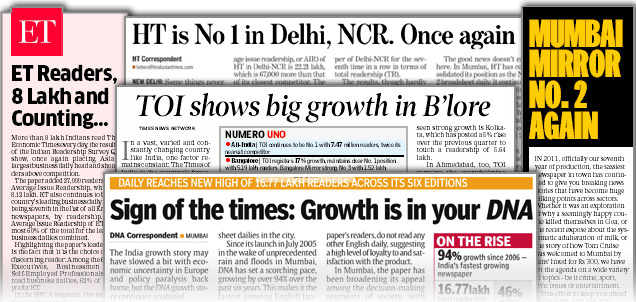
    It’s ironic. Mumbai is where most of the biggie media agencies exist. Some of the largest spenders are headquartered here. Still, publications pull out all stops to make crazy claims.


    Okay, they aren’t incorrect and the initiated amongst them can obviously see through the claims, but those who don’t – the lay reader, the young homemaker or the senior citizen who is not in the know – is sure to wonder what the truth. And if he/she subscribes to more than one paper, we are sure there will be some confusion.


    Obviously, the belief is that the reader is an ass. But this is a policy that can backfire terribly.


    But the confusion in a city like Mumbai is thanks to the two types of data that MRUC throws up in its IRSes – Average Issue Readership (AIR) and Total Readership (TR). Publications put up the data which throws them in better light. Also, newspaper X is a compact (tabloid- like-sized) newspaper while Y is a broadsheet. So one may be the #2 overall, another may be #2 broadsheet. Z may be #2 by TR and Y may be #2 by AIR.


    Fact is AIR is the accepted currency and there is a section which believes that a newspaper that comes free with another paper shouldn’t be taken for review. But there is a section which says that if a newspaper is able to attract revenues separately, that’s decidedly the best yardstick for the product’s utility. Perceived or otherwise.


    Sadly, the conferences which the Market Research Users Council and Hansa Research Group would conduct to release every round of the Indian Readership Survey have been done away with. The detailed dump is no longer handed out to the trade media. All of this charade of X, Y, Z could’ve been avoided had we got city and region-wise numbers from the MRUC (or via Hansa), but that’s not to be.


    Let’s look at the tables in detail (that we have based on the toplines publicly available).


    There’s no need of words. The growth or degrowth percentages tell the story. Some spectacular successes. Others not so.

  • IRS 2011Q4: Not much change in rankings but dailies witness significant growth

    By A Correspondent


    Top 10 Hindi Dailies:

    IRS Q4, 2010 v/s IRS Q4, 2011

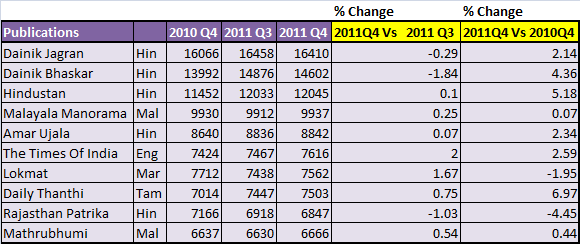
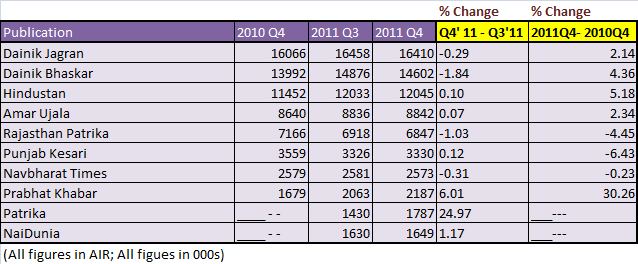
    There is not much of a difference in the rankings of the Top 10 Hindi Dailies. Dainik Jagran, Dainik Bhaskar,Hindustan, Amar Ujala and Rajasthan Patrika continue as the Top 5 Hindi Dailies. When compared to IRS 2010 Q4, IRS 2011 Q4 reveals the Top 4 Hindi Dailies, namely Dainik Jagran, Dainik Bhaskar,Hindustanand Amar Ujala have further strengthened their readership.


    A look at percentage change from Q4, 2010 to Q4, 2011 finds that Dainik Jagran has witnessed a growth of 2.14 per cent, Dainik Bhaskar grew by 4.36 per cent,Hindustanby 5.18 per cent while Amar Ujala grew by 2.34 per cent. The only Hindi daily to have witnessed double digit growth is Prabhat Khabar with a whopping 30.26 per cent growth in Q4, 2011 as against Q4, 2010. A total of five Hindi dailies have witnessed growth Quarter on Quarter.


    Q3, 2011 Vs Q4, 2011

    But the results for IRS Q4, 2011 Vs Q3, 2011 have a slightly different story to tell. The top two most read Hindi dailies – Dainik Jagran and Dainik Bhaskar – have witnessed a decline in Average Issue Readership (AIR), the decline is however marginal. Besides Dainik Jagran and Dainik Bhaskar, the Hindi dailies to have recorded growth in Q4, 2011 v/s Q3, 2011 are Hindustan, Amar Ujala, Punjab Kesari and Prabhat Khabar.


    Top 10 English Dailies:

    IRS Q4, 2010 Vs IRS Q4, 2011:

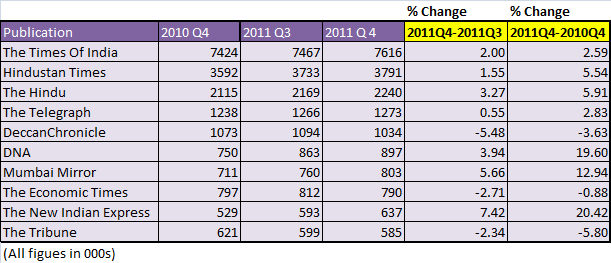
    The English dailies have performed exceedingly well in Q4, 2011. Seven out of the Top 10 English dailies have registered growth in their AIR. While DNA, Mumbai Mirror and The New Indian Express have registered growth in double digits, the top four English Dailies: The Times of India, Hindustan Times, The Hindu and The Telegraph have also witnessed growth quarter on quarter.


    IRS Q4, 2011 Vs Q3, 2011:

    The results for Q4, 2011 in comparison to the previous quarter also highlight the growth for most of the top Ten English dailies.


    Top 10 Language Dailies:

    IRS Q4, 2010 Vs IRS Q4, 2011:

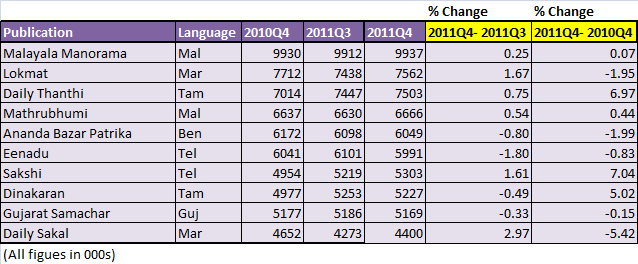
    The Q4, 2011 results as compared to the Q4, 2010 results have shown mixed reactions for Language dailies as only five publications witnessed growth since Q4, 2010 to Q4, 2011. Malayala Manorama continues to be the number one publication among the Language Dailies. According to IRS Q4, 2011 v/s Q4, 2010 findings, the Malayalam daily grew 0.07 per cent.


    Ranked second is Marathi daily, Lokmat which saw a decline of 1.95 per cent. The other Language dailies to have registered growth in their AIR are Daily Thanthi, Mathrubhumi, Sakshi and Dinakaran.


    Unlike the top two dailies, Daily Thanthi, ranked as third Language daily, grew by 6.97 per cent in IRS Q4, 2011 when compared to IRS Q4, 2010.


    It has been observed that the Malayalam dailies – Malayala Manorama and Mathrubhumi and the Tamil dailies – Daily Thanthi and Dinakaran have recorded growth in their AIR. Malayalam, Marathi, Tamil, Telugu, Gujarati and Bengali are some of the popular language dailies to have found a place in the Top 10 Language dailies.


    IRS Q4, 2011 v/s Q3, 2011:

    The top four Language dailies: Malayala Manorama, Lokmat, Daily Thanthi and Mathrubhumi have registered growth in their AIR numbers in IRS Q4, 2011 v/s IRS Q3, 2011. Besides the top four language dailies, Sakshi, the Telugu daily and Daily Sakal, the Marathi daily have also witnessed growth in their readership numbers.


    AIR or Average Issue Readership is defined as the readers of an average issue of a publication i.e. the estimated number of those who have read or looked at any issue of the publication within a specified time interval, which is equal to the periodicity of the publication (excluding the day of the interview). This is the preferred currency of media agencies across the country though often publications quote Total Readership (TR) when their AIR numbers are not impressive. MxMIndia only uses AIR in its IRS reportage.
  • IRS Q4 2011: Dailies flourish Year-on-Year


    The fourth quarter results of 2011 for the Indian Readership Survey were published on Monday and a quick look at comparing the numbers of IRS Q4 2011 versus Q4 2010 data, eight of the Top 10 publications – Dainik Jagran, Dainik Bhaskar, Hindustan, Malayala Manorama, Amar Ujala, The Times of India, Daily Thanthi and Mathrubhumi ­- have grown in their AIR (Average Issue Readership) Year-on-Year (YoY). Tamil daily Daily Thanthi and Marathi Daily Lokmat and Hindi Daily and the second most popular newspaper, Dainik Bhaskar  have registered the highest growths in AIR.


    When we compare Q3 2011 V/s Q4 2011, Dainik Jagran, Dainik Bhaskar and Rajasthan Patrika witnessed a slight decline in their readership. Dainik Jagran, Dainik Bhaskar, Hindustan, Malayala Manorama and Amar Ujala have retained their spots as the top five publications.


    After looking at the numbers, MxMIndia spoke to some of the publications for their views on the IRS Q4 2011 Topline numbers. Mr Rahul Kansal, Chief Marketing Officer, Times of India Group said: “Overall, I am quite happy with results, we have done pretty well in most of the markets including Delhi, Mumbai and Chennai, where we have seen very good growth.”


    However, Mr Rajiv Verma, CEO of HT Media Ltd, is disappointed with the IRS numbers but said in a statement, he will continue with investments in various markets. “While Hindustan Times has for long been No 1 in Delhi and No 2 in Mumbai, and Hindustan and Mint have consolidated their positions in their respective markets, as a group we are disappointed that these IRS numbers don’t reflect the full picture of our growth, and the reality of our investments and our efforts in the various markets across the country. However, we will continue to invest in various markets, to meet the needs of our readers and our advertisers, and will hope that the readership growth will be fully captured going forward.”


    Mr Sanjeev Kotnala, Vice President, Dainik Bhaskar Group said: “The IRS figures justify our focus on the urban, non-metro cities. Dainik Bhaskar is the only Gujarati newspaper to have a readership of more than 10 lakh in cities like Jaipur and Ahmedabad. If you see the figures for only the urban, non-metro cities, then you will realise that Dainik Bhaskar dominates the list. As far as the overall figures are concerned, we feel that it is a minor fluctuation, nothing major as far as our own perspective is concerned.”


    Speaking on trends from IRS Q4 findings, Mr Gautam Dalal, Vice President, Marketing, DNA said: “We observe that within Mumbai there is an increase in the overlap of English dailies readership – for every two readers there are three dailies being read. Mumbai, therefore, is seeing more penetration of English dailies and the trend of reading multiple newspapers is on the rise. Having such a high overlap percentage is a positive sign.”


    “In Mumbai we have had the highest number of growth for DNA, and these numbers are a testimony to our stand of having a high level of copy supported by the cutting edge editorial and by a focused market programme,” he added.


  • Print shines in IRS2017


    By Indrani Sen


    The IRS 2017 Topline Report released on January 18, 2018 has reinstated the advertising and marketing industries’ trust in audience research. Kudos must be given to MRUC, RSCI and Nielsen for getting the world’s largest readership survey back on track. IRS 2017 is a definitely a richer version of its predecessors, backed by enlarged sample size, changes in methodology, introduction of new readership metrics and concepts enabling in depth analysis of not just print media but overall media consumption. The strict scrutiny and quality control designed and deployed by the IRS TechCom helped in ensuring the accuracy of the findings.
     

    MRUC however has to revisit the common NCCS definition and the durable based grid as already pointed out by Shripad Kulkarni in “IRS 2017 Top 5 Takeaways” on January 19. With rise in electrification, LPG stove ownership, B&W TV production becoming obsolete and every third home possessing a two-wheeler, it is not surprising that NCCS D/E have been found as “Fast Shrinking”. However, the reality may be different riddled with power cuts and shortage of LPG Gas cylinders, particularly in rural areas. Ownership of colour TV provides the 24X7 entertainment to the entire family at a very low cost through cable operators and DD’s Free Dish. Ownership of two-wheeler is a necessity for a livelihood to many living in Tier 2 and Tier 3 cities. How far the ownership of ceiling fan, LPG stove, two-wheeler and colour TV will help us in the socio-economic classification indicating the disposable income of the house holds should be re-examined. At the upper end, NCCS A1 and A2 seems to be apparently stagnant, however, based on the growth in the number of total households, there has been a few crores growth in the numbers of A1 and A2 households.


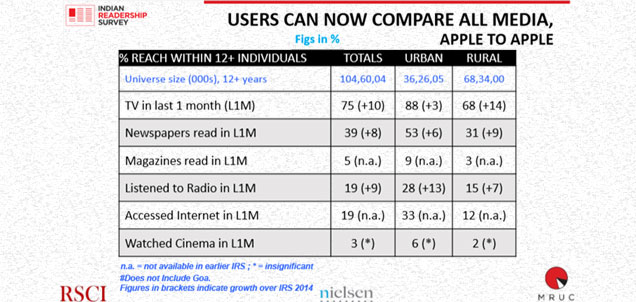
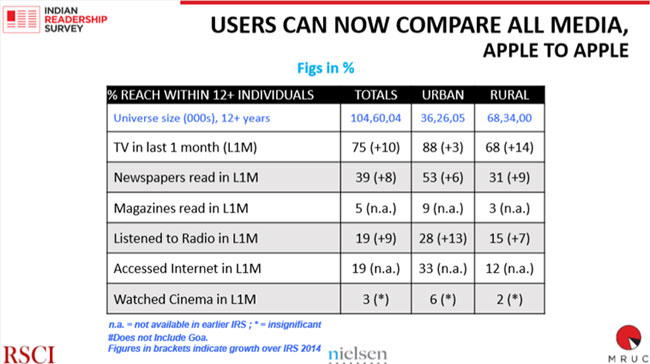
    In spite of the growth in urbanisation, 2/3rd of the almost 30 crores home in India still belong to the rural area. It is encouraging to note that TV reach and Newspapers reach are growing at a faster rate in rural area than in urban area.Again radio reach and newspaper reach are growing at faster rate than TV reach in urban area.

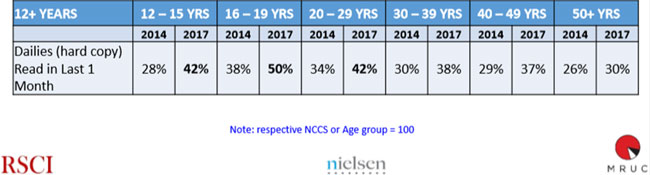
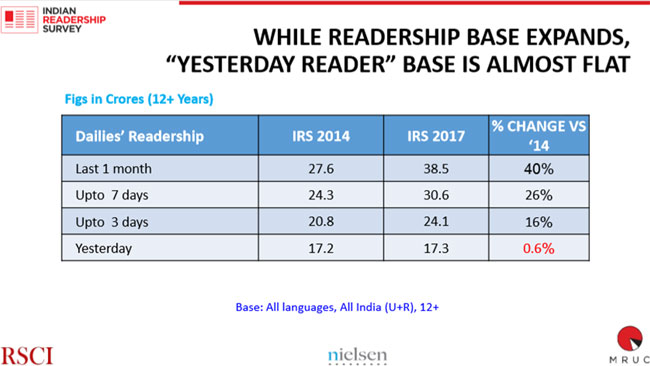
    All these reach figures are calculated on the basis of reach within 12+ individuals in last 1 month, the new readership metrics introduced in IRS 2017. Dailies added 11 crore readers in last three years, of which 4 crores came from urban India and 7 crores from rural India. On the demographic front, the readers among the younger age groups (12-15, 16-19, 20 -29 years) have shown higher growth than the older age groups. With more than 40% of our population below the age of 20 years, this trend is encouraging for the future of Print media.

    The high readership among the younger age group probably explains the stagnation in the yesterday readership against the growth in the other categories, up to 3 days, up to 7 days and last 1 month. Readers below 20 years and in their early twenties may not be regular readers of newspapers due to their pre-occupation with studies and other activities.

    This rise in readership of newspaper among younger age groups is a phenomenon of non-metro Tier 2 and Tier 3 cities and rural areas as we do not see the reflection of this trend among the youth in the metro cities, skewed to English medium and digital media. IRS 2017 has found that newspaper read online is only 26% among NCCS A1, so our educated urban youth probably are engaged with other content on the internet.


    Except Times of India which ranks 11th,the Top 20 dailies are all in Hindi and other regional languages. From 2014 to 2017 most of the regional languages dailies have grown more than the growth of English dailies (10%). The highest growth has been achieved by Oriya which, from a smaller base, has grown by 83% while Bengali has grown by 9%. Among the South Indian Languages, Telegu has grown by 66%, Tamil 44% and Kannada 37%. Malayalam newspaper market is more saturated and has shown only 19% growth. Marathi has grown by 31% with Gujarati scoring above it with a 45% growth. Hindi has also grown by 45% while Punjabi and Urdu have grown by 51% and 53% respectively from smaller bases.


    Armed with the findings of IRS 2017 and various other studies which show the growth potential of the smaller towns and rural areas, it is high time for the language newspapers to challenge the difference in the advertising rates of English and language newspapers in India. Marketing communication in any regional daily can work effectively when the content is also effectively designed in the same regional language and is not a poor translation from English or Hindi.As our creative agencies have not shown much interest in developing content in regional languages, perhaps the regional language newspapers can explore the option of developing advertising content for their own markets. If journalism can develop so well in regional language, it may not be difficult to develop advertising content and increase profitability in the new era of content marketing.


  • MRUC releases IRS 2019/Q3

    By A Correspondent


    Just last evening young Ramesh was celebrating with his family that his parents would celebrate New Years’ Eve at home with him. He still recalls how the big Independence Day holiday that he was hoping to celebrate got messed thanks to IRS 2019/Q2 being released. But alas, Ramesh’s dream of a holiday are going to be shortlived. Earlier today (December 28), at 5.08am to be precise, our inbox received the all-important communique:


    The Media Research Users Council (MRUC) has announced the release of IRS 2019Q3 data. The 2019Q3 data is a rolling average of the last quarter of IRS 2017 (Q4) and three quarters of IRS 2019 (Q1+Q2+Q3). IRS 2019Q3 fieldwork covers August 2019 through November 2019.


    Notes a communique: “Multimedia consumption is the order of the day with each medium holding on to their loyal consumers. Overall media reach has grown with digital leading the growth trajectory.”


    In view of sample shortfall in Andhra Pradesh, the IRS Technical Committee has decided to release IRS 2019Q3 data excluding AP, as of now. The IRS 2019Q3 data including AP will be released in a fortnight’s time. Comparative analysis until then, at all India level, will not be permissible. While the reporting sample size at all India level (including AP) is 3.30 Lakh Households (Urban: 2.14L Households and Rural: 1.15L Households), without AP, the reported all India sample size will be 3.15Lakh Households (2.05L HH in Urban and 1.09L HH in Rural).


    IRS2019Q3 fieldwork in Jammu and Kashmir was adversely affected because of political and administrative developments in the State (now union territory). In consultation with the IRS Technical Committee, it has been decided to report J&K data  by utilising and projecting the last four quarters of IRS data i.e. Q3+Q4 2017 and Q1+Q2 2019 to the updated universe for the current round of IRS 2019Q3.


    Commenting on the release of IRS 2019Q3 data, Pratap Pawar, Chairman, Sakal Media and Chairman of MRUC said, “IRS being the world’s largest survey not only reflects the ground reality in terms of print readership, but also for other media and product consumption. The stringent field monitoring system, rigorous data validation processes and the overall methodology of IRS ensures the industry gets a robust and reliable data.”

    Added Vikram Sakhuja, Group CEO Madison Media & OOH, Madison World and IRS Technical Committee Chairman: “The IRS is a fascinating barometer of how India consumes Media.  From this round we see that Indians consumption of media continues to grow with digital growing on top of other mediums remaining steady. I would urge all marketers to deep dive into the data. There are fascinating insights about the diversity that is India waiting to be found.”


    Please click here for deck of IRS 2019Q3 Highlights

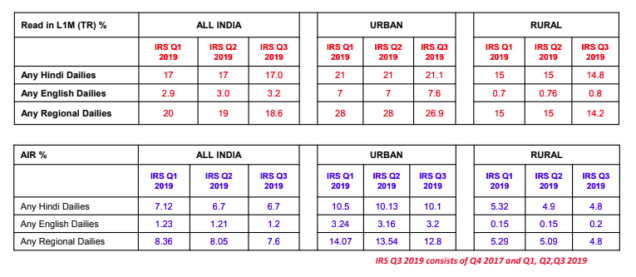
    Some pointers from the all-important AIR and TR slide:

    • English readership grows. Grows or stays steady in most of the country except for Uttarakhand where it has gone down by 1%

    • AIR Hindi dailies All-India is the same vis Q2. Urban has degrown by 0.03%. Rural goes down by 0.01%

    • AIR English dailies vis-a-vis Q2 All-India has degrown by 0.01%. Urban has grown by 0.04% and rural also by 0.05%

    • Any Regional dailies AIR: vis-a-vis Q2 AIR has gone down by 0.09% in All-India. Urban has gone down by 0.06%, and Rural by 0.29%

    • TR Hindi dailies All-India is the same vis Q2. Urban has grown by 0.1%. Rural goes down by 0.2%

    • TR English dailies vis-a-vis Q2 All-India has grown by 0.2%. Urban by as high as 0.6% and rural also by 0.04%

    • Any Regional dailies TR: vis-a-vis Q2 AIR has gone down by 0.4% in All-India. Urban has gone down by 1.1%, and Rural by 0.8%