Category: COLUMNS

  • Ranjona Banerji: Why is war like a children’s game for our news channels?

    By Ranjona Banerji


    The news website Quint, started by entrepreneur Raghav Behl who also once owned Network 18, put out a story on Thursday that Indian Special Forces crossed the Pakistan border and killed 20 terrorists to avenge the Uri attack. This is a story right up our wear-on-your-sleeves patriotism currently on trend. Times Now apparently (this is hearsay evidence, I did not watch our Chief Patriot on Fire) was also gung-ho about this operation, though why it did not break this “exclusive” story, I cannot say.


    The rest of the media and this includes our other patriotic news channels rubbished Quint’s story. Whether that is because the story is bogus or whether the rest were jealous, I cannot say either.


    But I can say that what is a very serious problem between two neighbouring states (one of which has consistently attacked India in a number of ways) has turned into a Who’s The Better Patriot battle between competing TV news channels. It’s almost like a children’s game, apart from being so bizarre and bereft of responsibility.


    NewsX continues to scream and shout about leftists not being up to its anchors’ ideas of ‘patriotism” and India Today TV made much of a “top secret” meeting chaired by the prime minister. Although the fact of the meeting should not be unusual because one would expect several such meetings after the Uri attack; significantly our patriots do not know what happened at the meeting so close but no cigar.


    If there ever was a divide between print and TV journalism, it is most evident now. Matters of war and international relations are serious. The complete lack of depth in our public discourse since TV is the dominant media is now proving to be dangerous. This is not the usual complaint of glamour and frivolity getting more attention than “serious” news. It is far worse. This is “serious” news being treated like it was a Hollywood or Bollywood action blockbuster.


    As for the Quint story about the “revenge” for Uri, it is most intriguing. If we work on the principle that journalists must carry any story they get (bypassing the New York Times’s famous motto of “All the news that’s fit to print”), then Quint had to carry its “exclusive”. But a little further thought takes you into the mindset of whoever leaked the information to Quint. Usually most countries keep their covert operations, well, covert, for self-evident reasons. So why was this operation revealed? To buy a little street cred with war-hungry patriotic votebanks? Or was it just a story sold to a credulous reporter? Despite the backlash, Quint has stuck to its story, so perhaps its sources want to ensure that this idea is out there even if it threatens future covert ops by India.


    I sincerely urge my fellow journalists to watch the Barry Levinson film, Wag the Dog. A little cynicism is necessary if you want to be a journalist. I phrase it like that because I feel there is some hope yet for my compatriots in the world of television news.


    **


    There’s war, there’s Syria, there’s racial tension, there’s the fight between Donald Trump and the sentient world and then there’s “Brangelina”. First, cynically, one has to give thanks that this awful portmanteau word will no longer be heard. Second, how important is it to anybody that Hollywood actors Brad Pitt and Angelina Jolie are about to divorce? Actually, extremely important if you consider the amount of space and time this split has been given in the media. There was plenty excitement when Pitt left Friends’ star Jennifer Aniston for Jolie. But that was over a decade ago and basically, what is so surprising about Hollywood stars not being married to each other any more?


    Was it one of the Gabor sisters who said she was a housekeeper because every time she got divorced, she kept the house?


  • Ranjona Banerji: Hail the Patriotic News Anchor!

    By Ranjona Banerji


    How disappointing life must be for our so very patriotic TV news anchors and their “guests”, handlebar generals and all, who were clamouring for a war with Pakistan after the attack on the army base at Uri. The Prime Minister of India, who promised his followers strong and stern action against our troublesome neighbour before he was elected, decided that the way to beat Pakistan most effectively was to compete with it on who gets rid of poverty first.


    But fear not. Our patriotic colleagues in the world of TV news are past masters at the art of shifting gear (not much of an art actually when anyone who drives a vehicle can do it, but perhaps not with so much shameless aplomb). Immediately we went from war talk to fulsome and lavish praise about how Narendra Modi was now a “world leader” and a “statesman”.


    Those Patriotic TV Journalists with a little brain (this is a reference to AA Milne’s Winnie the Pooh, for those who are ill-read as well) may recall that they already called Modi all that and more when he invited Pakistan prime minister Nawaz Sharif to his coronation, when Modi zipped around the world in 300 days in his first year as PM and when he dropped into Sharif’s birthday party in December last year. However, selective amnesia is useful and short-term memory loss is essential for TV news anchors, especially when you want to make some point, any point to stir the pot night after night on television.


    Modi having now declared a war on poverty (shades of Indira Gandhi’s “garibi hatao”, anyone?), our TV anchors were left with their own problems. The next idea that came to them was “meetings”. These are secret things that happen in government and high places. So everyone informed us that Modi was going to have a “top level” and “secret” meeting about the Indus Valley Treaty – a water-sharing deal between India and Pakistan which was worked effectively since 1960.


    It’s quite remarkable how many ways you can find to say, “The prime minister is going to hold a secret and top level meeting” (see how I switched those words around?), but they managed it.


    Since then the meeting has been held but I don’t know what happened. It was secret.


    **


    Meanwhile, the newspapers have quite cogently explained the Indus water agreement and how it works, for those interested. The upshot seems to be that the best course for India would be to use water which it is allowed to but has not done so far. The best course apparently is not to stop water to Pakistan. But as we all know, newspapers are nowhere near Patriotic enough.


    **


    External affairs minister Sushma Swaraj gave Pakistan a good answer at the United Nations General Assembly. Sadly for her however she will not be hailed forever as a world leader or a statesman by our Patriots because we can’t have so many of them from the same government in the Modi era.


    **


    There was an interesting discussion on Rajya Sabha TV the other day, on the way the problems with television news brought up the fascinating point of calling a discussion “live” when the same guest appears at the same time on another show wearing different clothes. Everyone laughed, no one had an answer.


    **


    Happy Birthday to Google! The search engine celebrates its 18th birthday today. There can be no doubt that Google revolutionised the way we work and for journalists at least, there is no better friend! If only TV people used it more often to find synonyms for “secret” and “top level”, no?


  • Sanjeev Kotnala: Model Village approach; the need of Rural CSR

    By Sanjeev Kotnala


    If one was to believe the rural masses and the message that comes loud and clear, then there is nothing called Corporate Social Responsibility. There are NGOs and charities but no CSR.


    The rural masses are clear that the need of CSR is seen as the failure of GSR or Government Social Responsibility. Truly so, as the government sees CSR as an efficient low-cost alternative towards an inclusive growth.


    If a company takes care of its employee or resource catchment area, the rural masses see it as a leveraging tool for the company final growth objectives and not as a social responsibility initiative.


    For a moment, let us distance ourselves from this point of view and try seeing CSR as a Corporate Action in Interest of Society. These CSR acts are guided by the responsibility an organisation feels towards the society. This arises from the impact of its operations on employees, community and environment. Most of the activities can be justified under this banner. However, when you add the filter of ‘Going Beyond Obligation’ and ‘Voluntary Action’, quite a few initiatives by government and private enterprise fail the test.


    Rural population is equally smart in understanding the initiatives with commercial slant and differentiating them from the one driven by passion. Not surprising that every company branded initiative is questioned. For example, If there is a dental brand which is populating oral care and hygiene in the villages, it is seen with a clear interest, and the population questioning the transparency and validity of the initiative. They are rightly able to see these as the brand’s way to push the sales of their products.


    Lacking deep understanding of the real rural area and is needs, most of CSR initiatives are fragmentally focused and restricted to the areas of health, education and environment. There are projects in infrastructure, skill enhancement with a socio-economic tint, nevertheless, hardly anything on sustainability of processes, efforts and results.


    The CSR efforts are shallow, patchy, fragmented, and obligatory. Many a time, it is just a formality. People working in these forums and organisations are not sure of the funds, Manpower, commitment and other resources. There is hardly any assurance of initiative longevity, forget about sustainability. No doubt, it faces acute talent shortage.


    The CSR still is an HR baby. Very few organisations have CSR departments and most try working through remote control. Some of them will be better off by buying into an NGO’s initiative in the area of their choice, funding and monitoring it.


    Rampant irrational mushrooming of CSR is giving birth to another problem, something that the organisations and government is yet to take cognizance of. The town-ward migration of the CSR influenced population. The current set of CSR programmes are built without any thought of how it impacts migration (the right word will be fleeing) from the rural area and economy. Currently, the prevalent education initiatives just facilitate migration. There is no understanding of ‘reverse migration’ which can be created by concentrating on employment and viable livelihood based on the resources available in the area.


    There are hardly any initiatives that completely focus on amplifying, archiving, preserving and transfer of rich rural heritage, geographical knowledge, region-specific skillsets and amplification of natural resources. The kids in the rural area are busy aping the towns with a ‘A for Apple’ approach.


    On top of that there is a fragmented sector development approach. The rural mass is subjected to lopsided treatment under the CSR umbrella. So depending upon the corporate initiative and the current fad, the village finds itself driven through the path of education, women empowerment, vaccination, swatch Bharat or such schemes. Yes, they call it scheme. It is here today and gone tomorrow.


    I am of a strong point of view that it is useless to work in just one or few areas. It requires an all-round push? Proper coordinated efforts are required. A model village approach is desirable. It is a complex ecosystem there. Here, it is essential that multipoint collaborative initiative by Government, Private ( read corporate), village and NGO should work in sync.


    There is a need for the CSR implementer to take the beneficiary in complete confidence while attempting to create sustainable socio-economic initiatives. These should be moulded and approved basis the need-gap analysis and not just transplantation of a successful project at some other point. The impact effect must be honestly tested with rigor at a pilot level before they are replicated. Hopefully, this can ensure positive transformation.


    It is true that the CSR initiatives by corporate are far more systematic, organised and monitored than that by the government. However, they are neither leak-proof pipeline for funds, nor something that is immune to target and impact manipulations.


    The rural India today needs efforts in all sectors. It means that all areas are tackled simultaneously as in a ‘Model village’ approach. Maybe there is a need for a central body that collates all the inputs and contribution and allocates them in a focused geographical area to create desired impact. The template is then used to amplify, catalyses the whole process with regional tweaking. It may be good to collate the CSR funds from corporates and divest them in a more organised fashion under a completely independent autonomous body.


    I know the mere thinking in this direction is a problem. If someone even smells of this idea reeking of huge fund deployment possibilities, the corrupts will start honing on the


    I think there is a strong need for Four-point action.

    1. Work with Model village approach and a central nodal body (explained above). Model village approach requires a simultaneous tackling of multiple areas with sustainability and self-reliance in focus. Work needs to happen across identified areas like Education, health, infrastructure, cattle welfare, farm mechanisation, local skill, localisation. Sustainable livelihood, watershed management, etc.
    2. laws to stop mushrooming crop of NGOs need to be framed. Currently, it is too easy to create a NGOs or a Not-for-profit organization. Check organisation, which are just on paper.
    3. Corporate should only be allowed to engage a pre-approved set of NGOs, which have passed certain scrutiny and have proven themselves in the field. Organisations like ‘Deepalya’, ‘Nudge’ and ‘Aid-et-action’ can really help drive CSR initiatives more effectively in the area of education, woman empowerment, skill empowerment and health.
    4. Create robust monitoring and audit process / regulation for CSR activity. Currently, CSR field visits are more of CSR tourism. The stakeholders are taken through the luxurious window of staged impressions.
    5. A corporate must choose a limited set of areas based on its strength and capabilities. This may help create focus, and avoid dilution of efforts.


    It may sound counterproductive as large organisations like Tata, GAIL, Bharat Petroleum, Infosys and Mahindra may be able and willing to act on multiple fronts in rural areas. These should be allowed to adopt an area for all round interventions without the need of a nodal body.

    …………………………………………………………………………………………………………………..

    CSR in a rural perspective is new to me. And what I above is pieced together from alumni of Agriculture Engineer colleges and IIM Agriculture Business Management as well as few NGO. The area of feedback is more centrally located and hence cannot be considered national sample. However, knowing the way success is duplicated and failure is avoided within corporate, rural and the Government ecosystem, one can with a fair degree of surety can extrapolate this for the country.

     

  • Siddhartha Mukherjee: Ad Agency business needs to showcase Value & Variety!

    By Siddhartha Mukherjee


    A few days back, we saw the acquisition of one of the largest home grown PR Firms by a global media and advertising giant. While talks of this PR firm’s buyout were doing the rounds since a couple of years now, what is interesting is that the final acquirer actually turned out to be an ad agency network (given that PR Global Firms had also shown interest to invest).


    Given that ATL or Advertising has been the mainstay for most such networks, the growing ineffectiveness of this tool is forcing media agencies to showcase diversity and value additions. Building up internal value adds like PR Consultancy and Implementation skill sets renders them this benefit.


    Going forward, it will be interesting to observe the following:

    a) Financial & Growth benefits: It will be interesting to see the net additional growth benefit this PR Firm accrues under the aegis of a Media/Advertising Agency.

    b) Changes in Work Culture & Ethics: Having operated as in independent entity for decades, it will be interesting to see how this PR Firm settles and merges within the work culture and ethics of this Media/Advertising giant.

    c) Showcasing of PR prowess: Without generalising though, let us face it that the Advertising world doesnot really understand what the PR services actually do or the effort and planning involved in it. Needless to say, they feel the industry is all about liquor, killing negative stories and chasing journalists to publish news clips. Therefore, it will be interesting to see if this PR Firm is made to work with the advertising side of the business or will it be treated as a side business, showcased to the client as a cosmetic enhancement.


    The future potential is in making the advertising and public relations stimulis work together for brand buidling. While Individual PR Firms have seldom got the opportunity to work together  in partnership with their advertising cousins, the success of them as a part of Advertising Umbrella business depends on how the Parent perceives this business.


    How well a traditional advertising and media agency understands the PR prowess and projects it to the client world will be part of the future observations.


  • Shailesh Kapoor: Uri & After: Finally, we can see some news!

    By Shailesh Kapoor


    It’s 12 days since the Uri attacks on September 18. The incident, and its aftermath, which included speeches at the UN General Assembly and the surgical strikes late Wednesday night, has meant that newsrooms across the country are in the middle of their most active and substantive period in a long time. 2016, in particular, has been a slow news year.


    With the exception of the Pathankot attacks in January and the state elections in May, rest of the news has been fairly routine. In a multi-channel scenario, accentuated by the presence of countless digital news platforms, this meant that news had to be created out of thin air. The need to do that comes with its own share of theatrics and hyperbole, because after all, who’s interested in soft presentation of soft news!


    But the last 12 days have been different. It’s like those old times when you go to a news channel because you actually want to watch something that’s of interest to you. Historically, news has been most purposeful genre on television, across the world. News viewers have had an imagery of being learned and intelligent, and even if stereotypically so, a lot older than the average populace.


    But across the world, over the last two or three decades, the definition of news has evolved to include things that are more socially relevant and have the potential of becoming hot discussion topics, even if they lack depth of impact over a period of time. This is probably the only definition of news the millennials understand.


    I’ve been watching the coverage over the last 12 days with great interest. How does a media that is so used to serving news is a flashy, dumbed-down package to appeal to the vast fringes of news viewing respond when it has to cover something several notches more important than what it “covers” day in day


    By and large, there has been pleasant surprise on offer. Restraint and maturity are not words you would associate with the Indian media (or most media across the world today), but we saw glimpses of that over the last 10 days. The government at the Centre played an important enabling role here, by being direct and decisive in its communication and action. If we leave out the silly side story fueled by MNS, related to Pakistani talent in India, the overall coverage has an air of urgency and responsibility around it. For the first time in what seems like forever, the messaging is consistent across channels, anchors and most political groups, barring a few that are left-aligned.


    It’s not as if the DNA has changed, though. Within three days of Uri, we had Pakistani guests on a few channels, including on The Newshour. And we had Barkha Dutt wondering, at least on Twitter, why they are being called. Arnab Goswami continued to dare “some channels” who have acting as peace doves to come out of their proverbial hiding. Name each other, can’t you? It would be a lot more interesting that way.


    Clearly, the story around Pakistan is still developing. It may take, even months, before it finds its way in the soft news section. The real test of our newsmen and newswomen is still to come. We saw during 26/11 how the media was just not prepared to handle an issue of national importance. Have they learnt their lessons? 2016-17 may just give us the answer.


  • Ranjona Banerji: Is this journalism?

    By Ranjona Banerji


    There is a “small, irrelevant” group of people, declared India’s star TV news anchor Arnab Goswami last night, who insist on talking peace with Pakistan and are against the Armed Forces (Special Powers) Act. The implication is clear: this small, irrelevant group of people – presumably those who have questions about the Indian Army’s “surgical strikes” on terror camps in Pakistan-Occupied Kashmir – are traitors, anti-nationals, anti Armed Forces and so on.


    Since one major swathe of TV journalism – not just Goswami, although he is leader of the pack, sorry all you wannabe pretenders – has moved as far away from journalism as possible, is there any use in pointing out that the AFSPA has nothing to with these surgical strikes? The Armed Forces exist to protect India and Indian territory from hostile attacks by foreign nations. But AFSPA’s provisions have been used to cover up abuses committed against Indian citizens. Should no one speak up – small and irrelevant though this group may be – for the women in the North East who allege they have been raped by Armed Forces and security personnel?


    Irom Sharmila of Manipur was on continuous fast for 16 years, until she ended it this year, trying to pressure the authorities to repeal the AFSPA and get justice for victims of human rights abuses. To many people – not just in Manipur but in the world — she is a hero and this is not by any means a “small, irrelevant group”. In any case, the joy of a democracy is that even a “small, irrelevant” group is allowed to have a voice.


    Patriotism and nationalism are fine qualities. But here’s the thing: The Armed Forced are made up of human beings. Some of those human beings can and will make mistakes, will abuse their power, will overstep the line, will cover up for the behaviour of others, will lie about their age, will become spies, will be involved in shady deals. This is human nature. It may be patriotic to respect the Armed Forces. But it is not patriotic to worship anyone when you are a journalist in a democracy. If I was a TV journalist, would I declare that the court which convicted former army major general Anand Kumar Kapur for disproportionate assets “anti-national”? Perhaps I would, because showmanship, specious logic and spurious home work are the hallmarks of some TV news anchors.


    What is the job of a journalist at time like this? From the time that the US made “embedded” journalists some sort of a medal-winning performance during the George W Bush Gulf War, militaries have used the opportunity to use the media to block all criticism. India now has a whole herd of TV journalists who see the Kargil war as the ultimate statement of patriotism and build their reputations on that. The cost of war itself they are oblivious too – although if they saw what was happening in Syria right now for instance, they may get some clue.


    To answer my own question, the job of a journalist at any time is to collect facts and ask questions. This job remains the same whether you are asking film stars what she or he had for lunch or asking a government spokesperson about any claims made by his or her government. Being a jingoistic cheerleader – even if you belong to a large and relevant group – is not journalism.


    So therefore, after India’s surgical strikes on terror camps in Pakistan Occupied Kashmir, you give your viewers or readers whatever facts you have been able to gather about what happened and analysis of what this means. The rest is personal aggrandisement. The rest is looking for handouts. The rest is an ego trip. And the rest is whatever I say is right and how dare any small or irrelevant group disagree with me.


    By the way, I may be small and irrelevant, but this is my column! So shoot me!


  • Ranjona Banerji: The Invented Absurd of News Television

    By Ranjona Banerji


    A fortnight since the attack by Pakistani terrorists on the army camp at Uri and we have not changed the discourse in television media. The calls for war are not just getting louder but are also careering from outrage to outrage in way that makes a mockery not just of journalism but also of good sense.


    A good number of our TV news anchors are now wearing a permanent expression of almost mystified fury: how dare anyone criticise their cries for war? Does no one want to avenge the deaths of Indian soldiers? Unfortunately for them, two words come to mind: Cynical and Disingenuous. It is evident that their war hysteria is carefully calibrated and aimed at increasing viewership. Their pain is bogus. Therefore, Cynical and therefore, Disingenuous.


    For how long people are going to fooled by this strategy is another question. There are other issues that would ordinarily interest journalists but not apparently the Patriots in news television. The deaths of the entire Bansal family after AK Bansal was jailed during a corruption investigation contains many levels of interest: top of the pile is Bansal’s accusation that he was tortured by a CBI officer who boasted of his closeness to BJP president Amit Shah. There is also the human interest story of four people in one family committing suicide. How many prime time TV discussions have we had on this?


    You may point out that it is unfair to ask such a question. Each media outlet has the right to make a judgment call and decide which issue it wants to highlight. That is 100 per cent correct. But this is a branch of the media which headlines the same sort of question to just about anyone: “Why has X not spoken out against Pakistan?”, “Why has this Pakistani person not condemned his own country” and such.


    Any journalist who wants an answer to those questions needs to go and ask the persons concerned what they think. It is easier however for an anchor to rant and rave, then call up a few people who also rant and rave, to go on Twitter and report on anyone else is ranting and raving or not ranting and raving.


    This is in fact the normal tactic of an internet troll, to accuse someone you follow of not speaking on this subject or that. The accusation is made without research or reference. A troll though is looking to annoy and provoke. What is a TV anchor purporting to be at the forefront of news trying to do? Further the cause of the Fourth Estate by inventing issues?


    The monsoon in India has been destructive and inconsistent across the country. Do we perhaps need a primetime debate on environmental degradation and water and the future? If you want a further “peg”, you can try the Paris climate deal. How many discussions on reworking the Indus water treaty with Pakistan focused on the diminishing reserves in the Indus basin aquifers – something that will affect not just the subcontinent but also the planet?


    How many primetime discussions have we seen on all the claims being made by various regions across India that they are now “open defecation-free”? All of us who live in India usually don’t have to do more than look out of the window to know the truth. How about the continued abuse of Tribals in Chhatisgarh or is that too anti-national a subject to discuss? Farmers? Have they magically become better off since we last discussed them? Black  money? Defence deals to friends of the government? The state of telecom? Jayalalitha’s health? What went wrong at Uri?


    No. Evidently, the invented absurd is all we are interested in.


  • Sanjeev Kotnala: Do you have a combat strategy for a completely naked market?

    By Sanjeev Kotnala


    This is a time of great anxiety for the marketers. The traditional synchronised product development process that they so wisely learnt and understood was never a complex process. It was a seamless choreographed process. The collaborating teams from verticals like research, manufacturing, marketing, communication and sales found their unique ways to formulate benefit claims to dress up the show. The nervous consumer got his kick and the counter the sound everyone loved.


    In case of doubt, the marketers had the option to fallback on technological inspired jargon, newly initiated rituals, comparative sheets and slogans were available to enchant the consumer community. A wave of experiences and front-loading of sales was all that was needed for the brand to gain some momentum. The war of sales and distribution was fought on ground zero.


    Media and communication have always been critical for success. Slick glamour quotient upped by the celebrity endorsements along with beautiful location seduced consumers from every screen and page. Consumer continued to believe everything that was printed and screened. Moreover, consumer education in the category, product or brand usually was completed at the retail point the last point of connect.


    Marketers today are like the king with no clothes. The brand no longer can hide behind the fig leaf of campaigns and survive on after-sales service. In the era of information and technology, the new WOR (Word on Review) and comparison, nothing is hidden. The consumer does a much deeper research and finishes comparative analysis with a click. They have the power to read, listen and decipher original, copied and fake voices in reviews. Additionally, the social media allows them the chirping feedback and experience from people they trust and believe in. It is more powerful then the nest of the demonstrations and TVCs.


    Marketers rightly believed they could strengthen, create or break perceptions. I have been on that side spending nights over these discussions, and feeling elated when ever the consumer appreciated efforts by the ringing counters.


    It will be faulty to believe that the same is true today. The foundation of brand’s early imagery may still be initiated by the campaign and the buzz; however, the final skew of perceptions gets strengthened over media and input they hardly are able to control.


    Truly, in the era gone by, a unilateral unholy alliance between client and agency rarely had the consumer in sight. Earlier, role and touchpoints were very compartmentalised and hence leveraged differently, unfortunately. The boundaries have blurred.


    The consumer mindspace is cluttered and enriched with all the data and analysis much before contacting the retail salesman. We are slowly but surely moving to an era where last mile connectivity will be dominated in digital space with retail point (if at all) remaining a mere formality. The consumer belief in manufacturer statement is low. Higher credence is given to influencers, prosumers and existing users and buyers. They have their set of consumer points to refer and connect with.


    This as expected is creating a new set of third party validation of products and services. It’s not rare to find an automobile service centre calling you for good review in JD Power survey. Or the hotels and airlines follow up for fresh review with loyalty points. Earlier, such validation and reviews were more B2B-centric. Currently, they have become hygiene even for B2C and B2I.


    Brand owners and custodians may like it or not; the guard is down in the overtly naked market. The layers are slowly and surely being ripped off the celebrated positioning and promises experiences. The brand was never more naked then this.


    Unfortunately, most of the comments and reviews tend to be full of negativity and issues faced by the consumer. Not only, it’s tough for the brand to match the expectation of most of the market, but humans are known more to crib than appreciate. One cannot discount these digital pouring across social media and review sites. These are more than free unsolicited advice and feedback.


    How well-equipped is the brand to listen to the digital noise? Can it filter the contextual remarks, understand the language tonalities and its implications? Who is watching such matrices and at what frequency? How empowered is the frontline? Do they need to confer with upper management to tackle everyday situations? How good the brand is in anticipating issues? Does the brand have a cohesive policy of internal education on issues of market nakedness? There are too many right questions with few complete answers.


    What is liked and who like’s it, is a valuable trigger for future sales. More important is that the reviews also tell you what is being disliked or what are the points in product, brand or service the marketer need to iron out? Reviews are the opportunity to engage the audience. It will most likely create a positive impression if the organisation starts listening and acting on the needs.


    ‘Good news must travel, but the bad news must travel faster’. The organisation must be alive to such situations and convert them into positive experiences. There is an absolute need for efficient management of external perceptions. For this, there is a need for review, buzz and feedback promotion strategy, along with listening and monitoring the noise. In this, a system that is empowered and does not require frequent escalation works best.


    Remember that digital impressions are never can be wiped, they are permanent in nature. The organisation of today have to engage all consumers, satisfied or irritated. The only way to burry a negativity is to create higher level of positivity.


  • Ranjona Banerji: Will Times Now learn something from its owners?

    By Ranjona Banerji


    A “brave” reporter from CNN News18 phoned a Pakistani police officer in Pakistan Occupied Kashmir, claimed to be his boss and found out that India did attack several spots in POK, kill and wound several jihadis and that these jihadis were supported by the Pakistan army.


    This was obviously played up by the channel as “proof” that India did conduct “surgical strikes” inside the Line of Control because it had been confirmed by this one police official, even if the Pakistani authorities were denying anything happened.


    Some questions: sting journalism itself is questionable. Journalistic ethics demands that you declare who you are to the person you are questioning. Journalists are not interrogators either authorised by or employed as spies by the Indian state. There is another intriguing aspect to this “sting” – it suggests that the news channel did not believe the Indian Army’s statement on the strike. The news channel of course would like to dress it up as trying to gather evidence for the naysayers and doubters within India and for the Pakistani authorities. It shows a distressing naivete about the way geopolitics works or of the complicated nature of Indo-Pak relations.


    Not surprisingly this “coup” was not picked up by rival TV channels or by newspapers as a major event.


    In fact, what has overtaken everything else is Bollywood. Because no matter what happens in the world it is vital that film stars, directors, producers, extras, dance directors, make-up artists, singers and stunt doubles et cetera comment on it. For Indian news television, this remains the biggest question of the hour: Patriotism for Indian news anchors is Bollywood saying all Pakistanis should go somewhere else. And for Pakistanis in India, here is a new kind of Tebbitt Test: if you want to work in India, publicly denounce Pakistan and its actions. What was seen as wrong in the UK in the 1990s when put forward as proof of loyalty for Pakistanis and Indians by a Conservative politician is now seemingly proper for Indians to use on Pakistanis. Talk about double standards.


    Actually, what is the use? Television in times of patriotism dances to a very different tune. Vineet Jain is Managing Director of Bennett Coleman and Company Limited, owner of The Times of India and Times Now among other properties. This is what he had to say on Twitter on October 6, 2016:


    “By supporting Pak artists v come out stronger globally.we get known as a liberal&peaceful nation.We isolate Pak even more among pak citizens”


    Contrast this with what Times Now and its editor-in-chief Arnab Goswami and his colleagues have been doing every day on the news channel. Jain’s tweet is wise and wide-seeing. It looks at the importance of soft power and its undeniable influence on choices. It is a long-term view on how to “infiltrate” Pakistan with culture and thought. Perhaps such subtlety of thought is beyond Times Now or it just does not care. As BCCL already informed us a while ago, the organisation is a “federal structure” where every editor is free to project whatever point of view he or she wants. Sigh. If only that were completely true.


    Meanwhile, forcing Pakistanis in Bollywood or random film people in India to denounce Pakistan is just smoke and mirrors. An attempt by Times Now to create drama and more noise than the next news channel one touch on the remote away.


    So, luckily, is the viewer’s choice to save himself or herself from idiocy.


  • Time for telly to look at customisation to up revenues


    By Shailesh Kapoor


    The most festive month of the year is here. The Navratri has started, Dassera is round the corner, and the month of October will be rounded off with Diwali. A large part of the commercial significance of this period revolves around the spending spree it fuels among consumers. Auspiciousness and celebrations come together in a period that’s an advertiser’s delight.


    Print has been the medium that’s traditionally benefited the most from this period. With no cap on inventory or edit-to-ad ratio, newspapers can add pages and supplements endlessly to monetize the festive fervor.


    Television has its own challenges. TV doesn’t allow you to add a front-page jacket and then another one on the top of it. Hence, the only two conventional ways to exploit the festive seasons are: By increasing the FCT available on the channel, and by launching big-ticket properties coinciding with the period. The former has been reasonably restricted in these days of the ad cap, putting all the pressure on the latter.


    A line-up of festive properties this year looks as good as any year, especially on the films front. Most movie channels, across languages, have big-ticket premieres and festivals planned. The world television premiere of Sultan, scheduled on October 15 on Max, is the marquee event here.


    On the original programming front, Bigg Boss will enjoy a festive launch, coming on October 16 this year. A series of fiction and non-fiction shows are lined up for launch too, but that would be the case through much of the year anyway.


    Which brings me to the question that I end up asking every year around this time: Are our TV channels doing enough to monetise the huge opportunity around this festive season?


    The gap lies in being able to create customized content for the festival advertisers. Just FCT-led exposure is tough to monetise, especially given the growing spends from the e-commerce category, which relies heavily on the more contextual digital medium for exposure.


    In the early years of satellite television in India, Advertiser-Funded Programming (AFP) evolved as a secondary source of revenue for the broadcasters. As such, it always got secondary status at the broadcaster programming end, even as some of the top media agencies tried their best to bring AFPs into the mainstream. For a programming head at a channel, an AFP is content he/ she is forced to put on-air. It would never get the same creative investment that a “regular” programme will.


    That could make some sense if your AFP is about an LG Microwave or a Philips Air Fryer. But the moment one thinks of a wider brand like Amazon, the opportunities of creating well-integrated, consumer-centric content, which creates entertainment and client value in equal measure, are endless. But there are very few such ideas floating around.


    You cannot expect a brand or its agency to do all the hard work here. The channels have to set the ball rolling from their end too. Various sales structures have been attempted across networks to enable this, but most such teams have becoming coordination points, balancing sales and programming, than focusing single-mindedly on adding value.


    Today, the internet is teaching TV a thing or two about customisation. Hope the TV guys are listening!


  • Sanjeev Kotnala: Does Pierce Brosnan’s class work for Pan Bahar

    By Sanjeev Kotnala


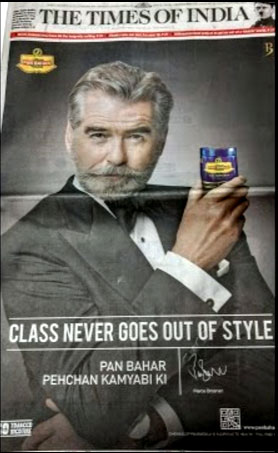
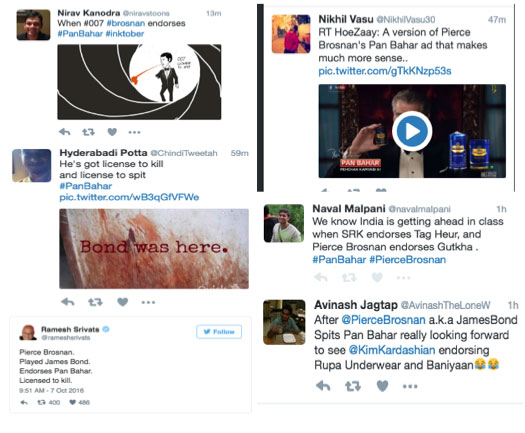
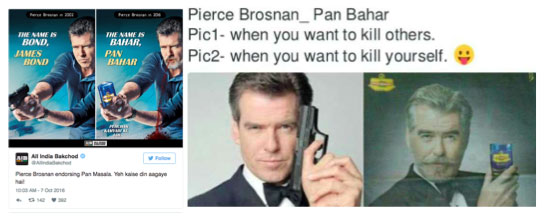
    I know this is late. In today’s world, this PANBOND event is no longer the news. However, the subject is not dead as the advertising community seems polarised in commenting on it.


    More has been said, commented and shared on the last Friday’s seemingly innocuous front-page press ad of Pan Bahar (PAB) that was talk of social media in India. There was a flutter in the segment hyperactive in social media. Pierce Brosnan (PB), the ex-Bond endorsing such a product. It may be noted that the 007 franchise prevents a direct reference to 007. Moreover, the brand in its different avatar is not only banned in many places but is tough to imagine him enjoying it. It’s a marketing subtle difference that the endorsed brand carries ‘mouth freshener’ tag and hence does not play foul to the suggestive industry guideline. It does not violate the recommendation that such products must not use celebrity endorsement. The brand escapes with a common advertising license to execute.


    The truth remains ‘Pan Bahar’ got an opening in social media. They neither anticipated nor were they prepared for the trolls. For a change, it was the press ad and not the TVC that triggered the reaction, once again getting print an uncalled-for attention. It anyway was a full-page advertisement. Few could refuse.


    There are theories about how this happened. In the famous ‘post-rationalization’ act that the industry is well known for, many would seem possible. I have no reason not to give credence to them.


    It could be seen as a brilliant move by the agency to get a celebrity like Pierce Brosnan to penetrate and open a new segment. May be, it was the owners; hell-bent on scaling the celebrity mental barrier jumping from also ran Indian celebrities to a Hollywood item. Could the idea have originated from the agents of cash-strapped Pierce Brosnan making it an enticing offer tough to refuse? Or some crazy media maverick in the team suggested this as a route to get the amplified impact in social media at a far lower cost.


    I am never one to jump to a conclusion. So, I did what was best possible and try getting in touch with few of the consumer. The conversations suggested that Pierce Brosnan was not exactly the right choice without the 007 tag. They do not recognise this bearded face. Most of them recall the active clean shaven look of 007. So, it does not stack-up.


    If one was to evaluate this attempt as a door-opener to a completely new consumer segments and gain inroads into fashionable impressionable population, it may fail the test but is not something irregular or unexpected. Moreover, the brand has the legacy of using celebrity endorsement. Why are these so-called intellectual voices when the Indian actors continue to patronize gutka (a chewing addictive mix known for health hazards)? Oh, may be it is acceptable but why Bond of all the people endorsing this. ?


    Going by the press release, it seems a genuine act of misplaced conviction. Quoting from it: Pan Bahar, a leading FMCG brand that links its identity to success, signing iconic Bollywood stars as the face of their campaign, ups its game, presenting the Bond of all commercials, shot in distant Austin, U.S.A. with none other than Pierce Brosnan.’


    The act is justified by the creative behind it, ‘Our choice of Pierce Brosnan as brand ambassador for Pan Bahar is in line with our campaign idea of ‘Pehchan Kamyabi Ki’ (the mark of success). Thanks to his previous avatar as James Bond, Mr. Brosnan is seen the world over as a symbol of sophistication, suavity and success. And Pan Bahar, as his choice, reflects that aspiration in the consumer base we were targeting’ it definitely sounds genuine.


    I am unsure, if the spoof and jokes erupting on the subject really work for or against the brand. May be the dice is not rolling in the way the brand would want it to, but give the credit for the brand to have attempted the unexpected.


    It is not the first or the last for Indian consumer to be exposed to such an endorsement featuring Hollywood actors. It is the reaction not for the association but the brand. How could a brand like ‘Pan Bahar’ has the audacity to think and act beyond conventions?


    The tagline “Pan Bahar. Class never goes out of style,” will not have many takers. I personally do not see any harm in this upward mobile attempt of the brand. Maybe what Bollywood could not do for the brand, this old Hollywood may succeed. The strategy is a bit convoluted and not on the track, but what were you expecting in this category and a brand like ‘Pan Bahar’. It is completely synergistic with the brand’s stated approach.


    The known health hazards make the endorsement controversial. It is another instance where the consumer segment is aware that the endorser is most likely not a user. No issue there. Do we really have the same reaction to Indian Film actresses pushing soap?


    Here is the stated rationalisation of the choice which many of us will continue to find fault with. Quote from company release “For us, the decision to bring Mr. Pierce Brosnan on board as Pan Bahar’s brand ambassador speaks volumes about our vision and ambition. His class, look, style, sophistication, facial expression and body language, etc. tell a lot about the mastery, maturity and perfection, etc. – He is like a master of various talents. Pan Bahar – a master blend stands for class, success and sophistication, etc. Hence; we see our association with Mr. Brosnan as a natural fit.”


    A comment by my friend Praful Mishra puts in differently. It’s Achche Din (good days) for a desi brand and maybe not a Burrey Din (bad days) for the Hollywood stars.


    The TVC or the AV is equally obnoxious.


  • Shailesh Kapoor: The GEC Middle Ground: Good vs. Bad Differentiation

    By Shailesh Kapoor


    The disappointment around the quality of mainstream GEC content in India is not a new topic, either for this column or for the industry as such. The media discourse around poor standards of fiction content on Indian television has caught steam over the last year or two. Loss of GEC viewership has meant that broadcasters have been left with little choice. They just have to take up the transformation process on high priority.


    Over the last three-four years, there have been several attempts at addressing this area, led by market leaders Star Plus and Colors. Colors has done two seasons of 24, Star Plus dabbled with finite fiction in Everest, Tamanna and Dahleez recently, and have now lined up P.O.W. Sony’s Yudh was not its first attempt at breaking the mould. After all, they started it all with YRF Television in 2010.


    Most, if not all, of these attempts, have been failures of worrying magnitude. Not only have these shows not rated over their lifespan, they didn’t even open well, indicating widespread concept-level rejection by the audiences.


    Casual observers will conclude that the Indian audiences are not ready for quality content and would rather be satisfied with the afternoon soaps they are being dished in the prime time. You get what you deserve, is an oft-mentioned argument. But that’s not an accurate assessment of things.


    There’s high level of operating dissatisfaction, as is apparent in falling ratings and low levels of launch ratings of new fiction shows. Yes, dissatisfaction is an opportunity, but conditions apply. A dissatisfied consumer will still apply her due filters in assessing the “differentiated” content on offer. And irrelevant differentiation will never cut ice.


    And that’s where the problem has been. Almost everything that been attempted as differentiated content has been conceived at the expense of viewer relevance. Dysfunctional families, dark settings, moody pace, mumbled dialogue delivery and excessive use of English have marred most of these shows. Also, for some reason, there is an obsession with the thriller genre. YRF Television bet heavily on it, and then we had 24, Yudh and now P.O.W.


    Good differentiation should be in the framework of the mainstream, where you set new standards in areas of content the consumer is hungry for. The best attempts at good differentiation over the last decade or more have been a lot more inclusive:

    1. Jassi Jaisi Koi Nahin (before the makeover)
    2. Sarabhai Vs. Sarabhai
    3. Balika Vadhu (the first two years)
    4. Bade Achhe Lagte Hain (before the leap)
    5. Ek Hasina Thi
    6. Mahabharat
    7. Crime Patrol (before factory production took over)


    Each of these properties had a significant impact on the fortunes of the respective channels when they went on-air or when they reached their true potential. They offered good differentiation, giving the audiences new but palatable fare. They became the “middle ground”. The middle ground between trashy afternoon-ish soaps and the entirely unrelatable dimly-lit thrillers that are barely comprehensible to an Indian audience.


    It’s this middle ground that must be treaded more often. Because it’s here that the change will come from. Bad differentiation, on the other hand, runs high risk. That of throwing the baby out with the bathwater. Watch out!