Category: CANNES LIONS 2015

  • Ajay Kakar: 10 reasons Cannes is the place to be

    There are adfests and then there are adfests. But for everyone in the A&M ecosystem, undoubtedly the most prestigious event of the year are the Cannes Lions. Here are some compelling (and some fun) reasons for why you should be at this French Riviera town when the biggest awards ceremony kicks off this weekend.

     

    By Ajay Kakar


    1. Whether you represent an agency, media or client side of the Marketing Services fraternity, I believe that the Cannes Lions festival is a Mecca for you. It is the melting pot of learning and inspiration. Where else would you get to see, hear and experience the world’s most creative leaders, all under one roof, across all the disciplines of our ecosystem?


    2. The festival reflects and represents the ever-changing, ever-evolving times in which we live. It urges you, nudges you and provokes you to at least keep up with the times. And for the few who care or dare, it also inspires you to think ahead of the curve. A festival that, till yesterday, was synonymous with the world of creativity, merely in the context of advertising, today stands for creativity in the context of ideas, big ideas. This year, they have introduced the Innovation Lions, shifting the focus to creativity in innovative big ideas.


    3. People who have attended the festival over the years will vouch that this is where they saw and heard the future, first. Yesterday’s dreams, today’s reality. It is at the Cannes Lions that we first heard about what sounded like a make-believe world where — thanks to technology — man will no longer need a map to travel, a directory to search, an encyclopedia to learn and pen and paper to communicate. Today, these predictions have come true and taken for granted; a part of our routine life.


    4. Bill Clinton. Al Gore. Ben Affleck. Yoko Ono. Mark Zuckerberg. Sir Martin Sorrel. Freida Pinto. Maurice Levy — a motley of renowned achievers and renowned speakers from various walks of life. From across the world. All under one roof.


    5. Why attend? The numbers representing the converts and believers speak for themselves: Over 12,000 delegates, more than 4,000 companies from some 90-odd countries. Convinced yet?


    6. It’s not ‎just the agencies that attend. Adidas, Amazon, Audi, Bank of America, BMW, Citi, CNN, HSBC, Heineken, Ikea, ING, Kraft Foods, Levi’s, Nestle, Nike, P&G, Pepsico – the list goes on and on. These are just a few of the corporate giants whose CMOs and marketing teams attend the festival.


    7. Unilever and P&G‎. Coke and Pepsi. WPP and Publicis. Where else can you hear and learn from some of the biggest competitors/ business rivals across the world? Only at Cannes, of course.


    8. The most sought-after recognition in the world of marketing services is a Cannes Lion. But just winning is not enough to get you on the stage. Only work that earns a Silver or Gold-plus gets to take a bow on the stage. And attending the awards night is a treat. Every evening you can get a glimpse of the work that actually won a Gold, thanks to a two-minute clip for every win. Learnings from the best-of-the-best – work created over 12 months in more than 90 countries, all unfurling before your eyes.


    9. As a marketer, you get an opportunity to stand shoulder to shoulder with the people who created the magic. And thanks to the experience, whichever country, category or brand you represent, you go back humbled, realising that there is so much more that can and needs to be done.


    10. Whether you represent the agency, the media or the client; whether you are young or experienced, there is something for everyone. So much to choose from. Workshops, seminars, forums, masterclasses, displayed work and of course, networking opportunities, all happen simultaneously. You will always go back feeling unsatisfied‎. Wishing you had more time to imbibe things. And also hoping that you will have the opportunity to be back again, the following year.


    Ajay Kakar is CMO – Financial Services at the Aditya Birla Group
     

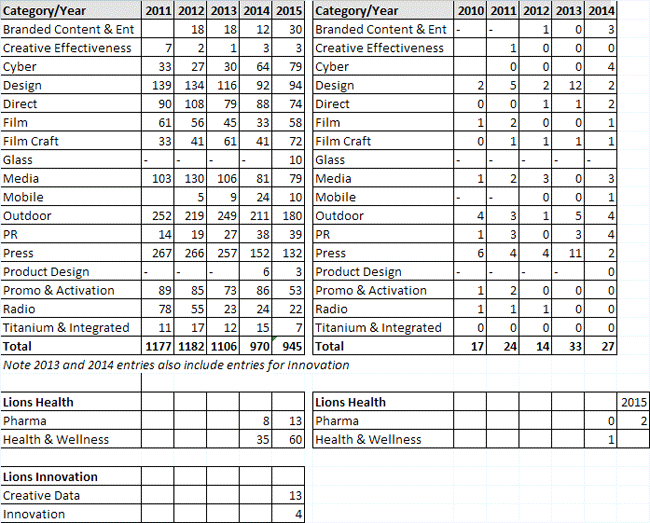
  • @CannesLions15: Indian entries & winnings over last 5 years

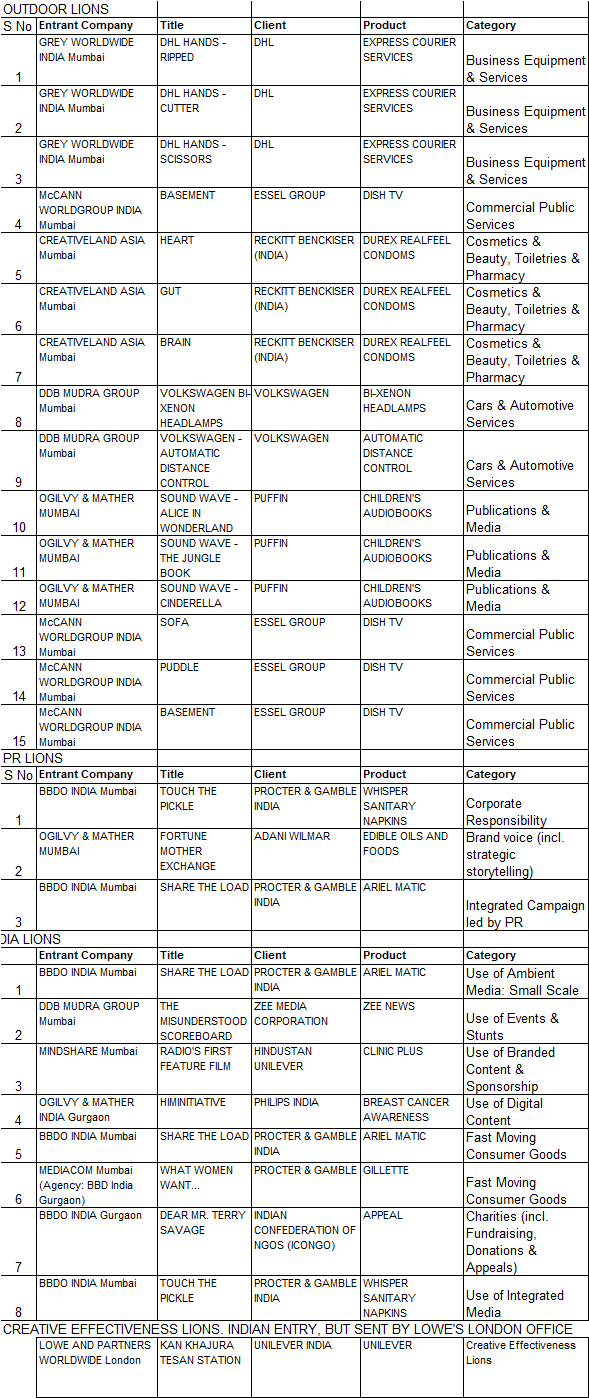
    Let the numbers do the talking. Presenting the number of entries Indian agencies have sent over the last five years and our winnings since 2010. Note these do not include entries sent by regional or worldwide offices of agencies – as is the case with Lowe Lintas which does not participate in creative awards.
     

  • @CannesLions15: Day 1 report: With 945 entries, India eyes bagful of Lions

    By Shephali Bhatt


    Delegates of the 62nd Cannes Lions International Festival of Creativity were yet to start making their plans for the day via the Cannes app when the awards committee announced shortlists for the Press, Mobile, Innovation, Direct and Promo & Activation categories.


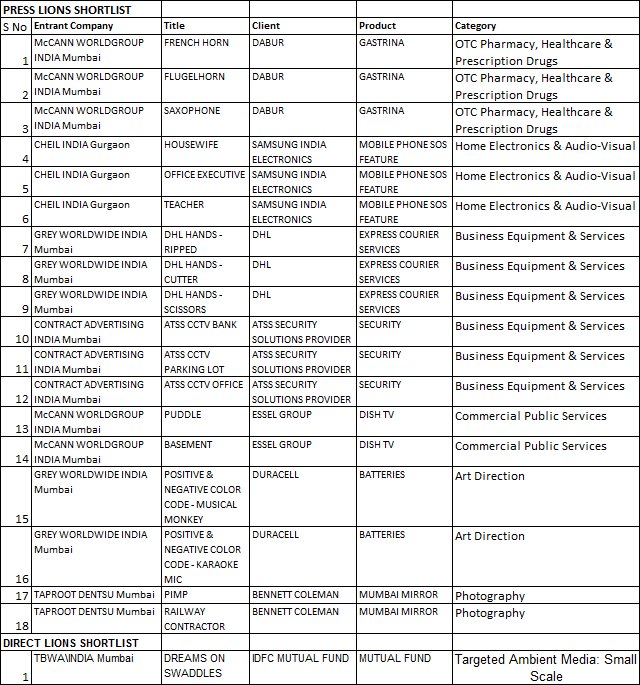
    No show from India on any of the categories, except Press — which fetched them 18 shortlists — and Direct, which got TBWA a shortlist.


    How many entered in the category? 132 and 74, respectively. A 13 per cent conversion rate in Press and 1.3 per cent in Direct but the percentage doesn’t matter as long as the shortlists go on to win big, says KV Sridhar, chief creative officer of SapientNitro. “People will remember that one great campaign that won across categories and not the number of entries you’d sent,” he adds, citing the example of Duracell’s positive negative stories campaign that won a handful of Lions last year.


    With mobile replacing digital in the ‘digital is the future’ prophecy, one would’ve expected some shortlists in the mobile category. “Maybe we are actually not doing enough exciting work in the space just yet. And perhaps rightly so,” says Sanjay Mehta, joint CEO of Social Wavelength and one of the Mobile jurors at the festival. “Whatever got shortlisted, I have truly not seen anything of that calibre in India,” he says.


    The total number of entries has also come down this year, marginally so, from 979 to 945. Sridhar, also one of the Press jurors for Cannes Lions this year, attributes this to the declining agency participation in domestic awards. “Only if I play well at domestic cricket do I stand a better chance at excelling at international cricket,” he says.


    Advertising isn’t very different in this regard. Agencies like Ogilvy and Lowe have started inhouse awards and Leo Burnett has stopped entering awards with the enthusiasm it used to. “All this comes through in the craft and quality of the work that’s entered at international awards,” he Sridhar. The pressure for validation isn’t the same anymore.


    “A lot of work entered to win at Cannes isn’t mainstream work anyway,” notes Grey’s Dheeraj Sinha. Only a matter of 24 hours (until the awards ceremony) before we find whether India is on its way to equalling or topping a great run last year.


    Source:The Economic Times

    Copyright © 2015, Bennett, Coleman & Co. Ltd. All Rights Reserved

    Licensed to republish


  • @CannesLions2015: India gets 3 Silvers & 1 Bronze on Day 2. 26 shortlists in Outdoor, Media & PR + Kan Khajura Tesan, but that credit will go to UK

    By Shephali Bhatt


    India’s award hunt at the 62nd Cannes Lions International Festival of Creativity is off to a promising if not a spectacular start. Of the 18 shortlisted entries in the Press category, Indian agencies romped home with three Silver Lions and a solitary Bronze Lion.


    Leading the pack was McCann Worldgroup with two silver metals for its campaigns for Dish TV and Dabur’s Gastrina. While Grey picked up a silver for its DHL Express campaign, the bronze went to Taproot Dentsu for Mumbai Mirror.


    The Grand Prix winning entry in the category was from The Community, Miami, for its work on the Buenos Aires Public Bike System.


    The solitary entry in Direct from TBWA failed to convert while India had a no show in other categories announced on Sunday like Promo & Activation, Innovation and Mobile Lions.


    The Indian contingent has reason to stay hopeful though. BBDO has two shortlists in PR for Ariel and Whisper and O&M has one for Fortune Oil.


    In the highly-prized Creative Effectiveness category, HUL’s mobile radio platform Kan Khajura Tesan has an entry submitted by Lowe & Partners Worldwide given the well-known antipathy of the agency’s Indian unit Lowe Lintas to awards.


    In Outdoor category, India has 15 shortlists from five agencies out of 469 total shortlisted entries. These include McCann Worldgroup for Dish TV, Creativeland Asia for Reckitt Benckiser, Grey Worldwide for DHL, O&M for Puffin and DDB Mudra for Volkswagen.


    In the Media Lions, India has eight of the 294 shortlisted entries. Interestingly enough, it’s not a media agency, but creative shop BBDO that leads the tally in this category with shortlists for its work on Ariel, Whisper and iCongo.


    DDB Mudra has a shortlist for Zee Media and O&M for Philips. Among the media agencies, the shortlists are Mindshare for Clinic Plus and Mediacom for Gillette. Jasmin Sohrabji, CEO of Southeast Asia at Omnicom Media Group and one of the Media jurors feels that the work is good but not consistent.


    “Most of the innovative work was not scalable. I think we need to add sustainability as a criteria along with idea, execution, strategy and results,” she says.


    Source:The Economic Times

    Copyright © 2015, Bennett, Coleman & Co. Ltd. All Rights Reserved

    Licensed to republish


  • How to Survive a Zombie Attack and more at @CannesLions2015

    By Dyanne Coelho


    Excitement loomed large at the Cannes Lions International Festival of Creativity, with the MediaCom-curated session on ‘How to Survive a Zombie Attack’ that focused on AMC’s ‘The Walking Dead’, a television drama that features zombies and portrays the life of humans in the aftermath of a zombie apocalypse. Jon Gittings, Global Business Development Strategy Officer, MediaCom, suggested that these stories ‘help us find solace and conquer our fear of extinction.’ The objective of the session was to highlight the consumer connect to content over the years and how brands can use these insights to market themselves effectively.


    Civilisations throughout time have always created these apocalypse myths, whether it’s the flood, or battles between man and God, Gittings pointed out. These are the stories humanity clings to, to collectively prepare for the threat of our extension. We turn to these stories to find solace and to help us conquer fear, he said.
     

    Gittings placed some interesting facts on the table. For one, Frankenstein was published in 1818 as a reaction to the 19th century’s fear of uncontrollable science. It’s no coincidence that Frankenstein was published the same year that the first successful human blood transfusion took place, he said.In the year 1954, Godzilla was conceived as a reaction to the terrifying, destructive power of the nuclear age. And zombies of course are a uniquely new-world myth, he added. “If apocalypse myths are a way of conquering fear, what exactly are we afraid of in the 21st century,” Gittings asked. “To try and answer that we pulled data on some of the established psychological explanations behind apocalypse myths, and then we correlated that with the viewing data of The Walking Dead. One of those explanations is the fear of how we abuse nature. It raises the question; are we scared of the zombies, or are we scared of becoming a zombie?”


    Said Dave Alpert, Executive Producer of the show, “We have one of the most engaged fan bases out there and it’s great because they let us know when they love something, they let us know when they really don’t like something. We have conversations with them both in person at conventions and online.”


    Josh Sapan, President and CEO, AMC Networks discussed that the elements that make the success of the show is the story, the characters and the craft. “The people behind the show didn’t just say let’s go do a show about this, they were deep into it. My observation even of the actors is that they didn’t find themselves there; they were there because of their origins.”


    Steven Yeun, who plays the character of Glenn Rhee on the show, shared his growth as a character on the show. “It’s great because as an actor you get to grow with the character, you get to change him, to mould him. It’s like a game you get to choose a character and follow him for six seasons. I think that’s what draws people and keeps them there,” he said.


    Gittings presented six dimensions that provide information about how brands and storytellers should communicate – hierarchy, individuality, masculinity, femininity, uncertainty, pragmatism and indulgence.Each of these was used in over a 100 countries to understand how each country’s culture works and how we as storytellers can use it to shape content and shape connections for brands. France to begin with was scored high on uncertainty. The uncertainty score shows how tolerant a society is towards ambiguity and whether or not they feel threatened by ambiguity. This means that France doesn’t like uncertainly, it is a society that shows emotions much more freely. It means they like rules but don’t like conflict. The first cluster, US, Canada and UK, was defined by high individuality and high indulgence whereas the second cluster of Turkey, Spain and Brazil, much like France was found to be high on uncertainty and low pragmatism, which means they have a short term culture, and they like yes or no questions. It means that they are quite conventional and don’t like change. The cluster one countries indicate societies that are highly competitive, the like to challenge and question things. In comparison cluster two countries indicate communication that flows like a pyramid in hierarchies.


    “By looking at The Walking Dead as a brand, we see how cultural dimensions can help us evolve across diverse geographies,” Gittings pointed out.“It helps us identify what markets can be clustered together, which part of the brand story we should focus on and how we should target it; should we be sensationalist or should we embrace disorder,” he said. Further, it can help us identify how brands should behave in channels and clears the doubt of whether we should ask questions or be more authoritative and issue statements, Gittings added.


    “If the apocalypse happened, never wear loose clothing, and get a haircut. That way you won’t be easily caught,” Jon Gittings humoured closing an engaging and informative discussion.


  • The Agency of the Future is an Algorithm: Razorfish-Contagious seminar @CannesLions2015

    By Dyanne Coelho


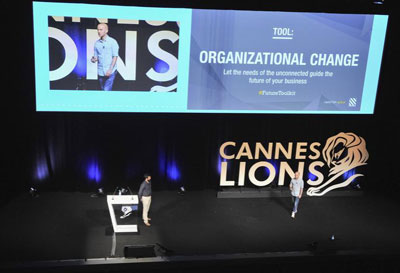
    There’s absolutely no point sticking to the rules anymore. The last decade has changed the way marketing works in our industry and the growth of the digital space has created more opportunities, more expectations and more solutions. But how prepared are we for what comes next? While we talk of the ever increasing pace of change, it’s clear that what matters is not so much what we know about the future, but how we adapt to it. A well-worded introduction, set the pace for the seminar entitled ‘Toolkit for Transformation’with Ray Velez, Chief Technology Officer, Razorfish Global and Will Sansom, Director, Content and Strategy, Contagious Communications.

     

    “Is it just us or have we reached a point where the industry has hit pause,” Sansom asked. “We carry devices in our pocket now that have more processing power than the super computers that put man on the moon. Statistics suggest, that young people switch media platforms over 25 times an hour,” he said.

    “Technology breeds technology, and innovation breeds innovation. Knowing about the future isn’t enough; you also need to plan on how to adapt to it,” Velez added.


    We think in the future, brand loyalty will become extinct, Sansom revealed. According to him, we’ve never been better enabled andequipped to switch between brands no matter the category. Research shows that there is about $6.2 trillion in revenue to be made from people switching loyalty from one brand to another. This is now being called the switching economy. This is proof that brand loyalty is becoming extinct, they discussed.


    We have more choice now. A lot of the new generation start-ups that are now huge global multibillion dollar companies are all about giving us more choice, Sansom explained. “We have more information at our disposal, comparison sites, reviews, social media, and from a trusted network we can tap into it any time we need it.”


    A major study that Razorfish conducted into cross-channel experiences and loyalty across four key markets – US, UK, Brazil and China, found that word of mouth and online reviews were the greatest influencers of purchase decisions. This led to the next point of ‘Considered Consumption’. This includes decisions consumers make based on how much they know about the brand, like their ethical practices, their carbon footprint etc. For example, the company Sir Richards is a new contraceptive company. For every condom that they sell in the Europe or US, they donate one condom to developing markets specifically those where sexually transmitted diseases are a vital problem. There are a lot of companies like this now, because consumerslike to spend money with good brands, but also like to spend money on brands that do good, they suggested.


    “In our opinion, one of the biggest contributors to brand loyaltyis the fact that we celebrate the self. And we live in an age where we’re equipped and encouraged particularly through social media to promote who we are as individuals. But brands are not treating us as individuals. For far too long brands are relying on flawed segmentation processes that market to demographics, but they don’t market to me,” Velez pointed out.


    Crucially customers increasingly want a relationship with a brand that feels more personal. Razorfish asked in a study how important is it that brands provide a product or service that feels like it was made just for you? Close to two-thirds of the respondents wanted just this. “It’s a challenge, but we believe the solution is in data. Data is how we listen to our customers. If we’re not using data, we’re in essence ignoring our customers. In the end data gives us that roadmap on how to reach customers on a one-to-one basis,” Velez added.


    The speakers divulged a few tools that are essential when dealing with the problem of a fading consumer loyalty. For one, design around them, not around your short-term sales targets. People are migrating towards brands that treat them like individuals, they said. Secondly as far as creativity is concerned, disrupt your business, not just your advertising and for organisational change, make a commitment to being in beta. In the future the unconnected world will need connecting, Sansom pointed out.


    A McKinsey study showed that even by 2017, close to 4.2 billion people will still be unconnected, or will remain offline; that’s roughly half the world’s population. Velez revealed. “For consumers, educate and enable before advertising,” he said.


    For creativity, think beyond browsers, for organisational change, let the needs of the unconnected guide the future of your business, Sansom suggests.


    “Great brands will liberate us from our screens. The connected today face a fatigue from being too connected to screens,” Velez explains. We ought to design for the human interface, not for the screen. The internet is not the screen, Sansom added.


    The agency of the future will be an algorithm, the speakers discussed. We’d be kidding ourselves if we thought that industries aren’t about efficiency, about making things better, faster, cheaper. Are we ever going to get to a point where an algorithm could create a whole piece of advertising from start to finish, by itself?


    “Imagine dealing with a creative director who is an algorithm. He literally knows all the answers,” Sansom said. But does that mean that we will be out of jobs? Not at all, he says, but what we do is going to change, and it will free us up of mundane tasks, it will be better.


  • No metals for Indian agencies on Day 4 of #CannesLions2015

    By Shephali Bhatt


    After winning 11 Lions and a Grand Prix, India had a gong-less night at the awards on the fourth day of Cannes Lions. Hungover from the Times of India party the previous night, Indian admen were seen entering the Palais well past lunch time.


    Some opted for a compensatory off from the fest for a day, remaining to the confines of their hotel rooms overlooking the magnificent and sparkling Promenade de la Croissette.


    After BBDO India’s clean sweep at the Glass Lions, a section of the Indian contingent busied itself in deducing how ‘Touch the Pickle’ campaign for P&G’s Whisper sanitary napkins — a piece that wasn’t too popular within the subcontinent — fetched a Grand Prix. While some concluded with the cliché about Cannes wins being “unpredictable”, the less charitable types claimed it was due to the South American lobbying skills of a prominent ad man from BBDO’s global network who was on the jury.


    We don’t know whether to be flattered or disappointed that no credit or blame was laid at the door of Tista Sen, national creative director at JWT who was the sole Indian on the Glass Lions jury. Clients emerged the happiest out of the whole episode with Dabur winning a silver metal. Given the FMCG major’s feeble enthusiasm for domestic awards, this counted as a big deal.


    On Creativeland Asia bagging a silver metal in Outdoor Lions, Sukhleen Aneja, category head at Durex India, said, “This outdoor campaign is a step in that direction and we are thrilled that it has been recognised as one of the best pieces of communication in the world at the Oscars of advertising.”


    Source:The Economic Times

    Copyright © 2015, Bennett, Coleman & Co. Ltd. All Rights Reserved

    Licensed to republish


  • BBDO India, Taproot get shortlisted in Film Lions on Day 5 at #CannesLions2015

    By Shephali Bhatt


    Only two days for the Cannes Lions festival to come to a close and still no sight of Indian admen, barring a few, anywhere close to the seminar halls. One would conclude the only Indians who are here to attend sessions are the Young Lions. Except we heard one of them say ‘Young Lions’ is just another way of getting an entry to the fest.


    Nothing is sacred anymore, we guess. But guess who arrived without notice right in the middle of the day to collect a Grand Prix Lion — BBDO India’s chairman and creative chief Josy Paul and chief executive Ajai Jhala.


    “We told Chris (Thomas) there’s no need to courier our Lions, the courier boys are here now,” he said. It’d seem that Paul got off the right side of the plane in the morning because BBDO India’s video for iCONGO titled ‘The World Wants More of A Good Thing’ got a shortlist in Film Lions.


    Also shortlisted is Taproot Dentsu’s film for Mumbai Mirror. The BBDO entry is particularly ironic though, considering its premise is to question the fake entries that win at global festivals such as Cannes.


    The video is addressed to Terry Savage, chairman of Cannes Lions, in fact. On hearing the news, Jeroninio Almeida, founder of iCONGO said: “I am sure very soon people in award ceremonies will also get conscientious about tracking the veracity of social campaigns created by advertising agencies. The process for change has begun and I am sure we will see impact on a bigger scale very soon. Though it’s ironic I am glad that people who had put in their efforts to help us raise this issue are getting their due recognition.”


    Source:The Economic Times

    Copyright © 2015, Bennett, Coleman & Co. Ltd. All Rights Reserved

    Licensed to republish


  • Ajay Kakar on 10 reasons why the ‘new-look’ Cannes Lions was a success (despite it being a forgettable year for India)

    By Ajay Kakar


    As the week-long Cannes Lions festival came to an end, here are some observations on the Good, the Bad and the Ugly at this year’s edition of the festival of creativity.


    1. ‎There is a magic about the Cannes Lions festival that you cannot deny. With the Palais as its epicentre, the entire city comes alive with the over 12,000 delegates who make Cannes their home for the entire week. Every corner of the city seems to exude excitement and inspiration.


    2. The Festival keeps evolving, and this year was no different. New awards, new categories and an entirely new focus. The introduction of the Glass Lion (to promote gender equality) and Innovation categories brought in newer and richer learnings. This year, the festival‎ dedicated itself to Innovation and Data x Tech x Ideas. So you were surrounded by young people and simple, new and innovative ideas that went beyond mere advertising or communications, and into the realm of product development.


    3. More clients and more about clients. The Unilevers and P&Gs have historically been associated with, and committed to, the festival.‎ But this year, you saw and heard many more clients. On one side you had names like Airbnb, Spotify‎ and Snapchat, while at the other end were the likes of Mars, Nestle, Pepsico, Heineken and Mondelez. And a window to hear three leading CMOs, every day, in a freewheeling discussion.


    4. The opportunity to hear industry giants and thought leaders like James Murdoch, Al Gore‎, Sir Martin Sorrell and Unilever CMO Keith Weed. And wonder how they manage to stay with their purpose and messaging, despite attempts to distract or provoke them.


    5. Monica Lewinsky was clearly the star speaker of the week. Not for reasons one would expect, though. She did share her story, honestly and sincerely. But contextualised it with a passionate plea about the ills of online shaming and cyber-bullying that have become a fact of life in our social discourse.


    6. Amir Kassaei, Chief Creative Officer, DDB Worldwide‎ made a strong case for embracing all that was new. But more importantly, to remember what must never be forgotten – ie, the purpose of our being is to build brands and businesses.‎


    7. The realisation that ideas can come from anyone and anywhere. Ad agencies that won PR awards. Communications partners that drove product innovation. Big countries that won small, and small countries that won big. It was inspiring to see the work and wins from unexpected countries like Switzerland, Spain, Sweden, Ecuador, Belgium, Colombia, UAE, Tunisia, Czech Republic, Turkey and Poland. And Egypt won its first Titanium Lion, the most coveted among the coveted.


    8. The power of simple ideas. And their ability to create a powerful impact. It is well worth the effort to view some of the campaigns that lived this thought, whether it was the ‘Lucky Iron Fish’ project; the Volvo ‘Life paint’ idea; Procter and Gamble’s ‘Like a Girl’ campaign or Vodafone’s ‘Red Light Application/Between Us’ initiative. Also on the list were the ‘Unskippable’ message by an insurance company and the ‘SOS SMS’ by the Mexican Red Cross and the icebucket challenge initiated as a global campaign to create awareness about ALS. Not surprisingly, all these were winners of one or more Lions.


    9. A ‎key gratification for the marketing and communications industry at the Cannes Lions festival is the tally of Lions won by agencies, networks and countries. Countries like Brazil take pride in the tally of Lions won by them, irrespective of which agency wins it. Their national pride shows, with the announcement of every win.


    10. While the good news is that India won a Grand Prix in the Glass Lion category in its maiden year, we do not have much to celebrate or be proud of, so far. Our tally of wins this year is far below what is expected from a country that is proud of its talent and work. This year is not one that India will celebrate or care to remember. Our focus has always been on the obvious categories, like Direct, Media, Cyber, Mobile and PR. While it’s curtains down Cannes 2015, let’s set our eyes and hearts on the festival next year, and hope to win some pride for our work and our country.


    Ajay Kakar is CMO – Financial Services at the Aditya Birla Group