Category: ADVERTISING

  • Namit Prasad joins L&K Saatchi & Saatchi

    By Our Staff

    Namit Prasad
    Namit Prasad

    L&K Saatchi & Saatchi has announced the appointment of Namit Prasad as Senior Vice President. He will be based out of Mumbai and will report to Snehasis Bose, Chief Strategy Officer, L&K Saatchi & Saatchi.

    Bose: “Over time and managing various categories and roles, Namit possesses a rare combination of fluid and strategic acumen in seeking and owning solutions that impact business growth. He is a great fit in our team of explorer-strategists, missioned to find the sweet spot between consumer need gaps X technology X clients’ business growth. I am looking forward to working with him and adding fresh spark to the agency’s entrepreneurial DNA.”

    Added Prasad: “As an enterprise builder myself, L&K Saatchi & Saatchi’s business focus – closely working with brands with an entrepreneurial mindset and contributing to growth beyond just communication – interested me hugely. Add to this Paritosh and Snehasis’s ambition and passion! With my kind of experience, I hope to bring in a bit of ‘Baniya Branding’ mentality, wherein all branding efforts are tightly aligned to business objectives. While of course ensuring creative flair and the inventive possibilities of integration.”


  • Motilal Oswal launches new campaign

    By Our Staff

    Motilal Oswal Financial Services Ltd’s (MOFSL) value added stock broking service has come out with a new ad campaign targeting new to market/novice investors. The film is live on digital and social media.

    Said Ramnik Chhabra (Executive Director Marketing MOFSL): “When you are doing something for the first time; not everyone will get it right without expert advice. In this campaign we have used this insight in a relatable way to address the substantial Point Of Market Entry equity investing audience. Our equity expertise available through a unique combination of a physical advisor available on phone & digital advisory tools on the investing app can help new to market/novice investors start investing the right way.”


  • Havas Media Group bolsters top deck

    By Our Staff

    Sanchita Roy
    Sanchita Roy

    Havas Media Group India is reorganising and strengthening its team with Sanchita Roy taking over as Head of Strategy. Roy, who joined the group as Head of West to manage the overall Mumbai operations last year, is armed with over 19 years of experience in media planning and strategy.

    In her new role, she will be responsible for driving the growth strategy for Havas Media Group India and leading strategic investments for its clients.  Sanchita will continue to report to Mohit Joshi, CEO, Havas Media Group, India.

    Mohit Joshi
    Mohit Joshi

    Said Mohit Joshi, CEO, Havas Media Group India: “Havas Media Group India has won many new clients last year despite the slowdown and continues to keep the momentum this year too with many prestigious clients such as Dominos, CG Foods, Micromax and more. Our India offering is now a key contributor to the overall global pie and hence this is an important step towards strengthening our product portfolio. Sanchita’s vast experience as a strategist makes her a perfect fit for this role and further bolsters our leadership team.”

    Added Roy, Head of Strategy, Havas Media Group India: “The last one year has been one of constant change across the world, especially so in the way consumers are interacting and engaging with brands. In my new role, the endeavour would be to understand these shifts and deliver Meaningful Media for our clients, using data, technology and content. I am excited about this opportunity and look forward to adding value and partnering Havas Media Group India in its new growth journey.”

  • So how do the GroupM & Madison forecasts compare?


    By Indrani Sen


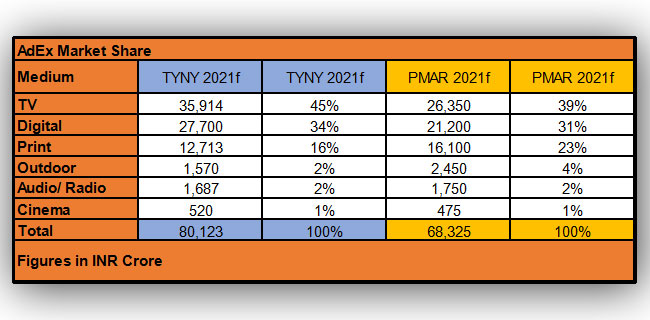
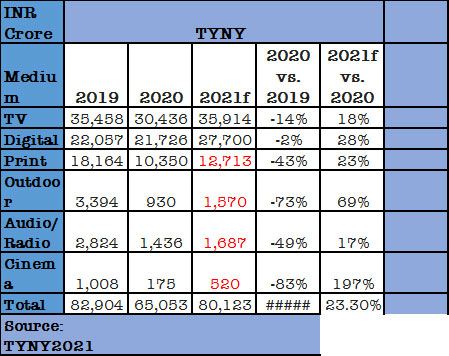
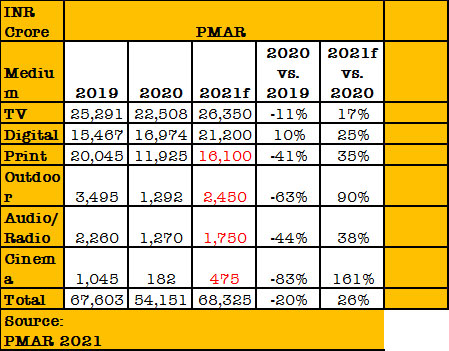
    Like every year, last week we saw the release of both This Year Next Year 2021 (TYNY2021) by GroupM and Pitch Madison Advertising Report 2021 (PMAR2021) by Madison Media. Both agreed that the pandemic year 2020 was a disastrous one for the Indian Media and Advertising Industry, when the overall AdEx dropped by 20% (PMAR2021) to 21.5% (TYNY2021) from the 2019 level. Both have predicted better days in 2021 with the overall AdEx growing by 23.3% (TYNY2021) to 26% (PMAR2021).  According to PMAR2021, the predicted AdEx INR 68,325 crore in 2021 will touch the AdEx INR 67,603 crore in 2019. According to TYNY2021, the forecast for 2021 is INR 80,123 crore, which falls short by 3.35% from the AdEx in 2019 which was INR 82,904 crore.


    In spite of the huge gap in the overall AdEx estimates by the two agencies, it is relieving to find that the trends predicted by both of them are similar. The gap in the estimated size of the Indian AdEx between the two reports has been existing over many years and the Media and Advertising Industry has learned to live with the differences. TYNY2021 has estimated both TV and Digital AdEx at much higher levels than PMAR2021. On the other hand, PMAR2021 has estimated Print AdEx at a much higher level than TYNY2021. The following two tables show the details of the two reports by medium for making easy comparisons.


    According to PMAR2021, the pandemic year 2020 will go down in the history of Indian Media and Advertising as the year when Digital overtook Print and became #2 in terms of market share of overall AdEx. However, TYNY2019 showed Digital as the #2 and Print in the #3 positions in terms of market share. In 2020, GroupM estimated a 2% degrowth in Digital from 2019 level, while Madison Media estimated a 10% growth in Digital over 2019 level. Both the reports show Print AdEx in 2021 would be below the 2019 levels, while Digital AdEx would be crossing the 2019 levels in 2021. So, we can now conclude that Digital has the second highest market share in overall AdEx and it is unlikely that Print would be able to regain that position in 2021 or later.


    TV which holds the #1 position in Indian AdEx in both the reports, had degrowth of 11% (PMAR2021) to 14% (TYNY2021) last year, but is expected to grow at higher rate 17% (PMAR2021) to 18% (TYNY2021) in 2021 and touch or cross the 2019 AdEx levels.


    Both the reports show the huge loss which was suffered by the other traditional media, Outdoor, Radio and Cinema during 2020.  In spite of the overall growth of AdEx predicted for 2021, these three media would be far below their 2019 benchmarks. The combined market share of these three media continues to be less than 10% in both the reports. A difference in reporting between TYNY and PMAR has been noticed this year regarding Radio. While PMAR2021 has reported only on Radio, TYNY2021 has changed the nomenclature to Audio. It is however not very clear what other audio component apart from Radio has been included under that definition.


    It is encouraging to find from the two reports that the worst effect of pandemic is over; Media and Advertising industry is on the path of recovery; the process of digitisation has been accelerated; we are expecting a robust GDP growth and globally India will continue to be the second-fastest growing AdEx market among the top ten countries in 2021. At the same time, it is also frightening that the economic effects of Covid-19 have manged to wipe off two years of overall AdEx growth (2020 & 2021) and many media-owners and some media agencies still have to fight battles for survival.


  • FMCG adspend expanding by 14% a year in India: Zenith

    By Our Staff


    Media agency network Zenith has forecast that fast-moving consumer goods (FMCG) food and drink brands will increase their ad expenditure on digital channels by 7% a year to 2023, according to its Business Intelligence – FMCG Food and Drink report, published on Monday. That’s well ahead of the 4% annual growth forecasts for FMCG adspend as a whole in the 12 markets included in this report.


    Zenith has forecast that India will be the fastest-growing market by some distance over the next three years, with FMCG adspend expanding by 14% a year. It will benefit from blossoming consumer demand as disposable incomes rise rapidly, coupled with the catch-up expansion of the underdeveloped ad market: advertising accounts for only 0.3% of India’s GDP, less than half of the global average of 0.7%. All of the other markets in the report are predicted to grow steadily at between 2% and 5% a year.


    Said Jai Lala, CEO, Zenith India: “FMCG growth will continue to be robust considering various reasons. Firstly, despite the pandemic, it is one category where the demand is constant, if not seen increasing. Secondly, with evolving consumer demand, FMCG continues to see a slate of new product launches and category expansion. Lastly, with the vast population being in Tier 2 and rural areas – it is one untapped potential market where the FMCG brands continue to increase penetration.”


    Meanwhile, FMCG brands still rely heavily on traditional TV, spending 39% of their budgets on television advertising in 2020, compared to 24% for the average brand. Excluding China, where FMCG brands have already adopted digital advertising as their main form of commercial communication, FMCG brands spent 52% of their budgets in television, compared to an average of 26%. Their principal goal is to maximise brand awareness and reach so they are front of mind at the point of purchase for as many consumers as possible. This is something that TV has historically excelled at, but its declining reach – particularly among the young – is making it less effective.


    “FMCG brands need a new comprehensive approach to reach-based planning,” added Ben Lukawski, Global Chief Strategy Officer, Zenith. “That means combining TV, paid advertising in online video, virtual placement in SVOD platforms and perhaps even a presence in gaming, using first-party and second-party data to prevent duplication and optimise incremental reach.”


    FMCG brands are therefore following audiences to digital channels. Zenith forecasts that FMCG digital adspend will increase from US$12.3bn in 2020 to US$14.9bn in 2023, and that its market share will rise from 46% to 49%. After the pandemic gave FMCG ecommerce its urgent stimulus in 2020, brands will look to support and expand their ecommerce capabilities, channelling consumers to DTC operations or retail partnerships. But the big challenge will lie in using digital to replace television effectively – creating large-scale brand awareness while managing frequency. The rise of Subscription Video on Demand (SVOD), which locks away high-value audiences from direct advertising, will make this even harder, as will the end of third-party cookies.


    Out-of-home is the exception to the declining reach of traditional media. As traffic returns to normal after the COVID-19 slump, the spread of digital displays will make it even more effective at reaching consumers with targeted and relevant ads near the point of sale. FMCG out-of-home advertising is forecast to grow by 9% a year from 2020 to 2023, while its market share rises from 6.1% to 7.0%, slightly ahead of its pre-pandemic share of 6.8% in 2019.


    Ad expenditure by FMCG brands fell more sharply than the ad market as a whole in 2020, shrinking by 10.7% to US$26.7bn. This was not because of any shortfall in demand. On the contrary, demand soared as people stopped eating in restaurants, cafes and bars and shifted consumption to the home. Instead, FMCG companies were faced with the challenge of ramping up production while supply chains were disrupted, and using limited available distribution to get their products onto shelves in stores, or to consumers’ homes. Many FMCG companies therefore cut back on promotional activity for products they couldn’t get to consumers quickly enough to satisfy demand, and invested in distribution infrastructure instead, especially ecommerce operations and partnerships.


    Zenith forecasts that the recovery of FMCG adspend will roughly track the market as a whole in 2021-2023. A bounce-back is almost inevitable in 2021 given the comparison with the sharp drop-off in 2020, particularly during Q2, though it will still be 6% below 2019 levels. FMCG companies face uncertainty over how quickly consumers will return to shops, and how much their behaviours have been permanently affected by the pandemic. However, now that FMCG ecommerce infrastructure is being put in place, brands will need to increase their investment in advertising to support it. Zenith forecasts 4.4% annual growth in FMCG adspend between 2020 and 2023, reaching US$30.3bn in 2023. At this point it will have fully recovered from the pandemic-induced drop in adspend, exceeding 2019 levels of spending by US$0.5bn.


    China stands out as the market where brands have most rapidly embraced ecommerce and digital advertising. In 2020, Chinese FMCG brands spent 71% of their budgets on digital advertising, compared to 46% across all 12 markets. Here, these brands focus on online video, which has a high and broad reach, and is open to commercial partnerships. This can mean advertising in online shows, or special livestreams by influencers, in which viewers can directly purchase the items being demonstrated. They also routinely advertise on ecommerce platforms to drive sales at the point of purchase. Chinese FMCG brands spent 35% of their total budgets on online video and 13% on ecommerce advertising in 2020.


    “Ecommerce will be the key battleground for FMCG brand growth over the coming years,” said Jonathan Barnard, Head of Forecasting, Zenith. “Western brands should look to China for best practice in using digital communication to drive FMCG ecommerce sales.”


    *The 12 markets included in this report are Australia, Canada, China, France, Germany, India, Italy, Russia, Spain, Switzerland, the UK and the US, which between them account for 73% of total global adspend. FMCG food and drink includes all packaged foods and soft drinks.


  • Ranveer Singh & Dhoni top IPL recall rankings

    By Our Staff


    Both actor Ranveer Singh and cricketer MS Dhoni have have done equally well in the annual IPL ad recall research of the Indian Institute of Human Brands (IIHB) conducted 10 days after the start of the league this year. The research polled 879 respondents in the age-group of 18-35 years (M=481, F=398) across India. The interviews were conducted telephonically.


    Dream 11 was the most spontaneously recalled brand in this year’s survey, which possibly also helped enhance both the brand equity and recall of Dhoni who anchored the 12-ad series for the brand as its ambassador and protagonist. Jio Fiber, with multiple IPL teams featured with an effervescent Ranveer Singh gyrating with a sing-song brand message, came in second on recall in the research, also helping the celebrity endorser to considerably strengthen his personal recall. Byju’s was the most spontaneously recalled brand on the IPL last year; though its celebrity endorser Shah Rukh Khan trailed behind other celebrities.


    Expectedly, Virat Kohli did well on recall too and came third in the recall rankings. Salman Khan did surprisingly well in this year’s survey and came in at No. 4, ahead of Rishabh Pant, Rahul Dravid, Varun Dhawan, Alia Bhatt and Saurav Ganguly who followed in that sequence. Ajay Devgn, Sachin Tendulkar, Shikhar Dhawan, Shah Rukh Khan, Boman Irani, Kareena Kapoor, Ranbir Kapoor, Katrina Kaif, Ayushmann Khurrana and Akshay Kumar, on the other hand, had very few mentions and scored very poorly on respondent recall. There were sporadic mentions of Virender Sehwag and Priyanka Chopra too. In the last survey conducted in October 2020, MS Dhoni had the highest spontaneous recall as a celebrity endorser. Virat Kohli was a not-so-close second. Akshay Kumar was at rank 3; Ayushmann Khurrana at rank 4.


    Said Dr Sandeep Goyal, Chief Mentor of IIHB: “MS Dhoni and Ranveer Singh had a disproportionate share of visibility and recall in the IPL research we just conducted. This was in synch with the ultra-high recall of the brands they respectively endorse. It is interesting nevertheless to note that brands without celebrities like Phone Pe, Byju’s and others too have done well wherever media investments are heavy”.


    IIHB team used its proprietorial Celebar tool based on Celebrity Brand Association & Recognition to assign a metric score to each celebrity and associated brand. The tool takes into account:

    • Spontaneous recall of the brand

    • Spontaneous recall of the celebrity

    • Association between brand & celebrity together

    • Recency of communication

    • Media weight behind campaign

    • Solus versus multiple brands using the celebrity


    MS Dhoni had a Celebar score of 87, up from 82 at the last IPL. His spontaneous recall was an unusually high 82%. His association with Dream 11 was also very constant at 79% from the last edition. He got 9% association with IPL/Star TV, 8% brand association with Indigo Paints, 6% with Orient Fans for Orient Fans and Livfast Solar. 2% recall came from SunFeast Yippee. So, most of Dhoni’s brand goodness got hijacked by Dream 11, much like last year. If Dhoni had only been endorsing Dream 11, his Celebar score would have been near 100, given his strong association with that one brand, to almost the relative exclusion of the other brands he endorses.


    Ranveer achieved a Celebar score of 86, empirically almost equal to that of MS Dhoni. But his association was more democratically spread with Jio Fiber at 56%, JD mart at 48%, My11Circle at 22% and Bingo at 18%. Names of some other brands were mentioned by respondents but these were filtered out as they were not part of the IPL broadcast.


    Both MS Dhoni and Ranveer gained massively also on account of their main brands spending disproportionately large amounts of media monies which made them exponentially more visible than other competing celebrities.


    Virat Kohli trailed behind the Top 2. His score of 45 on Celebar is mostly derived by his 94% association with MRF tyres. Bluestar is in low single digits on association.


    Salman Khan at a Celebar of 38, owes 82% recall to Rajshree elaichi and the balance to Pepsi. Rishabh Pant climbed up interestingly to No. 5 on the strength of his JSW appearances. Varun Dhawan had 76% of his recall from Lux Cozi and much lower from Frooti. Alia owed most her recall also to Frooti with scattered mentions of Dark Fantasy.


    Interestingly, the IPL seems to be running no/few ads with Amitabh Bachchan, Akshay Kumar, Deepika Padukone, Ranbir Kapoor, and even with cricketers Rohit Sharma or KL Rahul or Hardik Pandya, or the media weightages behind those ads were too insignificant to be noticed by viewers.


    The Cred ad for Rahul Dravid was spontaneously recalled by 17% respondents but only 2% remembered Jackie Shroff and only 1% mentioned Kumar Sanu for the same brand.


    Mutual Funds (AMFI) ads had 22% recall but most respondents got the protagonists mixed up, with the most attributing the messaging to Dhoni and Kohli.


    Dream 11’s association with multiple cricketers was mentioned by many respondents but most were not sure if they remembered current creatives. Only the connect with MS Dhoni was unambiguous.


    Despite heavy media weights, Vimal Elaichi ad featuring Ajay Devgn and Shah Rukh Khan had only an 8% recall. Netmeds with Kareena Kapoor and Renuka Shahane had a good 9% recall. Priyanka Chopra’s Appy Fizz and Katrina’s Slice were almost not recalled. Hema Malini managed 3% recall on Kent RO. Randhir Kapoor’s Asian Paints managed 4% while Kareena Kapoor’s and Pankaj Tripathi’s Berger creatives both got below 1%. Ayushmann was remembered by less than 1% in Urban Company. Gajaraj Rao was mentioned in less than 1% for Voltas. Unacademy featuring Sunil Gavaskar and Harsha Bhogle too scored poorly at 2%. Gamezy featuring KL Rahul got less than 1% recall.


    On the ads without celebrities, the most remembered were Phone Pe (32%), Byju’s (31%), Vivo (22%), One Plus (21%), Groww (20%), Upstox (20%), Kia (19%), MPL (18%), Bisleri (11%), PharmEasy (11%), Thums Up(9%), Coca Cola (6%), Renault Kiger (6%), Tata Safari (6%), Skoda (3%), Ajio (3%), Dark Fantasy (2%), LikedIn (2%), Raymond (2%) and Tuborg (1%).


    As more gets added to the broadcast as the IPL progresses, both standings of celebrities and recall of brands may change, a communique added.


     

  • All Colour, One Price disruption by JSW Paints


    Sanjeev KotnalaBy Sanjeev Kotnala


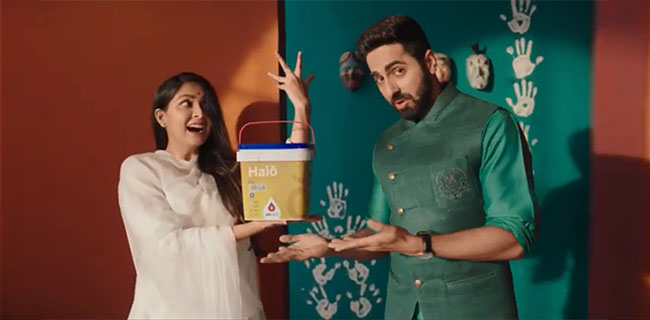
    JSW Paints’ new campaign, Any Colour One Price  featuring brand ambassador Ayushmann Khurrana, was just waiting to happen. As a consumer, I can relate to and appreciate the thought.


    When you decide to paint your house, many variables creep in; colour, shade combinations, price, design, features, and quantity. JSW Paints tries to make one variable redundant.


    In recent times, paint companies have tried to provide product or marketing solutions to evolving needs of the consumers. With time, we have started wanting more and more from paints. Just like we want more and more from our mobile phones. Well, not really comparable, but you get the drift.

    PAINTING WAS NEVER MERELY A SHADE CHOICE. 


    The era of Mera Waala Pink is over. Now you can get to the place and mix the paint to your comfort. The feature like long-lasting binding, easy to wipe, low maintenance, dirt, sun, water-resistant has been democratised. Even claim to remove harmful pollutants from the air! There is paint consultancy on offer and visualisation tools to see how the shades compliment each other or what would work best in your home. There is even on time painting promise. A few times, the brand even checked if you saw the colours right- as colour means a lot. Most good paints offer you the same.


    The consumer still appreciates the emotions associated with home and painting. ‘Har Ghar Kuch Kheta hai’ and ‘Jab Ghar ki Raunak badani ho’ still remains relevant. But, now it seems plausible that har paint kuch kehta hai and reflect or enhance your status in society.


    NEXT MOVE IN FEATURE DEMOCRATISED MARKET.

    So, when technology and features get democratised, what is left is to break the biases and differences. Make it easier for the consumer to make a choice. So, in this inclusive era – where we are talking of One Nation- One Rule, One Nation- One Price- the leap to One brand- One Price or rather Sachche Rang – All Colour- One Price seems natural.


    What is surprising to me is why did this not happen earlier. And then I think because no consumer ever questioned this differential pricing.

    JSW PAINTS DO IT WELL.


    JSW Paints need to be appreciated for this counter move. The brand Ambassador Khurrana continues from the last campaign, ‘har rang har kisi ka’ that laid the foundation. There they presented how the colours been dividing, whereas they should unite. And they shared the range of 1808 colours under the theme of making India beautiful. Enjoy behind the scene of the making of this video.


    Post this, the new campaign ‘All Colours One Price’ seems so logical. I also love the way the films have been made. That is a hint of q subtle younger-elder brother interplay and hitting at another brand and taking away the need of even the paint calculator.


    There is a format that makes Khurana suggest the answer compellingly. The price transparency is registered completely, though I felt that the brand association needs to be enhanced somewhere.

    JSW SAME PRICE AN ADVANTAGE.


    Though the brand questions the unfair industry practice of differential prices. I am unsure if JSW itself had differential prices earlier.


    If they did, then strategically, they have been brilliant in taking a step-by-step approach and I am surprised other brands did not see it coming.


    If they have bridged the gaps to make All colour- One price a reality, then too, JSW paints win as they are first to say it.


    Whatever may be true, it is advantage JSW Paints. The consumer doesn’t ask such questions. Now, it is for the other brands to evaluate the impact and justify differential pricing for red-blue-green in the same sub-brand. How Tera wala pink could be differentially priced from Mera wala pink.


    WHAT NEXT.

    The campaign will impact the market. It will make customers rethink, question the price disparity and maybe push other brands to follow.


    If JSW wants to take such decisive, bold steps and question what they term as unfair practices to make a mark; they will have to score again. I will be waiting for the next bullet from their arsenal.


    ……………………………………

    If you have got your house painted in the recent past – and here past would mean pre-covid era- do you recall different colours priced differently? Was that an issue with you? Do you think JSW is making a mountain out of a molehill, or this All Colour One Price is an open space to play?


  • Yellophant Digital collaborates with ExpertMFD

    By Our Staff


    Yellophant Digital has bagged the digital marketing mandate for financial advisory firm ExpertMFD. The agency will be managing the brand’s digital marketing duties, comprising creative and content solutions, social media management, digital campaign strategy, media planning and buying, ORM, SEO, and SEM. Yellophant Digital plans to educate and give insights to potential entrepreneurs about the brand via targeted strategy on all digital platforms.


    Said Himanshu Vyapak, MD, CIEL: “We have about 2.3 crore unique mutual fund investors in India. The growth in mutual fund distributors has not kept pace with the growth of assets in the mutual fund industry. We endeavour to build a strong foundation and a cohesive growth environment for future financial experts to create Atmanirbhar India by providing a full-stack end-to-end platform for anyone who wants to become a mutual fund distributor. For this, we are very thrilled and delighted to join hands with India’s leading AMCs and look forward to seeing Yellophant Digital gives us a digital presence across all the platforms and helps us reach more people and create mutual fund entrepreneurs of the future. This is a big opportunity and as 90% of the Indian audience has become social media savvy, we want to create a huge impact on various digital platforms. We understand that Yellophant Digital knows how the industry works and we are thrilled to see how they will make ExpertMFD a brand that reaches everyone. That is the reason we have collaborated with Yellophant Digital and I am confident that working together will help our brand reach new heights.”

     

    Preksha Seth
    Preksha Seth

    Added Preksha Seth, Co-founder, Yellophant Digital: “We are always looking for challenges, here at Yellophant Digital and in turn making a difference. We look forward to working with ExpertMFD, which focuses on creating new financial entrepreneurs. It is the first time in India that all of the Mutual Fund Industry is coming together to create a revolution in investing. We are fortunate and grateful that we have this responsibility to build the digital first brand from inception. We are super excited to come up with insight first thoughts for the brand and use social media to amplify the same.”


  • Dentsu APAC launches Common Ground to unite employees

    By Our Staff


    Dentsu international has launched a new internal initiative for its 11,000 employees in 17 markets in Asia Pacific, entitled “Common Ground”. Notes a communique: “It is a way for employees at Dentsu to make connections in other markets and regions based on their common interests, whether that’s food, sport, music, travel, books, film or as obscure as stamp collecting. By using common interests as a way to reflect diversity, dentsu believes its people will shine through. Dentsu’s DEI lead in APAC, Merlee Jayme partnered with Gautam Reghunath, CEO, Dentsu Webchutney, to bring this initiative to life for diversity month believing that building strong relationships by understanding each other’s backgrounds is a big step to diversity.”


    Said Jayme: “People are at the heart of every great creative business and dentsu is a hallmark of that. With a clear strategy on how we want to build our identity in the region, bringing our people together in a fun, informal way is a meaningful start. We’re thrilled with Common Ground volunteers in Japan, Thailand, India, Philippines, and Australia exchanging Instagram handles and making travel plans to countries already. Common Ground has something for everyone at dentsu, and we’re proud to launch during diversity month. I can’t wait to see how it will bring people together in new ways across our network.”


    Added Ashish Bhasin, CEO, Dentsu APAC: “Our talent is as ingenious as they are diverse. Dentsu has always bet on the serendipitous connections across regions and fostering that kind of networking in such an organic manner is going to take us to new places. In a data-rich world, I’m proud all the pairings will happen based on actual interests and actual people. The team has asked me to be patient before I get to meet my dentsu twin!”


  • DMC Insights publishes report on Covid impact on women

    By Our Staff


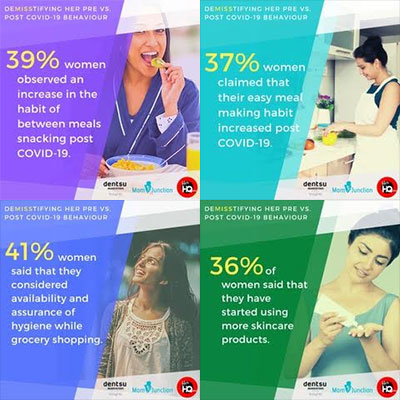
    A collaborative study by DMC Insights, MomJunction and HerHQ Media was set up to understand the impact of the COVID-19 pandemic on women – both working professionals and homemakers. The report was aimed at capturing the shift in overall practices with regards to Food Consumption, Shopping Behaviour, Skin Care, Health Consciousness, and Household Chores.


     

    The recently concluded survey covered 1083 women aged 20 and above. The teams used a river sampling method where the MomJunction.com readers were invited to participate in a survey. The findings have been published in the report titled “Demisstifying her pre vs. post covid-19 behaviour”. The main takeaways show women’s consumption pattern in two distinct areas – food and skincare products and their household responsibilities that have increased post-COVID-19, therefore, impacting their buying decisions.


    Said Abhinay Bhasin, Vice President (Asia Pacific), Data Sciences, Dentsu Aegis Network: “Our research reveals 56% of women have claimed to have had an increase in domestic dependence on overall household work. The report will reveal how COVID-19 has played a role in impacting the lives of women in urban India. As global conglomerates adapt to a new reality, brands and companies must take into account the differentiated needs of their workforce, especially working moms who shoulder an even higher burden of care.”


    Added Natasha Garyali, Vice President, Business Development & Strategic Partnerships, IncNut Digital: “As the primary gatekeepers, we saw women take a more central role in household decisions and finances, redefining, adapting and influencing the pre-existing dynamics and shifting priorities in the wake of the pandemic. The report delves deeper into these changing and evolving behavioural shifts across key categories and provides an insightful perspective for brands to understand and harness these new emerging priorities by tailoring more meaningful communication and experiences that suit and shape the next normal.”


    Said Meera Chopra, Founder, HerHQ Media: “Despite its negative impact, many paradoxical trends emerged that transformed certain consumer behaviour and habits, and thus businesses. These changes indicate shifts in consumer behaviour and needs. Consumers, especially women who are the primary caregivers and home-runners, have displayed unprecedented lifestyle changes that would influence future buying trends, trends that need to be considered by media and marketing professionals while designing their marketing solutions in the post-COVID-19 world.”


  • Divya Karani is CEO Media at Dentsu. Kartik Iyer, COO of the network

    By Our Staff


    Kartik Iyer
    Kartik Iyer

    Dentsu International has announced key leadership changes in India as part of its global organisational redesign. Kartik Iyer, erstwhile president – Media Brands and Amplifi, will now join the network’s market leadership team as its Chief Operating Officer (COO). He will continue to report to Anand Bhadkamkar and will be instrumental in driving the implementation of Dentsu’s new business model within the country.


    Divya Karani
    Divya Karani

    The network has also appointed Divya Karani, CEO at Dentsu X India, as the Chief Executive Officer (CEO) for Media, South Asia. Here, media includes the agencies Dentsu X, Carat, iProspect and Posterscope. In this additional role, Karana will be responsible for driving the global media strategy and delivery in South Asia, ensuring its alignment and relevance to the market. She will continue to report to Anand Bhadkamkar.


    Anand Bhadkamkar
    Anand Bhadkamkar

    Said Bhadkamkar: “Dentsu is committed to delivering the best to its clients and Kartik and Divya are veterans in what they do. Kartik is recognised industry-wide for his media expertise while Divya is one of our finest from the industry. Her strength lies in delivering first-class, client-centric results and I am confident that their expertise and experience will only help accelerate the effectiveness, purpose, and performance offered to our clients.”


    Meanwhile, Haresh Nayak will continue to serve as COO for Dentsu Media in India in addition to his other roles as President, Posterscope Asia Pacific and MD, Posterscope India, while Rubeena Singh is now incharge of the freshly rebranded iProspect. Anita Kotwani will continue to lead the Carat brand for India.


  • eYantra acquires Digital Ozone

    By Our Staff


    eYantra, a brand merchandising and marketing firm, has acquired Hyderabad-based digital marketing agency, Digital Ozone to further expand its digital marketing capabilities. With this acquisition, eYantra aims to solidify its brand marketing capabilities and offer end-to-end digital marketing service offerings to its 1000+ large corporate customers. eYantra has already invested in more than 25 + start-ups till date. Digital Ozone will be rebranded as eYantra Media post acquisition.


    Raj N
    Raj N

    Said Raj N, Founder of eYantra: “From our experience of working on corporate branding for large corporates (B2B), we realized that there is a lot of gap between their digital marketing needs versus what is offered by competition. The service model that most Digital marketing agencies offer hinders growth in the long term. There is dearth of good digital marketing agencies with a B2B focus across the world. We aim to fill this void with eYantra Media, a one- stop shop for all branding and marketing needs of B2B enterprises. Hence this association marks the beginning of creating a niche in the B2B SaaS marketing space. We aim to work towards consolidating all our Digital efforts, and stand as the first Digital media company that deploys a structure that works to curate technology and content for the B2B space.”