Tyre manufacturer Ceat has launched its new television commercial for the monsoon season, highlighting its all season tyres.
Arnab Banerjee, ED, Operations, Ceat, said, “This is the first time that we are trying this technique, which will approximate the real view as seen by a biker on the road. We have a fantastic all-season tyre which is excellent for wet conditions. We know how Indian roads are, there is no road sense and we feel like yelling out. It’s important to keep ourselves and everyone safe on the road during the monsoons, which is why the Ceat all season tyre is great. We never had a wet condition film; this is the first time we are doing such a thing and we are sure it will give our customers an additional assurance that you are safe on Indian roads even in wet conditions.”
Prabkahar Tiwari, GM Marketing, Ceat, added, “We have focused on superior grip which is a major product benefit to the customer and therefore offer safety as a key consumer benefit.”
Anup Chitnis, ECG O&M, said, “This is a new offering from Ceat and we therefore wanted to enhance what actually happens in rainy seasons, where the biker needs very good grip on the road, because its slippery, and people are trying to avoid a pothole, so we thought it would be beautiful to show what the biker actually goes through and what he faces, hence we came up with a script that shows the point of view of the biker in the real conditions.”
Prabhakar Tiwari also said that the communication is not only limited to a TVC but this time they are going to launch a first-of-a-kind property called Ceat Monsoon Smart where they are reaching out to bikers across the country to create the awareness of safety during the monsoon via an on-ground activation medium like a tyre check-up camp, a demo tool to showcase the wet grip tyre and its benefits, and some dealer level activation. The idea will also be extended to the digital medium extensively.
Taproot India has launched a design unit, SquareRoot Design. Sameer Asth, who recently joined Taproot India as Head of Business and Strategy, will be involved in SquareRoot Design, which will be fronted by Santosh Padhi and Agnello Dias.
SquareRoot Design is a brand consultancy focused on multiplying brand and business growth – from defining a path to growth to creating a name, nomenclature, verbal and visual language, packaging, tangible retail engagement and viral content for the virtual world.
Have been watching the ‘Sulking Advani’ drama on television very closely. Not because the man interests me, but because it’s a deja vu feeling, I have seen this before. Not in politics, in the corporate world. It’s the same story: When the grand old man of the organization is past the sell-by date, the board of directors and the young CEO have no idea how to get rid of him, they get badly stuck. I am sure you have witnessed this situation in your own career at some point or another.
I once worked at an ad agency whose creative chief, a few years away from retirement, had failed to evolve with changing times and was stranded in the old school. Basically, he was burnt out. The younger creatives could not connect with him, but were compelled to politely seek his views. The client service people would guffaw behind the old gent’s back, and the clients stopped asking for his presence at important meetings. But the man himself, in complete denial of his loss of relevance, soldiered on, making life difficult for everyone.
The agency leadership could not muster enough courage to ask him to quit. And yet, he was deliberately left out of meetings. Not even, and this is the most humiliating part, consulted on creative department reshuffle. The man was totally isolated, but he would not get the message. Watching it all happen first-hand, I felt very sorry for him. And I entirely blamed the organization for this mess.
Why? Because in this situation, to save everyone the misery, it was the CEO’s job to make that tough call: Amble across to the elderly gent’s cabin, and graciously show him the door. Sadly, this step, which is actually the best and the most professional one, seldom gets taken in many Indian organizations. Which is a pity.
The BJP faces the same conundrum today. Senior leaders in the party ought to have asked Advani to retire a long time ago. The 86-year-old man is no longer a vote catcher, and his thinking is redundant. They didn’t, and now find themselves in a sorry situation. The party, if it lets go of him now, will be perceived as one that does not respect its elders. This directly goes against Indian culture, and could prove costly for the BJP in the coming elections.
***
PS: Speaking of old dogs, here’s a speech by Dave Trott, a huge inspiration for creative people. Not just for youngsters, for senior creative directors, oldies who have lost their way or feel burnt out.
Anil Thakraney is a senior journalist and commentator. He is also Editor-at-Large, MxMIndia. The views expressed here are his own. He can be reached via Twitter at @anilthakraney
DDB Mudra has appointed Subhasis Chatterjee as AVP, Mumbai. He will report in to Shally Mukherjee, Senior VP, DDB Mudra, Mumbai.
Mr Chatterjee joins DDB Mudra from Contract Advertising where he was Group Account Director. With over 12 years of experience, he started his career at Hutchison Essar and then switched to the agency side. He has worked with some well-known agencies including Bates, Publicis Ambience and Triton, on brands such as Google, Piramal Realty, Tata Photon, Set Wet, Papa John’s Pizza, Parachute Aftershower and ICICI Debit and Credit cards among others.
Commenting on joining DDB Mudra, Mr Chatterjee said, “I started my career working with a great brand – Orange, where I saw how a brand was more than just what we see in the ATL space. While the lead task of brand building may still depend on mass media, the Indian consumer wants much more from brands today. The multi-domain expertise of DDB Mudra Group, offers great potential to deliver such comprehensive and true brand solutions. And I am excited to lead this effort for my businesses.”
On his appointment, Shally Mukherjee, Senior VP, DDB Mudra Mumbai, said, “Subhasis comes with cross-category experience and a great ability to partner clients and grow business. He will be partnering me on driving the DDB Mudra Group agenda while adding value to our clients’ businesses and growing with them. He is a great addition to the team and we expect him to help further the confidence that clients have in DDB Mudra. We extend a very warm welcome to Subhasis and wish him a rewarding career with the organization.”
Rajiv Sabnis, President, DDB Mudra Group, said, “Subhasis is a welcome addition to the DDB Mudra West talent pool. He comes from a strong creative and planning culture and we look forward to his contribution in the organization. He arrives at a time that DDB Mudra has upped the ante in the country and we are looking at consolidating and providing strong growth in the coming years. We expect Subhasis to deliver senior counsel to our clients and ensure communication integration across our group specializations. We welcome Subhasis to the DDB Mudra Group family and wish him a long and successful innings here.”
There’s this builder who’s been advertising on the national television network. They are building a residential complex called Gaur City in Greater Noida. Nothing wrong with that, if makers of bras and panties can sell their wares on the cover pages of dailies, why can’t a builder.
The problem is this: The Gaur guys have signed up Mr and Mrs Rishi Kapoor as brand ambassadors. And this happy, lovely couple hawks Gaur City’s apartments in the commercial, giving us their first-hand experience of living out there. Now this sends the brain into an immediate tailspin. Er, haven’t Rishi and Neetu been residents of Bandra for decades? Have they shifted to Greater Noida? When, when, when? Why, why, why? Did they have a tiff with son Ranbir? Is Rishi joining politics? Is Neetu fed up of Slumbai? Questions, questions, questions!
Yes, I am aware many advertisers use celebrities quite mindlessly. Because, in their view, this trick works in the star-obsessed India. Still, shouldn’t there be at least some thought given to credibility of the communication? Or, does this builder think the nation is teeming with morons?
Okay, if you push me really hard, I might just believe that SRK drives his junior assistant’s Santro now and then. Or that Shri Bachchan has been to Gujarat on occasion. But Rishi and Neetu selling us apartment flats for a complex being built in Uttar Pradesh? I am still reeling.
So then what next? Rajnikanth as brand ambassador for Orissa? Why not? I am ready for anything now.
Rating: (On a scale of 1-5): 0. Can I buy Rishi’s Pali Hill flat, now that he’s migrated to Noida?
Anil Thakraney is a senior journalist and commentator. He is also Editor-at-Large, MxMIndia. The views of the writer are his own.
‘Unilever to boost reliance on crowdsourcing with eYeka’ – News item
“[Lowe] have created a very strong creative vehicle that’s extremely well defined and portable. But their work has created a problem for them, because it makes Peperami the obvious candidate for crowdsourcing.” That’s how a Unilever London spokesperson explained it when, two years ago, the company fired the advertising agency on Peperami, in favour of crowdsourcing.
Some compliment! Can you see the agency head calling in the Peperami team? “Folks, I’ve just returned from lunch with John Client. Peperami is tracking superbly on every parameter. You’ve created one of those rare great brand properties that will stay with the brand for many, many years. Unilever have paid you the ultimate compliment: we’re fired. From now the public will make the ads.
“Jean, pop the bubbly. I’m proud of you guys. You are our A Team, and here’s an A Team challenge for you. I am assigning you to our biggest Unilever brand: get fired on it within the year. A special Christmas bonus if you make it. Cheers, and more power to your elbow.”
If the idea itself is strange, the outcome is bizarre. Unilever received 1,185 entries and selected not one but two submissions (Both of which came from laid-off advertising professionals: a copywriter from London and a former creative director from Germany. So much for the crowd.), and announced that they would combine the two ideas to make the new campaign. “We’re certain the two ideas will be a successful campaign,” said the Peperami marketing manager. That, from the company which taught us that every advertisement must be based on a “Single Selling Idea” – the first of the ten Unilever Principles of Great Advertising.
Whether Unilever’s winning Advertiser of the Year at Cannes that year was because of Peperami or despite it we don’t know.
Meanwhile, Kraft Foods in Australia crowdsourced the name for the new cheese variant of its iconic bread spread Vegemite, and chose – hold your breath – iSnack 2.0.
“The name Vegemite iSnack 2.0 was chosen based on its personal call to action, relevance to snacking (I snack, get it?), and clear identification of a new and different Vegemite (2.0, wow!) to the original,” said a Kraft spokesperson. “We believe these three components completely encapsulate the new brand.” Consumers didn’t, apparently. Following a furore, Kraft rather tamely put out a list for people to choose from, and equally tamely changed the name to a blase Vegemite Cheesybite.
Around the same time Frito-Lay in India sought ideas for new flavours of chips. To the credit of Frito-Lay it must be said that they weren’t chintzy – on the contrary, they generously spent more than they might have had they done conventional market research instead. For four shortlisted flavours they awarded a prize of Rs 5 lakh each – a total of Rs 20 lakh or over US$ 40,000, way more than Unilever London paid to get a new idea for Peperami. The prize for the ultimate winner was Rs 50 lakh (over US$ 100,000) and 1 percent of sales revenue.
Frito-Lay were truly generous, but in any event, what they did was essentially to solicit consumer opinion on a new product, which might otherwise have been done by conventional market research. But meanwhile other marketers like GE, General Mills, Pepsi, Dell and Starbucks have been seeking everything from product and service ideas to, reportedly, inputs on agency selection and media placement.
Crowdsourcing shops have come up which will brief the crowd and filter the solutions, as Idea Bounty did for Peperami. That’s awfully interesting. Suppose one day Lowe had told Unilever London, “You’ll be delighted to know we’ve increased the creative strength on your business. We’ve fired your entire creative team. Now, instead of being limited to a handful of people under our roof, we’ll put our briefs on your brands out on the Internet and get ideas from hundreds, if not thousands.” Might they have saved the Peperami account? I don’t know about you, but I can’t see a delighted client congratulating the agency on its farsighted initiative.
Now Unilever has taken a big step in the direction of crowdsourcing, saying, “A key role for us as marketers is to create magic and to excite people with innovative ideas.” I always thought a key role for marketers and related professionals was to actually develop the ideas that create the magic, but perhaps I’m wrong.
Proponents of crowdsourcing cite the ‘wisdom of crowds’, propounded by Surowiecki in his book of the same name. “I don’t think people realize how powerful the crowd can be when engaged on working on a good idea,” says one. Perhaps, but this is not the crowd working on a good idea; it is a multitude of individuals independently developing ideas. They’re not building on each other’s thoughts; there’s no cross-fertilization of thinking.
Diversity, independence and decentralization are three of the four “elements required to form a wise crowd” that Surowiecki lists: “Diversity and independence are important because the best collective decisions are the product of disagreement and contest, not consensus or compromise.” But 1,185 responses to a brief from perhaps as many people working independently of each other do not constitute collective thinking, and are not the product of disagreement and contest.
Surowiecki’s fourth element is aggregation: in this context, the marketing management of the company deciding – singly, collectively or sequentially – among the shortlisted submissions. So it is finally down to the quality of decision-making. If you decide on iSnack 2.0, it doesn’t matter whether the submissions come from the crowd through a crowdsourcing agency, or from known people through an advertising agency.
That the advertising agency has designated, informed people and institutional memory is only one of its advantages over a crowd. The other is that if you make bad decisions you can always blame the agency and fire it. You can’t fire a crowd.
The writer is a Strategic Marketing and Media Consultant
Mindshare has announced the elevation of Amin Lakhani as Leader, Team Unilever South Asia. In his new role Amin Lakhani will head Fulcrum, a unit of Mindshare that manages the media planning and buying for the Unilever business in South Asia, including India, Pakistan, Bangladesh and Sri Lanka. He will replace Anupriya Acharya who is moving on from the organization reportedly for personal reasons.
In his experience of over 15 years, Mr Lakhani has worked as a product manager with an Indian pharmaceutical company and in media agencies. In his stint with GroupM India, he handled various roles starting with Maxus as the Head of Trading for West region, moving on to GroupM as Trading head for West and then on to Mindshare where he played the architect of The Exchange function in 2008, finally leading up the Trading Lead for the Unilever business.
Ravi Rao
Announcing the appointment, Ravi Rao, Leader South Asia, Mindshare said, “Amin was our unanimous choice and we know he will turn a new chapter in Mindshare Fulcrum by raising media excellence in strategic planning and world class execution backed up with award winning innovations for Unilever. We wish Anupriya all the best and thank her for a short but great stint at Mindshare Fulcrum”.
Commenting on his new role, Mr Lakhani said, “It is an exciting opportunity especially in challenging times. Mindshare Fulcrum has been a centre of excellence. I am looking forward to building on our strong base and continuing to provide delight to India’s most esteemed client, Unilever.”
The Emvies, the premier media awards instituted by The Advertising Club in 2001, are completing 13 years. Celebrating breakthrough innovations in Indian media, Emvies recognizes and awards the most outstanding media initiatives developed over the year gone by. The awards ceremony this year will be held on September 6 at the Taj Lands End, Bandra, Mumbai at 6pm.
The Emvies 2013 will retain the best practices of the past years including the online judging process initiated last year.
The Emvies Committee at the Ad Club after co-opting the participation of media agencies and taking their suggestions on board in an Emvies Town Hall session has introduced the following changes this year.
Launching the first ever judging rounds in New Delhi in addition to Mumbai.
Recognition for the so far ‘unrecognized heroes’ of media agencies with the “Best Implementation Team of the Year” award.
Introduction of new sub-categories in Best Media Innovation-TV, Best Media Innovation-Print, Best Integrated Campaign and Best Use of Research.
Re-introduction of categories like Best Use of Sponsorship.
Announcing the Emvies 2013 date schedule in the entry form.
Entrants may note that the brochure and entry form for the Emvie 2013 Awards can be downloaded from www.theadvertisingclub.net. The last date for submitting entries is July 8. More information is available from the Ad Club secretariat on 23894091 / 23810213.
It’s a gloomy, rainy Friday in Mumbai, and for a change, I want to take a break from the usual work talk, and instead deal with a human issue. And this is triggered by starlet Jiah Khan’s suicide and the subsequent arrest of her boyfriend, who’s been charged with abetment. That case will collapse in court on the very first day of the hearing, but that’s not what I wish to discuss here.
Thing is, just like the showbiz, the world of media, advertising and marketing is bustling with single women. Naturally, they date, they have intimate relationships, they live-in or they marry. While our industry doesn’t put as much strain on the girls as it happens in Bollywood, the pressures of career success, the longing for a better life, the dynamics of human relationships, etc, are pretty much the same. Being single and often without family support means that the young women have to find a way to deal with stressful situations on their own. I personally know of at least two women from the ad world whose life went downhill because they fell for the wrong guy. One landed in a hospital, another one had a nervous breakdown, she left the country to live with her NRI parents. Thankfully, no one committed suicide, not that I know of.
But it can happen, and therefore this post. Now, I am no agony aunt, in fact, I usually like to spread agony all around. J However, this much I have learnt in life: Relationships will get forged, some will be great, some will be disastrous. You will meet nice guys and you will meet creeps. Creeps most likely, and I say this as a man: Many of us guys are jerks, we will eventually disappoint you. Therefore you have to make your mind steely hard, and the heart shatter-proof. You have to be emotionally tough. So that when things go all wrong, you can simply shrug, down a few tequila shots with your gal pals, and move on. No man is worth dying for, period. Don’t want to hear of a Jiah Khan or Nafisa Joseph tragedy in our world.
I’ll leave you with this quote from Marilyn Monroe, it worked then and it works now: “This life is what you make it. No matter what, you’re going to mess up sometimes, it’s a universal truth. But the good part is you get to decide how you’re going to mess it up. Girls will be your friends – they’ll act like it anyway. But just remember, some come, some go. The ones that stay with you through everything – they’re your true best friends. Don’t let go of them. Also remember, sisters make the best friends in the world. As for lovers, well, they’ll come and go too. And baby, I hate to say it, most of them – actually pretty much all of them are going to break your heart, but you can’t give up because if you give up, you’ll never find your soul mate. You’ll never find that half who makes you whole and that goes for everything. Just because you fail once, doesn’t mean you’re gonna fail at everything. Keep trying, hold on, and always, always, always believe in yourself, because if you don’t, then who will, sweetie? So keep your head high, keep your chin up, and most importantly, keep smiling, because life’s a beautiful thing and there’s so much to smile about.”
Good luck to all of you. And keep smiling.
Anil Thakraney is a senior journalist and commentator. He is also Editor-at-Large, MxMIndia. The views expressed here are his own. He can be reached via Twitter at @anilthakraney
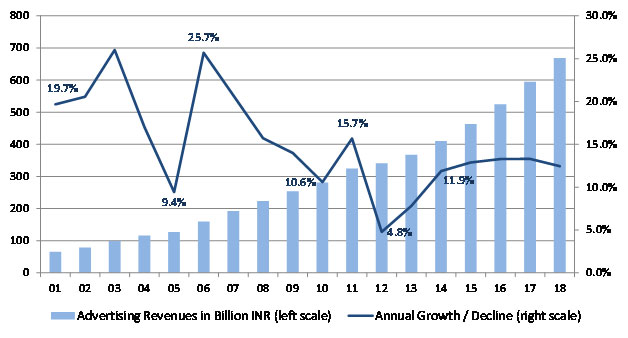
We must confess we were pretty relieved by the numbers thrown up by the IPG Group’s MagnaGlobal earlier today. So the advertising growth has come down just a few notches from its December prediction of 8.7 percent. The forecast now is 7.8 percent.
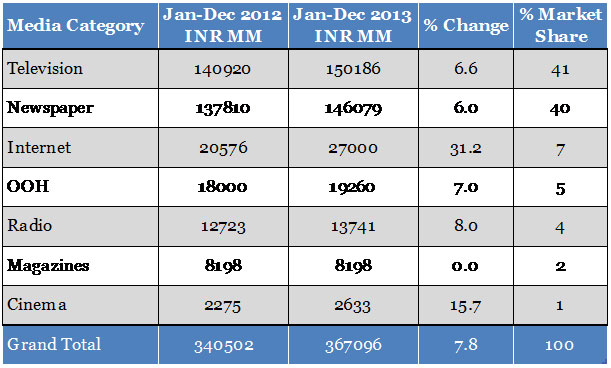
Television advertising will grow 6.6%, digital media growth +31% is faster than any other category with mobile and video outgrowing traditional display. Print is not yet dying in India newspapers expanding in language and regional segments leading to growth of  6%, magazines though stay flat. Radio and out-of-home advertising will grow 8%.
Interestingly, the forecast for 2014 is 11.9 percent.
Does all this make you happy? Well, we thought it would be a shade lower, even though the last few months have been good.
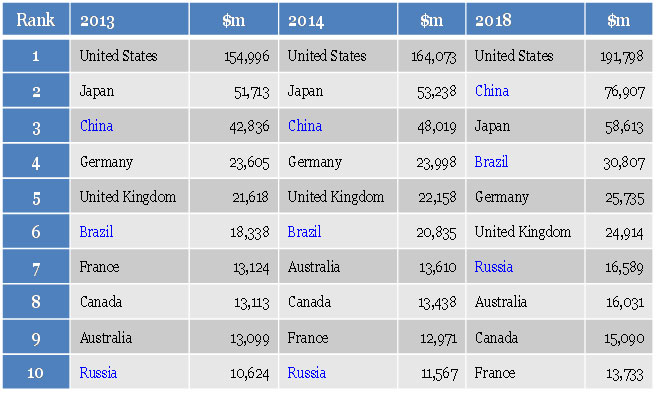
But, note, we were supposed to be in the Top 10 in 2017 as per the December numbers and now we aren’t in that exclusive club a year hence in 2018.
The India story can only look up if the socio-political story improves. And that’s in a mess. The media is doing its bit about unearthing all the bad stuff, but we need to all work towards creating an image of an India that’s shining. Bharat Nirman!
Magna Global predicts the global advertising market to grow by +3.0% this year, to $486 billion, thus slowing down from 2012 (+3.9%), and then accelerate by +6.1% in 2014, to $515 billion. Compared to the firm’s previous forecasts, published in December 2012, this represents a small downgrade for 2013 (-0.1%) and a small increase for 2014 (+0.1%). Magna’s analysis covers ad market conditions in 73 individual markets, adding three new markets this time: Sri Lanka, Pakistan and Kenya.
The Indian Economy experienced its worst near decade slowdown in 2012, with real GDP growing by +4.0% compared to +7.7% in the previous year (source IMF). The downgrading of economic outlook by rating agency hampered the investment climate. The government took some measures to reduce subsidies, opened up FDI in retail and plan to introduce targeted subsidy through direct cash transfer to cut expenditure. However the impact of these reforms remains uncertain in the short to medium term. In its April report, IMF forecast +5.7% of real GDP growth this year and +6.2% in 2014.
The Global Headlines:
# Media Owners Advertising Revenues will grow by +3.0% in 2013 to $515 billion dollars and accelerate to +6.1% in 2014.
# In 2013 APAC and Latin America growth will offset the stagnation in EMEA and North America
# In 2014, US and European ad markets will benefit from economic recovery, US mid-term elections and global sports events.China remains a reliable growth engine and Japan confirms a surprise return to growth.
# Digital Media will grow by +13.4% in 2013, reaching a 23.3% market share.
# Social media generated $5.9 billion in advertising revenues in 2012 and we anticipate an impressive 39.6% growth in 2013.
# Automated “programmatic” buying already represents 17% of online display transaction in the US and up to 30% in some other advanced markets.
Magna expect’s the advertising market to grow +7.8% in 2013 with television and print contributing over two-thirds of all revenue. Television advertising will grow +6.6%. Digital media growth +31% is faster than any other category with Mobile & Video outgrowing traditional display. The Print story is still relevant in India and will continue, Newspapers category expanding in language and regional pockets is estimated to grow +6.0%, magazines will however remain flat. Radio and out-of-home advertising will grow +8.0%. With the investment climate expecting to warm up and demand from external economies backed by solid domestic consumption we forecast the advertising revenue to grow +11.9% in 2014.
The rest of the forecast is as follows, as received from MagnaGlobal:
Globally, the predicted acceleration in ad revenues is in line with expectations of accelerated economic growth in the second half of 2013 and throughout 2014. In its April 2013 report, the IMF predicted 2013 real GDP growth to reach +3.3% globally and 2014 to accelerate to +4.0% in 2014. Although the economic forecast is still modest for developed markets (+1.2% and then +2.2%) and for Europe in particular (+0% and then +1.3%), it will in many cases bring the economic environment to the point where business growth triggers not only ad spend growth but, in some markets, faster-than-GDP growth. In markets where marketers have been cautious, they may at last switch from optimization mode to expansion mode.
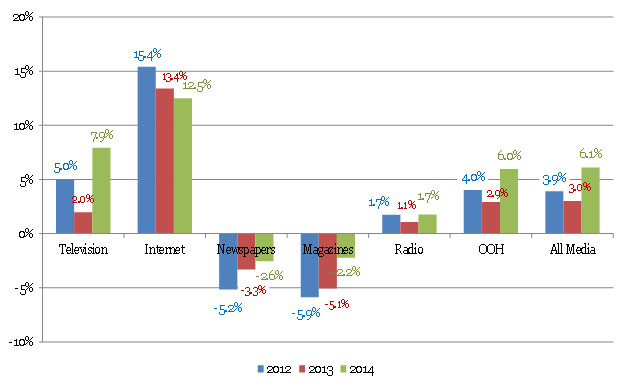
Digital media will continue their double-digit growth in 2013, as ad revenues will increase +13.4% to $113.6 billion. Growth will be driven by search (+14.6% to $52 billion), video (+21% to $6.6 billion), mobile formats (+54% to $12 billion) and social formats (+39.6% to $8.2 billion). Other formats will barely grow, and actually decline in many markets due to the commoditization and deflation of display inventory.
Television advertising growth will slow down in 2013 due to the absence of global televised events. Following a +5.0% growth in 2012, ad sales will grow by only +2.0% to $196.5 billion, but TV remains the leading media category(40% market share) ahead of digital. Print formats continue their decline: in 2013 newspaper ad revenues will decline by -3.3% and magazine revenues by -5.1% to a combined $110 billion (a 23% market share). Radio advertising will grow by +1.1% to $32.5 billion and out-of-home media revenues will increase by +2.9% to $32.6 billion
Slowdown downgrades India from Top 10 in 2017: Venkatesh S, MagnaGlobal
We had published IPG Mediabrands’s MagnaGlobal forecast for adspends in 2013 in the month of December along with an interview with the Bengaluru-based Venkatesh S, EVP and Director Intelligence Practice at MagnaGlobal on the study. On receiving the mid-year projections, we interviewed Mr Venkatesh yet again. Here’s the Q&A:
The annual forecast made in December 2012 had your annual forecast for India at 8.7% y-o-y growth. Now it says 7.8%. That’s not too big a drop given that the year has been no great shakes so far. What’s your comment on this change?
The change is because of drop in newspaper projections. While overall the volumes have gone up in similar period of comparison, the growth is coming from smaller towns and editions.
In December, India was among the Top 10 markets in the year 2017. Now it doesn’t figure even in 2018. Reason for us to sob?
Our predictions are basis macro-economic modeling factoring in structural changes in local markets. The slowdown experienced last year will drag the economy for some time to come. The business and consumer confidence is slightly optimistic currently.  These factors have led the downgrade of India from the Top 10.
These days, the spends on BTL and various experiential activities have increased. How do you see the growth of that? And would you see it being captured under a separate head in the years to come?
There is a realization in the industry that activations or experiential marketing drive brand preferences compared to visibility campaigns. These will continue to gain traction. While there are estimates of the activation industry size to be anywhere in the range of INR 8000-12000 crores, the challenge to quantify is to define the constituents of BTL and quality of data capture. For example, should sampling be part of BTL?
Also, do you think social media and PR will also find place in this study?
We have been covering most of the constituents in the digital space including social and reported under Internet category.
Magazine numbers have gone down from December to now. In Dec, you had predicted 4.2% growth. Do you see a beginning of a decline in spends on magazines?
Magazine especially general category has been on the decline. One of the reasons is our readership methodology being skewed towards newspapers. Keeping fingers crossed on the new methodology addressing this category.
There’s no change in the internet from Dec to June. One would’ve expected a growth in the estimation?
While overall digital spends have not changed, though some of the sub-categories within have gone through few movements
What percentage of this is in the traditional internet and what is it on mobile phones?
Social and mobile contribution to total internet is about 19%
Lastly, would you see 7.8% increasing when we get next year’s report in December?
Not ruling out slight adjustments inter-category, I don’t have any visibility of this going up.
2013-2014 across geographies
There continue to be wide regional and national contrasts in the global advertising landscape in 2013. There will be almost no growth this year in EMEA (+0.4%) and North America (+0.7%). On the other hand, we are increasing the 2013 forecast for Latin America (+12.5%) and for APAC (+5.9%).
EMEA: ad markets hit by European recession
EMEA will barely growin 2013, with the sub-region going through varied states.
Plagued by economic recession and record unemployment levels (12.2% in the Eurozone, 8.4% in the UK), Western Europe ad revenues will decline by -1.6%. Resilience of the two biggest markets – the UK (+2.2%) and Germany (+0.6%) – will partially offset the decreases in Southern Europe (France -3.3%, Spain -10.4%, Italy -9.4%). However, after three, four andsometimes five years of negative growth in some markets, we believe most of Western Europe will bottom out in 2013. For instance, there are signs already that television pricing may stabilize in the second half of the year and increase, however slightly, in 2014.
Central and Eastern Europe will grow by an average +7.6%, in line with previous expectation, but again reflecting national contrasts, with double-digit growth in Russia (+11.7%) and Turkey (+10.2%) partially offset by stagnation in several smaller markets (Poland, Czech Republic, Hungary).
The Middle East and Africa sub-region will be growing by +4.8%, with advertising expenditure increasing in the Gulf Cooperation Council countries (+3.8%) and in South Africa (+5.5%) but decreasing in Morocco (-2.1%) and Kenya (-20%).
US: light at the end of the tunnel
The US economy is on a slow but steady trajectory towards recovery. Despite the government sequester and higher payroll taxes that have contributed to the uncertainty that plagued the beginning of the year, 2013 will show moderate economic growth. The second half of 2013 and 2014 are expected to improve, due notably to a stronger housing and job markets and higher business and consumer confidence. The US unemployment rate remains high (7.6%) but is declining month after month (+175,000 non-farm jobs in May).The latest consumer sentiment index showed a surge at 84.5 compared to 76.4 in April, bolstered by optimism stemming from rising stock market, home prices, and employment.
For 2013, we expect +0.4% growth in media owners ad revenues, to $155 billion. These growth rates are not normalized and do not take into account the absence of the incremental Olympics and political spend that occurs in even years. If neutraled for political and Olympic spending in 2012 and 2013, the underlying growth would be stronger by approximately 1.5%.
We anticipate total US television advertising to decline -2.8% in 2013 with -6.8% in broadcast TV due to the absence of Olympics and political spend, and +2.4% for cable TV. Digital media is the only category to show significant growth in 2013 (+11.5%), although the pace of growth should plateau slightly as a result of deflationary pricing trends affecting display formats. The category will be driven by mobile advertising continuing its aggressive growth at +61.7% to $5.4bn. Print advertising will continue to decline as ad sales will drop by -6.7% for magazines and -6.8% for newspapers. Radio is expected to remain flat this year and out-of-home advertising will grow +3.5%.
China: a successful soft landing
The Chinese economy successfully engineered a “soft landing” in 2012, with real GDP growing by +7.8% compared to +9.3% in the previous year (source IMF) and inflation coming under control (it was +1.8% in 2012 following +7.8% in 2011). The Chinese government can thus afford to continue stimulus programs and maintain high-single-digit real GDP growth rates in the mid-term. In its April report, the IMF forecast +8% of real GDP growth this year and +8.2% next year. When factoring inflation, that translates into low-double-digit nominal GDP growth for the next five years.
Advertising spend had its own soft landing last year; it increased by 9.3%, which was the first time it grew at a slower pace than nominal GDP. In the mid-term however, MagnaGlobal believes the ad market still has the potential to grow faster than the economy because domestic and international brands are competing for the attention of Chinese consumers while media inventory is limited, therefore driving media cost inflation. In 2013 we expect the advertising market to grow by +11.6% to RMB 302 billion. Television continues to command the highest media market share, growing 7.6% to RMB 109 billion and while digital is rapidly gaining (+27% to RMB 88 billion). Internet penetration will have to expand to older rural demographics for continued gains as the urban youth market has been completely saturated. Supported by robust domestic demand, ad expenditure will grow again by 12.1% in 2014 and by 12.6% in 2015 and China will pass Japan to become the 2nd largest media market globally by 2016.
Another “sleeping giant” is waking up in Asia: Japan. Following the general elections of December 2012, Shinzo Abe from the Liberal Democratic Party became the new Prime Minister. Prime Minister Abe introduced an aggressive unorthodox, expansionist economic policy – that has become known as “Abenomics” – to break the pattern of deflation/stagnation that has plagued Japan in the last fifteen years. In April the IMF raised its real GDP growth forecast to +1.6% for 2013 (+0.4) and to +1.4% for 2014 (+0.7). The IMF is acknowledging a shift in the Japanese economy: after 10 years of deflation, CPI inflation is expected to be flat in 2013 (+0.1%) and up by +3.0% in 2014, which, by Japanese standards, sounds like hyperinflation. The perspective of more dynamic economy and positive inflation in the mid-term has led us to change our advertising spend scenario too. We revise ad revenue growth forecast from +0.2% to +1.5% in 2013 and from +2.3% to +2.9% for 2014.
In Russia, already the world’s 10th largest advertising market, advertising sales grew by +11.4% in 2012 and are expected to grow at a similar rate (+11.7%) in 2013. Unlike many other large European markets, digital claims less than 20% of the total spend in Russia, while television controls half of total ad spends. TV advertising cost inflation continues to drive double digit television growth rates (+10.3% in 2013), and despite recent regulation requiring no TV sales house to control more than 35% market share, there are still only a handful of dominant points of sale and therefore limited competition. The Winter Olympics in Sochi in 2014 will also benefit television ad spend. Russia’s GDP growth should remain robust in the high single digits, which will continue to drive Russia’s advertising market higher in the top 10 global rankings.
Latin America bracing for the World Cup
As Latin America is gearing up for the 2014 FIFA Soccer World Cup (the first to be organized in the region since Mexico 1986), we anticipate stronger advertising demand in the next 12 months, most notably in the host country Brazil, and mostly on television. The region’s ad revenues will grow by +12.5% in 2013: growth will be moderate in markets with low inflation (Brazil +10.7%, Mexico +5.5%) but explosive yet again in countries with hyper-inflation (Argentina +28.7%, Venezuela +15.7%).
In 2014, ad growth will accelerate further to +12.9%. The entire region will benefit from domestic and international brands investing to be associated with the event. The Brazil market will grow by +13.6%, Argentina by +21.9% and Chile by +4.7%. Television will be the biggest winner, growing +13.6% to $25.5 billion and strengthening its leadership in the region (59% market share) but digital media and social are also expected to thrive, with ad revenues growing by +19.7% and +43% respectively. Brazil is already the second biggest market for Facebook with more than 70 million users and the big sports events of 2014-2016 are bound to accelerate social usage even further.
2014: strongest growth since 2010
For 2014 MagnaGlobal predicts global advertising revenues to grow by +6.1% to $515 billion, which is a slight acceleration compared to our December forecast (+6.0%). This will be the highest annual growth since 2010, when the global advertising market grew by +8.2%, having rebounded from the worst recession year on record, 2009 (-11%).
The global ad market will be driven by a stronger economy (+4.0% of real GDP growth according to the IMF), aggressive economic policy in China and Japan and stabilization in Western Europe. In addition, adspend will be driven by the even-year events: Soccer World Cup in Brazil (with soccer becoming increasingly popular in markets like Japan, China and the US), Winter Olympics in Sochi, Russia, and the mid-term election cycle in the US. Since the “Citizen United” decision of the Supreme Court that removed any limitation to fund-raising and campaign spending, ad spend around mid-term congressional elections and “propositions” has become almost as big as a presidential race year.
We have increased our 2014 forecast for North America from +5.1% to +5.6% (US: from +5.4% to +5.9%) and our forecast for EMEA from +3.2% to +3.3%. APAC will grow by +7.4% and Latin America by +12.9%.
Focus on Digital Media
In its new report, MagnaGlobal is also focusing on two major trends affecting digital media advertising: the rise of programmatic buying and social media.
Programmatic buying is a method of buying and selling digital display inventory through automated, data-driven platforms and, sometimes, through real-time bidding (RTB). It fundamentally allows the demand side to buy audience for online display and video formats as they buy key-word search. Programmatic transactions continue to grow in the US, commanding an increasingly large share of display advertising revenues. In 2012, programmatic transactions represented $2.4 billion i.e. 17.4% of total display advertising, and we expect this to increase to 48% of revenues by 2017. Internationally, most markets still lag the US at this point, but some less advanced digital markets may face smaller legacy issues and resistance to change in the value and therefore evolve more rapidly towards automation.Some Western Europe are showing robust RTB growth such as the Netherlands where 29% of digital ad sales are already transacted via programmatic methods. Expansion in APAC and South America is still in more nascent stages.
For the first time, MagnaGlobal is publishing estimates and forecasts on the size of social media within internet advertising revenues. Says Vincent Letang, Director of Global forecasting and author of the report: “In recent years, social media has become a central part of the online experience, partly at the expense of portals and emailing. Everywhere, internet users already spend 25% to 30% of their online time on social networks. Facebook is the leader with 1.1 billion users to-date, but other forms of social internet are flourishing, notably in Asia or Russia, and monetization is accelerating in 2013”. Global social advertising revenues are estimated $5.9bn in 2012, growing 36.8% compared to 2011. Social media advertising is expected to increase further from $8.2bn in 2013 to $24.3 in 2018, representing a 24% CAGR in the next five years.
The next MagnaGlobal forecasts will be published in December 2013.
Figure 1: Global Advertising Market (Media Owner Revenues)
Figure 2: Advertising Revenues by Media Category (Growth Forecasts)
Of the 1110 entries from India at the Cannes Lions, the shortlists against four of the categories were declared yesterday.
In Direct, where 79 Indian entries were sent, there were three shortlists. The first was for Leo Burnett for Coke Studio (Ambient Media, Small Scale for Reflection of Music-Table Mat), the second was for DDB Mudra Group for Aarambh (Best Low Budget Campaign, Titled: Helpdesk) and the third shortlist was for Leo Burnett again for Coke Studio (Publications & Media category, Titled: Reflection of Music-Installation)
In Promotions and Activations, 73 entry submissions generated only 1 shortlist. This was under the ‘Charities’ sub-category, titled Helpdesk, Aarambh being the Client and created by DDB Mudra Group, Mumbai.
In PR, where there were 27 entries, there were four shortlists. Publicis Gurgaon’s ‘Adopt a Pothole’ for Apollo Tyres, Ogilvy & Mather’s entries for Akanksha School and Lifebuoy Roti Reminder were shortlisted and BBDO Mumbai’s entry for Gillette Fusion was shortlisted.
In Creative Effectiveness, there was one entry sent and there was no Indian entry shortlisted and in the newly introduced Innovations Lions the shortlists for which were announced earlier, four Indian entries were sent, but none of them were shortlisted.
 By Anil Thakraney
 By Chintamani Rao

 We must confess we were pretty relieved by the numbers thrown up by the IPG Group’s MagnaGlobal earlier today. So the advertising growth has come down just a few notches from its December prediction of 8.7 percent. The forecast now is 7.8 percent.
 We had published IPG Mediabrands’s MagnaGlobal forecast for adspends in 2013 in the month of December along with an interview with the Bengaluru-based Venkatesh S, EVP and Director Intelligence Practice at MagnaGlobal on the study. On receiving the mid-year projections, we interviewed Mr Venkatesh yet again. Here’s the Q&A: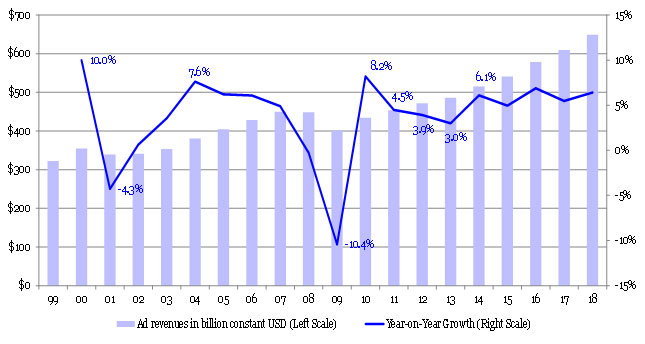
 By A Correspondent