Author: Pradyuman Maheshwari

  • MxM Live with Yashwant Deshmukh

    MxM Live with Yashwant Deshmukh

    Yashwant Deshmukh is a prominent figure in the field of opinion polling and political analysis, known for his expertise in deciphering public sentiment and electoral trends. As the founder, editor and managing director of CVoter, a near-30-year-old  global agency specialising in public opinion research and data analytics, Deshmukh has played a pivotal role in shaping political discourse and decision-making processes across various nations. With a keen eye for detail and a deep understanding of socio-political dynamics, he continues to be a trusted authority in providing insightful perspectives on elections and governance worldwide. Deshmukh and his company, Dataeye Asia, are now also focusing their energies on conducting the Consumer Mood of the Nation (COTN), overlaying the recently launched the Indian Socio-Economic Classification (ISEC).

    In this interview with Pradyuman Maheshwari, Founder and Editor-in-Chief, MxMIndia, Yashwant Deshmukh speaks on opinion polling, his views on ISEC and the Consumer Mood of the Nation studies that his company will produce.

    Watch. Enrich yourself. Enjoy. Like.

    For more news and updates on media and advertising, check our website http://www.mxmindia.com.

  • MxMLive with Rana Barua

    MxMLive with Rana Barua

    In early January 2024, it was announced that Rana will extend his remit to include South East and North Asia. The expansion of Barua’s scope adds nine additional markets under his leadership in his new role as Group CEO India, South East and North Asia. His new titled reads: Group CEO, Havas India, South East Asia and North Asia

    Over the last few weeks, he has met with the media, talking about his new role and vision for his agency network.

    As part of a new season of MxMLive, Pradyuman Maheshwari, Editor-in-Chief spoke with Rana Barua over an interview via Zoom.

    Watch. Enjoy. Like.

  • The MxMIndia Code of Ethics

    The MxMIndia Code of Ethics

    Every six-odd months, we publish our Code of Ethics. For more than ever before, the Indian media needs to adopt one and practise it.

    We are now part of the Digital Publishers Association of India and will follow the self-regulatory procedures set by it. Our editor is also a member of the Editors Guild of India and the Press Club, Mumbai. More than ever before, it’s important the media acts responsibly as must people around it.

    MxMIndia adopted a Code of Ethics even before it was launched. Although it’s on the site, since it could have become a blindspot, we publish it as our Big Story once or twice a year. This is the link to the Code: http://www.mxmindia.com/code-of-ethics/

    Read on…


    The MxMIndia Code of Ethics

    This code of ethics is not meant to be a treatise in ethics. We believe all MxMers are mature professionals, of sound character and have values we agree with.

    However, since a Code of Ethics is not really followed in organisations that some of our employees may have worked with in the past, we have a formulated an easy-to-follow set of Do’s and Don’ts that each and every employee has agreed to follow.

    Also, since there’s a general belief that many media companies (business-to-business and mainstream) follow unethical practices, it’s hence critical to put the record straight on why MxMIndia isn’t like the ‘many’ others.


    1. While the objective of MxMIndia is to be a profitable enterprise, our revenues will not come from compromising editorial standards. Excellence is what we are setting out to achieve, Ethically and with Integrity.


    2. We will not be influenced in any way by advertisers – past, present or future, and will write or comment on an individual, service or organisation regardless of whether or not it advertises with MxMIndia.


    3. We will not sell our editorial content. Content includes text, photographs, videos or any visuals.


    4. Accuracy in presenting facts is of utmost importance and facts must be correctly presented.


    5. We will not present any bias in our news sections. If, however, MxM India does undertake a campaign, it will clearly state its editorial policy


    6. If there’s any advertisement that could be confused with editorial content in appearance, it will be clearly tagged as an Advertisement and be displayed in a style that is different from normal editorial content.


    7. Our reports and features will always attribute sources to people. In case, the source does not want to be named for fear of loss of employment or due to some sensitivity, every attempt must be made to look for an alternate source who could be named. If that fails, every attempt should be made to make the reader rest assured that our source is authentic and this may be done by describing who the source is.


    8. We have a no tolerance policy towards plagiarism. Employees may be given a warning if found plagiarising, but in most cases, the services of any employee found plagiarising – regardless of her/his seniority or utility to the organisation – would be terminated within 24 hours of the Editor-in-Chief conducting his/her investigation on the act of plagiarism.


    9. If any attempt is made to influence us by way of a threat to withdraw advertisements, we reserve the right to expose such individuals and/or their organisations.


    10. We will not publish photographs off the internet. If a picture is be taken from the internet, it will be done only after written permission of the source. Else, we will own the rights for the picture which may be procured by buying rights for appropriate usage. Ditto for text. If we do carry syndicated content, the source needs to be clearly be stated at the end of the article.


    11. Our journalists will take the permission of the interviewee to record her/his comments, especially when the meeting is not face-to-face.


    12. Unless approved by the Editor, we do not part with the transcript of any interview. A journalist may however play back a few quotes attributed to an individual.


    13. We will allow individuals or organisations adequate time to revert with their response to a question. In most case the adequate time would mean four to six hours. If it’s a non-critical story, then we would recommend holding the story for at least (and at most) a day.


    14. We will not accept any gifts that attempt to influence us. These should be returned immediately. Gifts in the form of chocolates, mithai, flowers or basic promotional material that is of reasonable value (of up to Rs 750-1000) is fine. Mementos or promotional material of nominal value may be accepted. No gifts must be solicited. If there’s a doubt, please consult the Editor-in-Chief/CEO. If an organisation is found to influence an MxMIndia journalist, under extreme cases, MxMIndia may even blacklist the organisation and/or its products and services.


    15. We will not solicit any outstation trips. If however there is an invitation for a junket, we will accept it only if the Editor believes there is a news value in the event. In such a case, MxMIndia will mention that the journalist concerned has visited an outstation venue at the invitation of the company which must be named. For local travel, all our employees are defrayed expenses towards local travel, and hence we discourage taxi pick-ups or drops, as is the norm in some sections of the media.


    16. We will not solicit any invitations for a meal or a drink. We discourage MxMIndia employees to drink beyond their limits at events, dinners, press conferences etc where they represent the Company. We will also not solicit free books, software, movie tickets etc.


    17. MxMIndia employees are discouraged from moonlighting. If, however, employees do receive requests to write an occasion article for a non-competing publication, the employee could do it after seeking permission via email.


    18 .Unlike some media houses, we are happy to see our employees – regardless of their seniority levels – to be interviewed and featured in other media. However, prior permission is desired for every appearance on television. Employees must ensure that their work at MxMIndia doesn’t suffer due to their appearances on TV, radio etc. While tweeting, participation in social networks like Facebook and Linked In are encouraged, every attempt must be taken to ensure that the values and interests of the organisation are not compromised.


    19. We will ensure that our ethical standards are followed in all that we do – events, conferences and awards. We will ensure our integrity is not compromised.


    20. We discourage the use of pirated products and services for official use. We advise our employees to only use legally procured software. Employees using their personal computer equipment for work are encouraged to switch to legal software.


    21. MxMIndia has a no tolerance policy on sexual harassment.


    22. Our employees are not allowed to deal in stocks related to the media and entertainment sector. If they hold shares before joining the organisation, they must disclose their holdings in writing to their immediate boss. They could, however, invest in mutual funds related to the M&E sector.


    23. While this Code is only applicable towards conduct as an employee, we advise all MxMers to ensure that they are ambassadors of MxMIndia and all that it stands for even outside of work hours.


    24. Over the last few years, there have been question marks raised about the ethical standards adopted by journalists and media organisations. While a lot of it may be untrue, we believe that journalists and others working in various media organisations are also responsible for this perception. At MxMIndia, our attempt will be to reverse this.


    25. This Code is applicable for all employees of MxMIndia. Associates, retainers, columnists, regular contributors are also required to adhere to the above Code.


    We encourage all our constituents and advertisers to read the above document and cooperate with us and enable us to abide by it. If you wish to report a dishonest act, write directly to pradyumanm [at] mxmindia.com

  • Present Imperfect. Future Shock. Journalism students see an industry in crisis

    Present Imperfect. Future Shock. Journalism students see an industry in crisis

    By Trish Audette-Longo & Christianna Alexiou

    It’s hard not to see the journalism industry as one in crisis.

    In February, Bell Media announced it was ending multiple CTV newscasts, making other programming cuts and selling 45 radio stations. Its parent company, BCE Inc., also announced it is cutting 4,800 jobs “at all levels of the company,” saying fewer than 10 per cent are at Bell Media.

    Weeks later, Vice Media said it would stop publishing on Vice.com and lay off hundreds.

    These decisions followed CBC’s December 2023 announcement that it would cut 600 positions, and news last fall that some Canadian journalism schools had shut down or paused their programs.

    Across the country, the outlook for the future of news is — at best — uncertain. Not talking about the state of the industry is not an option for journalism educators.

    In journalism school, students learn their craft while engaging with critical questions about their roles and responsibilities. They are often taught by previous or current journalists, whose work experiences prepare them to help students tackle reporting challenges.

    Crises ask journalism educators, students and practitioners to grapple with sharing stories about what the future could hold. What will journalists’ jobs look like in five years? Or 25 years?

    No one in any industry would be able to answer such questions with certainty. But critical events in journalism demand we talk through uncertain futures. And this presents follow-up questions. What are the risks and rewards of talking openly about precarity? How do you start a conversation when the future is so uncertain?


    Understanding journalism education

    In 2015, with the shock of the 2008 economic crisis still working through newsrooms, journalism educators offered a wide-ranging map for reevaluating the goals of journalism schools, and whether they are solely meant to train future journalists.

    Crises run into each other, overlapping and informing responses to change. COVID-19 and a reckoning with racism in journalism and other institutions have demanded new reflections on journalism education.


    Pathways to the future

    It’s time journalism educators shift conversations with students, to address their experiences, their worries and their understanding of what journalism is and what they want it to be.

    In 2022, we asked journalism students at Carleton University — where we, respectively, teach and studied — how they felt about their training through COVID-19. We were curious about how students viewed online learning and transitioning into journalism jobs.

    What we heard were concerns about burnout, precarity, work-life balance and the long-term outlook for a life in journalism.

    “I just feel like almost every week or every few weeks, I go on Twitter and there’s a journalist who’s like in their 30s or 40s, like halfway through their career, who just quit,” one student said.

    Students knew the risks of going into the industry, thanks to news of other cutbacks, guest speaker testimonies and their own experiences losing internship opportunities when the pandemic forced newsrooms online.


    Anticipating challenges

    We asked journalism students what they thought a day in the life of a journalist looked like. They talked about days that demanded endurance, dedication and working through different kinds of uncertainty.

    “They’re just always on,” one student said. “I don’t think journalists have a normal day. As in, you know, get up, get to work, get home.”

    Another student described “general burnout” as “a huge part” of the job.

    It isn’t surprising that students anticipated challenges finding work and worried about long-term financial stability. In some ways, their responses align with a broader Gen-Z refusal to put their jobs at the centre of their lives or accept low pay.

    “I don’t want to say, you know, the more money you make the more successful you are, but being able to just have that security is, I think, a huge thing,” one student said.

    “Maybe it doesn’t quite align with ‘success’ in a ‘making a difference’ kind of way. But I think (financial security) gives you an ability to make a difference.”

    Students also flagged the importance of mental health and well-being.

    “There is an expectation that your entire life should revolve around chasing a story until you physically cannot anymore,” one student said, explaining that this kind of thinking turned them away from journalism.


    Learning together

    Today’s journalism students have likely been told their entire lives — by friends, family, pop culture and so many reports — that it’s a dying industry. Nonetheless, they’re driven to find out more.

    Journalism in crisis, as others have argued, presents an opportunity to unpack traditions and reimagine practices.

    It’s also an opportunity to reconsider how journalism schools and newsrooms respond to the concerns of emerging journalists. How can precarity and burnout be addressed collectively inside and outside journalism, not as individual matters?

    One place this can begin is with classroom conversations, collectively taking on uncomfortable truths and fears alongside building new skills.


    Navigating not having reassuring answers

    One risk, for educators, is not having ready-made, reassuring answers to questions of insecurity.

    Introducing worst-case scenarios also risks scaring away students. In our interviews, one student cautioned against presenting guest speakers’ negative portrayals of the industry too early, for example.

    But recent news makes industry crises impossible not to talk about.

    Talking through crises can allow for discussion of alternatives and solutions. However, care should be taken to not romanticize what has worked in the past, including precarious conditions like long hours, low pay or competing for fewer and fewer jobs.

    Instead, it’s helpful to think of imagining different journalism futures as an in-progress collaboration for students, educators, journalists and news organization leaders. Such collaboration is a project of articulating not only crisis conditions, but drawing on shared experiences to figure out what it would take to make things better.

    Looking back, we wonder what responses and creative solutions we would have heard if we asked students what they wanted their days to look like as journalists — not just what they thought the job looked like already.The Conversation


    Trish Audette-Longo is Assistant Professor of Journalism Studies, Carleton University and Christianna Alexiou is an MSc in Regulation Student at the London School of Economics and Political Science. This article is republished from The Conversation under a Creative Commons license. Read the original article.

  • TikTok fears point to larger problem: Poor media literacy in the social media age

    TikTok fears point to larger problem: Poor media literacy in the social media age

    By Nir Eisikovits


    The U.S. government moved closer to banning the video social media app TikTok after the House of Representatives attached the measure to an emergency spending bill on Apr. 17, 2024. The House voted on each of the four components of the bill, and the one affecting TikTok passed 360-58 on Apr. 20, 2024. The packaging is likely to improve the bill’s chances in the Senate, and President Joe Biden has indicated that he will sign the bill if it reaches his desk.

    The bill would force ByteDance, the Chinese company that owns TikTok, to either sell its American holdings to a U.S. company or face a ban in the country. The company has said it will fight any effort to force a sale.

    The proposed legislation was motivated by a set of national security concerns. For one, ByteDance can be required to assist the Chinese Communist Party in gathering intelligence, according to the Chinese National Intelligence Law. In other words, the data TikTok collects can, in theory, be used by the Chinese government.

    Furthermore, TikTok’s popularity in the United States, and the fact that many young people get their news from the platform – one-third of Americans under the age of 30 – turns it into a potent instrument for Chinese political influence.

    Indeed, the U.S. Office of the Director of National Intelligence recently claimed that TikTok accounts run by a Chinese propaganda arm of the government targeted candidates from both political parties during the U.S. midterm election cycle in 2022, and the Chinese Communist Party might attempt to influence the U.S. elections in 2024 in order to sideline critics of China and magnify U.S. social divisions.

    To these worries, proponents of the legislation have appended two more arguments: It’s only right to curtail TikTok because China bans most U.S.-based social media networks from operating there, and there would be nothing new in such a ban, since the U.S. already restricts the foreign ownership of important media networks.

    Some of these arguments are stronger than others.

    China doesn’t need TikTok to collect data about Americans. The Chinese government can buy all the data it wants from data brokers because the U.S. has no federal data privacy laws to speak of. The fact that China, a country that Americans criticise for its authoritarian practices, bans social media platforms is hardly a reason for the U.S. to do the same.

    The debate about banning TikTok tends to miss the larger picture of social media literacy.

    I believe the cumulative force of these claims is substantial and the legislation, on balance, is plausible. But banning the app is also a red herring.

    In the past few years, my colleagues and I at UMass Boston’s Applied Ethics Center have been studying the impact of AI systems on how people understand themselves. Here’s why I think the recent move against TikTok misses the larger point: Americans’ sources of information have declined in quality and the problem goes beyond any one social media platform.

    The deeper problem

    Perhaps the most compelling argument for banning TikTok is that the app’s ubiquity and the fact that so many young Americans get their news from it turns it into an effective tool for political influence. But the proposed solution of switching to American ownership of the app ignores an even more fundamental threat.

    The deeper problem is not that the Chinese government can easily manipulate content on the app. It is, rather, that people think it is OK to get their news from social media in the first place. In other words, the real national security vulnerability is that people have acquiesced to informing themselves through social media.

    Social media is not made to inform people. It is designed to capture consumer attention for the sake of advertisers. With slight variations, that’s the business model of all platforms. That’s why a lot of the content people encounter on social media is violent, divisive and disturbing. Controversial posts that generate strong feelings literally capture users’ notice, hold their gaze for longer, and provide advertisers with improved opportunities to monetise engagement.

    There’s an important difference between actively consuming serious, well-vetted information and being manipulated to spend as much time as possible on a platform. The former is the lifeblood of democratic citizenship because being a citizen who participates in political decision-making requires having reliable information on the issues of the day. The latter amounts to letting your attention get hijacked for someone else’s financial gain.

    If TikTok is banned, many of its users are likely to migrate to Instagram and YouTube. This would benefit Meta and Google, their parent companies, but it wouldn’t benefit national security. People would still be exposed to as much junk news as before, and experience shows that these social media platforms could be vulnerable to manipulation as well. After all, the Russians primarily used Facebook and Twitter to meddle in the 2016 election.

    Media literacy is especially critical in the age of social media.

    Media and technology literacy

    That Americans have settled on getting their information from outlets that are uninterested in informing them undermines the very requirement of serious political participation, namely educated decision-making. This problem is not going to be solved by restricting access to foreign apps.

    Research suggests that it will only be alleviated by inculcating media and technology literacy habits from an early age. This involves teaching young people how social media companies make money, how algorithms shape what they see on their phones, and how different types of content affect them psychologically.

    My colleagues and I have just launched a pilot programme to boost digital media literacy with the Boston Mayor’s Youth Council. We are talking to Boston’s youth leaders about how the technologies they use everyday undermine their privacy, about the role of algorithms in shaping everything from their taste in music to their political sympathies, and about how generative AI is going to influence their ability to think and write clearly and even who they count as friends.

    We are planning to present them with evidence about the adverse effects of excessive social media use on their mental health. We are going to talk to them about taking time away from their phones and developing a healthy skepticism towards what they see on social media.

    Protecting people’s capacity for critical thinking is a challenge that calls for bipartisan attention. Some of these measures to boost media and technology literacy might not be popular among tech users and tech companies. But I believe they are necessary for raising thoughtful citizens rather than passive social media consumers who have surrendered their attention to commercial and political actors who do not have their interests at heart.


    This article was updated to indicate that the U.S. House passed the TikTok measure on Apr. 20, 2024.The Conversation Nir Eisikovits, Professor of Philosophy and Director, Applied Ethics Center, UMass Boston. This article is republished from The Conversation under a Creative Commons license. Read the original article

  • Teens say ‘for you’ algorithms get them right

    Teens say ‘for you’ algorithms get them right

    By Nora McDonald

    Social media apps regularly present teens with algorithmically selected content often described as “for you,” suggesting, by implication, that the curated content is not just “for you” but also “about you” – a mirror reflecting important signals about the person you are.

    All users of social media are exposed to these signals, but researchers understand that teens are at an especially malleable stage in the formation of personal identity. Scholars have begun to demonstrate that technology is having generation-shaping effects, not merely in the way it influences cultural outlook, behavior and privacy, but also in the way it can shape personality among those brought up on social media.

    The prevalence of the “for you” message raises important questions about the impact of these algorithms on how teens perceive themselves and see the world, and the subtle erosion of their privacy, which they accept in exchange for this view.

    Teens like their algorithmic reflection

    Inspired by these questions, my colleagues John Seberger and Afsaneh Razi of Drexel University and I asked: How are teens navigating this algorithmically generated milieu, and how do they recognise themselves in the mirror it presents?

    In our qualitative interview study of teens 13-17, we found that personalized algorithmic content does seem to present what teens interpret as a reliable mirror image of themselves, and that they very much like the experience of seeing that social media reflection.

    Teens we spoke with say they prefer a social media completely customized for them, depicting what they agree with, what they want to see and, thus, who they are.

    If I look up something that is important to me that will show up as one of the top posts [and] it’ll show, like, people [like me] that are having a nice discussion.

    It turns out that the teens we interviewed believe social media algorithms like TikTok’s have gotten so good that they see the reflections of themselves in social media as quite accurate. So much so that teens are quick to attribute content inconsistencies with their self-image as anomalies – for instance, the result of inadvertent engagement with past content, or just a glitch.

    At some point I saw something about that show, maybe on TikTok, and I interacted with it without actually realising.

    When personalised content is not agreeable or consistent with their self-image, the teens we interviewed say they scroll past it, hoping never to see it again. Even when these perceived anomalies take the form of extreme hypermasculine or “nasty” content, teens do not attribute this to anything about themselves specifically, nor do they claim to look for an explanation in their own behaviors. According to teens in our interviews, the social media mirror does not make them more self-reflective or challenge their sense of self.

    One thing that surprised us was that while teens were aware that what they see in their “for you” feed is the product of their scrolling habits on social media platforms, they are largely unaware or unconcerned that that data captured across apps contributes to this self-image. Regardless, they don’t see their “for you” feed as a challenge to their sense of self, much less a risk to their self-identity – nor, for that matter, any basis for concern at all.

    The human brain continues to develop during adolescence

    Shaping identity

    Research on identity has come a long way since sociologist Erving Goffman proposed the “presentation of self” in 1959. He posited that people manage their identities through social performance to maintain equilibrium between who they think they are and how others perceive them.

    When Goffman first proposed his theory, there was no social media interface available to hold up a handy mirror of the self as experienced by others. People were obligated to create their own mosaic image, derived from multiple sources, encounters and impressions. In recent years, social media recommender algorithms have inserted themselves into what is now a three-way negotiation among self, public and social media algorithm.

    “For you” offerings create a private-public space through which teens can access what they feel is a largely accurate test of their self-image. At the same time, they say they can easily ignore it if it seems to disagree with that self-image.

    The pact teens make with social media, exchanging personal data and relinquishing privacy to secure access to that algorithmic mirror, feels to them like a good bargain. They represent themselves as confidently able to tune out or scroll past recommended content that seems to contradict their sense of self, but research shows otherwise.

    They have, in fact, proven themselves highly vulnerable to self-image distortion and other mental health problems based on social media algorithms explicitly designed to create and reward hypersensitivities, fixations and dysmorphia – a mental health disorder where people fixate on their appearance.

    Given what researchers know about the teen brain and that stage of social development – and given what can reasonably be surmised about the malleability of self-image based on social feedback – teens are wrong to believe that they can scroll past the self-identity risks of algorithms.

    U.S. Surgeon General Vivek Murthy discusses the harms teens face from social media

    Interventions

    Part of the remedy could be to build new tools using artificial intelligence to detect unsafe interactions while also protecting privacy. Another approach is to help teens reflect on these “data doubles” that they have constructed.

    My colleagues and I are now exploring more deeply how teens experience algorithmic content and what types of interventions can help them reflect on it. We encourage researchers in our field to design ways to challenge the accuracy of algorithms and expose them as reflecting behavior and not being. Another part of the remedy may involve arming teens with tools to restrict access to their data, including limiting cookies, having different search profiles and turning off location when using certain apps.

    We believe that these are all steps that are likely to reduce the accuracy of algorithms, creating much-needed friction between algorithm and self, even if teens are not necessarily happy with the results.

    Getting the kids involved

    Recently, my colleagues and I conducted a Gen Z workshop with young people from Encode Justice, a global organisation of high school and college students advocating for safe and equitable AI. The aim was to better understand how they are thinking about their lives under algorithms and AI. Gen Zers say they are concerned but also eager to be involved in shaping their future, including mitigating algorithm harms. Part of our workshop goal was to call attention to and foster the need for teen-driven investigations of algorithms and their effects.

    What researchers are also confronting is that we don’t actually know what it means to constantly negotiate identity with an algorithm. Many of us who study teens are too old to have grown up in an algorithmically moderated world. For the teens we study, there is no “before AI.”

    I believe that it’s perilous to ignore what algorithms are doing. The future for teens can be one in which society acknowledges the unique relationship between teens and social media. This means involving them in the solutions, while still providing guidance.The Conversation


    Nora McDonald, Assistant Professor of Information Technology, George Mason University. This article is republished from The Conversation under a Creative Commons license. Read the original article.

  • Have smartphones killed the art of conversation?

    Have smartphones killed the art of conversation?

    Mikoto (Pexels free images), CC BY-NC-SA


    By David Le Breton

    Once upon a time, human relationships unfolded without smartphones. The reality may be hard to recall, so profoundly have these devices transformed the way we relate to the world and others in fifteen years or so.

    As an anthropologist interested in modernity, I am particularly preoccupied by the impact of these devices on our conversations. In my book, The End of the Conversation? Words in a Spectral Wociety (French original: La fin de la conversation? La parole dans une société spectrale), I investigate the pernicious effects of this technology on our social fabric, and make a point of distinguishing conversation from communication.


    Communication is not conversation

    When I’m communicating, my relationship with another is usually mediated via a screen. Communication calls to mind notions of distance, physical absence, and by extension, frazzled attention. The age of communication induces feelings that everything is going too fast and we have no more time to ourselves. The next notification, message or call is always only a moment away, keeping us in a state of restless alertness.

    Conversations, on the other hand, are often free. One chats while enjoying a stroll or meeting a new person, sharing words like one breaks bread. While communication does away with the body, conversation calls for mutual presence, attention to the other person’s face, their facial expressions and their gaze. Conversation is happy to accommodate silence, pauses and each person’s rhythm.

    This is in contrast to communication, where any cut-off warrants a knee-jerk reaction: “We’ve been cut off”, “Are you there?” “I can’t hear you”, “I’ll call you back”. This isn’t an issue when conversing, because the other person’s face has never disappeared and it’s possible to be silent together in friendship, in complicity, to express a doubt or a thought. Silence in the course of a conversation allows us to breathe, while in the field of communication we would label it with words such as cut-off or breakdown.

    A few months ago in Taipei, Taiwan, I was at a popular restaurant when a dozen people from the same family sat down at a table nearby. The youngest were 2 or 3 years old, while the oldest were in their 60s. Having barely glanced at the menu before ordering, their eyes rapidly proceeded to attach to their mobile phones. Barely uttering a word, they ate with their smartphones in hand. The only exception was the occasional tension between two of the children, who must have been 4 or 5 years old. They stayed for a good hour, exchanging little more than a few sentences, without really looking at each other.

    The scene could have taken place in Strasbourg, Rome or New York, in any city in the world. Today it is commonplace. You only have to walk into a café or restaurant at random to see the same situation. The old family or friendly encounters are gradually disappearing, replaced by these new manners where we are together but separated from each other by screens, with the occasional smattering of words exchanged before returning to the tranquillity of our laptop. What’s the point of bothering with others, since a world of entertainment is immediately accessible, where we no longer have to make the effort to nurture relationships? Conversation becomes obsolete, useless and tedious, whereas the screen is a beautiful escape that doesn’t disappoint and that occupies time pleasantly.


    Cities populated by zombies

    The massive disappearance of conversation, even with oneself, is reflected in the fact that cities are now deserted, where you meet no one, and the pavements are full of zombies walking around hypnotised by their smartphones. Eyes downcast, they see nothing of what’s happening around them. If you’re trying to find your way, don’t ask for help, there’s no one around. Some are wearing earphones, talking to themselves, and displaying an ostentatious indifference.

    “Are You Lost in the World Like Me?”, Moby and the Void Pacific Choir, These Systems Are Failing (animation, Steve Cutts).

    Sometimes, communication is imposed in the public space. Those who dare not protest or go elsewhere find themselves invaded by the words of someone who has come to sit on their bench or near their table to start a conversation aloud. Another increasingly common practice is to watch a video without earphones or to put the loudspeaker on to hear the other person’s voice better.

    Another common form of incivility that has become commonplace is talking to someone who can’t stop pulling their smartphone out of their pocket every thirty seconds, in fear of missing out on a notification. Teenagers are particularly susceptible to the fear of missing out (FOMO) fever, but not only, and this frantic quest for the smartphone in your pocket, unless it’s always in your hand. Even when placed on a table next to you, experience shows that the smartphone exerts a magnetism that is difficult to counter, with people regularly looking at it with a kind of longing.

    For these users, relationships at a distance, without a body, are less unpredictable and frustrating as they demand only the surface of the self. They give rise to relationships that are in line with desire and based on personal decision alone, with no fear of spillover, because then all you have to do is interrupt the discussion on the pretext of a network problem and cut off communication. Face-to-face interactions are more uncertain, more likely to hurt or disappoint. But the more we communicate, the less we meet, and the more conversation disappears from everyday life.


    A growing sense of isolation

    Accelerated by Covid lockdowns, the digital society does not have the same dimension as concrete sociability, with people in mutual presence who talk and listen to each other. It fragments the social bond, destroying old links in favour of the abstract and often anonymous ones of social networks.

    Paradoxically, some people see it as a source of connection at a time when individual isolation has never been so acute. Never has the mal de vivre of teenagers and the elderly reached such a level. Frequent use of multiple social networks or the ostentation of one’s private life on a social network creates neither intimacy nor links in real life. The hundred “friends” on social networks are no match for one or two friends in everyday life.

    The digital society occupies time and provides a way of getting away from everything that annoys us in our daily lives, but it doesn’t give us a reason to live. Of course, some people find a connection through their isolation, but isn’t isolation also a consequence of the fact that we no longer meet in real life?

    New forms of expression are emerging that are now a matter of course for many of our contemporaries, and not just for the digital natives. Globally, connection is taking over from conversation, which has become an anachronism, but not without a major impact on the quality of the social bond, and potentially on the functioning of our democracies.The Conversation


    David Le Breton is Professeur de sociologie et d’anthropologie at Université de Strasbourg.  This article is republished from The Conversation under a Creative Commons license. Read the original article.

  • Yes, Machine Learning can Violate your Privacy!

    Yes, Machine Learning can Violate your Privacy!

    By Jordan Awan

    Machine learning has pushed the boundaries in several fields, including personalised medicine, self-driving cars and customised advertisements. Research has shown, however, that these systems memorise aspects of the data they were trained with in order to learn patterns, which raises concerns for privacy.

    In statistics and machine learning, the goal is to learn from past data to make new predictions or inferences about future data. In order to achieve this goal, the statistician or machine learning expert selects a model to capture the suspected patterns in the data. A model applies a simplifying structure to the data, which makes it possible to learn patterns and make predictions.

    Complex machine learning models have some inherent pros and cons. On the positive side, they can learn much more complex patterns and work with richer datasets for tasks such as image recognition and predicting how a specific person will respond to a treatment.

    However, they also have the risk of overfitting to the data. This means that they make accurate predictions about the data they were trained with but start to learn additional aspects of the data that are not directly related to the task at hand. This leads to models that aren’t generalised, meaning they perform poorly on new data that is the same type but not exactly the same as the training data.

    While there are techniques to address the predictive error associated with overfitting, there are also privacy concerns from being able to learn so much from the data.


    How machine learning algorithms make inferences

    Each model has a certain number of parameters. A parameter is an element of a model that can be changed. Each parameter has a value, or setting, that the model derives from the training data. Parameters can be thought of as the different knobs that can be turned to affect the performance of the algorithm. While a straight-line pattern has only two knobs, the slope and intercept, machine learning models have a great many parameters. For example, the language model GPT-3, has 175 billion.

    In order to choose the parameters, machine learning methods use training data with the goal of minimizing the predictive error on the training data. For example, if the goal is to predict whether a person would respond well to a certain medical treatment based on their medical history, the machine learning model would make predictions about the data where the model’s developers know whether someone responded well or poorly. The model is rewarded for predictions that are correct and penalized for incorrect predictions, which leads the algorithm to adjust its parameters – that is, turn some of the “knobs” – and try again.

    The basics of machine learning explained.


    To avoid overfitting the training data, machine learning models are checked against a validation dataset as well. The validation dataset is a separate dataset that is not used in the training process. By checking the machine learning model’s performance on this validation dataset, developers can ensure that the model is able to generalise its learning beyond the training data, avoiding overfitting.

    While this process succeeds at ensuring good performance of the machine learning model, it does not directly prevent the machine learning model from memorising information in the training data.


    Privacy concerns

    Because of the large number of parameters in machine learning models, there is a potential that the machine learning method memorises some data it was trained on. In fact, this is a widespread phenomenon, and users can extract the memorised data from the machine learning model by using queries tailored to get the data.

    If the training data contains sensitive information, such as medical or genomic data, then the privacy of the people whose data was used to train the model could be compromised. Recent research showed that it is actually necessary for machine learning models to memorise aspects of the training data in order to get optimal performance solving certain problems. This indicates that there may be a fundamental trade-off between the performance of a machine learning method and privacy.

    Machine learning models also make it possible to predict sensitive information using seemingly nonsensitive data. For example, Target was able to predict which customers were likely pregnant by analysing purchasing habits of customers who registered with the Target baby registry. Once the model was trained on this dataset, it was able to send pregnancy-related advertisements to customers it suspected were pregnant because they purchased items such as supplements or unscented lotions.


    Is privacy protection even possible?

    While there have been many proposed methods to reduce memorisation in machine learning methods, most have been largely ineffective. Currently, the most promising solution to this problem is to ensure a mathematical limit on the privacy risk.

    The state-of-the-art method for formal privacy protection is differential privacy. Differential privacy requires that a machine learning model does not change much if one individual’s data is changed in the training dataset. Differential privacy methods achieve this guarantee by introducing additional randomness into the algorithm learning that “covers up” the contribution of any particular individual. Once a method is protected with differential privacy, no possible attack can violate that privacy guarantee.

    Even if a machine learning model is trained using differential privacy, however, that does not prevent it from making sensitive inferences such as in the Target example. To prevent these privacy violations, all data transmitted to the organisation needs to be protected. This approach is called local differential privacy, and Apple and Google have implemented it.

    Differential privacy is a method for protecting people’s privacy when their data is included in large datasets.


    Because differential privacy limits how much the machine learning model can depend on one individual’s data, this prevents memorization. Unfortunately, it also limits the performance of the machine learning methods. Because of this trade-off, there are critiques on the usefulness of differential privacy, since it often results in a significant drop in performance.


    Going forward

    Due to the tension between inferential learning and privacy concerns, there is ultimately a societal question of which is more important in which contexts. When data does not contain sensitive information, it is easy to recommend using the most powerful machine learning methods available.

    When working with sensitive data, however, it is important to weigh the consequences of privacy leaks, and it may be necessary to sacrifice some machine learning performance in order to protect the privacy of the people whose data trained the model.


    Jordan Awan is Assistant Professor of Statistics, Purdue University. This article is republished from The Conversation under a Creative Commons license. Read the original article.

  • Journalism’s trust problem is about money, not politics

    Journalism’s trust problem is about money, not politics

    Caption: Photo: Roger H Goun on Flickr | Creative Commons Licence

    By Jacob L Nelson

    Journalism faces a credibility crisis. Only 32% of Americans report having “a great deal” or “fair amount” of trust in news reporting – a historical low.Journalists generally assume that their lack of credibility is a result of what people believe to be reporters’ and editors’ political bias. So they believe the key to improving public trust is to banish any traces of political bias from their reporting.That explains why newsroom leaders routinely advocate for maintaining “objectivity” as a journalistic value and admonish journalists for sharing their own opinions on social media.The underlying assumption is straightforward: News organizations are struggling to maintain public trust because journalists keep giving people reasons to distrust the people who bring them the news. Newsroom managers appear to believe that if the public perceives their journalists as politically neutral, objectively minded reporters, they will be more likely to trust – and perhaps even pay for – the journalism they produce.Yet, a study I recently published with journalism scholars Seth Lewis and Brent Cowley in Journalism, a scholarly publication, suggests this path of distrust stems from an entirely different problem.Drawing on 34 Zoom-based interviews with adults representing a cross-section of age, political leaning, socioeconomic status and gender, we found that people’s distrust of journalism does not stem from fears of ideological brainwashing. Instead, it stems from assumptions that the news industry as a whole values profits above truth or public service.The Americans we interviewed believe that news organizations report the news inaccurately not because they want to persuade their audiences to support specific political ideologies, candidates or causes, but rather because they simply want to generate larger audiences — and therefore larger profits.


    Commercial interests undermine trust

    The business of journalism depends primarily on audience attention. News organizations make money from this attention indirectly, by profiting off the advertisements – historically print and broadcast, now increasingly digital – that accompany news stories. They also monetize this attention directly, by charging audiences for subscriptions to their offerings.Many news organizations pursue revenue models that combine both of these approaches, despite serious concerns about the likelihood of either leading to financial stability.Although news organizations depend on revenue to survive, journalism as a profession has long maintained a “firewall” between its editorial decisions and business interests. One of journalism’s long-standing values is that journalists should cover whatever they want without worrying about the financial implications for their news organization. NPR’s Ethics Handbook, for example, states that “the purpose of our firewall is to hold in check the influence our funders have over our journalism.”What does this look like in practice? It means that journalists at the Washington Post should, according to these principles, feel encouraged to pursue investigative reporting into Amazon despite the fact that the newspaper is owned by Amazon founder and executive chairman Jeff Bezos.While the effectiveness of this firewall in the real world is far from assured, its existence as a principle within the profession suggests that many working journalists pride themselves on following the story wherever it leads, regardless of its financial ramifications for their organization.Yet despite the importance of this principle to journalists, the people we interviewed seemed unaware of its importance – indeed, its very existence.


    Bias toward profits

    The people we spoke with tended to assume that news organizations made money primarily through advertising instead of also from subscribers. That led many to believe that news organizations are pressured to pursue large audiences so that they can generate more advertising revenue.Consequently, many of the people interviewed described journalists as being enlisted in an ongoing, never-ending struggle to capture public attention in an incredibly crowded media environment.“If you don’t get a certain number of views, you’re not making enough money,” said one of our interviewees, “and then that doesn’t end well for the company.”People we spoke with tended to agree that journalism is biased, and assumed that such bias exists for profit-oriented rather than strictly ideologically oriented reasons. Some see a convergence in these reasons.“[Journalists] get money from various support groups that want to see a particular agenda pushed, like George Soros,” said another interviewee. “It’s profits over journalism and over truth.”Others we spoke with understood that some news organizations depend primarily on their audiences for financial support in the form of subscriptions, donations or memberships. Although these interviewees saw news organizations’ means of generating revenue differently from those who assumed that the money mostly came from advertising, they still described deep distrust toward the news that stemmed from concerns about the news industry’s commercial interests.“That’s how they make money,” one person said about subscriptions. “They want to entice you with a different version of the news that is not, I personally believe, overall going to be accurate. They get you to pay for that and – poof – you’re a sucker.”


    Misplaced concern about bias

    In light of these findings, it appears that journalists’ concerns that they must defend themselves against accusations of ideological bias might be misplaced.Many news organizations have pursued efforts at transparency as an overarching approach to earning public trust, with the implicit goal being to demonstrate that they are doing their work with integrity and free from any ideological bias.Since 2020, for example, The New York Times has maintained a “Behind the Journalism” page that describes how the newspaper’s reporters and editors approach everything, from when they use anonymous sources to how they confirm breaking crime news and how they are covering the Israel-Hamas War. The Washington Post similarly began maintaining a “Behind the Story” page in 2022.Yet these displays do not address the chief cause for concern among the people we interviewed: the influence of profit-chasing on journalistic work.

    Instead of worrying quite so much about perceptions of journalists’ political biases, it might be more beneficial for newsroom managers to shift their energies to pushing back against perceptions of economic bias.Perhaps a more effective demonstration of transparency would focus less on how journalists do their jobs and more on how news organizations’ financial concerns are kept separate from evaluations of journalists’ work.

    Cable news as a stand-in

    The people we interviewed also often appeared to conflate television news with other forms of news production, such as print, digital and radio. And there is ample evidence that television news managers do indeed appear to privilege profits over journalistic integrity.“It may not be good for America, but it’s damn good for CBS,” said CBS chairman Leslie Moonves of the massive coverage of then-presidential candidate Donald Trump in 2016. “The money’s rolling in.”With that in mind, perhaps discussions about improving trust in journalism could begin by acknowledging the extent to which the public’s skepticism toward the media is well-founded – or, at the very least, by more explicitly distinguishing between different kinds of news production.In short, people are skeptical of the news and distrustful of journalists, not because they think journalists want to brainwash them into voting certain ways, but because they think journalists want to make money off their attention above all else.For journalists to seriously address the root causes of the public’s distrust in their work, they will need to acknowledge the economic nature of that distrust and reckon with their role in its perpetuation.The Conversation

    Jacob L. Nelson is Associate Professor of Communication, University of Utah. This article is republished from The Conversation under a Creative Commons license. Read the original article.

  • Olympics 2024: what new social media guidelines mean for athletes and their sponsors

    Olympics 2024: what new social media guidelines mean for athletes and their sponsors

    Representative pic: person taking a selfie. Courtesy: pickpik.com (Creative Commons Licene)


    By Layckan Van Gensen

    Cellphone cameras are ubiquitous at modern sporting events. Whether it’s a school swimming gala, the local rugby club squaring off against their bitter rivals or a national team fighting for tournament glory, every moment is a potential photograph.

    The Olympic Games are no exception. More than 10,000 athletes from 200 countries or regions are set to compete in 32 sports in this year’s host city, Paris, giving fans ample opportunity to fill their camera rolls with images of their favourite sporting heroes.

    And participants, too, will be able to memorialise their time in Paris – far more freely than ever before. This comes after the Games’ governing body, the International Olympic Committee (IOC), unveiled new social media guidelines in December 2023.

    Most of the guidelines are aimed at athletes; some relate to “accredited individuals other than athletes” such as coaches, technical staff and countries’ Olympic committee representatives.

    As a legal scholar specialising in sports law, with a focus on image rights, I’ve been closely following the IOC’s stance on athletes’ use of social media – especially photographs and videos. Image rights are a broad bundle which may include rights over the use of the individual’s still, moving and animated images, name, signature recorded voice, catch phrases, associated iconic acts, logos, trademark and brands.

    These rights can be worth a lot of money. For example, Indian cricketer Virat Kohli can earn anything between US$2 million and US$2.7 million per social media post.

    Overall, it appears that the IOC has tried to strike a balance between protecting the media rights holders while still recognising the value of a participant’s image rights. It allows them to show more content than before and, more importantly, to acknowledge their personal sponsors, who play an important role in commercialising their images and building their brands. Loyal fans will get a fuller picture of their favourite athletes’ Olympic journeys than they’ve been able to before.


    Social media at the Olympics

    Vancouver’s 2010 Winter Olympics have been described as “the first social media games”, marking the first time that the IOC created social media guidelines. These were refined for the London 2012 Summer Olympics.

    At the last Summer Olympics, hosted by Tokyo in 2020, athletes were not allowed to:

    • share any content from accredited areas used for a sporting competition or ceremony
    • post about their personal sponsors.

    These restrictions were designed, the IOC said at the time, to protect media rights-holders such as TV stations and other big media organisations.


    What’s changed

    Under the new guidelines accredited participants can share their experiences far more freely on social media platforms during what the IOC calls the “game period”, from 18 July to 13 August.

    They may:

    • take photographs and record audio and video inside and outside the accredited areas
    • share photographs on their personal social media platforms up to one hour before the start of the competition they’re taking part in, and after they have left the doping control areas
    • share posts from the training and practice areas, the opening and closing ceremonies and the Champions Park, where athletes gather after their competitions to meet and interact with fans.

    Of course there are still some restrictions.

    Videos may not be live streamed, may not be longer than 2 minutes and may not include actual competitions. So, coaches can’t film an athlete in action and then share the video or photos. Athletes also can’t record another athlete training, or post highlights from their personal competition on social media. They can only share such images or videos from official media rights-holders’ accounts.

    Perhaps most intriguingly, photographs and videos that use artificial intelligence may not be shared. It’s unclear how the IOC intends to police this rule.


    Not for commercial purposes

    Media rights-holders aren’t left completely unprotected by the new guidelines. Participants are not allowed to post for commercial purposes throughout the game period.

    A post will be regarded as “for commercial purposes” if its purpose is to generate financial profit or promote any third party or products or services.

    One of the main goals of the new social media guidelines is to balance the rights of media holders and those of the participants. This attempt at a balancing act can be seen in the new rules for non-Olympic partners – those who don’t sponsor or have official merchandise licensing contracts with the IOC.

    Brands or companies in this category may run generic advertising during the game period as long as it hasn’t been especially designed for the Olympics and has already been in the public eye for at least 90 days before the tournament starts. Advertisements in this category can’t be run more frequently during the Games than they have been previously. The IOC will apply these rules flexibly to enable “business-as-usual” campaigns.

    Participants are allowed to provide one “thank you” message to each of their non-Olympic partners during the games period but it may not include a personal endorsement.The Conversation


    Layckan Van Gensen is Junior Lecturer in Mercantile Law, Stellenbosch University. This article is republished from The Conversation under a Creative Commons license. Read the original article.

  • Cutting marketing spending often backfires on businesses: Journal of Marketing

    Cutting marketing spending often backfires on businesses: Journal of Marketing

    By Andre Martin

    Businesses are often tempted to cut their marketing budgets for the short-term savings it provides – but those cuts can cause problems in the long term. A new study my colleague Tarun Kushwaha and I published in The Journal of Marketing proposes a method for predicting whether these counterproductive cuts will take place up to a year in advance.We gathered transcripts of nearly 25,000 earnings calls held by public companies from 2008 to 2019. We then analyzed how management teams discussed marketing and earnings. We found that the more earnings-oriented language was in a call — think words like “lucrative” or “revenues” — the more likely a management team was to cut their marketing budget for a boost in earnings.Unlike business-as-usual budget shifts, the motive in these cases was to raise short-term earnings to gain personal profits – for example, to boost stock prices before an executive retires – to raise immediate funds, or to satisfy investor pressure and expectations. These cuts in exchange for a bump in earnings are shortsighted, since investing in marketing tends to grow a company’s market share over time.


    Why it matters
    Executives often feel pressured to meet short-term earnings targets at the expense of long-term goals, survey data and research have shown. Cutting costs is one way businesses make themselves look better in the short term. And since investing in marketing takes time to pay off, marketing spending often winds up on the chopping block.My fellow marketing professors call these “myopic” marketing spending decisions – “myopic” being a fancy word for shortsighted. They often happen before initial public offerings, share repurchases and executive retirements.While these myopic decisions have short-term benefits, they harm investors, customers and other stakeholders in the long term. After companies myopically cut marketing spending, they often lose market value; that’s why such cuts are linked with worse stock-market performance in the long run. A tool that helps investors identify myopic marketing spending would help them protect their portfolios from negative long-term consequences.Our method isn’t just backward-looking – it can be used to forecast future shortsighted cuts to marketing spending. Investors could use it to analyze publicly available earnings-calls transcripts for useful data up to four times a year. We estimate that for every US$100 invested, using our method to avoid investing in shortsighted companies could return an additional $6.44 over four years compared with conventional methods. Marketing firms and advertising agencies could also use it to identify companies that plan to pare their marketing budgets.


    What’s next
    As part of our research efforts, my team has published the algorithm and data necessary to replicate our findings. This will let individual investors and other stakeholders gain valuable insights into executives’ intentions regarding the funding of their marketing and research departments.While our research has primarily focused on transcribed text from earnings calls, we see more potential in analysing the audio and video from these calls. Audio analysis could reveal insights from tone, pitch, pauses and filler words, while video analysis could capture the brief involuntary facial expressions known as micro-expressions.

    Andre Martin, Assistant Professor of Marketing, University of Notre Dame This article is republished from The Conversation under a Creative Commons license. Read the original article.

  • Before there was diving and relays, there was the Poetry Olympics…

    Before there was diving and relays, there was the Poetry Olympics…

    Jonas Åkerström’s 1790 work, Session of the Accademia dell’Arcadia on August 17 1788.
    Nationalmuseum/Cecilia Heisser


    By Katrina Grant

    Ever wondered whether you’d have a better chance at winning an Olympic gold if you could fling words rather than a javelin? Or maybe you could beat down your opponents with comedic wit? If so, you may have been a strong contender at the Poetry Olympics, held in Rome around 1700.

    Some 200 years before the modern revival of the Olympics as we now know it, a group of poets met in a garden in Rome to revive the ancient games in their own way. Their Giuochi Olimpici (“Olympic games” in Italian) was based not on speed or strength, but on one’s ability to string together a poem or win a debate.


    An ode to the mythical pastoral poets

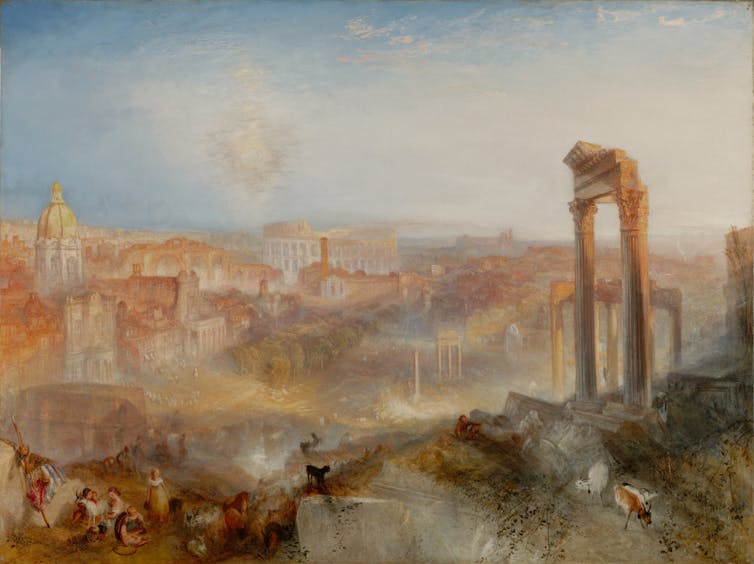
    The first of these new games was held in 1693 and they ran semi-regularly into the mid-18th century. The group met outdoors in places including the Farnese Gardens, a lofty site on the Palatine Hill in Rome overlooking the ruins of the Ancient Forum.

    Joseph Mallord William Turner’s 1839 oil painting, Modern Rome – Campo Vaccino, shows Baroque churches and ancient monuments in and around the Roman Forum.
    Getty Museum Collection

    They was a mix of (mostly male) poets, writers, lawyers, clergymen, nobles, artists and musicians. All were members of the Arcadian Academy, a group named for the region of ancient Greece – Arcadia – that was regarded as the “home of poetry” in Early Modern Europe.

    In 1504, the writer Jacopo Sannazaro had published a poem called Arcadia that presented an ideal vision of a world in which shepherds lived in harmony with nature.

    This idea took hold of writers and artists, who came to view such an idyllic landscape as a necessity for poetic invention. They imagined shepherds and shepherdesses roaming with their flocks and conversing in poetry with nymphs and satyrs – an image that was further popularised in 17th-century paintings by Nicholas Poussin and Claude Lorrain.

    These later 17th-century writers longed to inhabit this world of mythical pastoral poets. When they met, they cast aside their real names to use pseudonyms as shepherds or shepherdesses. They pretended the garden they met in was an Arcadian wood. The garden they built in Rome is still called “Bosco Parrasio” or Parrhasian Wood (Parrhasia was a region in ancient Arcadia).

    They described their meetings as “democratic” gatherings, which was highly unusual in Rome at the time, as all aspects of daily life were governed by social hierarchies and strict etiquette. But the naturalistic setting of the gardens and the playful disguises as shepherds or shepherdesses allowed for a bending of the rules.

    The title page of one of the published editions of poems composed during the Poetry Olympics held in Rome in 1705.
    Internet Archive

    It was in this setting the poetic revival of the Olympic games took place. It was one of a few revivals in 17th-century Europe, with several sporting competitions in England also calling themselves “Olympicks” or “Olympiads”. But the Olympics in Rome was the first to focus only on poetic and literary performance.

    Later on, poetry also became an official part of the first of the modern Olympic games – and remained so until 1948.


    Intellectual combat

    The Poetry Olympics took the ancient pentathlon, but replaced the five sporting competitions with five new games based on poetic composition and intellectual debate. A description from 1701 lists these as “the foot race, the javelin, the discus, the wrestling and the long jump”. Each was intended to showcase skill in poetry, wit or song.

    The foot race became a game called “the oracle”, in which a debate was held on a topic set by the custodian of the games. The javelin became a game of dispute, in which the “shepherds” took part in friendly poetic disagreements. They were encouraged “to sting and prick each other with verses” to dispel any “bitterness that may have occupied their minds”.

    The third game, the discus, became a game of wits in which the poets bested each other in composing witty songs.

    Wrestling changed to a “game of transformation”, drawing from the myth of the metamorphosis of the ancient Arcadian King Lycaon, who was transformed into a wolf by Zeus after he sacrificed his son (one origin of the werewolf myth).

    The poets presented sonnets about transforming into inferior things such as animals and plants, and then considered the virtues of these new states. In one poem that was recorded in one of the short books published after the event, a competitor imagines becoming an industrious bee, going from petal to petal and creating sweet honey to help them bear the “bitterness of the world”.

    In the fifth game, called “the garland”, the winner was the person who could weave together the most beautiful poem in praise of nature. This was the only game in which women could compete.

    While this may seem exclusionary, it was actually very permissive for Rome around 1700. Most women at the time received less education and were expected to live relatively cloistered lives. The more relaxed social structure of the academy and the games allowed women to participate in poetic performances and socialise beyond their immediate households.


    A way to build bridges

    The 300-year-old gathering of poets in a garden in Rome might seem very distant from athletes converging in Paris for the 2024 Olympics, but we can draw some parallels.

    Structured play, with its clear rules of engagement, is often regarded as a way of mimicking more serious types of social confrontation. The “play” of games at the Olympics – whether poetic or physical – allows all of us (spectators included) a chance to move through the emotions of combat, disagreement, disappointment and elation in a friendly way.

    Gathering for play also encourages us to envision new and better ways to come together as people. Roman poets in 1700 used wit and metaphor to push against the limits of courtly society. In 2024, leaders can point to the Paris Olympics and ask us to imagine a world that comes together in friendly competition, rather than conflict and disagreement.The Conversation


    Katrina Grant is Research Associate, Power Institute for Arts and Visual Culture, University of Sydney. This article is republished from The Conversation under a Creative Commons license. Read the original article.